
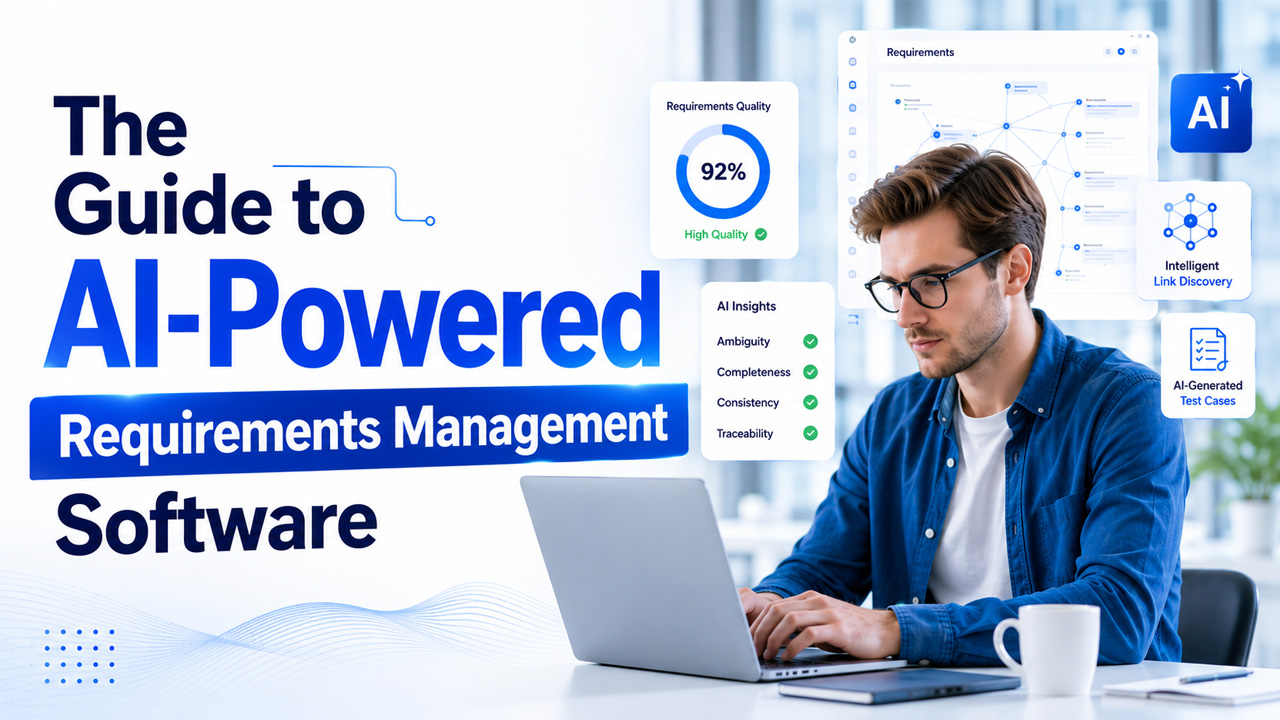

Every AI-Powered Requirements Management Software vendor now claims advanced AI capabilities. Search vendor websites and you'll find the same language: "AI-powered," "intelligent," and "smart." The challenge is separating genuine engineering intelligence from AI features that amount to little more than marketing.
Some platforms have embedded NLP engines that evaluate requirements quality against established engineering standards. Others have added a chatbot to their UI and called it an AI feature. The difference matters because AI that does real work in requirements management catches defects months before they'd otherwise surface, while AI that's cosmetic in nature gives you a feature checkbox and nothing else.
This guide evaluates the leading AI-Powered Requirements Management Software platforms based on what their AI actually does inside engineering workflows, how deeply it integrates into requirements management, and whether it produces measurable outcomes for regulated product development teams.
Best AI-Powered Requirements Management Software
| Platform | Best For | Key AI Capabilities | AI Integration Depth |
| Jama Connect | Regulated product development | AI-assisted requirements refinement (INCOSE/EARS), automated test case generation, intelligent link discovery, MCP server support, AI-generated test cases | Deep (core workflow) |
| Visure Solutions | Integrated FMEA and risk analysis | Requirements analysis, risk-linked AI | Moderate |
| IBM DOORS Next | Large enterprise RM | watsonx platform AI, NLP capabilities | Platform-level |
| Polarion (Siemens) | Siemens ecosystem | New AI modules in Polarion X | Developing |
| Codebeamer (PTC) | Automotive ALM | PTC AI portfolio integration | Developing |
5 AI-Powered Requirements Management Platforms
The following AI-Powered Requirements Management Software platforms were evaluated based on AI maturity, requirements quality analysis, traceability automation, compliance support, integrations, scalability, and practical engineering value rather than marketing claims alone.
1. Jama Connect (Best overall AI for requirements management)
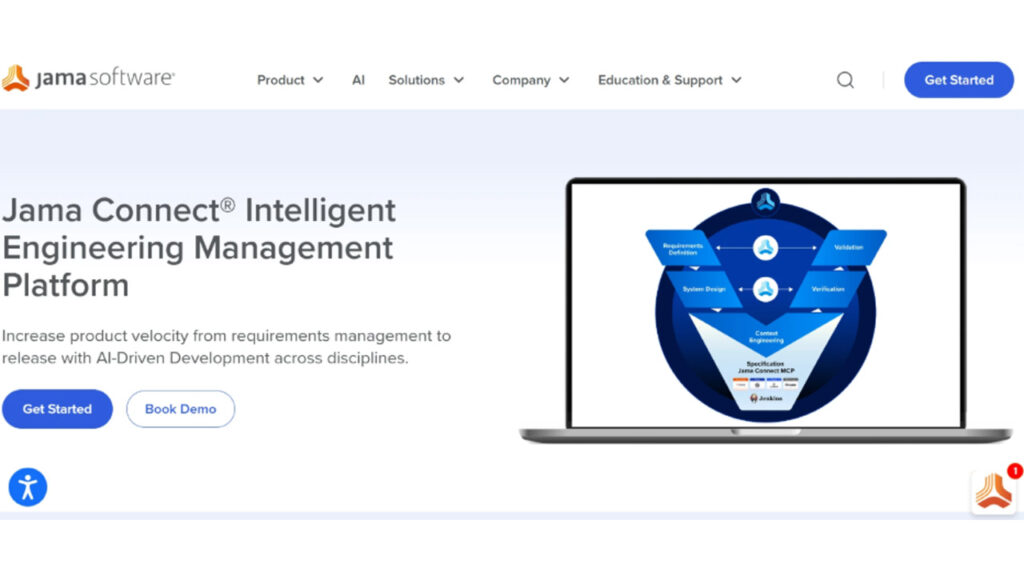
Jama Connect is one of the most mature AI-Powered Requirements Management Software platforms available today because its AI capabilities are deeply integrated into day-to-day engineering execution rather than offered as standalone automation features. Jama Software has built Jama Connect around the needs of regulated product development teams that require continuous visibility across requirements, validation, testing, risk management, and compliance activities. That approach has helped the platform maintain strong adoption across multiple industries that manage highly complex engineering programs. As a trusted brand that generates an estimated $200-250 million in annual revenue, Jama has established itself as the category leader in AI-powered requirements management, traceability, systems engineering, and engineering lifecycle management.
A major part of that strategy centers on Jama Connect Advisor, which embeds AI-driven engineering assistance directly into requirements authoring and traceability workflows. Rather than focusing solely on NLP-based quality analysis, Advisor supports a broader set of capabilities that help teams improve specification quality, accelerate validation activities, and reduce manual engineering overhead across regulated development environments.
The platform evaluates requirements using frameworks aligned with INCOSE guidance and EARS notation, helping teams identify ambiguous wording, incomplete logic, conflicting conditions, and structurally weak specifications before those issues affect downstream testing, validation, or safety analysis. Beyond quality analysis, Jama Connect Advisor also supports AI-assisted requirements refinement, automated test case generation, glossary definition generation, semantic review analysis, and intelligent relationship discovery across engineering artifacts.
What separates Jama Connect from many AI-focused competitors is the practical engineering focus behind these capabilities. Much like AI and Machine Learning in CRM, its AI is embedded into everyday workflows to improve productivity, reduce manual effort, and deliver measurable business value. Instead of offering generic AI summaries or chatbot-style interactions, Jama Connect ties AI directly into traceability, validation readiness, and compliance workflows used in regulated development environments. Requirements quality issues identified during authoring can immediately improve downstream verification quality, reduce audit preparation overhead, and strengthen overall traceability coverage.
The platform also extends AI-assisted engineering into other areas of product development. Jama Connect supports automated test case generation from requirements content, AI-assisted requirements refinement, intelligent document parsing for legacy specification imports, glossary generation, and predictive identification of higher-risk engineering areas based on change activity, dependency relationships, and traceability conditions. MCP server-enabled workflows further support orchestration across AI-assisted engineering and validation processes.
These AI capabilities feed directly into Jama Connect's broader Live Traceability environment. Customers using these workflows report significantly faster defect identification and substantially fewer downstream test failures compared to teams relying on manual traceability management approaches.
Jama Connect also aligns these workflows with industry-specific compliance expectations through Traceability Information Models (TIMs) supporting standards such as DO-178C, ISO 26262, ISO 14971, IEC 61508, and IEC 62304. The platform integrates with Jira, Azure DevOps, Windchill, Teamcenter, Enterprise Architect, MATLAB/Simulink, GitHub, GitLab, Jenkins, and other engineering ecosystems through native integrations and REST API support.
Jama Connect Pros
- AI-assisted engineering capabilities are embedded directly into requirements, validation, and traceability workflows
- Jama Connect Advisor helps teams improve requirement quality before issues impact downstream engineering activities
- Automated test generation and requirements refinement reduce manual workload for validation teams
- Trace Scores provide continuous visibility into traceability completeness across complex engineering environments
- Strong scalability for large multidisciplinary engineering organizations and supplier ecosystems
- Flexible deployment and security capabilities support aerospace, automotive, defense, and other regulated industries
Jama Connect Limitations
- Primarily focused on requirements management, traceability, and compliance workflows rather than full software delivery lifecycle management
- Pricing information is not publicly listed and requires direct engagement with the vendor
2. Visure Solutions
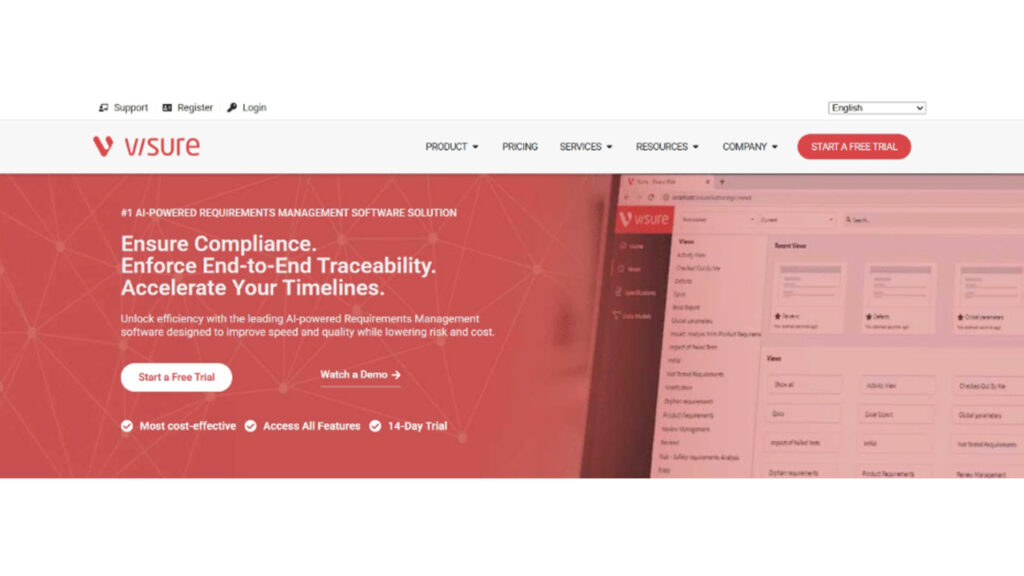
Visure Solutions is an AI-Powered Requirements Management Software platform that combines requirements management with integrated FMEA, risk analysis, and compliance capabilities. The company has been expanding AI features for requirements analysis and quality assessment, with particular strength in connecting AI-assisted requirements work to integrated risk analysis.
Visure's AI capabilities focus on requirements quality evaluation and change impact analysis within the context of its broader FMEA and risk management tools. For teams where risk traceability is inseparable from requirements traceability, Visure's integrated approach means AI-assisted requirements improvements flow through to connected risk artifacts without manual steps.
The platform offers compliance templates for aerospace, automotive, medical device, and railway industries, and ReqIF support for supply chain requirements exchange. Its AI features are developing but represent a genuine effort to embed intelligence into the requirements-to-risk workflow.
Visure Pros
- Integrated FMEA and risk analysis connected to AI-assisted requirements management
- Multi-industry compliance templates reduce setup effort
- ReqIF support simplifies multi-vendor requirements exchange
Visure Limitations
- Smaller company with a more limited integration ecosystem than IBM, Siemens, or PTC
- AI capabilities for requirements quality analysis are less mature than Jama Connect Advisor's NLP engine
- Enterprise scalability for very large global programs can be a consideration
3. IBM DOORS Next
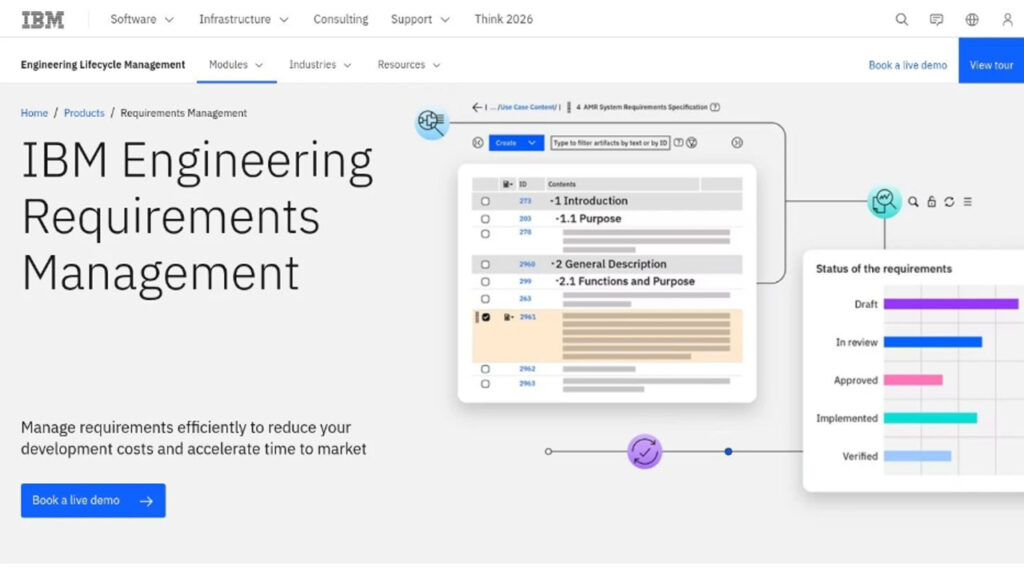
IBM DOORS Next is the web-based successor to DOORS Classic, positioned within IBM's Engineering Lifecycle Management (ELM) suite. IBM's AI investment is substantial through its watsonx platform, though the depth of native integration between watsonx AI and DOORS Next's requirements management workflows is still evolving.
IBM's AI story is compelling at the platform level. Watson and watsonx provide NLP, machine learning, and generative AI capabilities that can be applied to engineering data. The question for requirements teams is how much of that AI power is accessible inside DOORS Next workflows versus requiring separate configuration through the broader IBM AI platform.
The requirements management feature set itself has decades of refinement. DOORS Next addresses Classic's lack of web-native architecture, providing a modern browser-based interface. But the migration path from Classic to Next remains non-trivial, and users continue to cite administration complexity as a friction point.
IBM DOORS Next Pros
- IBM's watsonx investment provides a substantial AI technology foundation
- Web-based architecture resolves the accessibility limitations of DOORS Classic
- Part of the comprehensive ELM suite for full engineering lifecycle coverage
IBM DOORS Next Limitations
- AI capabilities are more platform-level (watsonx) than built into day-to-day RM workflows
- G2 reviewers call out the administration overhead and the time it takes new users to become productive
4. Polarion (Siemens)
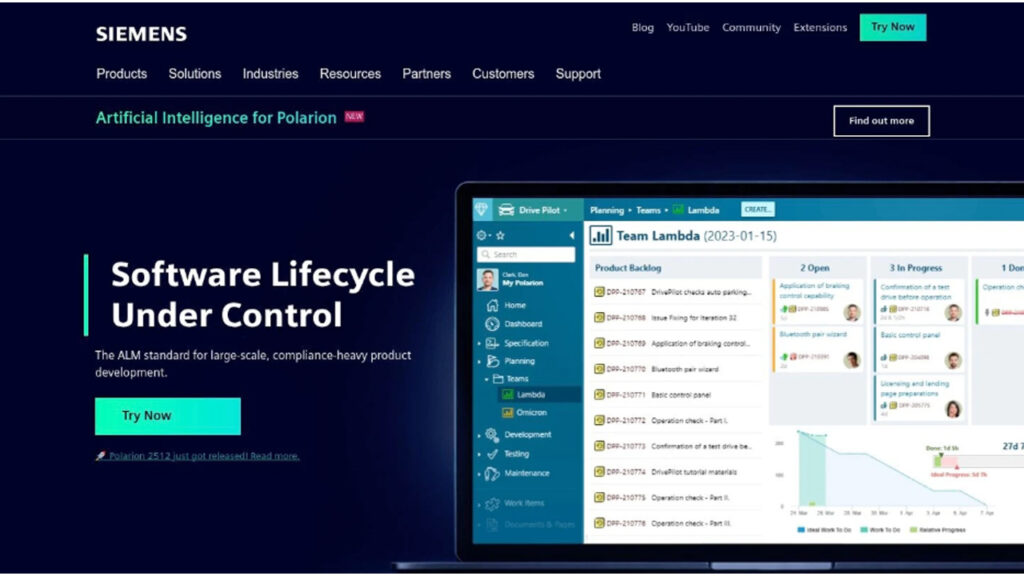
Polarion is Siemens' ALM and requirements management platform, with new AI modules introduced in the Polarion X product line. Siemens has been investing across its digital industries portfolio in AI, and Polarion is beginning to benefit from those investments.
The AI capabilities in Polarion X are new, which means they're evolving fast but haven't yet had the time to develop the maturity of more established AI-enhanced RM platforms. Polarion's primary value proposition remains its deep integration with the Siemens PLM ecosystem (Teamcenter, NX), and the AI modules add a layer of intelligence to that ecosystem-integrated workflow.
Polarion Pros
- Native Siemens PLM integration links requirements to Teamcenter product data and NX design models
- New AI modules in Polarion X demonstrate active investment
- Variant configurator and SAFe support address enterprise needs
Polarion Limitations
- AI modules are new, so maturity and depth for requirements-specific analysis are still developing
- Integration with non-Siemens tools (Jira, third-party modeling tools) remains challenging
5. Codebeamer (PTC)
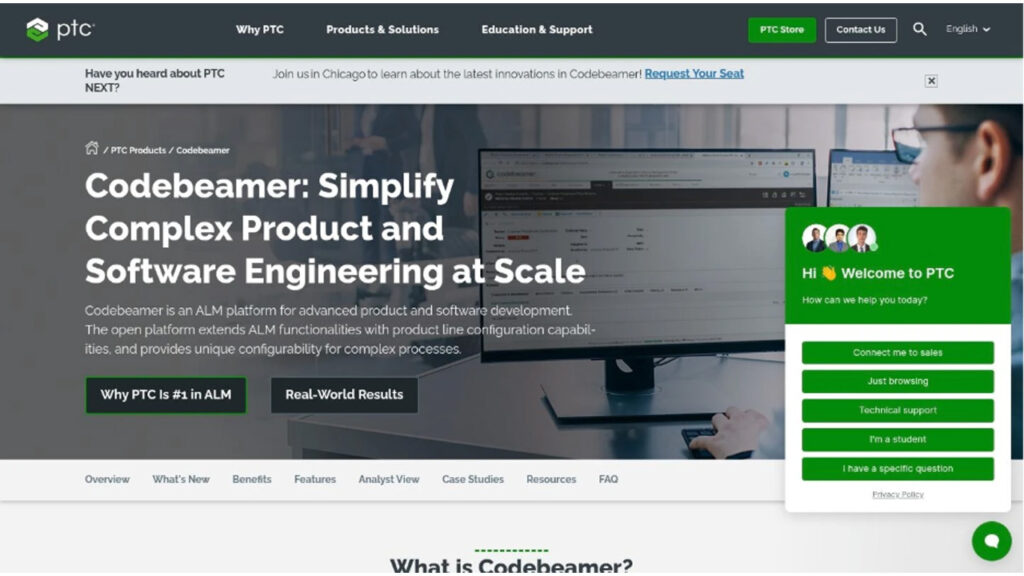
Codebeamer is PTC's ALM covering requirements through DevOps in one platform. PTC has been investing in AI across its product portfolio, and Codebeamer is part of that broader strategy. The AI capabilities are developing within the context of PTC's full-lifecycle approach.
Codebeamer's AI story is tied to PTC's broader AI investment. As those capabilities mature and extend into requirements management, Codebeamer could become more competitive in AI-enhanced RM. Today, its primary differentiators are full ALM coverage, variant management, and automotive industry templates rather than AI-specific requirements analysis.
Codebeamer Pros
- Full ALM approach provides end-to-end traceability from requirements through deployment
- PTC's AI portfolio investment positions Codebeamer for future AI capabilities
- Strong automotive presence with ASPICE and ISO 26262 templates
Codebeamer Limitations
- AI for requirements-specific analysis is less developed than platforms focused above all on RM
- Overlaps with Jira, creating friction for Atlassian shops
- Software-centric heritage limits depth for multi-discipline systems engineering
How to Choose the Right AI-Powered Requirements Management Software
Selecting an AI-enhanced RM platform requires asking different questions than selecting a traditional RM tool. Here's what to prioritize:
Evaluate AI depth, not AI claims. Every vendor now says "AI-powered." The question is whether the AI is embedded in core requirements workflows (authoring, review, traceability analysis) or available as a separate module you have to configure and manage. Platforms where AI runs on its own within the workflow you're already using deliver more value than platforms where AI requires a separate step.
Demand measurable outcomes. Ask vendors to demonstrate specific, quantifiable improvements from their AI capabilities. How much faster do teams catch defects? How much rework is reduced? How much time is saved on audit preparation? If a vendor can't provide data on AI-driven outcomes, the AI may be more marketing than substance.
Check the quality standard. Requirements quality analysis is the highest-value AI capability in RM. But not all quality analysis is equal. Platforms that evaluate against established engineering standards like INCOSE rules and EARS notation provide actionable, specific feedback. Generic text analysis that just flags "unclear" requirements without explaining the engineering implication is less valuable.
Frequently Asked Questions
Q1. What makes AI requirements management different from traditional RM?
Traditional RM relies on manual authoring, manual review, manual coverage checking, and periodic manual audits. AI-enhanced RM automates quality analysis during authoring, generates artifact drafts, scores traceability health on a running basis, and identifies high-risk areas based on data patterns. The practical difference is catching problems earlier and with more reliability than manual processes at scale.
Q2. How does NLP improve requirements quality?
NLP engines analyze requirements text against established quality standards like INCOSE rules and EARS notation. They identify ambiguity ("the system should respond quickly" vs. "the system shall respond within 200ms"), missing conditions, passive voice that obscures responsibility, and structural issues that make requirements harder to test. Jama Connect Advisor provides this analysis built into the authoring workflow.
Q3. Is AI in requirements management mature enough to rely on?
For specific capabilities, yes. NLP-based requirements quality analysis and AI-generated test cases are production-ready in leading platforms. Live traceability scoring is mature in Jama Connect. More experimental capabilities like end-to-end automated requirements generation from stakeholder conversations are still developing. Evaluate maturity per capability rather than treating "AI in RM" as a single technology.
Q4. Which platform has the strongest AI for regulated industries?
Jama Connect offers the deepest integration of AI into regulated requirements workflows. Advisor checks requirements quality against INCOSE/EARS rules, AI generates test case drafts, risk scoring flags high-change areas, and Trace Scores monitor traceability health in real time. All of this runs inside compliance frameworks built for DO-178C, ISO 26262, and ISO 14971. No other platform combines that level of AI capability with that level of regulatory specificity.
%201.png)

%201.png)

%201.png)