

An AI visibility tool can look affordable in a demo and become expensive as an agency adds clients. Prompt setup, quality checks, reporting, permissions, and analyst time all grow with the portfolio.
That makes agency selection different from choosing an AI visibility tracker for one in-house brand. The product must work at multiple levels: reliable enough for analysts, understandable to clients, governable across accounts, and commercially sensible for the service being sold. Agencies also need to evaluate how effectively a platform supports AI search visibility across different client accounts, markets, and AI-generated search experiences.
The best choice of AI visibility tool also depends on the agency. A boutique consultancy delivering a focused quarterly diagnostic does not need the same infrastructure as a global agency monitoring several markets for a regulated enterprise. “Best” has to be defined by the client work, not by a generic leaderboard.
AI Visibility Tools: Define the service before selecting the software
Start by deciding what clients will actually buy. AI visibility can support several distinct services:
- a one-time baseline or competitive audit;
- ongoing prompt, mention, and citation monitoring;
- content and digital PR recommendations;
- AI search reporting added to an existing SEO retainer;
- brand-risk or misinformation monitoring;
- an enterprise program spanning markets, products, and teams.
Each service creates different requirements. A diagnostic needs fast setup, defensible evidence, and a clean export. A retainer needs stable prompt groups, historical comparisons, annotations, and efficient reporting. A strategy engagement needs enough detail to move from “we are absent” to action.
Be precise about what the agency will not promise. No tool can guarantee that a brand will appear in a probabilistic AI answer, and a movement in a dashboard does not prove that the agency caused it. The deliverable should be framed around observed presence, cited sources, competitive patterns, completed actions, and directional change.
Calculate cost per client, not cost per account
For agencies, the relevant unit is the fully serviced client. Estimate it before signing a contract:
Client cost = software allocation + setup time + recurring analysis + reporting + quality assurance + account administration
The software allocation may change with projects, prompts, AI platforms, markets, update frequency, seats, exports, or data retention. The labor component changes with the product’s usability. A lower subscription can still be the expensive choice if analysts must rebuild every chart, normalize brand names by hand, or investigate unexplained score changes.
Model realistic portfolio states rather than one ideal case. Can the team clone a framework without copying confidential data, archive a project cleanly, and add a market without hitting an operational cliff?
Packaging changes quickly in this category, so avoid building an agency offer around a fixed public price. Confirm current terms directly and test the conditions that drive cost. The goal is predictable gross margin and predictable analyst capacity, not merely a low starting fee.
Test multi-project scale in the interface
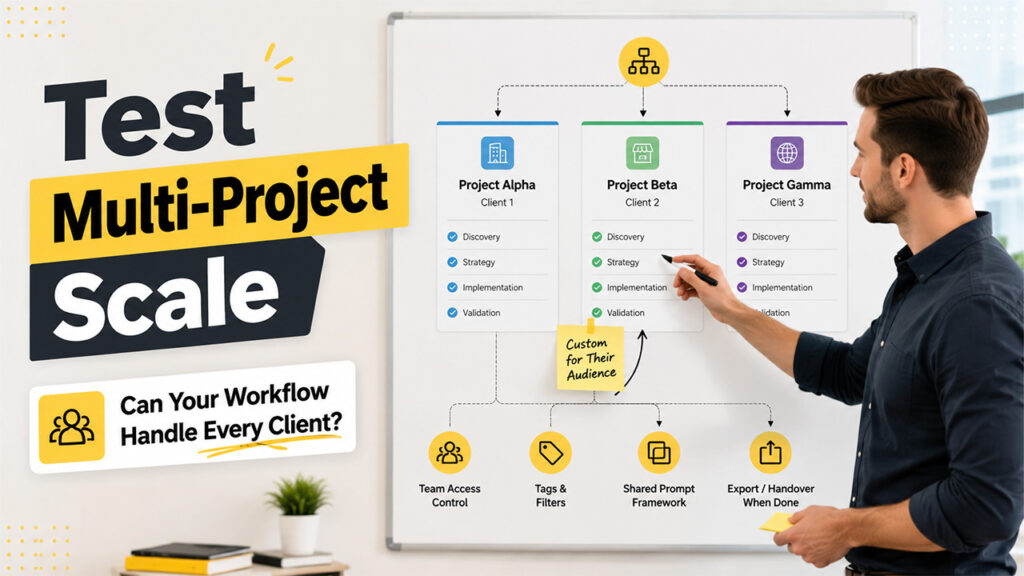
“Supports multiple projects” can mean anything from a project dropdown to genuine portfolio management. Ask an account team to perform normal agency tasks during the trial:
- Create projects for two similar competitors without mixing brand variants.
- Apply a common prompt framework, then customize it for each client’s audience.
- Give an analyst access to selected accounts without exposing the whole portfolio.
- Produce an executive view and an evidence-rich analyst view from the same data.
- Export or hand over a project when an engagement ends.
Search, naming conventions, tags, bulk edits, prompt groups, annotations, and filters determine whether a process remains usable at scale. If every client requires a custom spreadsheet, the platform is not carrying enough of the workload.
Standardization should not erase strategy. Agencies can maintain a shared prompt architecture—discovery, category, comparison, implementation, and branded validation—while tailoring the actual questions to the client’s customers, market, and sales process. Comparing identical generic prompts across unrelated clients creates neat dashboards but weak advice.
AI Visibility Tools Makes client reports evidence-first
Clients will ask why a metric changed. The agency needs to answer with more than “the score went down.” A report-ready AI visibility platform should retain the prompt, observed answer, model or surface, date, detected brands, and cited URLs behind the summary.
That evidence supports three layers of reporting:
- an executive layer explaining direction, business relevance, and decisions;
- a strategy layer grouping results by audience and intent;
- an analyst layer containing answers, citations, competitors, and methodology notes.
Avoid presenting average position as if it were a stable organic rank. AI responses can vary across repeated runs, and list ordering is particularly fragile. Frequency of presence across a meaningful prompt set, cited-source patterns, and changes observed over time are usually easier to defend. Even then, reports should disclose material changes in prompts, models, markets, and sampling.
The agency should also separate activity from outcome. “We updated four pages and earned two relevant mentions” is an activity record. “The brand appeared in a larger share of the tracked answer set” is an observed outcome. “The changes caused the increase” is a causal claim that usually requires more evidence.
Treat governance as a product requirement
Governance is easy to postpone when a team has one friendly client. It becomes urgent when the agency handles competing brands, regulated industries, or sensitive go-to-market plans.
During procurement, document:
- how client workspaces and permissions are separated;
- who owns prompts, annotations, exports, and historical data;
- what happens to data after a client leaves;
- whether changes have an audit trail;
- how long answers and reports are retained;
- what client information is sent to model providers;
- which security, privacy, and procurement materials are available;
- whether client users can access only approved views.
Do not infer enterprise controls from a polished homepage. Request documentation and involve the client’s security or legal team when the engagement requires it. A boutique project involving public prompts may have modest governance needs; a global rollout involving unreleased products and regional teams is a different procurement category.
Reporting governance matters too. Establish who can edit the prompt set, who approves new competitors, how anomalies are reviewed, and how methodology changes are disclosed. Otherwise, two account managers can produce incompatible “visibility” numbers for the same brand.
Match the shortlist to the agency model
A useful starting point is an evidence-led comparison of the best AI visibility tools, followed by a trial using real client scenarios. The comparison narrows the market; it does not replace due diligence.
Profound is relevant to evaluate when an agency needs enterprise-oriented workflows, broader answer-engine analysis, and client-ready reporting around a mature service line. Semrush One may be the practical candidate for agencies already delivering SEO through Semrush and wanting AI search to appear beside familiar organic reporting.
Searcherries can fit boutique agencies and lean consultancies that want mentions, competitor context, cited URLs, AI traffic, and SEO reporting close together. That can be useful when the AI visibility work is part of an SEO or growth engagement rather than a separate enterprise program. Agencies that require complex client portals, extensive permission structures, custom governance, or large pitch-room workflows should validate those requirements directly and may prefer an enterprise-first platform.
Peec AI is worth considering for a focused AI search analytics experience that account teams can explain without introducing an entire SEO suite. Otterly.ai can make sense for lighter monitoring engagements where prompt, mention, and citation tracking are the primary job. These are workflow positions, not declarations that one product is universally better.
An enterprise account may justify a heavier platform, while a small retained client may be served well with a focused tracker. Forcing every client into the same software can create unnecessary overhead or inadequate controls.
Run a portfolio-shaped pilot

Do not test only the agency’s own brand. Select two or three representative client scenarios: a boutique B2B company, a multi-location or multi-market client, and an enterprise account if that work is in scope.
Use the same evaluation sequence for each product:
- Define a stable prompt set and expected competitors for each scenario.
- Import or configure the projects without special vendor intervention.
- Inspect the answer-level evidence and citation records.
- Build a recurring client report and an internal analyst view.
- Assign users with different access needs.
- Turn one finding into a recommendation and estimate delivery time.
- Calculate software and labor cost at current and expected portfolio scale.
Score evidence quality, repeatability, project separation, permissions, reporting flexibility, exports, onboarding, support, and total servicing time. Include a “cannot verify” category so evaluators do not reward confident sales answers without proof.
Finally, have someone who did not configure the tool review the report. If that person cannot trace a conclusion back to prompts and answers, clients will struggle too. If the report requires a long verbal disclaimer to become accurate, the default presentation needs work.
Choose for trust and operational fit
The right agency platform is not necessarily the one with the most AI models, the most charts, or the strongest claim to being an all-in-one solution. It is the one the team can operate repeatedly across the intended client mix without losing evidence, margin, or control.
Boutique agencies should resist enterprise overhead that clients will not use. Larger agencies should not trade away workspace separation, governance, and auditability for a simpler dashboard. Both should insist on answer-level evidence and honest communication about variability.
When the tool matches the service, AI visibility becomes more than a novelty report. It becomes a disciplined way to identify opportunities, document uncertainty, recommend work, and give clients a clearer view of how their brands appear in AI-mediated discovery.
Conclusion
Agencies should choose an AI visibility tools which is based on the service they actually need to deliver, and not on features count or headline pricing. The strongest platform is among the key factor that scales across clients, while also preserving reliable evidence, clear reporting, appropriate governance, and healthy margins. A portfolio-shaped pilot can also reveal if those tools can reduce the operational work and support defensive client recommendations. If all these factors align, the AI visibility tool acts as a practical and repeatable agency service, rather than just another dashboard to maintain.
%201.png)

%201.png)

%201.png)