
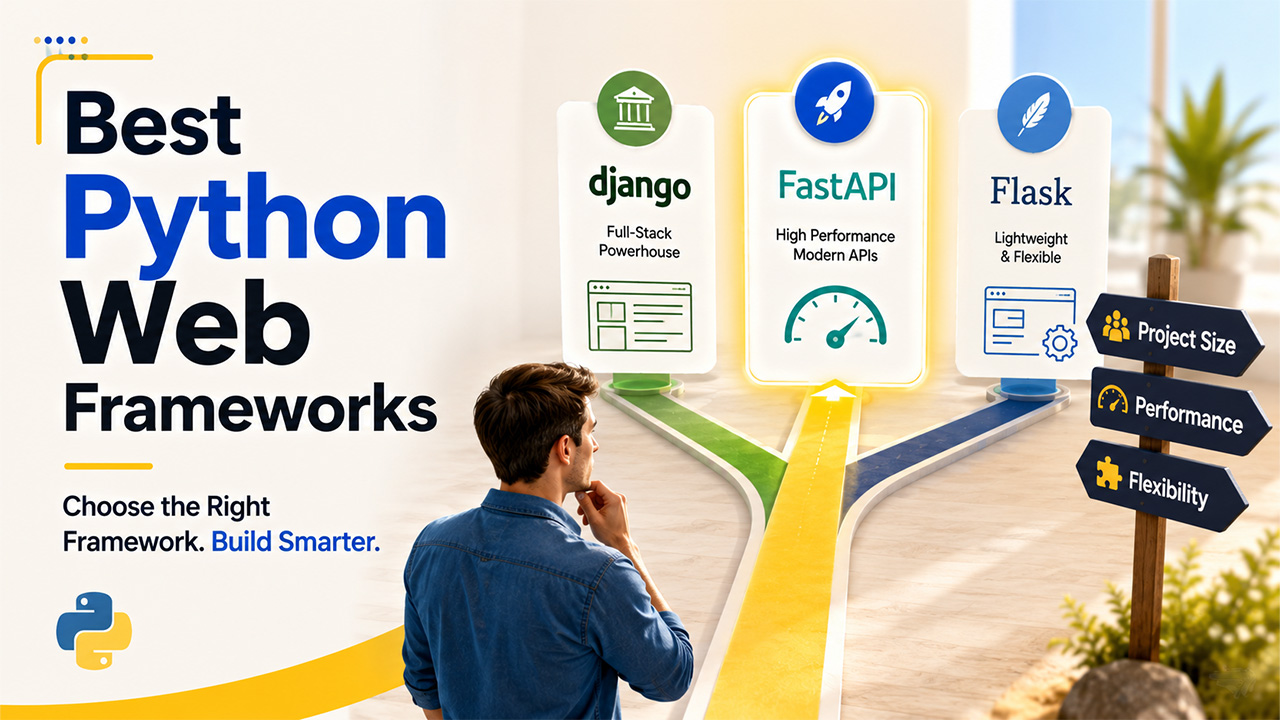

Choosing the right Python web framework can make or break how smoothly your project comes together. Python’s ecosystem offers dozens of options, each built around different priorities: some prioritize speed, others flexibility, and some are built purely for getting a simple API running fast without extra overhead.
Whether you’re building a full-scale web application, a lightweight API, or something in between, you must make the correct framework selection from the very beginning because making a poor framework selection will not only lead to development problems but also necessitate a complete code rewrite in the future.
In this blog, we’ll walk through what a Python web framework actually is, the different types you’ll come across, and seven of the best options worth considering in 2026, along with how to figure out which one actually fits what you’re building.
At a Glance: 7 Python Web Frameworks Compared
| Framework | Best For | Learning curve | Async Support |
| Django | Large, content-heavy applications | Steep | Partial |
| Flask | Small projects and APIs | Gentle | Limited (via extensions) |
| FastAPI | High-performance, modern APIs | Moderate | Full |
| Pyramid | Projects with unpredictable growth | Moderate | Limited |
| Tornado | Real-time apps, websockets | Steep | Full |
| Bottle | Prototypes and learning | Very gentle | None |
| Sanic | High-traffic, speed-critical APIs | Moderate | Full |
What Is a Python Web Framework?
A Python web framework is a collection of pre-built tools, libraries, and conventions that handle the repetitive parts of building a web application, things like routing, handling requests, managing sessions, and talking to a database, so developers aren’t rebuilding the same foundation from scratch every time.
Rather than writing new code to handle each HTTP request, a framework provides a structure where you implement your own logic within it. That’s really the whole appeal: less repetitive work, faster development, and a more consistent codebase to maintain over time.
Types of Python Web Frameworks
All frameworks do not have to be created to serve the same purpose. Knowing which categories exist will make choosing a framework simpler.
Full-stack framework: Comes with everything built in, routing, ORMs, authentication, admin panels, so there is no need to cobble up different things on your own.
Micro frameworks: Lightweight and minimal by design, giving you just the core essentials and letting you add exactly what you need.
Asynchronous frameworks: Built around async capabilities from the ground up, ideal from the ground up, ideal for handling high volumes of concurrent requests efficiently.
Most developers end up choosing based on project size and complexity: full-stack for larger applications with lots of moving parts, and micro or async frameworks for smaller, faster, more specialized builds.
7 Best Python Web Frameworks in 2026
Here’s a rundown of seven frameworks that consistently hold up, whether you’re building something large and complex or just need a lightweight API running fast.
1. Django
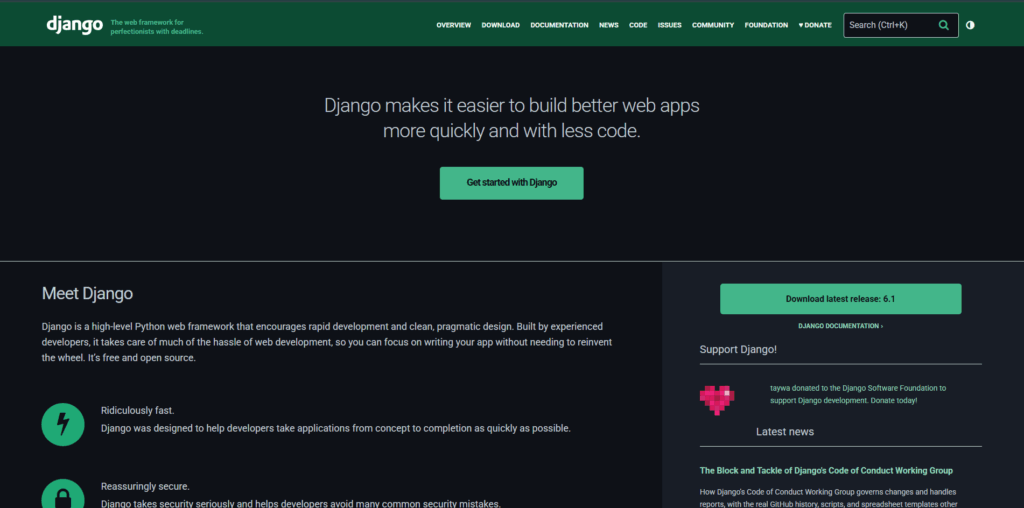
Django has earned its reputation as the framework people reach for when they want structure and speed at the same time. It’s opinionated by design, which sounds restrictive until you realize how much decision fatigue it removes from day one of a project.
- Massive ecosystem: Thousands of third-party packages exist for nearly anything you’d want to add, from payments to search.
- Built-in security defaults: Protection against common vulnerabilities like SQL injection and clickjacking comes standard, not bolted on later.
- Best for content-heavy sites: Publishers, marketplaces, and platforms with lots of structured data tend to lean on it.
2. Flask
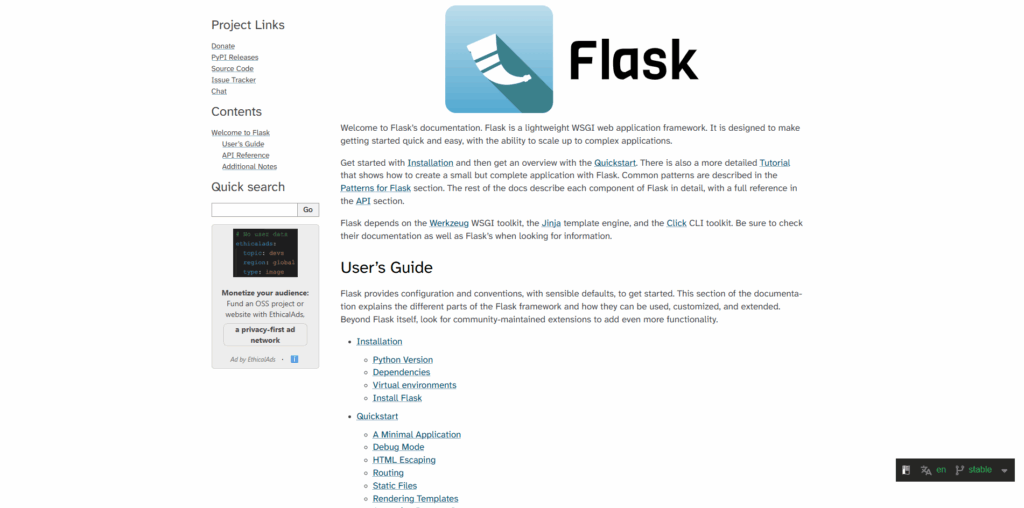
Flask earns loyalty for staying out of your way. There’s no forced structure, no assumptions about how your app should be organized, just a small core you build outward from. It pairs well with automation work too; plenty of developers use it alongside Gmail API automation scripts.
- Blueprint-based organization: Lets larger apps stay modular without needing a full framework’s rigid folder structure.
- Testing-friendly by design: Its simplicity makes writing and running unit tests noticeably less painful.
- Popular for microservices: Small, focused services often run on Flask precisely because it doesn’t carry extra weight.
3. FastAPI
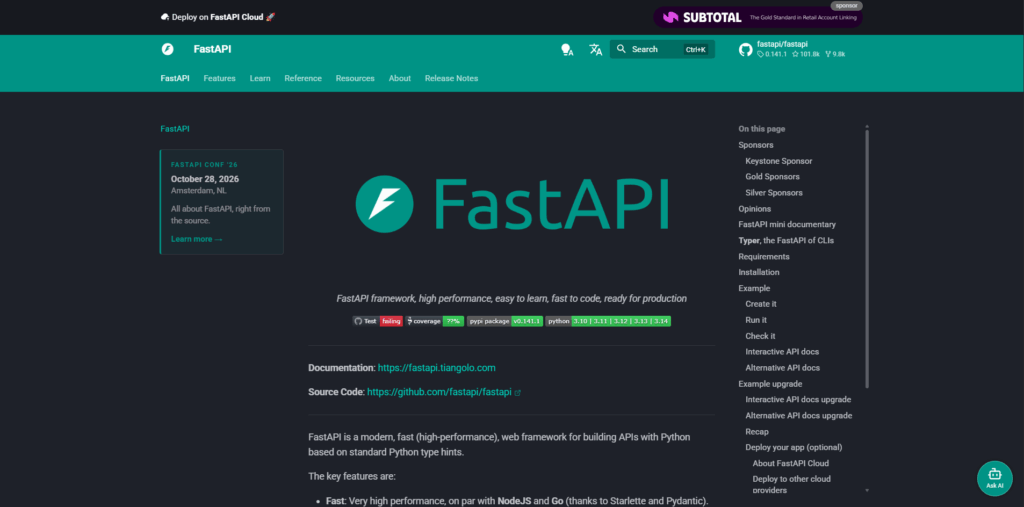
The success of FastAPI was not by chance but was a solution to a problem that many developers face. The framework relies on typing in Python, which unknowingly helps to eliminate bugs that could occur.
- Data validation built in: Pydantic handles request validation automatically, catching bad input before it reaches your logic.
- High performance under load: Benchmarks consistently place it among the fastest Python frameworks available.
- Great for machine learning APIs: Frequently paired with ML models that need to serve predictions quickly.
FastAPI can also work well for applications involving Python Data Analysis, particularly when data-processing workflows need to be exposed through fast and scalable APIs.
4. Pyramid
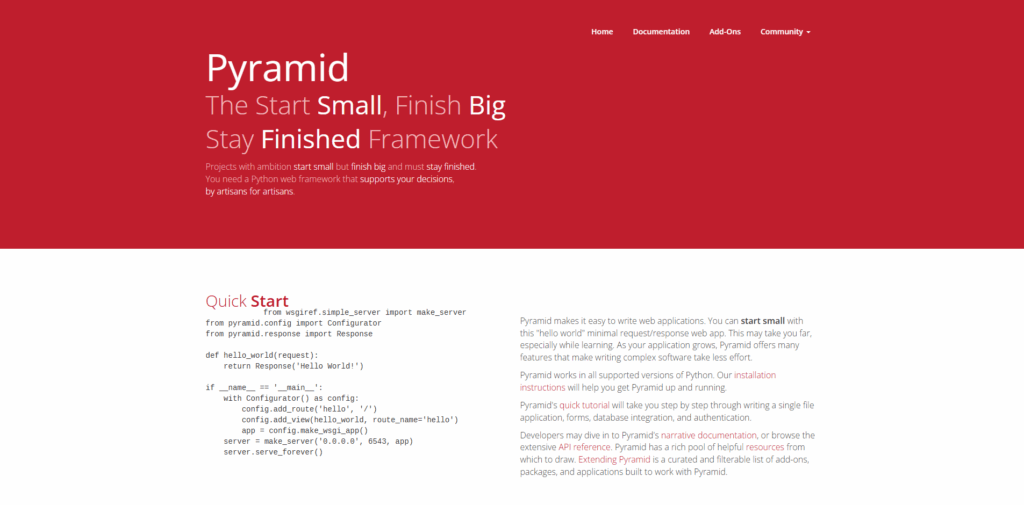
Pyramid’s biggest strength is that it doesn’t force a philosophy on you. Small teams like the freedom to pick their own tools, while large teams appreciate that it won’t fall apart as requirements pile on over time.
- Traversal-based routing option: Offers an alternative to standard URL routing that suits complex, nested data structures well.
- Strong for hybrid apps: Works well when a project needs both a simple public site and a more complex backend.
- Mature, stable codebase: Been around long enough that most edge cases have already been solved by the community.
5. Tornado
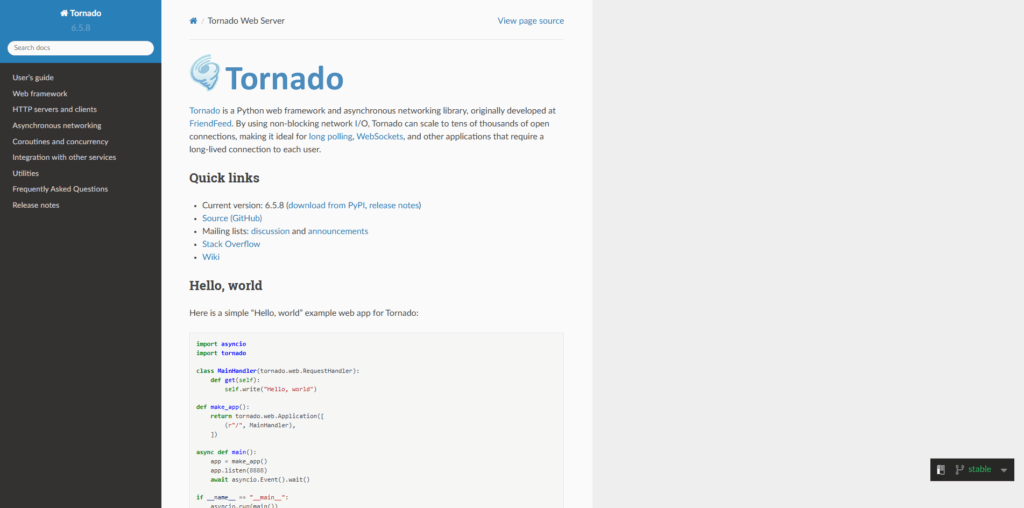
Tornado predates the current async boom by years, originally built to handle Facebook-scale traffic before “async” was even a common term in Python circles. That early focus still shows in how well it performs under sustained pressure.
- Custom I/O loop: runs its own event loop, giving finer control over how connections are managed.
- Ideal for websockets: A common choice specifically for building persistent, real-time communication features.
- Battle-tested at scale: Powers parts of major platforms that need to stay responsive under heavy simultaneous use.
6. Bottle
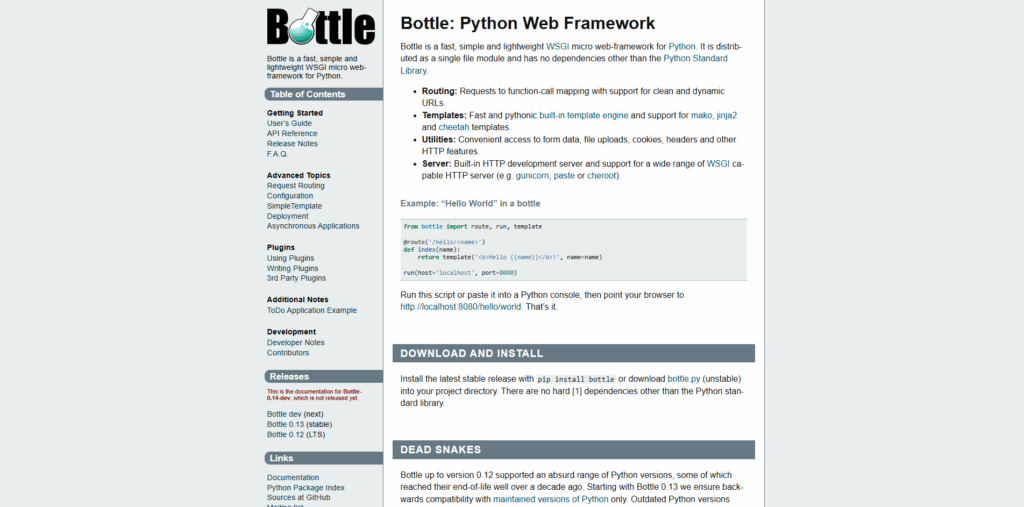
Bottle strips things down about as far as a framework can go without losing usefulness entirely. It’s less a framework and more a thin, helpful layer, which makes it a favourite for anyone who wants full visibility into what their code is actually doing.
- Fast to learn: Most developers can read through its entire source and understand it in an afternoon.
- No dependency headaches: Nothing extra to install or manage, which keeps deployment simple.
- Great for teaching: Frequently used in tutorials since there’s no framework magic obscuring what’s happening.
7. Sanic
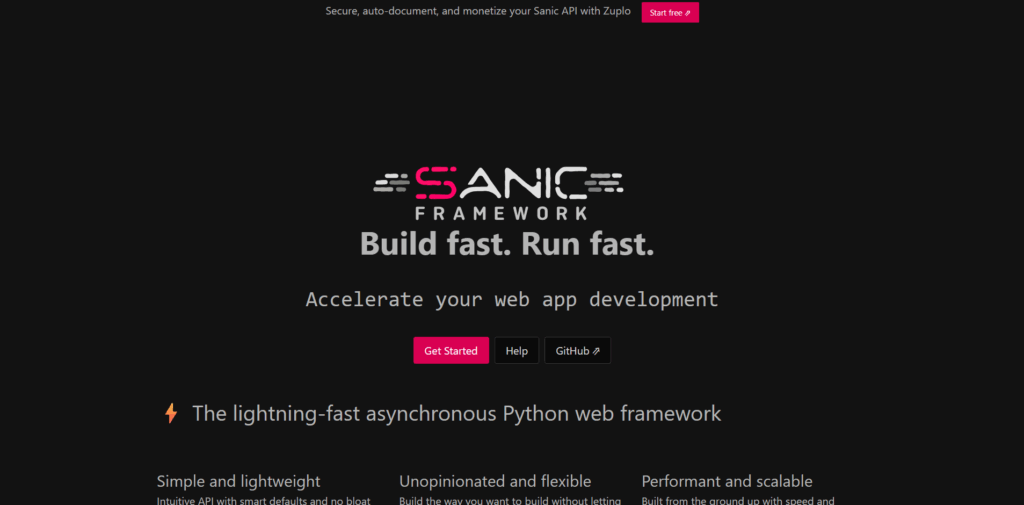
Sanic was built around a simple bet, that Python web development shouldn’t have to sacrifice raw speed for convenience. It borrows Flask’s approachable style while rebuilding the internals specifically for asynchronous performance.
- uvloop integration: Uses a faster event loop implementation under the hood for improved request handling.
- Built-in support for streaming: Handles large file uploads and downloads without extra middleware.
- Good fit for high-traffic APIs: Chosen often when performance under concurrent load outweighs the need for extra built-in features.
How to Choose the Right Framework
With seven solid options on the table, the decision should not be based on which one is currently popular; instead, it needs to match the project that you have in mind.
- Project size matters most: Large and complicated projects should be based on Django, whereas simple ones or APIs work best with Flask and Bottle.
- Consider your performance needs: If your application requires high concurrency, async-first frameworks such as FastAPI, Tornado, or Sanic would be the way to go.
- Think about your team’s experience: A framework with strong conventions, like Django, can actually be easier for teams to collaborate on than something too open-ended.
- Factor in long-term maintenance: Frameworks with active communities and frequent updates tend to age better than smaller, less-maintained options.
- Consider SEO requirements: Businesses should also consider how well their chosen framework supports their broader SEO framework, particularly when building websites that require search-friendly structures and performance optimization.
If you’re building something that requires custom integrations beyond what any single framework handles out of the box, it’s sometimes worth bringing in outside expertise, and looking into established API development companies can help fill that gap without slowing your own team down.
Conclusion
Ultimately, there is no such thing as the “best” Python framework for developing web applications. Django will be ideal for those looking to get up and running with an app quickly, while Flask and Bottle provide developers with freedom and flexibility. However, FastAPI, Tornado, and Sanic come in handy for situations where performance is crucial.
The good news is that Python’s ecosystem is mature enough that whichever framework you pick, you’re not locked into a bad decision forever. Most projects can migrate or scale into a different framework later if your needs change.
In any case, developers should stick with whatever framework seems the most appropriate right now and not the one they will require in two years.
Frequently Asked Questions
Which Python web framework is best for beginners?
Flask is generally the easiest starting point. Its minimal core means fewer concepts to learn upfront, and its huge community makes it simple to find tutorials, solutions, and support when you inevitably run into questions along the way.
Is Django better than Flask?
There isn’t any absolute winner because both frameworks were designed for different purposes. Django will be a good fit for big and complex apps, while Flask is appropriate for smaller projects that do not require numerous ready-to-use utilities.
Which framework is fastest for building APIs?
FastAPI is considered the fastest framework to build APIs, since it follows the asynchronous approach and provides automatic validation of requests. The framework Sanic is a good alternative option in case performance under high loads is your primary concern.
Can I switch frameworks later in a project?
Yes, though it usually requires significant rework depending on how deeply the original framework’s structure is woven into your codebase. Planning and choosing a framework based on long-term needs helps avoid this altogether.
Do Python web frameworks work well for mobile app backends?
Yes, web frameworks such as Django and FastAPI are often used for developing backend APIs, which mobile applications depend on to process the data, authenticate users, and perform business logic, while the frontend application is responsible for the UI.
%201.png)

%201.png)

%201.png)