
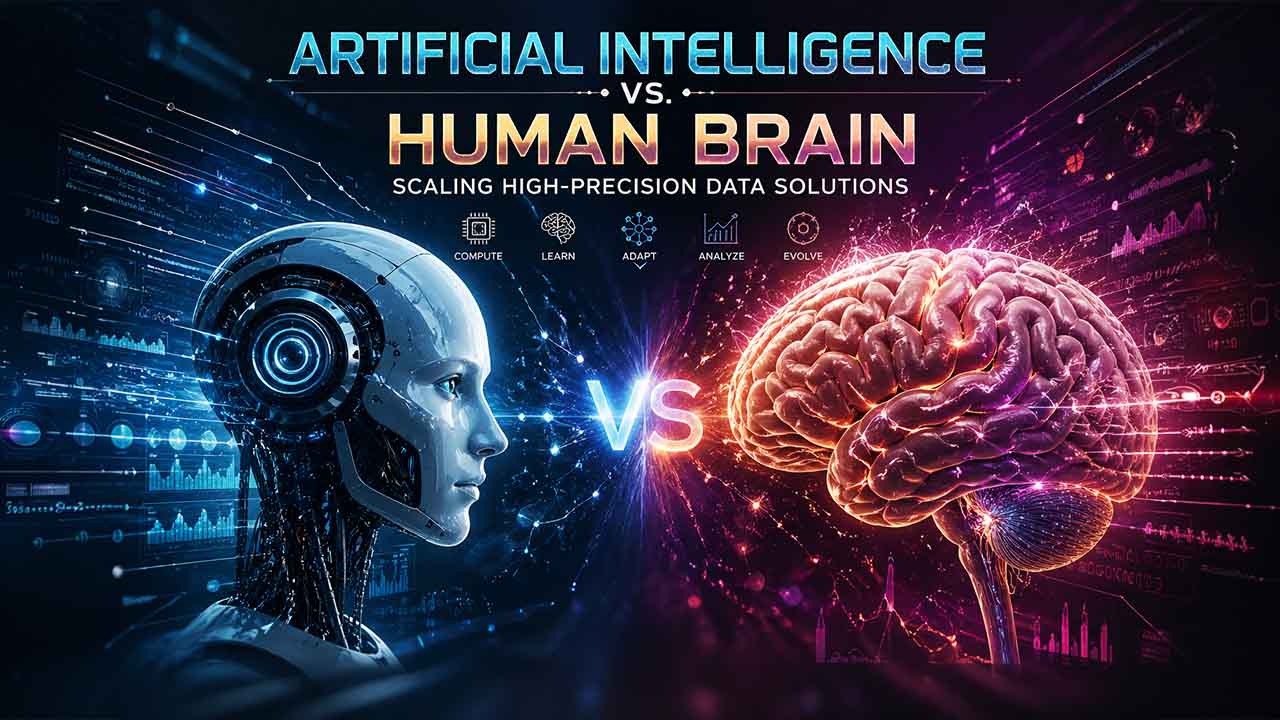

In 1822, Charles Babbage envisioned a world where logical labor could be automated. Today, as we navigate the complexities of 2026, that vision has transcended simple calculation. For enterprises across North America and Europe, the boundary between human intuition and machine processing is no longer a line in the sand—it is a strategic frontier.
The shift from IBM’s Deep Blue in 1997 to today’s Generative AI represents more than technical progress; it represents a fundamental change in how Western tech hubs approach innovation. At the heart of this evolution is the constant comparison of artificial intelligence vs human brain, a relationship that defines how modern businesses stay competitive in a landscape dominated by automation.
Round 1: The Silicon Titan – Efficiency at Scale
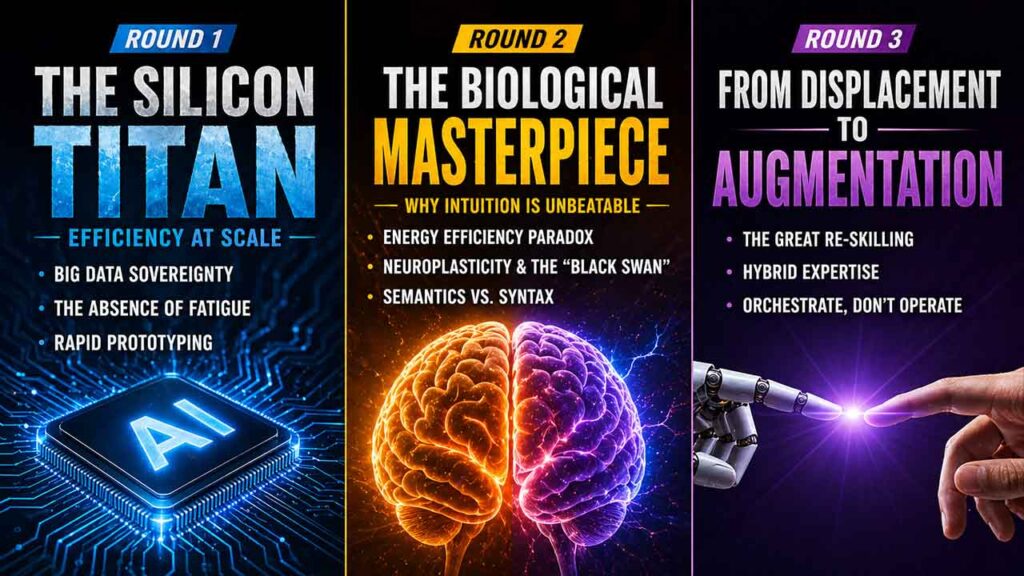
Modern AI is no longer a rigid system; it is a pervasive architecture. For US-based startups and British financial institutions, the "power" of AI lies in its ability to handle "Big Data Sovereignty" without biological friction.
A critical component of this sovereignty is the quality of the underlying data. Modern neural networks rely on high-quality image annotation services to achieve the computational velocity required for predictive SEO and hyper-analytics. These processes allow businesses in New York or London to anticipate market shifts before they even occur, transforming raw visual data into actionable strategic insights.
- The Absence of Fatigue: Unlike human teams that require REM sleep, AI provides the same surgical precision at 4:00 AM as it does at noon. In high-stakes environments like GDPR-compliant data processing, this unwavering reliability is a life-saving necessity.
- Rapid Prototyping: What used to take months of revision—whether it is a new website UI or a complex marketing funnel—can now be prototyped in minutes, allowing for a level of experimentation that was previously cost-prohibitive for European enterprises.
Round 2: The Biological Masterpiece – Why Intuition is Unbeatable
Despite models boasting trillions of parameters, the human brain remains the most efficient "computer" in the known universe. The goal isn't to replace the human element but to amplify it through expert data management and ethical oversight.
- The Energy Efficiency Paradox: While massive data centers consume megawatts to run a single LLM, the human brain performs creative tasks on a mere 20 watts. We believe the future of sustainable technology in the EU must move toward this "Low-Power, High-Impact" model.
- Neuroplasticity and the "Black Swan": AI thrives on historical patterns, but when faced with unprecedented events, it often falters. Humans excel in total uncertainty, using intuition to navigate crises where algorithms have no data to fall back on.
- Semantics vs. Syntax: AI is a master of syntax—rules and probabilities. But humans own semantics—the emotional weight and visceral meaning behind information. This is the "Secret Sauce" in premium marketing and high-level leadership.
Round 3: From Displacement to Augmentation
As we cross into 2026, the narrative of "job destruction" is being replaced by The Great Re-skilling. Value is no longer found in the ability to do the work, but in the ability to direct it.
This requires a hybrid expertise: a deep understanding of AI capabilities combined with high-level technical project management that meets Western quality standards. This orchestration model mirrors emerging practices in AI CRM integration for intelligent business operations. Organizations that master this orchestration by mid-2026 are projected to capture significantly more value than those using AI as a simple tool.
Verdict: The Era of the Augmented Human
Artificial Intelligence is not our replacement; it is our mirror. It reflects our desire to transcend our own limits. Every sophisticated neural network is, at its core, a consequence of human ingenuity.
The future belongs to those who stay human while mastering the machine. In a market flooded with generic AI output, the premium on uniquely human capabilities—ethics, deep intuition, and complex social negotiation—has never been higher. The machine provides the power, but only the human brain provides the purpose that drives global business forward.
%201.png)

%201.png)

%201.png)