


Sales teams have always wrestled with the same headache: a CRM overflowing with leads but a calendar short on time. For decades, we tried to fix this with filters—sorting by job title, company size, or how many times a prospect opened an email. The signals provided some information but failed to deliver complete results. They measured curiosity, not capability.
The real shift in 2026 isn't about tracking more clicks; it’s about understanding financial reality. The ability to automatically extract and interpret bank statement data is giving sales and marketing teams a layer of intelligence that was previously locked away in manual PDF reviews.
1. Beyond the "Assumed" Interest
Traditional lead scoring is built on assumptions. A prospect visits your pricing page? They must be interested. They download a whitepaper? They're in the research phase.
But none of that tells you if they can actually afford your solution, or if their business is stable enough to be a long-term partner. Bank statement extraction software flips the script. It moves lead scoring from "What did they click?" to "What is their financial health?"
2. What Exactly Is Bank Statement Extraction Software?
In simple terms, this software acts as a bridge. The system transforms unorganized and disorderly documents, which include PDFs, scanned images, and digital exports, into structured data that your CRM system can utilize. The technology has advanced beyond its fundamental OCR (Optical Character Recognition) capabilities by the year 2026.
The AI systems of today can automatically classify financial transactions and detect ongoing revenue streams, and identify potential risks, which include decreasing account balances and excessive debt ratios, without any need for human operators to examine bank documents.
3. Why CRMs Need a Financial Reality Check
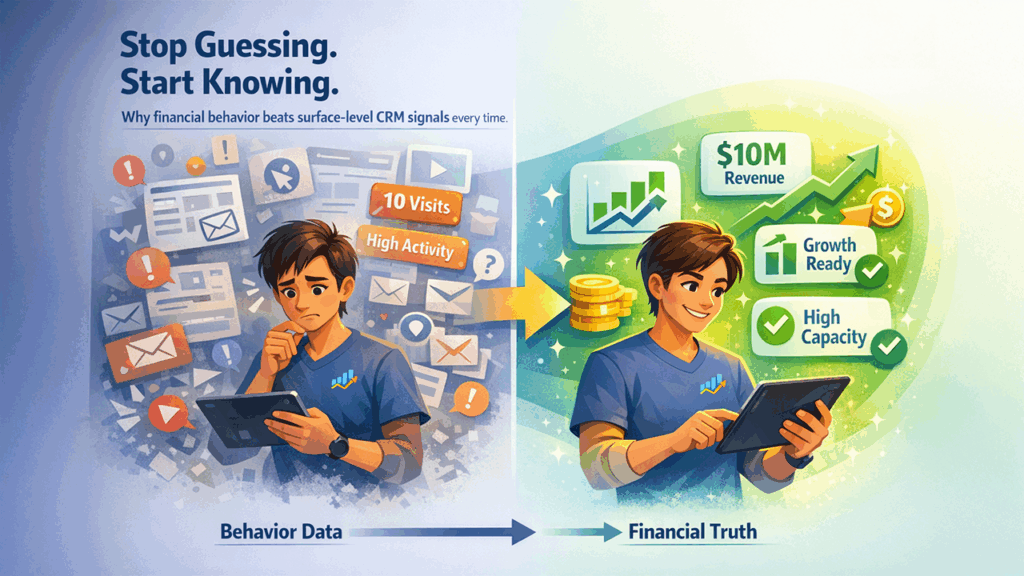
Most CRM setups are scoring the wrong things. They capture behavior, not capacity. A prospect might visit your site ten times, but they could be a student doing a project or a competitor doing recon.
Conversely, a quiet lead might have a $10M revenue stream and a desperate need for your service. Standard CRM data can't tell them apart. Financial behavior is the ultimate truth-teller. It reveals consistent income, manageable outgoings, and a pattern of investing in growth.
Traditional Lead Scoring vs. Financial Lead Scoring
The major difference between traditional lead scoring and financial lead scoring is what type of information a CRM uses to determine how valuable or sales-ready a prospect is.
Traditional Lead Scoring
Traditional lead scoring primarily evaluates the behavior and profile of the prospect. The CRM assigns points based on actions that indicate interest or buying intent. It includes scoring leads through sources like opening marketing emails, visiting the website, filling out a contact form, requesting a demo, or downloading an eBook.
Financial Lead Scoring
Financial lead scoring adds financial information to the scoring process. When a customer provides appropriate consent, data extracted from financial documents such as bank statements can provide additional signals. This can include income consistency, average account balance, cash-flow patterns, recurring expenses, or liquidity patterns.
A quick comparison between traditional lead scoring and financial lead scoring is as follows:
| Factors | Traditional Lead Scoring | Financial Lead Scoring |
| Primary Focus | Behavior and demographics | Financial characteristics |
| Data Sources | CRM, websites, email, forms | Bank statements and financial records with consent |
| Measures | Engagement and buying intent | Financial capacity and stability |
| Key Advantage | Identifies interested prospects | Adds financial context |
| Main Limitations | May lack financial context | Requires consent, security, and careful interpretation |
4. Four Financial Signals That Change the Score
The inclusion of extraction data in your scoring model enables your system to discover indicators that directly connect to high-value customers. These insights are also becoming essential in banking software development, where financial data plays a key role in decision-making.
- Income Consistency: The income consistency measurement shows that a customer will make timely payments while maintaining a long-term relationship with the business.
- Spending Velocity: Where is the money going? A business regularly spending on SaaS, marketing, and talent is in "growth mode"—the ideal time to sell to them.
- Liquidity Reserves: Does the prospect have a buffer? Leads with healthy reserves are significantly less likely to churn when the market gets bumpy.
- Risk Detection: Bounced payments or heavy overdraft reliance are early warning signs that a lead isn't worth the sales team's energy.
5. From Fintech to SaaS: The Use Cases
While lenders were the early adopters, the applications are widening:
- Subscription Models: Identify prospects who are already paying for competitors.
- B2B Enterprise Sales: Profile a client’s financial health before the first discovery call.
- Recruitment: Find businesses that are actively increasing their payroll spend.
6. The Rise of Predictive CRM
The real magic happens when this data feeds into AI-driven scoring engines. Instead of a static "point system," you get a dynamic model. It can weigh engagement history against financial trajectory in real time.
The CRM system updates its score in response to prospect statement uploads, which occur during the onboarding process. This system transitions from reactive CRM, which operates by analyzing past events to predictive CRM, which forecasts future events.
7. Better Lives for Sales and Marketing
For sales reps, the benefit is reclaimed time. You stop chasing "ghosts" and start talking to people who actually have the budget.
For marketing, it's about precision. You can stop spending your ad budget on "lookalike" audiences that don't have the financial profile to convert.
8. Integration: No Longer a Developer’s Nightmare
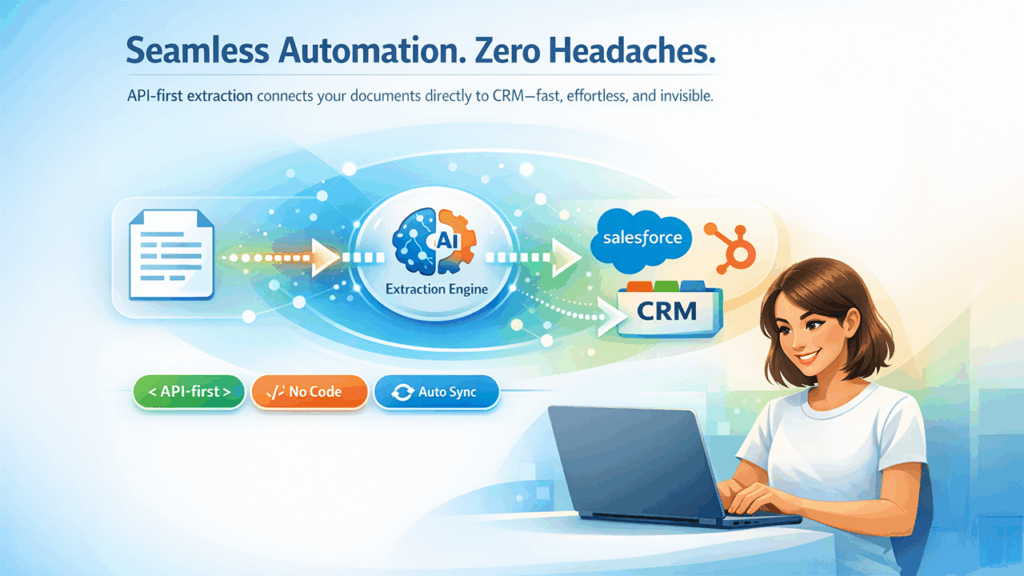
A large engineering team is unnecessary for implementing this solution. Current extraction tools operate through an "API-first" design, which enables direct integration with Salesforce, HubSpot, and Zoho systems. The document data travels through the extraction engine to reach the CRM record through an automated process that operates without user knowledge.
9. The Responsibility Factor
Bank data requires a discussion about security because trust establishes the foundation for this subject. Bank statements contain highly sensitive information about individuals. Organizations must meet GDPR and CCPA requirements as their minimum standard for compliance.
The technology requires teams to obtain both user permission and implement strong security measures. The implementation of AI technology requires human verification for all critical decision-making processes because AI systems make errors.
10. The Competitive Edge in 2026
Bank statement extraction isn't just a niche tool for accountants anymore. It’s becoming the backbone of how smart companies qualify their leads. Businesses that understand their customers' financial situations and their online behavior will achieve victory in today's market competition, where every company fights for market share.
Conclusion
Bank statement extraction is transforming CRM lead scoring by bringing financial insights into a process that has traditionally relied on behavioral and demographic data. Businesses can build a more comprehensive understanding of their leads and prioritize opportunities more effectively by extracting information such as income consistency, cash-flow patterns, spending behavior, liquidity, and financial risk indicators. As CRM platforms become more data-driven, businesses that combine intelligent automation with responsible financial data practices will be better positioned to create accurate, efficient, and customer-centric lead-scoring strategies.
Frequently Asked Questions
What is bank statement extraction used for in CRM?
It converts raw financial data into structured insights, allowing CRMs to score leads based on actual financial capacity rather than just website behavior.
Is it legal to use this data for lead scoring?
Yes, as long as you have explicit consent from the prospect and comply with privacy laws like GDPR or CCPA.
How accurate is the AI?
Most enterprise-grade tools hit 95%+ accuracy for digital formats and include "confidence scores" to let you know when a human needs to double-check a file.
Which CRMs play nice with this tech?
Almost all of them. Salesforce, HubSpot, and Pipedrive can all be connected via APIs or tools like Zapier and Make.
What are the most important signals to watch?
Look for income consistency, cash flow stability, and spending on growth-related tools.
%201.png)

%201.png)

%201.png)