

Corporate gifting has grown from a seasonal afterthought into a measurable part of how organizations approach employee engagement, loyalty, and retention. Companies are not spending on branded mugs and gift cards for no reason: survey data consistently links thoughtful, well-timed gifting to how employees say they feel about recognition, engagement, and their intent to stay. Increasingly, the tools driving that shift look less like a shopping catalog and more like a workflow — CRM and HR systems that trigger, personalize, and track gifting the same way they handle any other relationship data.
This guide covers what the data actually shows, how CRM and automation fit into a modern gifting program, the gift categories employees say they want, and the trends worth building around in 2026.
Why Corporate Gifting Matters: What the Data Shows
Employee perception of recognition is strongly and consistently linked to engagement, sentiment about the employer, and self-reported intent to stay, across multiple independent surveys. It's worth being precise about what these numbers can and can't tell us: most of this data reflects how employees say gifting affects their feelings and intentions, which is different from proof that gifting programs directly cause lower turnover. With that caveat, here is a snapshot of the most-cited figures.
| Metric | Figure | Source |
| Employees who say a work-anniversary gift would make them more likely to stay | 72% | Snappy, 2026 Workforce Study (n=1,500 U.S. employees) |
| Employees who say gifts from employers increase engagement and collaboration | 88% | Snappy, 2026 Workforce Study |
| Employees who rank personalization as the most important factor in meaningful recognition | 73% | Snappy, 2026 Workforce Study |
| Employees who say their employer consistently gets appreciation right | 32% | Snappy, 2026 Workforce Study |
| Employees who have ever received a work-anniversary gift from their employer | 47% | Snappy, 2026 Workforce Study |
Source: Snappy's 2026 Workforce Study, a third-party online survey of 1,500 full-time U.S. employees conducted in January 2026 and reported via PR Newswire (May and June 2026).
The gap between the 72% who say anniversary gifts would influence their decision to stay and the 47% who have ever received one is the opportunity most programs are missing. Fewer than a third of employees (32%) believe their employer consistently gets appreciation right — exactly the kind of gap CRM-driven, systematic recognition is built to close.
On the retention question specifically, it's worth separating self-reported intent from measured outcomes. Independent research from the Achievers Workforce Institute found that 29% of employees say recognition would reduce their likelihood of job-hunting — a correlational, perception-based finding rather than a controlled measurement of turnover reduction. Gallup research, cited across multiple HR industry sources, similarly finds that employees who receive high-quality recognition are less likely to be actively job-hunting than those who don't. Treat any specific turnover-reduction percentage in vendor marketing, including single-customer case studies, with caution; they typically describe one company's experience with one tool, not a generalizable effect.
The scale of this spending is part of why the operational question — how gifting programs actually run — matters. The global gifting market is estimated at roughly $956.9 billion in 2026, according to The Business Research Company, and a narrower analysis from Coresight Research and GiftNow puts the U.S. business-to-business corporate gifting segment on track to reach roughly $312 billion by 2025. At that scale, ad hoc, manually tracked programs stop being a viable operating model — which is where CRM and automation come in.
CRM & Automation for Corporate Gifting
Gifting programs that run on spreadsheets and manual reminders tend to break down at scale — someone forgets a five-year anniversary, a remote hire's welcome kit ships to the wrong address, or nobody can say afterward whether the program moved any metric. That's the operational problem CRM and marketing/HR automation increasingly solve.
How CRM-triggered gifting works
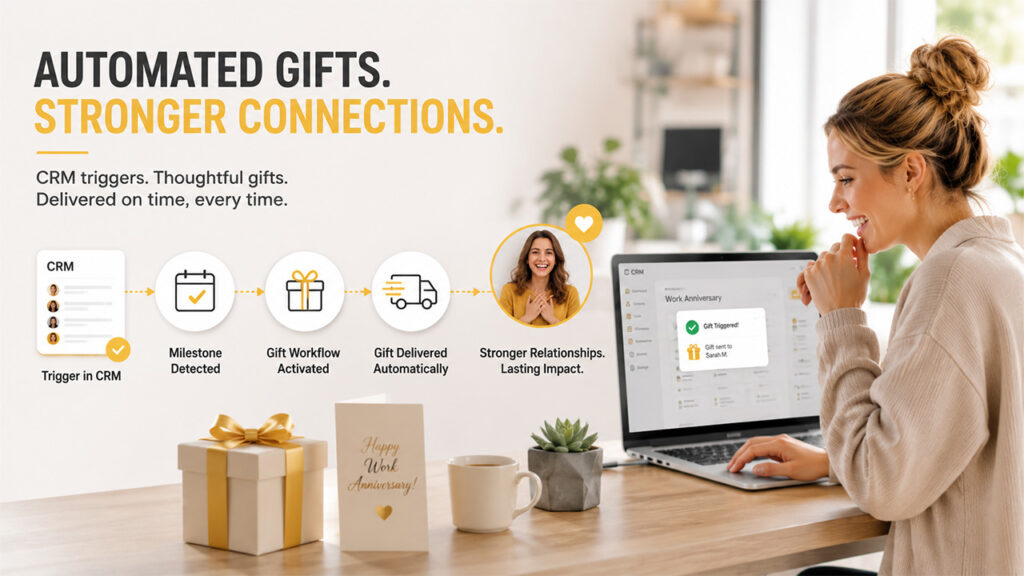
In practice, teams connect a gifting or rewards platform to the CRM or HRIS they already use to track relationships and milestones. Instead of a person manually deciding when to send something, the CRM fires a gift based on a defined trigger: a contact record hitting a work-anniversary date, a deal moving to “Closed Won,” a new hire completing onboarding, or a customer account reaching a renewal date. Industry write-ups on gifting automation describe the same basic pattern across vendors: define the trigger, connect the CRM or marketing automation tool, and let the workflow handle timing and fulfillment rather than a person tracking it in a spreadsheet.
For HR and people teams, this typically means connecting gifting to the systems that already hold the data that matters: start dates, milestone anniversaries, performance review cycles, and team rosters. For go-to-market teams, the same infrastructure triggers client and prospect gifts off deal stages or engagement signals. A CRM like OutrightCRM, or any platform with an accessible API and workflow automation, can serve as that trigger layer — the point isn't the specific vendor, it's having gifting logic live inside the system of record rather than in someone's calendar reminders.
What automation solves — and what it doesn't
- Consistency. Automated triggers close the gap between the 72% of employees who value anniversary recognition and the 47% who actually receive it, by removing reliance on someone remembering.
- Personalization at scale. CRM data — role, tenure, location, past preferences — can feed gift selection. Several gifting platforms now offer recommendation-style features that use redemption history or role/demographic data to narrow a catalog to a more relevant set of choices, similar in concept to e-commerce recommendation engines. This plausibly improves perceived relevance, though “higher ROI” claims from vendors should be read as self-reported rather than independently audited.
- Measurement. Routing gifting through a CRM makes it possible to tie spend to downstream fields like retention, survey participation, or deal outcomes — difficult to do from an ad hoc process.
- What it doesn't solve. Automation can't substitute for a genuinely thoughtful gift or message. Multiple surveys, including Snappy's 2026 study, find that generic, poorly timed recognition can feel more transactional than no gift at all — automation makes delivery reliable, not meaningful on its own.
If you're evaluating tools, the practical checklist is short: does it integrate with the CRM or HRIS you already use, can you define your own trigger events rather than relying on preset ones, and does it report back into that same system so gifting shows up next to the other data you use to evaluate engagement and retention.
A note on AI-driven personalization specifically: it's a real, shipping feature at several platforms, and choice-driven catalogs are well supported as a satisfaction driver independent of any AI involved. But specific ROI multipliers and claims about how widely sentiment analysis is used across employers, circulating in 2026 gifting-industry content, aren't traceable to a named, checkable study — treat them as vendor projection, not established data.
Gift Categories Employees Actually Want
Preference data suggests employees increasingly favor choice, flexibility, and personalization over generic swag. In a survey of over 1,000 U.S. workers reported by Rewordin, 54% said they'd prefer a gift card over a physical item, and 47.9% named a gift card as their ideal end-of-year gift — the single most popular choice.
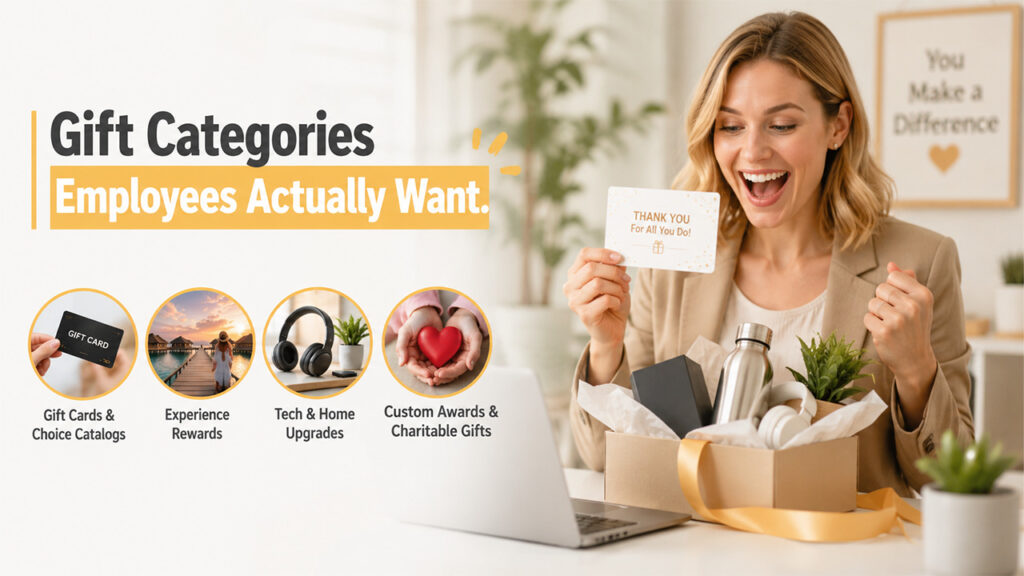
The categories that consistently perform well, in roughly the order CRM-driven programs tend to trigger them:
- Digital gift cards and curated choice catalogs — the most flexible options, and the easiest to trigger automatically since there's no physical fulfillment step.
- Experience rewards and wellness kits — higher-effort options usually reserved for milestone triggers like five- or ten-year anniversaries.
- Premium tech accessories and home-office upgrades — well suited to onboarding or hybrid/remote-team triggers.
- Custom milestone awards and charitable donation gifts — personalized options that work best when the CRM record already has tenure, role, or stated-preference data attached.
The pattern across almost every recent survey is the same: flexibility and personalization outperform one-size-fits-all gifts, whatever the specific category — which is also the strongest practical argument for feeding gift selection from CRM data rather than defaulting to a single gift for everyone.
Budget & Timing Benchmarks
There's no single right number, and published benchmarks vary by industry and company size. As a directional starting point: milestone anniversaries typically run
50–50–
150 per employee (scaled up at 5, 10, and 15 years), new-hire welcome kits
50–50–200, end-of-year gifts
25–25–100, and smaller peer-to-peer or life-event recognition
10–10–75. Smaller, more frequent recognition tends to outperform large, rare gestures in preference surveys — which is easier to sustain when a CRM handles the triggers rather than a person tracking every date manually.
5 Corporate Gifting Trends Shaping 2026
- Digital-first delivery. Roughly 39% of gifting programs now include digital gifts or virtual experiences — instant, trackable delivery that matters more for distributed teams than it did a few years ago.
- Deep personalization. With 73% of employees ranking personalization first, generic gifts are losing ground to tailored picks and handwritten notes.
- Sustainability as a baseline expectation. A majority of corporate buyers in recent surveys say they now favor eco-conscious sourcing, moving it from a nice-to-have toward an expectation.
- Always-on recognition. Budget is shifting from a single annual holiday spend toward smaller, more frequent, moment-based recognition spread across the year.
- CRM- and platform-driven programs. Manual spreadsheets are giving way to gifting workflows triggered from CRM and HRIS data, which is also what makes measurement practical in the first place.
Building a Program That Works
A durable program is a system, not a scramble every December. A reasonable build order:
- Define the moments that matter — anniversaries, onboarding, wins, peer recognition.
- Connect it to your CRM or HRIS so triggers fire automatically off dates and milestones you're already tracking, instead of relying on someone to remember.
- Prioritize choice and personalization — catalogs or gift cards let people pick what fits them, and CRM data (role, tenure, preferences) can narrow the options automatically.
- Set per-person budgets by moment, using the benchmarks above as a starting point.
- Measure results — track participation and redemption, and correlate against engagement survey scores and retention where possible, understanding these are associations, not proof of causation.
Mistakes That Quietly Kill Gifting Budgets
- Gifting once a year and calling it recognition. Frequency and consistency show up repeatedly in survey data as mattering more than the size of a single annual gesture.
- Skipping personalization. Employees consistently rank a generic gift as feeling more transactional than no gift at all.
- Ignoring remote and hybrid staff. Uneven delivery sends an unintended signal about who's central to the team and who isn't.
- No measurement. Without a way to connect gifting to engagement or retention data, it's hard to defend the budget at renewal time.
- Clunky, manual logistics. Manual sourcing and shipping consume hours that CRM-triggered automation is generally better suited to handle.
Gifting for Remote and Hybrid Teams

Distributed teams change the gifting playbook. When a meaningful share of staff never sets foot in an office, a shared box of holiday chocolates doesn't reach everyone — and uneven delivery can quietly signal who's central to the team and who isn't.
Leading with digital gift cards and choice catalogs solves this by letting everyone pick something useful regardless of location. Shipping physical items directly to home addresses, rather than a central office, and timing recognition to the actual moment rather than a single calendar date, keeps delivery consistent. CRM or HRIS records that already capture work location make it straightforward to route gifts the right way automatically, rather than assuming everyone is walking past the same shared mailroom.
How to Measure Gifting ROI
A program you can't measure is hard to defend at budget time. Connecting your gifting platform to your CRM or HRIS makes three things considerably easier to track than doing it manually:
- Retention association — compare retention among employees who received milestone gifts against those who didn't. Treat this as a correlational signal, not proof that gifting alone drove the difference; other factors like manager quality and tenure also affect retention.
- Engagement survey correlation — check whether gifting activity lines up with engagement survey scores over time, which Snappy's 2026 data and other industry surveys associate with higher self-reported engagement.
- Participation and redemption rates — low redemption is a fast, practical signal that the program isn't landing, regardless of what the top-line survey stats say.
When those three signals move in a consistent direction, you have a defensible, evidence-based case for the program going into the next planning cycle — rather than a single headline statistic.
The Bottom Line
Across multiple independent surveys, employees consistently report that feeling recognized is associated with higher engagement and a stated intent to stay — and thoughtful, well-timed gifting is one of the more direct levers available for making people feel recognized. With only 32% of employees saying their company consistently gets appreciation right, there's clear room for improvement in most organizations. Start with the moments that matter, lead with choice and personalization, connect the workflow to the CRM or HR systems you already use so it runs reliably rather than by memory, and measure what happens rather than assuming it's working.
%201.png)

%201.png)

%201.png)