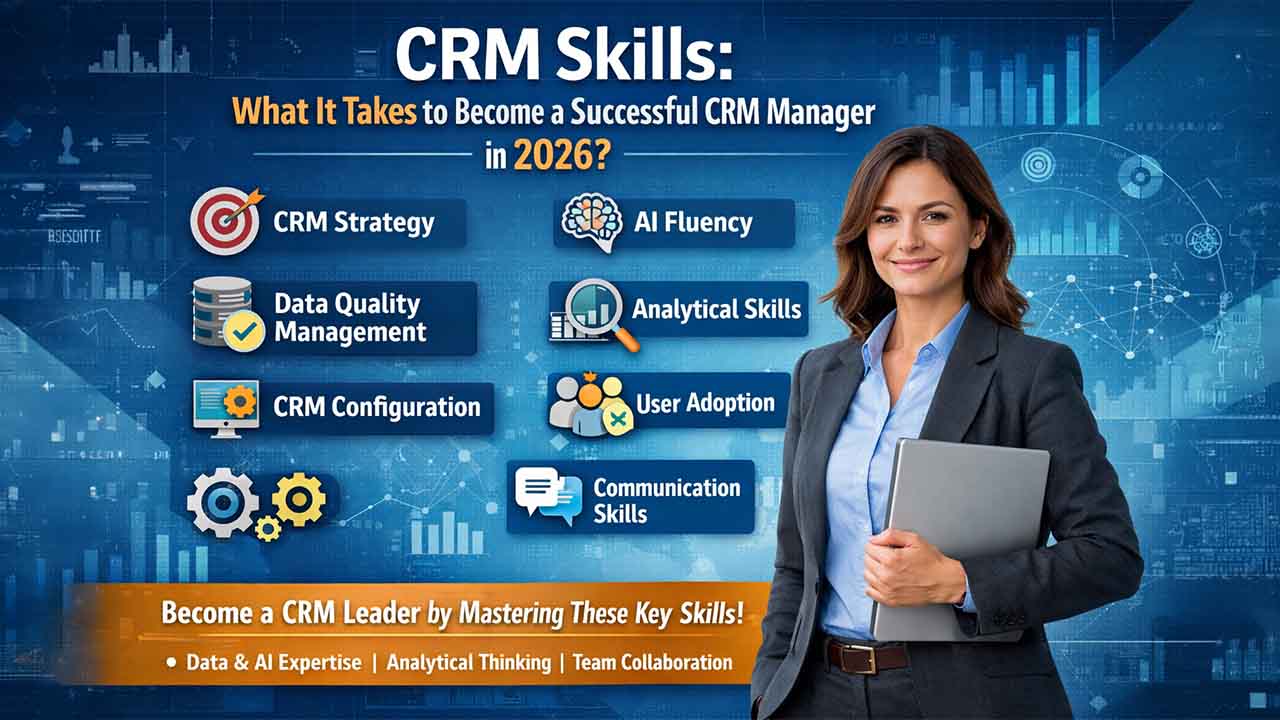

A CRM manager organizes CRM software and streamlines data to aid businesses in developing lasting relationships and improving the overall experience of customers. With businesses greatly depending on AI-powered insights and precise information to meet the expectations of customers, managers must be proficient enough at enhancing workflow efficiency and enabling teams to effectively use CRM. In this complete guide, you will understand core CRM skills companies generally look for in a CRM manager. You will also see how you can showcase these skills to crack interviews and land your dream job in the CRM industry. Companies expect more when you switch from being a specialist to management.
What CRM Skill sets Do Recruiters Need in a CRM Manager?
The responsibilities of a CRM manager vary by company. At an evolving company, employers may want you to spearhead a small team of CRM coordinators and specialists. If you are working in a startup, you might have to manage the entire customer relations strategy and CRM system.
In all cases, recruiting managers need a strong mix of soft and hard skills covering the entire content strategy, stakeholder management, and data analytics. You will require a detailed understanding of CRM tools, along with related concepts such as customer journey management and lifecycle management.
Now, ever since AI has disrupted markets worldwide, the demand for AI-related skills such as prompt engineering and digital expertise has also grown. According to a report by The Adecco Group, around two-thirds of business leaders plan to hire CRM managers who have specialist AI skills.
Companies will expect you to translate business goals into CRM workflows and architecture. To achieve this, organizations generally look for someone who has a good background in marketing concepts, backed by industry experience and a relevant degree.
Strong understanding of fundamentals, along with effective skill sets, is vital to land a role of CRM manager and achieve long-term success.
What Are the Seven Core CRM Manager Skills That Every Customer Relationship Manager Needs?
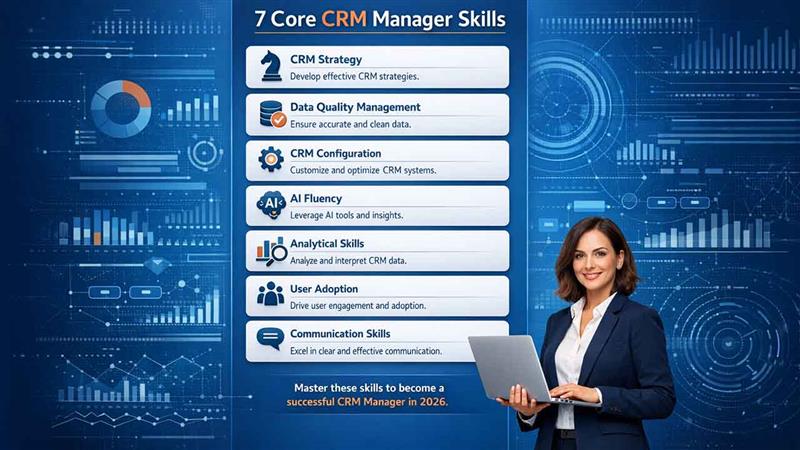
The most efficient CRM managers integrate strategic ownership with adaptability and technical ability to shape how sales teams interact with customers.
They comprehend what a business requires and develop a CRM that delivers while also making sure that customer data is clean and teams are aligned.
The seven key skills you need to go from being a CRM specialist to a successful CRM manager:
1. CRM Strategy Skills:
The first task in a new role will be to understand the objectives of a CRM and design a CRM strategy that aligns with them. Furthermore, CRM managers must also actively work with management to improve CRM strategy. Converting goals into CRM structure needs skillsets such as:
- Liaising with marketing, sales, and customer service teams.
- Creating sales pipelines that reduce sales cycles.
- Leading on customer segmentation to emphasize leads.
- Determining stages that trigger an effective follow-up action.
- Redesign present workflows to enhance conversions.
- Set KPIs to predict sales and track customer satisfaction.
- Handling projects and creating timelines for important milestones.
A CRM manager who is strategically minded might know how to use a mainstream CRM platform, such as GuestPostCRM, to develop post-sales pipelines and create automations to alert account managers when renewal dates come close.
In addition, they can develop custom dashboards to monitor upsell conversions by representatives and predict renewal revenue.
Through this system, sales managers can proactively handle renewals, find new opportunities, and translate priorities into CRM enhancements.
2. Skills of Data Quality Management:
Ensuring data remains relevant, accurate, and trusted is vital to achieving success in the sales and marketing campaigns of a company. If records are outdated or incomplete, sales representatives may chase cold leads while marketing teams send upsell offers to customers who have already churned. Strong management of data needs a mixture of technical knowledge, strategic thinking, and attention to detail. The capability to organize, collect, secure, and assess data within a CRM platform will allow you to convert insights into action to streamline customer engagement strategies.
You need to be absolutely spot on and resolve customer data issues before they impact customer interactions and reporting. In practice, this can involve:
- Setting needed data fields, so representatives skip data such as industry or company size.
- Auditing information to find incomplete records, activity gaps, or stale deals.
- Developing validation rules to identify data errors at the entry point.
When all the deals in your pipeline contain the same data, sales forecasting and data analysis become more reliable.
3. CRM Configuration Abilities:
Configuration is the skill of modifying a CRM to make it align in the way your team works instead of forcing your team to adjust to a default setup. You will require detailed knowledge of CRM, specifically the one you will be working with. No one can know how the CRM of a company works more than you do. Specialization is also advantageous if you want to work as a freelance CRM manager or consultant. Knowing how you can make the most out of one platform will allow you to create more authority and get higher rates.
Configuration abilities go beyond standard proficiency. You will have to convert your CRM into a system that enhances productivity and improves sales. For instance, you will be expected to create field structures that provide precise forecasting and comprehend how each pipeline adjustment influences sales behavior.
Being a seasoned professional with real-world experience will allow you to recruit new employees, train teams, and fix inefficiencies. If you are enrolling in a startup, you can be asked to lead the implementation team of a new CRM.
Effective configuration skills will enable you to develop and create a CRM that aligns with the budget and resources of a company.
4. AI Fluency:
AI technical skills enable CRM managers to enhance productivity and save time. They are also raising the stakes of what is expected of them. As per the McKinsey report on the use of AI in the workplace, around 92% of leaders expect to enhance spending on AI over the next three years. Now, higher spending naturally means more pressure on teams to deliver results.
The most efficient managers understand how they can use AI tools to recognize patterns in pipeline data, forecast high-potential deals, and use an AI email writer to simplify the sales process.
5. Analytical Skills:
Analytical skills are the capability to convert complex data into actionable and clear recommendations. For instance, an analytical CRM manager can develop dashboards to monitor important metrics such as pipeline velocity and deal size. With this data, they can recognize trends, execute new workflows, and translate performance into decision leadership.
You will have to assess reports and recognize which leads have the potential to give you the highest Return on Investment to transform your CRM strategy. You should also know how you can utilize sophisticated features of data management, such as Pivot Tables, VLOOKUP, and the IF function.
Robust numerical skills are also helpful. However, a CRM with visual reporting platforms is also important.
6. User Adoption Enablement:
A successful CRM adoption allows you to be a trainer, leader, and mentor in equal parts. You must understand why team members are not using the CRM and address the frictions to enhance its value. Having a good proficiency in communication allows you to ask good questions and listen to feedback to understand friction. Having strong skillsets in configuration is also significant because then you can easily design training that meets users where they are.
For instance, you can show the sales team how activity reminders minimize the risk of leads becoming cold or educate coordinators on how campaign information flows into the pipeline.
If you are adopting open-source CRM platforms such as SuiteCRM and SugarCRM, you can refer to OutRight Systems’ 10-day training guides to understand the core functionalities of the platform.
Communication Proficiency:
All good CRM managers are effective communicators. Having good listening skills helps them to understand the requirements of their team members and suggest changes that enhance workflows. If you have a good understanding of CRM software, you will be able to explain it in simple terms. Additionally, CRM managers must also deal with others tactfully and sensitively. For example, you might have to communicate to the sales director that a requested feature is not working without losing their confidence.
Interpersonal skills are equally significant when things do go wrong. If a break in workflow or migration disrupts sales outreach, leaders will always look for you. How you communicate your problems and what you do about them will determine how much stakeholders rely on them.
How to Showcase Your CRM Skills to Get a Job as CRM Manager?
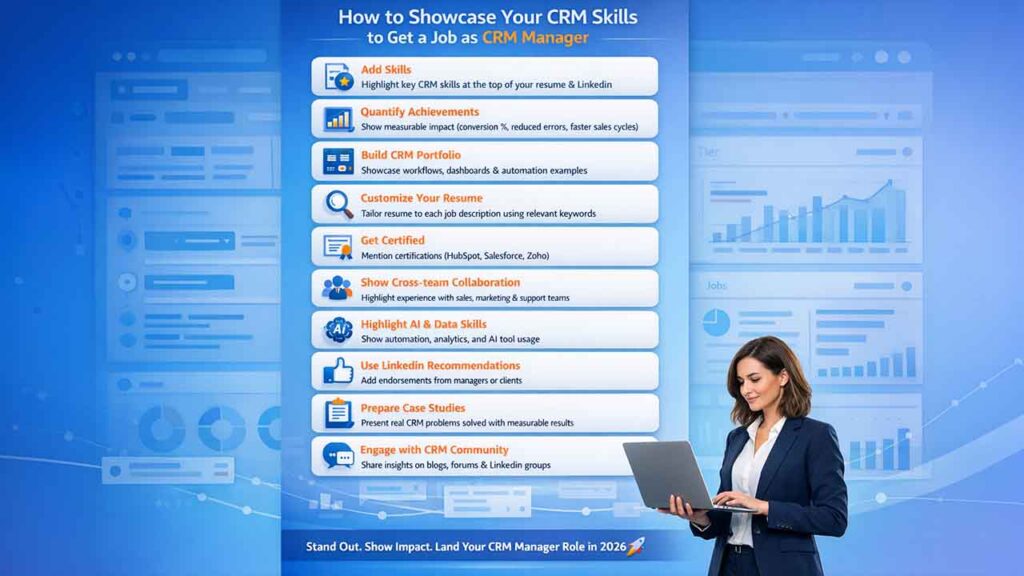
Getting a job as a CRM manager requires you to showcase your skills in a way that aligns with the role and shows impact. Recruiters look for impact, relevance, and clarity. They want to see how your experience and knowledge connect to their objectives. They will also look at your portfolio and how you have utilized your skills to enhance workflows. Here is how you can effectively present yourself and make yourself more hirable:
- Include a skills section in your LinkedIn profile and resume: Recruiters spend a maximum of 17-46 seconds reviewing a CV. So, you need to use this time to create maximum impact. Create a skills section, preferably at the top, and mention key skills that you possess.
- Quantify your achievements: Use metrics and indicators to showcase your work impact. For instance, you can mention how you have enhanced lead conversion rate by a particular percentage, minimize data errors by a particular number, or reduce sales cycles by a set timeframe.
- Develop a CRM portfolio: Show how CRM workflows work in the real-world. You can also show automation sequences or dashboards that you have designed. Include after-and-before comparisons to highlight different trackable improvements you have delivered.
- Personalize Your Resume to Every Job Description: Read the job postings carefully and mirror the language that you have used. Highlight the platforms, CRM tools, and strategies that the employers particularly mention in relation to applicant tracking platforms.
- Get Certified in Popular CRM platforms: Get certifications from platforms such as HubSpot, Salesforce, or Zoho to validate your technical “know-how” with these tools. Having such certifications indicates to recruiters that your knowledge is platform-specific and current.
- Highlight Experience in Cross-functional Collaboration: Showcase your capability to work alongside marketing, sales, and customer service teams. Employers prioritize CRM managers who align different departments around a centralized CRM strategy.
- Showcase Your Data Analytics and AI Knowledge: Mention specific automation workflows, AI tools, or data analysis techniques that you have applied. Considering the evolving demand for AI fluency, this can greatly differentiate you from other candidates.
- Use LinkedIn Suggestions: Get endorsements from managers, colleagues, or clients who can endorse you on LinkedIn. It is a valuable signal that establishes trust among recruiters about your credibility.
- Create a Data-based Case Study for Interviews: Explain to the interviewers about a particular CRM challenge that you have solved and the trackable results that you have achieved. This showcases strategic thinking and real-world ability to solve challenges.
- Interact with the Online CRM Community: Contribute to LinkedIn groups, CRM-related forums, or industry blogs to ensure your credibility. Sharing thought leadership and insights can position you as a passionate and knowledgeable professional in the field.
Conclusion
CRM proficiency is extremely important to create a successful career as a CRM manager. From mastering the quality of data and CRM configuration to ensuring AI fluency and communication proficiency, every skill is important to ensure desired business outcomes. Companies actively look for professionals who can convert strategy into action and lead teams with total confidence. By honing these competencies consistently and demonstrating them effectively to recruiters, you can position yourself as a valuable candidate ready to take ownership of a CRM environment.
%201.png)

%201.png)

%201.png)