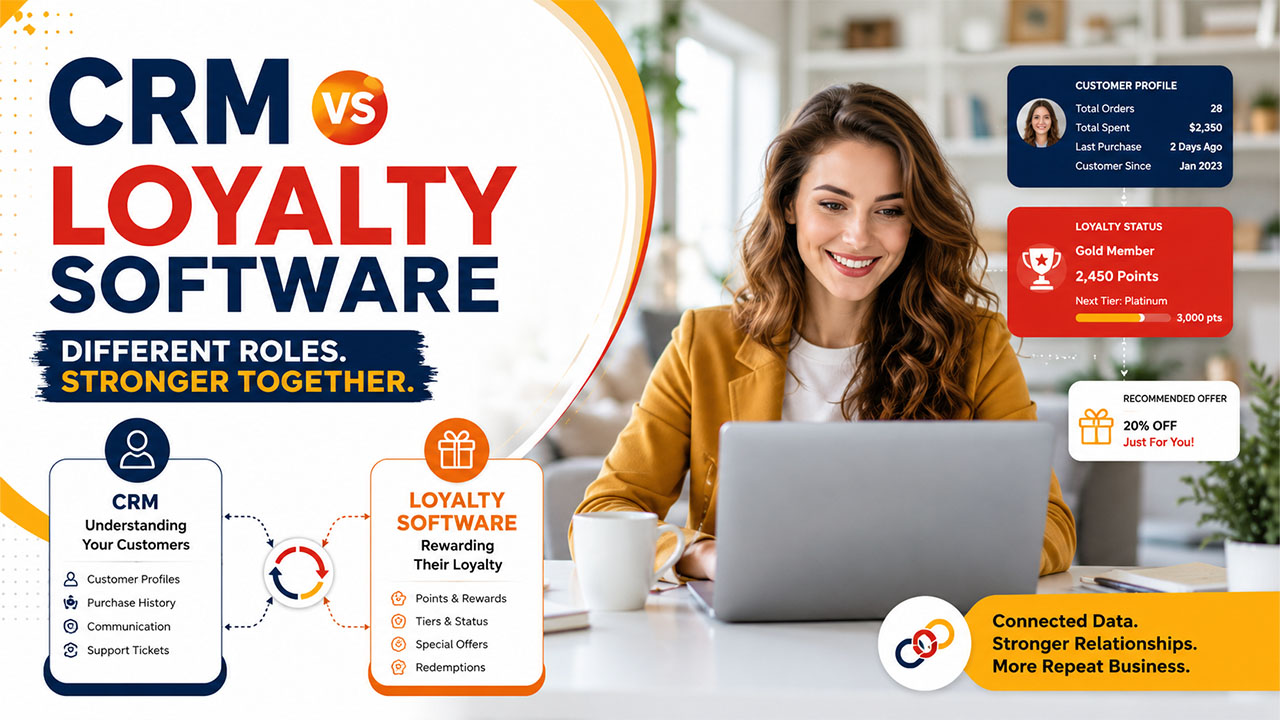

The number of businesses using CRM for their loyalty programs are quite surprising. This makes an intuitive sense, as the CRM already holds every customer, every order, every support ticket, and others. This makes it sure why businesses rely on the platform. The main problem is that the CRM and customer loyalty software are desigend to solve two major issues, and solving them as substitutes form the other is how companies end up with a reward program, which is slow, brittle, and quetly losing money.
This is not just an argument that if the business has selected the wrong CRM or not. The argument that loyalty is a separate job, and the two systems to do their best work side by side. The article is what each platform is actually designed to do, where the teams get the boundary wrong, and how to connect them seamlessly, along with your rewards mechanics that reinforce each other platforms.
The one-line difference
A CRM is a system of record. It exists to store and organize what you know about a customer and to move relationships through a pipeline — leads, deals, renewals, service history.
Customer loyalty software is a system of behavior. It exists to change what customers do next — earn points, climb tiers, unlock rewards, come back sooner and spend more when they do.
One remembers. The other motivates. You can see immediately why forcing a "remembering" tool to also run real-time reward mechanics tends to end badly.
What a CRM is built to do
A modern CRM is genuinely excellent at a specific set of things:
- A single customer record — contact details, company, communication history, preferences.
- Pipeline and deal management — where each account sits in a sales or renewal cycle.
- Service and support history — tickets, conversations, resolutions.
- Marketing automation — segmented emails, sequences, and campaign tracking.
- Reporting on relationships — lifetime value, deal velocity, churn signals.
The CRM platform is not designed for thee transactional machinery of rewards programs, but a point ledger that has to stay accurate to the cent across millions of earn-and-burn events, redemption rules firing in real time at checkouts, tier thresholds that can recalculate the moment, and program logic which are designed to act identically on the website, application, and in-store. Those are not reporting problems. They are engine problems.
What customer loyalty software is built to do

Dedicated loyalty software is a rules-and-rewards engine. Its core responsibilities look nothing like a CRM's:
- A points and rewards ledger with transactional integrity — every point earned, spent, expired, or refunded is tracked reliably.
- Earning and redemption rules — spend-based points, bonus events, birthday rewards, referral bonuses, campaign multipliers.
- Tiers and status — thresholds, benefits, upgrades and downgrades, all recalculated automatically.
- Member experience — account balances, reward catalogs, redemption flows that work across channels in real time.
- Program flexibility — the ability to change the rules of the program without re-platforming every time marketing has a new idea.
This is the category that platforms like Open Loyalty sit in: an API-first engine that runs the points, tiers, coupons, and rewards logic, and then feeds the results back into the rest of your stack. The key word is engine. It is doing the computation and enforcement that a CRM was never meant to do.
Where teams get the boundary wrong
The most common mistake is trying to bolt a loyalty program onto a CRM using custom fields and workflows. It looks cheap and fast on day one. It breaks in predictable ways:
- No real-time redemption. Custom-field workarounds can't reliably apply a reward at the exact moment of checkout across channels.
- A fragile points ledger. CRMs aren't built for high-volume, cent-accurate transactional accounting. Balances drift, and reconciling them becomes a monthly fire drill.
- Rigid rules. Every new campaign mechanic turns into a developer ticket, so the program stops evolving.
- Scale pain. What works for 5,000 members buckles at 500,000.
The reverse mistake is just as costly: buying loyalty software and treating it as a standalone island, disconnected from the customer record. Now you have rewards data that never informs your segmentation, your service team, or your marketing — a program that motivates behavior nobody in the rest of the business can see.
Side by side
| Your CRM | Customer loyalty software | |
| Primary job | Store and organize customer relationships | Change customer behavior with rewards |
| Core object | The contact / account record | The points-and-rewards ledger |
| Excels at | Pipeline, service history, marketing automation, reporting | Earning rules, tiers, redemptions, real-time rewards |
| Struggles with | Real-time points, redemption, program logic at scale | Being the single source of truth for the whole relationship |
| Answers the question | "Who is this customer and what's our history?" | "What will make this customer come back and spend more?" |
Why you actually need both
Read the table again and the relationship becomes obvious: these tools are complements, not competitors.
The CRM is the context. It knows who the customer is, what they've bought, what they've complained about, and how valuable they are. The loyalty engine is the mechanism. It turns that context into action — the right reward, the right tier, the right nudge at the right moment.
They get more powerful when they share data in both directions:
- Loyalty enriches the CRM. Points balances, tier status, redemption history, and reward engagement flow into the customer record, so your sales and service teams see the full picture and your segments get sharper.
- The CRM sharpens loyalty. Purchase history, lifecycle stage, and segments from the CRM feed the loyalty engine, so campaigns and rewards are targeted instead of one-size-fits-all.
A high-value customer flagged in the CRM can be routed into a premium tier automatically. A member about to hit a redemption threshold can trigger a service touch. That two-way loop is where retention actually improves. Businesses that combine CRM with dedicated Customer Loyalty Software also strengthen their overall Customer Retention Strategies, ensuring more personalized experiences and higher repeat purchases—and it only exists when each system does the job it's built for.
How to connect them
The connective tissue is integration, not migration. You are not moving loyalty into the CRM or the CRM into loyalty; you are wiring them together so the customer view stays whole.
In practice that means using the loyalty platform's API and webhooks to sync events both ways: an order or a tier change on one side updates the record on the other. Modern, API-first loyalty tools are designed for exactly this — they expect to live inside a stack alongside a CRM, an e-commerce platform, a POS, and a marketing tool, rather than trying to replace any of them. Keep one principle in mind: preserve a single, trustworthy customer view, and let each system be the source of truth for the data it owns — the CRM for the relationship, the loyalty engine for the rewards ledger.
How to tell your CRM isn't enough on its own
A quick gut check. If several of these are true, you've outgrown the DIY-loyalty-in-your-CRM approach:
- You're reconciling points balances by hand, or you don't fully trust them.
- Redemptions can't happen in real time at checkout across every channel.
- Every new promotion mechanic requires a developer.
- Your program is capped at simple "spend X, get Y" because anything richer is too hard to build.
- Rewards data lives in a silo and never improves your marketing or service.
None of those are signs of a bad CRM. They're signs that loyalty has become a real system in its own right — and real systems deserve real tools.
The bottom line
Your CRM and your loyalty program are answering two different questions. The CRM asks who is this customer and what is our history together? Customer Loyalty Software asks what will make them come back and spend more? Try to answer the second question with a tool built for the first and you'll get a program that's slow to change and expensive to trust.
Run them together, wired through an API so data flows both ways, and each makes the other better: the CRM gives loyalty its context, and loyalty gives the CRM a reason for customers to keep showing up. That's not redundancy. That's the whole point.
%201.png)

%201.png)

%201.png)