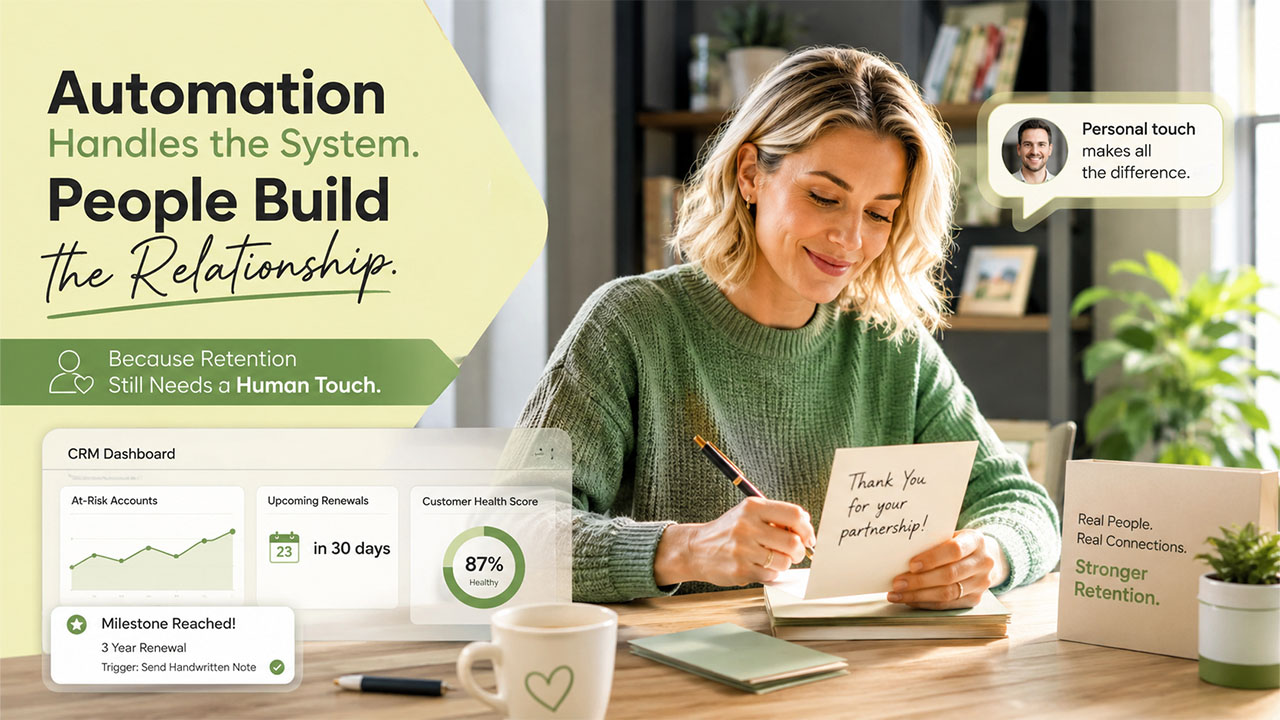

Modern CRM software can do a lot without anyone touching a keyboard after the initial setup. It scores leads, times follow-up emails to the moment a prospect is most likely to open them, flags accounts at risk of churning, and reminds a sales rep to check in before a renewal date sneaks up on them. For a sales or customer success team, this has changed what a normal week looks like. Fewer manual tasks, more time spent on the conversations that actually need a person.
But customer retention isn't only a data problem, and the parts of it that aren't have stayed stubbornly resistant to automation, no matter how good the underlying software gets.
What CRM automation is genuinely good at
It's worth being clear about where automation earns its keep, because the case for keeping a human element isn't an argument against the technology itself.
CRM systems are excellent at consistency. A follow-up email goes out at the right time, every time, regardless of how busy a rep's week has been. They're excellent at pattern recognition too: flagging a customer whose usage has dropped, or a lead who's gone quiet after showing early interest, patterns a person managing two hundred accounts would likely miss on their own. And they're excellent at removing the manual grunt work of logging calls, updating fields, and building reports that used to eat up hours of a sales rep's week.
None of this is in question. The question is what happens after the system correctly identifies that a customer needs attention. That's where the human hand still matters. For many businesses, automation creates a stronger foundation for Customer Retention Strategies by keeping every customer interaction timely and consistent.
Where automation runs into its limits

A CRM can tell a team that a high-value customer's contract is up for renewal in thirty days. It can even draft an email and schedule it to send. What it can't do is judge, the way a person who's spoken to that customer several times can, whether this particular account needs a phone call, a discount offer, an apology for a service issue three months ago, or simply a thank-you.
A few areas keep showing up as genuinely hard to automate well:
- Reading tone and context: A customer who's been quiet because they're satisfied and a customer who's been quiet because they're frustrated look identical in most CRM dashboards. Both show reduced engagement. Only a person who reads the account history, or picks up the phone, can tell the difference.
- Recovering from a mistake: An automated system can send an apology email after a service failure, and it will read exactly like every other automated apology email that customer has received from other companies. Actually repairing trust after something goes wrong tends to require a specific, unscripted acknowledgment of what happened, something a template can't quite manage.
- Marking a genuine milestone: A customer's one-year anniversary, a major expansion of their account, a referral they sent your way, these moments call for something that doesn't feel manufactured. An automated "congratulations on one year with us!" email lands with about the same weight as a birthday text from an insurance company.
What companies are doing to fill that gap

The response from a growing number of sales and customer success teams hasn't been to abandon automation. It's been to get more deliberate about which moments in the customer journey get a scripted, automated touch, and which ones get a genuinely personal one, even if that personal touch is still triggered by CRM data.
A renewal reminder can stay automated. A thank-you after a customer renews for the third year running is increasingly something teams handle differently, often with a physical, handwritten note rather than another email. The logic is simple: an inbox is full of automated messages competing for two seconds of attention. A card that arrives in the mail, written by hand, mentioning the customer by name, doesn't compete with anything. It just gets noticed.
Some teams handle this themselves for a handful of top accounts. Others, managing retention across hundreds or thousands of customers, use a handwritten notes service that can trigger automatically from CRM data, so a note goes out after a renewal, a milestone, or a recovery moment without someone on the team having to remember to sit down and write it. The trigger is automated. The result, from the customer's side, doesn't feel automated at all.
Deciding where the line goes
Not every account or every moment needs this kind of attention, and treating every touchpoint as an opportunity for a personal gesture tends to dilute the effect rather than strengthen it. Teams getting the most value from this approach tend to be selective about it, reserving a personal, physical touch for moments that actually carry weight: a first renewal, a significant expansion, a recovery after a service issue, or an anniversary that matters to the relationship. Using CRM insights to personalize these moments helps businesses strengthen customer retention without losing the authenticity that customers value.
That selectivity is itself informed by the same CRM data driving the rest of the retention strategy. Knowing which customer, at which moment, is worth a handwritten note instead of another automated email is a judgment call that data can inform but not fully make on its own.
The shape of retention going forward
None of this points toward less automation in customer retention. If anything, automation is likely to keep taking over more of the routine work, freeing up the moments where a human decision actually changes the outcome. What's becoming clearer is that retention was never purely a data problem to begin with. It's a relationship, and relationships have always run on a mix of consistency and genuine attention. CRM automation has gotten remarkably good at the first half. The second half still needs a person, or at least a very deliberate decision about when a personal touch belongs in the process.
Conclusion
There is no doubt that CRM automation has changed the way businesses track customer activity, manage follow-ups, and identify accounts that need immediate attention. However, automation alone is not enough to build strongest relationships. Moments that involve trust, appreciation, or recovery still benefit from genuine human interaction. The most effective customer retention strategies combine the efficiency of automation with thoughtful personal engagement, ensuring technology handles routine tasks while people focus on the conversations and gestures that leave a lasting impression.
%201.png)

%201.png)

%201.png)