
If your business runs on a CRM, you're sitting on a goldmine of customer data - names, emails, phone numbers, purchase histories, support tickets, behavioral signals. That's exactly the kind of data that privacy regulations like GDPR, CCPA, and a growing list of state-level laws were designed to protect.
The problem isn't awareness. Most teams know they need to handle customer data responsibly. The problem is execution: managing consent across touchpoints, fulfilling data subject requests without manual chaos, keeping your data map accurate as your stack evolves, and proving compliance when a regulator comes knocking.
That's where data privacy tools come in. The right platform doesn't just check a compliance box - it integrates into your existing CRM workflow and makes privacy operations something your team can actually manage at scale.
This guide breaks down the best data privacy tools in 2026, evaluated specifically through the lens of businesses that collect, store, and act on customer data every day.
What Are Data Privacy Tools?
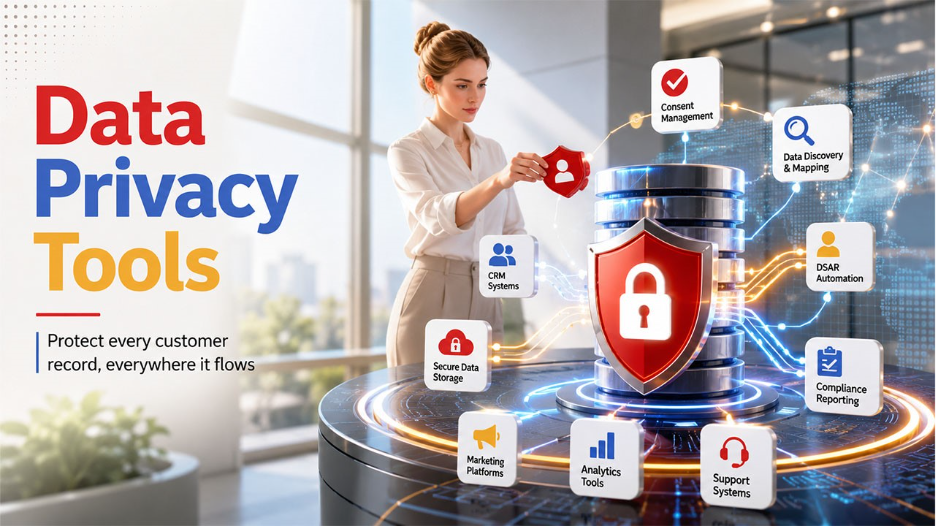
Data privacy tools are software platforms that help businesses collect, manage, and protect personal data in compliance with privacy regulations. They typically cover one or more of these core functions:
- Consent management - collecting and enforcing user consent across websites, apps, and marketing channels
- Data subject access requests (DSARs) - automating how you respond when a customer asks to see, export, or delete their data
- Data discovery and mapping - finding where personal data lives across your systems, including CRMs, data warehouses, and third-party tools
- Privacy impact assessments - evaluating how new projects, vendors, or features affect data privacy risk
- Compliance reporting - generating audit-ready evidence that your business meets regulatory requirements
For CRM-driven businesses, the most critical capability is how well these tools connect to your customer data infrastructure. A privacy tool that can't see inside your CRM, marketing automation, or analytics stack is only solving half the problem. Businesses storing customer data in CRMs also need to understand the broader data security and privacy risks that come with connected systems.
The 10 Best Data Privacy Tools for Customer Data Protection
1. Ketch
Best for: CRM-driven businesses that need consent enforced everywhere customer data flows
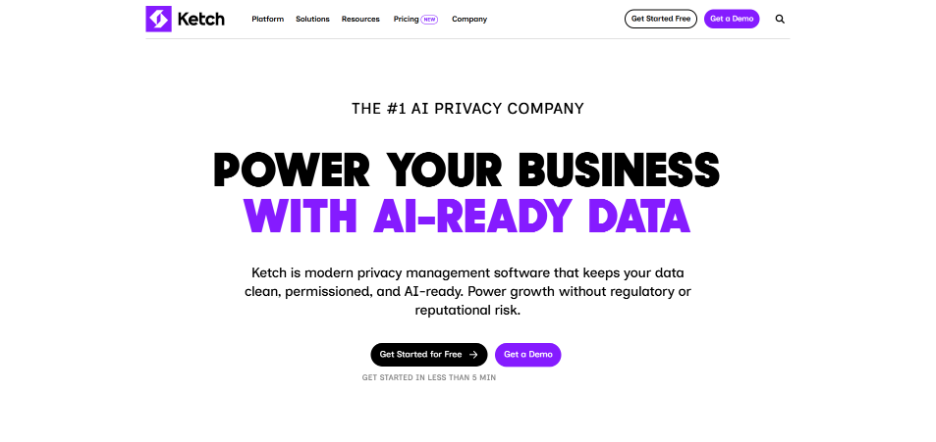
Ketch was built by founders from the ad tech world, and it shows. The platform treats privacy as a data operations problem rather than a legal checkbox - which makes it the most natural fit for businesses whose customer data is their core asset.
Its standout capability is identity-based consent enforcement. Most privacy tools track consent at the browser or cookie level. Ketch ties consent to individual customer identities, which means when someone opts out via your website, that decision follows them across your CRM, email platform, ad accounts, data warehouse, and every other system in your stack. Automatically.
For CRM teams, this solves the most common compliance gap: consent fragmentation. A customer says "delete my data" on your website, but their records still sit in your CRM, your support desk, and three marketing tools. Ketch's orchestration layer catches all of it. With hundreds of pre-built integrations (including Salesforce, HubSpot, Google Analytics, AWS, and Snowflake) and no-code setup for most workflows, it's also one of the faster platforms to deploy.
Where it falls short: Ketch is newer than legacy players like OneTrust and TrustArc, which means fewer enterprise case studies and less brand recognition in heavily regulated procurement processes where "nobody gets fired for buying OneTrust" still holds weight.
Pricing: Free plan available (up to 5,000 monthly users). Starter plan at $150/month (up to 30,000 users), Plus at $333/month (up to 100,000 users). Enterprise orchestration plans are custom-quoted.
2. OneTrust
Best for: Large enterprises that need a comprehensive privacy, risk, and compliance platform
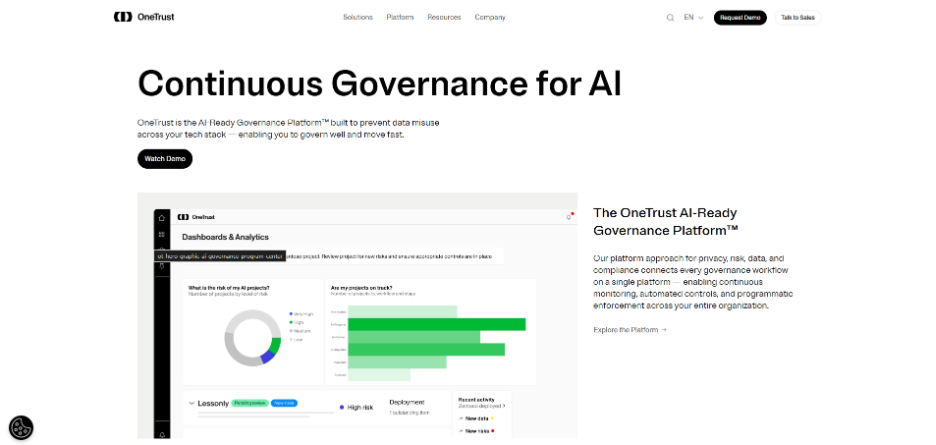
OneTrust is the most widely adopted enterprise privacy platform on the market. It covers consent management, DSAR automation, data mapping, vendor risk assessments, cookie compliance, and privacy impact assessments - essentially the full spectrum of privacy operations.
For CRM teams, OneTrust's strength is its breadth of integrations. It connects to Salesforce, HubSpot, Microsoft Dynamics, and most major marketing and analytics platforms, allowing you to enforce consent decisions and fulfill data requests across your entire customer data stack.
Where it falls short: OneTrust's minimum contract starts at $10,000/year, and most implementations take months with professional services support. The interface has a learning curve, and smaller teams often find the platform heavier than what they actually need. If your privacy needs are primarily consent and DSAR management, you're paying for a lot of unused capability.
Pricing: Custom quotes only. Minimum $10,000/year as of Q2 2026. Mid-market companies typically pay $40,000 - $120,000/year; enterprise contracts can exceed $500,000/year depending on modules and jurisdictions. Implementation fees can add $10,000–$50,000 to first-year costs.
3. BigID
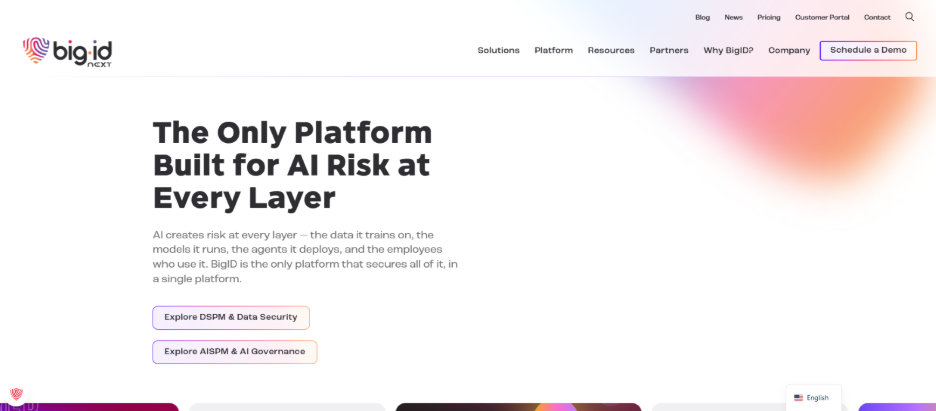
Best for: Organizations that need deep data discovery and AI-powered classification across complex environments
BigID approaches privacy from the data layer up. Instead of starting with consent banners and working backward, it scans your entire infrastructure - CRMs, data warehouses, cloud storage, SaaS tools - to find, classify, and map personal data automatically using machine learning.
This makes BigID particularly valuable for businesses that have customer data spread across multiple systems and need to understand exactly where it lives before they can protect it. If your CRM feeds data into a warehouse that feeds a marketing automation platform that feeds an analytics tool, BigID can trace that lineage.
Where it falls short: BigID is built for data teams and privacy engineers, not marketing or sales ops. The setup requires technical resources, and the platform assumes a level of data infrastructure maturity that smaller businesses may not have.
Pricing: Custom quotes only. Typically six figures annually for enterprise deployments.
4. TrustArc
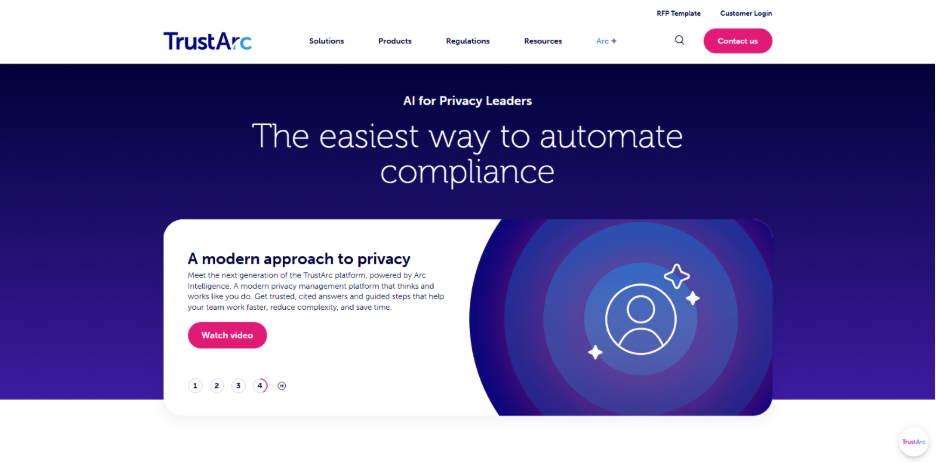
Best for: Enterprises that want the depth of OneTrust with better usability and hands-on support
TrustArc has been in the privacy space for 29 years - founded in 1997 as TRUSTe, it's one of the original players in online privacy. The company was acquired by Main Capital Partners in October 2025 and continues to operate independently. It combines privacy management software with Nymity Research (regulatory intelligence), certifications, and managed services. The result is a platform that doesn't just give you tools but also tells you what to do with them.
The platform covers consent, assessments, data inventory, vendor risk, and reporting. For CRM teams, TrustArc offers integrations with major platforms and a workflow engine that can automate privacy tasks triggered by CRM events - like a new lead form submission or a customer requesting account deletion.
Where it falls short: TrustArc's pricing is enterprise-oriented, and the managed services model means you're paying for expertise baked into the platform whether you need it or not. Teams that just want lightweight consent management will find it over-engineered.
Pricing: Custom quotes only. Generally comparable to OneTrust at the enterprise tier.
5. DataGrail
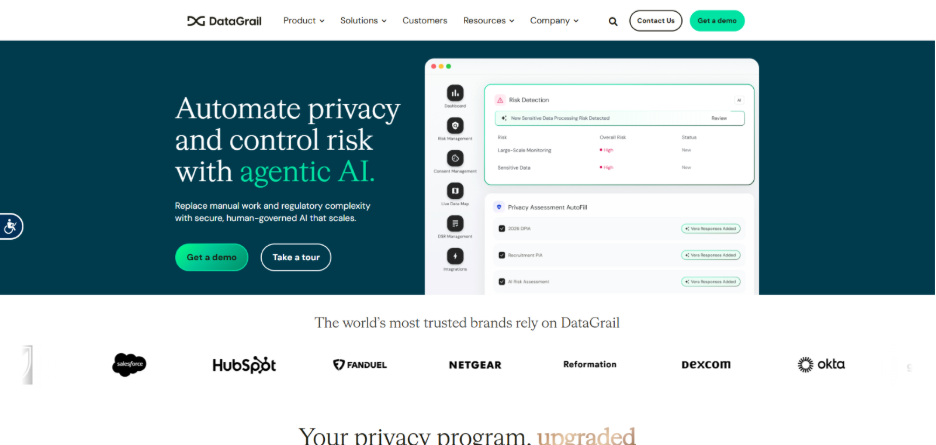
Best for: SaaS-heavy businesses that need automated DSAR fulfillment across many integrations
DataGrail focuses on the operational side of privacy - specifically, making data subject requests fast and reliable. Its integration network spans hundreds of SaaS tools, which means when a customer submits a deletion or access request, DataGrail can automatically locate their data across your CRM, support desk, payment processor, email platform, and analytics stack, then execute the request.
For teams that get a high volume of DSARs (common in B2C businesses or companies with EU customers), DataGrail removes what would otherwise be a painful manual process.
Where it falls short: DataGrail is operations-focused, not a full privacy program platform. If you need privacy impact assessments, vendor risk management, or deep data discovery, you'll need to pair it with something else.
Pricing: Custom quotes. Mid-market pricing, generally more accessible than OneTrust or BigID.
6. Transcend
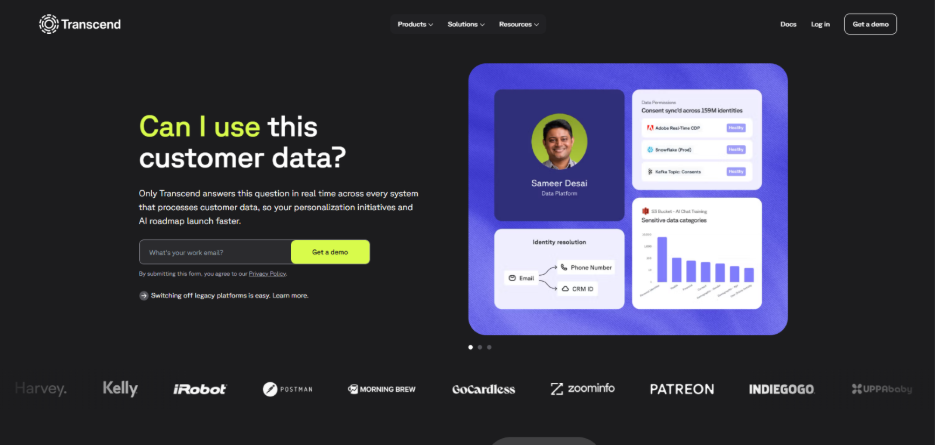
Best for: Engineering-led teams that want developer-friendly privacy infrastructure
Transcend takes a code-first approach to privacy. It offers consent management, data mapping, DSAR automation, and a privacy-as-code framework that lets engineering teams define privacy rules in configuration files rather than clicking through admin UIs.
For CRM businesses with strong technical teams, Transcend is appealing because it integrates cleanly into CI/CD pipelines and treats privacy configuration as part of the codebase — versioned, testable, and deployable alongside your product.
Where it falls short: The developer-first approach is a double-edged sword. Non-technical privacy or compliance teams may struggle to use Transcend without engineering support. It's not the right fit if your privacy program is run by legal or marketing.
Pricing: Custom quotes. Positioned at the mid-market to enterprise level.
7. Osano
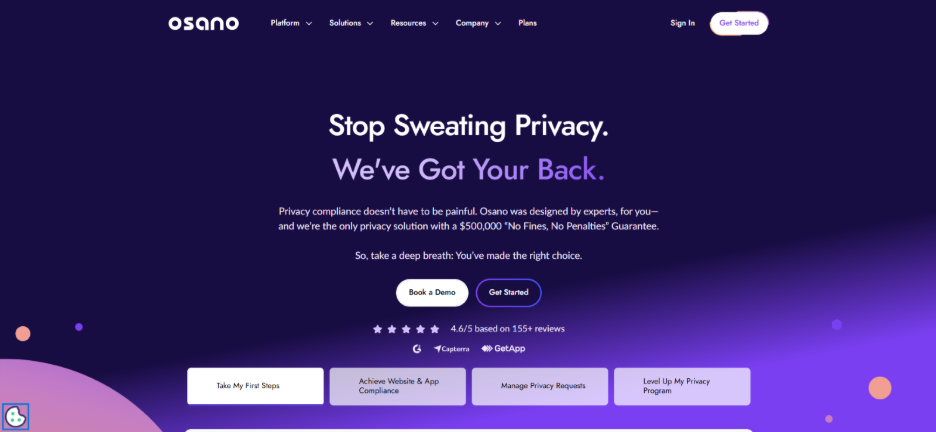
Best for: Small to mid-market businesses that need straightforward consent and compliance management
Osano strips away the complexity that makes enterprise platforms intimidating. It offers consent management, vendor risk monitoring, DSAR handling, and a regulatory tracker — all wrapped in an interface that a non-technical compliance or marketing team can actually use on day one.
For CRM teams at growing businesses, Osano's vendor monitoring is particularly useful. It continuously scores the privacy practices of the third-party tools in your stack (including your CRM, email provider, and analytics platform), so you can catch risk before it becomes a problem.
Where it falls short: Osano intentionally trades depth for simplicity. If you need advanced data discovery, AI classification, or complex workflow automation, you'll outgrow it.
Pricing: Free tier available for basic consent. Paid plans start at $199/month (billed annually) for up to 1 million monthly visitors on a single domain.
8. Usercentrics
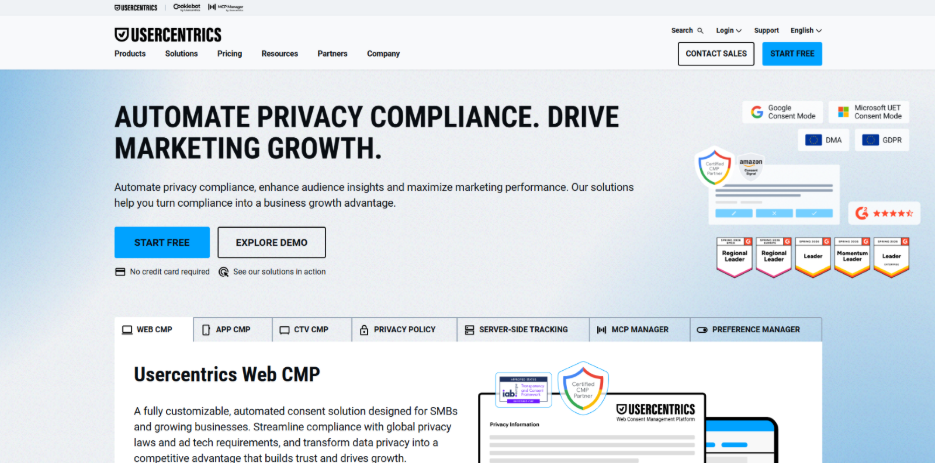
Best for: European businesses that need high consent rates without sacrificing GDPR compliance
Usercentrics is a consent management platform with a specific focus on optimizing consent rates - the percentage of users who actually click "accept" on your consent banner. This matters more than most businesses realize: a poorly designed banner can tank your marketing data quality by driving opt-out rates above 50%.
For CRM teams that depend on marketing attribution, Usercentrics helps you maintain data flow into your CRM while staying compliant. It supports Google Consent Mode v2, which lets you continue collecting modeled conversion data even when users opt out of cookies.
Where it falls short: Usercentrics is a CMP, not a full privacy platform. It won't handle DSARs, data mapping, or privacy assessments. You'll need to pair it with a broader tool if your compliance needs go beyond consent.
Pricing: Free plan available. Paid plans start at €7/month and scale up to €56/month based on session volume, with enterprise plans custom-quoted for high-traffic deployments.
How to Choose the Right Data Privacy Tool for Your CRM Stack
Not every business needs a full privacy orchestration platform. The right choice depends on three factors:
Your regulatory exposure. If you operate exclusively in one U.S. state with no EU customers, your requirements are different from a global SaaS business subject to GDPR, CCPA, LGPD, and a dozen state-level laws. More jurisdictions mean more complexity, which favors platforms like Ketch, OneTrust, or TrustArc that track regulatory changes automatically.
Your data complexity. If customer data lives primarily in one CRM with a few marketing tools connected, a lighter solution like Osano may be all you need. If data flows across a CRM, data warehouse, multiple ad platforms, a customer data platform, and custom applications, you need discovery and mapping capabilities from BigID or the orchestration layer of Ketch.
Your team's technical capacity. Developer-friendly tools like Transcend are powerful but require engineering involvement. If your privacy program is run by legal, compliance, or marketing, choose a platform with strong no-code workflows - Ketch, Osano, Usercentrics, or the managed services approach of TrustArc.
Why CRM Businesses Need Data Privacy Tools Now
The landscape has shifted fast. In the U.S. alone, over a dozen states now have active privacy laws beyond California's CCPA/CPRA. The EU continues to enforce GDPR with increasing fines. And the proliferation of AI in CRM and marketing tools creates new compliance questions around automated decision-making and profiling.
For businesses that rely on customer relationships — which is exactly what CRM is built for — privacy isn't a side concern. It's table stakes. Customers increasingly expect transparency about how their data is used, and they will leave if they feel that trust is broken.
The tools in this guide won't just keep you compliant. They'll help you build the kind of data practices that make customers willing to share their information in the first place. And in a world where first-party data is becoming the most valuable marketing asset, that trust is worth more than any ad campaign.
%201.png)

%201.png)

%201.png)