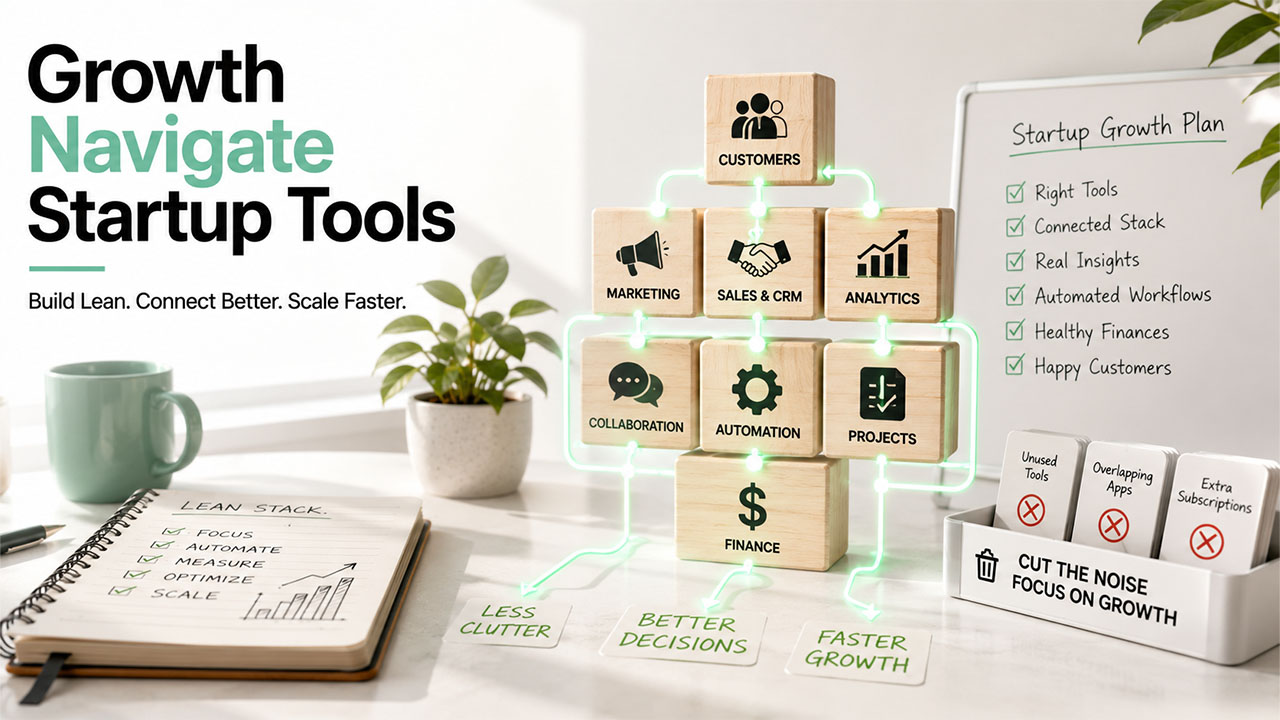

Growth navigation startup tools are the software solutions that early-stage businesses use to accelerate growth, work intelligently, and make decisions based on actual information instead of guesswork. They encompass all the core jobs that young businesses require: acquisition of customers, sales and CRM, project management, team collaboration, automation, analytics, and accounting. The objective is not to accumulate applications. It is to assemble an affordable and connected stack that aligns with your stage and eliminates friction as you scale.
Instead of just giving you a list of generic tools, this guide will let you know what your startup currently needs. The goal must be to create a system, not get a pile of subscriptions.
What Are the Growth Navigate Startup Tools Really?
In simple terms, these are the digital platforms that operate the daily work of a startup. They replace manual tracking, spreadsheets, and scattered email threads with platforms that collect real-time data, display it on dashboards, and automate routine tasks. A startup company often comes up against issues that an established company does not. Budgets are much tighter. Teams are essentially small, and thus, a handful of people have to do the work of the whole department.
Having the right tech stack helps level the playing field, allowing a five-person team to work with the speed and visibility of a larger company. This is one of the key reasons why Software Development for Startups focuses on scalable, cloud-based tools that support rapid growth without adding unnecessary complexity. The shift is already visible across industries. As of 2026, cloud-native platforms and cloud-based solutions account for more than 95% of all new software developments and digital workloads. This trend shows that founders are increasingly moving away from manual tracking and spreadsheets in favour of modern, scalable development practices.
Consider your tool stack as the operational pillar of your business. When such tools are simple and connected, it provides support to collaboration, automation, analytics, and customer acquisition all at once. When it is disconnected and bloated, it can not only slow you down but can also burn your cash.
Why Are the Right Tools So Important?
Tools are no longer about IT decisions. They are a main part of your business strategy, since most startups break on execution, not planning. A well-curated tool stack solves three key issues simultaneously:
- It accelerates the acquisition of customers. You can observe which marketing channels bring the right leads and focus hard on what works.
- You can minimize internal delays, automated reports, and tracking tasks to make sure everyone remains aligned without countless meetings.
- Furthermore, it replaces guesswork with evidence. Thus, decisions depend on numbers instead of hunches.
The payoff is genuine. A few startup platforms enable companies to reach the profitability stage sooner and get customers at a lower cost than generic software. Figures can vary, but the pattern is clear. Companies that have access to clear data and work on it tend to move at a quicker pace with less wastage.
The Core Categories That Each Startup Stack Requires

Before choosing particular products, comprehend the jobs that they do. A comprehensive stack encompasses six categories:
- Customer Relationship Management (CRM) ensures that every lead, deal, and customer interaction is in a centralized place, so the marketing and sales teams remain aligned.
- Team Collaboration and Project Management coordinate who is doing what and ensure that communication runs smoothly despite cluttered inboxes.
- Product Intelligence and Analytics showcase how users behave, converting raw activity into actionable insights.
Marketing automation operates emails, campaigns, and follow-ups without any manual effort. Workflow automation tethers your other tools so that the data easily moves between them. And, accounting and finance keep track of cash flow, runway, and burn rate, which is the core discipline that keeps a startup alive.
The Best Growth Startup Tools Categorized by Job
Here are widely used and proven platforms for every job. Align your job to your requirements first, then choose the tool:
- For Sales and CRM: AI-powered tools like OutRightCRM can make sure that marketing and sales remain on the same page with omni-channel communication, cloud-based scalability, AI-powered automation, and full customization.
- For Team Communication: Slack makes sure that interaction remains organized in channels and out of email, and it tethers to almost all aspects of your stack.
- For Project Management: Notion operates as an all-in-one workspace that combines wikis, notes, databases, and project boards, with an in-built AI assistant. ClickUp and Asana are top alternatives for project and task tracking, and Airtable is a top choice when you have a database that works like a spreadsheet.
- For Visual Planning: Miro provides a team with an infinite digital whiteboard for mind maps, brainstorming, wireframes, and sprint planning in real-time.
- For Analytics: Google Analytics (GA4) is the standard for comprehending user behavior and website, while Amplitude goes beyond and helps in retention and product analytics.
- For Automation: Zapier is the go-to platform for tethering apps and automating routine and manual tasks without creating code. For guest posting teams, tools like GuestPostCRM are also crucial for automating email filtration, negotiation, and invoice management.
- For Email Prospecting and Outreach: Finding vital customers is quite critical for survival. Numerous platforms are purpose-built for this. Such tools integrate discovery with outreach and verification capabilities:
| Platform | Starting Price | Free Option |
| Instantly | $47/month onwards | 14-day free trial |
| Snov.io | $39/month onwards | Yes |
| Apollo | $49/month onwards | Yes |
| Hunter | $43/month onwards | Yes |
Now, it is not necessary to use all of the tools. You should use the tool based on your team size, industry, market position, and priorities.
The Startup Metrics You Must Keep Track Of

Tools are only important if they keep track of numbers that maintain your position in the market. Whatever stack you create, ensure that it tracks such core numbers:
- CAC, short for Customer Acquisition Cost, is what you have to spend to win over a customer.
- LTV, which stands for Lifetime Value, is the worth of the customer over time. A profitable business always tries to keep LTV higher than CAC.
- Burn rate is how quickly you can spend cash every month.
- Runway is the number of months you can continue working before the cash burns out.
- MRR is the monthly recurring revenue, which tracks predictable income for subscription businesses.
If your tools cannot reveal such metrics weekly, you will never have a clear idea about where you stand. Clean metrics increase confidence among investors as well, since organized data indicates discipline.
How to Select Growth Navigate Startup Tools?
This is the aspect that most guides skip, and it is the one that saves you a lot of money. Include tools in the order that your business actually needs them-
- Idea and Pre-Product-Market-fit Stage: Stay streamlined. You mainly require a way to streamline thinking and talk to users to collect feedback. A standard setup (for planning and documents) and Slack (for interaction) is sufficient. Avoid the temptation to purchase heavy software before you see that people are interested in your product.
- Initial Traction Stage: Now that customers are coming. Incorporate a CRM such as OutRightCRM or Salesforce to manage leads or integrate GA4 to comprehend where they come from and what they do. This is where information begins shaping decisions.
- Growth and Scaling Stage: With repetitive opportunities for revenue growth, incorporate deeper product analytics and marketing automation to eliminate work. This is also where finance tools become vital to closely track runway and burn rate.
- The rule is quite straightforward: Before adding a tool, see whether it is solving real issues in your stack. It is not advisable to first add a tool and hope that they create value.
Mistakes That Drain Budget Quietly
Businesses often make the mistake of converting valuable tools into wasted money. It is important to avoid these mistakes at all costs to keep your stack lean and useful:
- The biggest mistake is automating too early before you discover a product that is fit for the market. In the early stages, you should be speaking to customers, not developing complex platforms.
- The second mistake is overloading your workflows with tools. You will end up subscribing to dozens of SaaS tools that no one utilizes.
- Another mistake is ignoring integrations. If the tools are not connected to one another, create double work and data silos.
- It would also be a mistake not to revisit your tech stack. Do not keep on paying for tools that serve no purpose to you.
A good benchmark is to keep the software expense in a sensible range, often between 10% and 20% of the operating budget for small teams.
How to Build a Startup Tool Stack Step by Step?

It has been observed that most founders reactively add tools. They face a problem, search for a tool, and add a subscription. They often do not realize when their stack outgrows their team. Deliberately building it instead just takes four steps:
- List Each Tool You Presently Pay for: Instead of assuming, pull the data from the credit card or bank statements. Keep note of the monthly expenses and who uses it currently.
- Flag Anything Overlapping or Unused: If no one has signed in this month, it must be cancelled. If two tools are doing the same job. It can be two CRMs or design apps. You can keep one and choose to drop the other.
- Notice How Effective Every Tool Links to the Rest of Your Stack: A tool with no Zapier integration or API often creates more manual work than it saves, irrespective of how effective its individual features are.
- Add No New Tool Until You Have Removed Old and Unused Tool: You can use this as a thumb rule to keep your tech from growing out of control. It forces each new subscription to justify itself against what you own already.
You can execute this audit each quarter. Growth navigate startup tools are the right option when the stack is reviewed as often as it scales, not just assembled one time and then forgotten.
Free vs Paid Growth Navigate Startup Tools
Choosing when to begin paying is as significant as deciding what to purchase. A straightforward framework becomes essential:
- Pre-revenue stage: Rely only on free tools. Slack, Notion, HubSpot’s free CRM, and Google Analytics are among the options. They cover communication, documentation, lead monitoring, and standard web data without touching your runway.
- Paying Customers, but Early: Choose to upgrade only those tools that affect your workflow. As you grow, a seat restriction, a contact cap, or a missing integration will bother you. So, upgrade only that. Choose not to upgrade preemptively “just in case.”
- Consistent Revenue and a Growing team: This is when premium plans for analytics, customer relationship management, and automation begin paying for themselves by helping you convert more customers and saving you time.
The general rule: It is not wrong to use free tools early on. However, going for a paid tool is not a bad option if a certain limit is slowing down the team and impacting your growth. The actual risk is not choosing a paid or free tool. It is actually paying for a tool that nobody utilizes. Reviewing active subscriptions and accurate login activity every quarter catches that waste before it accumulates.
Conclusion
Growth navigate startup tools are only useful when they match where your business stands actually — not where you hope to be in a year. A five-person team drowning in enterprise software wastes the same runway as a Series A company still juggling spreadsheets. The fix isn't more tools; it's the right ones, chosen in order and connected.
Start lean. Add a tool only when a real bottleneck demands it, not because a competitor is using it. Track CAC, LTV, burn rate, and runway from day one, since these numbers tell you faster than any dashboard whether your stack is actually working. Revisit what you're paying for every few months and cut anything that's stopped earning its place.
Build your stack around your stage, not your ambitions, and it will carry you further with far less waste.
FAQs About Growth Navigate Startup Tools
Q1. What are growth navigate startup tools?
A- They are software tools specially built for early-stage businesses to help them scale as well as grow, which encompasses project management, customer relationship management, marketing, analytics, automation, accounting, and workflow automation. The objective is a budget-friendly and connected stack that eliminates as the company scales.
Q2. Which tools must an early-stage startup start with?
A- Begin learning. Most of the early founders require a workspace such as Notion for Slack and planning for communication. Add a CRM like analytics and HubSpot, such as GA4, once actual customers begin arriving; then you can expand from there.
Q3. How many startup tools do I actually require?
A- You do not need a whole bunch of tools. The best stacks are often connected and simple, often just one platform per core job. If you add way too many overlapping tools early on, it can create confusion and cost without adding any value.
Q4. Can I start with free startup tools?
A- Yes. Most leading platforms include Notion, HubSpot, GA4, and Slack. It provides free tiers that are perfect for initial experimentation.
%201.png)

%201.png)

%201.png)