

Most marketing emails go unopened. Most sales calls go unanswered. Texts, on the other hand, get read, usually within minutes. That's why enterprise texting has become a standard line item for B2C companies in insurance, lending, education, retail, and home services.
There is only one catch, that is “enterprise texting solution” covers at least four different kinds of software, and for users, buying the wrong king can lead to an expensive mistake.
Here's the short answer, then the detail:
- Meera: best for AI-run two-way conversations that qualify leads and book calls
- TextUs: best for human 1:1 relationship texting at scale
- SimpleTexting: best for straightforward mass campaigns
- Textline: best for customer service and support teams
- Twilio: best for building custom messaging into your own systems
- Attentive: best for retail and ecommerce marketing
Comparing Enterprise Texting Solutions at a glance
| Platform | Best for | Who runs the conversation | CRM & stack fit | Pricing model |
| Meera | AI lead engagement & qualification | Conversational AI | Salesforce, HubSpot, Zoho, Five9 | Quote-based, managed onboarding |
| TextUs | High-touch 1:1 outreach | Your reps | Salesforce, ATS platforms | Per seat |
| SimpleTexting | SMS marketing campaigns | Campaign engine + shared inbox | Zapier + native connectors | Tiered, by volume |
| Textline | Support conversations | Support agents | Zendesk, Salesforce, help desks | Per seat |
| Twilio | Custom-built messaging | Whatever you build | Anything, via API | Usage-based |
| Attentive | Retail/ecom marketing | Campaign engine + AI personalization | Shopify, commerce stacks | Quote-based |
1. Meera: best for AI-powered lead conversations
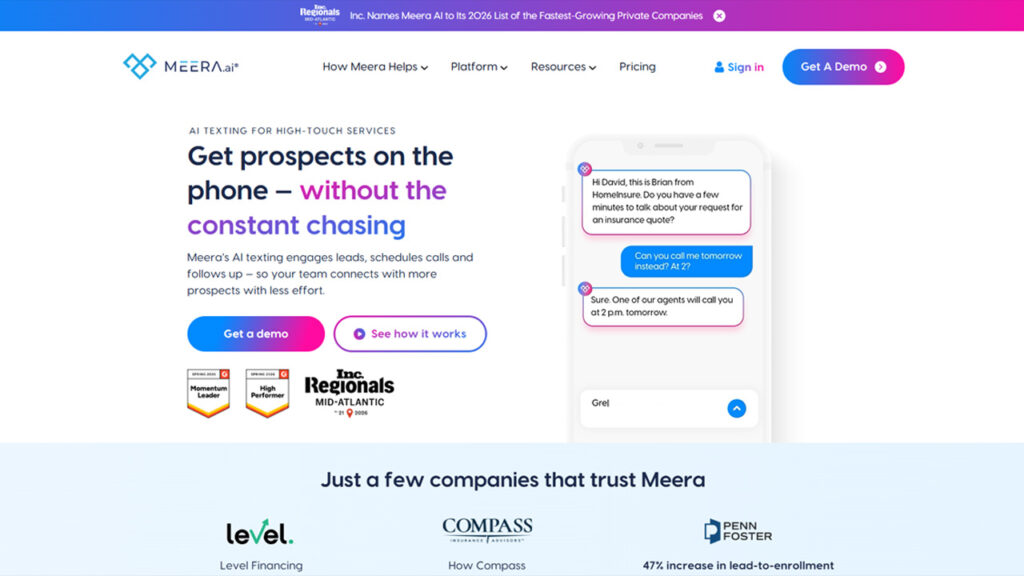
Meera occupies a category of its own on this list. Instead of giving your team a better way to send texts, its conversational AI holds the conversation itself. When a new lead comes in, Meera texts them within seconds, asks qualifying questions, answers theirs, and warm-transfers or books a call only when someone is actually ready to talk to a rep. The company reports response rates up to 9X higher than calls or email.
For a B2C team that is running on a CRM system, the integration story act as a differentiator. A native connector for Salesforce, HubSpot, and Zoho log every conversation and write qualification outcomes back to the record. A Five9 integration also handles the contact center side. Compliance is built in, with 10DLC registration, opt-out handling, and SOC 2 Type II certification.
Keep in mind: Meera is built for revenue conversations, not bulk promotions. If you only need to blast offers to a list, a campaign tool is cheaper. Pricing is quote-based with guided onboarding rather than self-serve.
2. TextUs: best for human 1:1 texting at scale
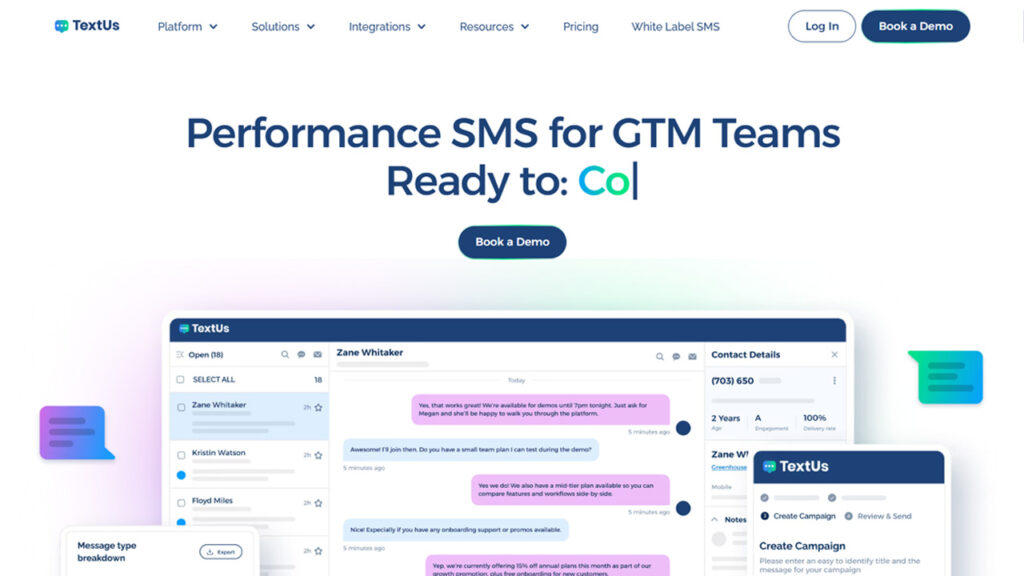
TextUs is designed for teams whose business runs on individual relationships: staffing and recruiting especially, plus healthcare and logistics. Reps text from real business lines, with shared visibility, templates, and campaign tools layered on top. Integrations with Salesforce and major applicant-tracking systems keep conversations attached to records.
Keep in mind: humans still drive every conversation, so results scale with headcount, not software.
3. SimpleTexting: best for uncomplicated mass campaigns
SimpleTexting offers a classic SMS marketing job, which includes list building with keywords, scheduled blasts, autoresponders, and two-way inbox replies. The platform performs all the following with a famously low learning curve. Native integrations and Zapier cover most stacks.
Keep in mind: its DNA is SMB-to-midmarket. Large B2C orgs may outgrow its admin controls, and replies land in a human-staffed inbox rather than being handled automatically.
4. Textline: best for customer service teams
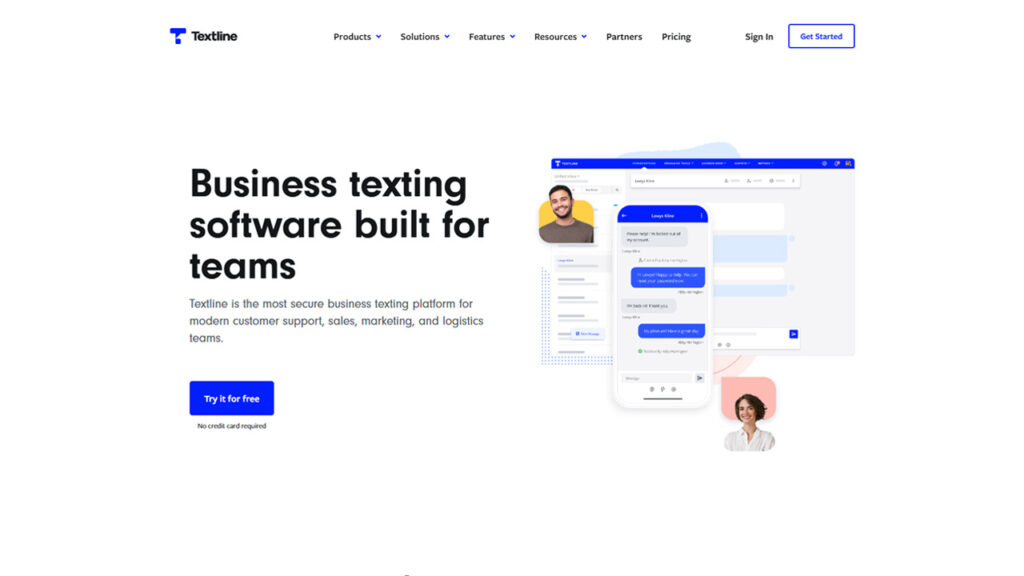
Textline is a platform that turns texting into a support channel, which is a shared team inbox with routing, internal notes, and SLAs, along with various security options, including HIPAA-eligible configuration, making it viable in regulated industries. The platform efficiently plugs into Zendesk, Salesforce, and other common help-desk stacks
Keep in mind: it's service software. If your goal is converting leads rather than resolving tickets, it's the wrong lane.
5. Twilio: best for building your own
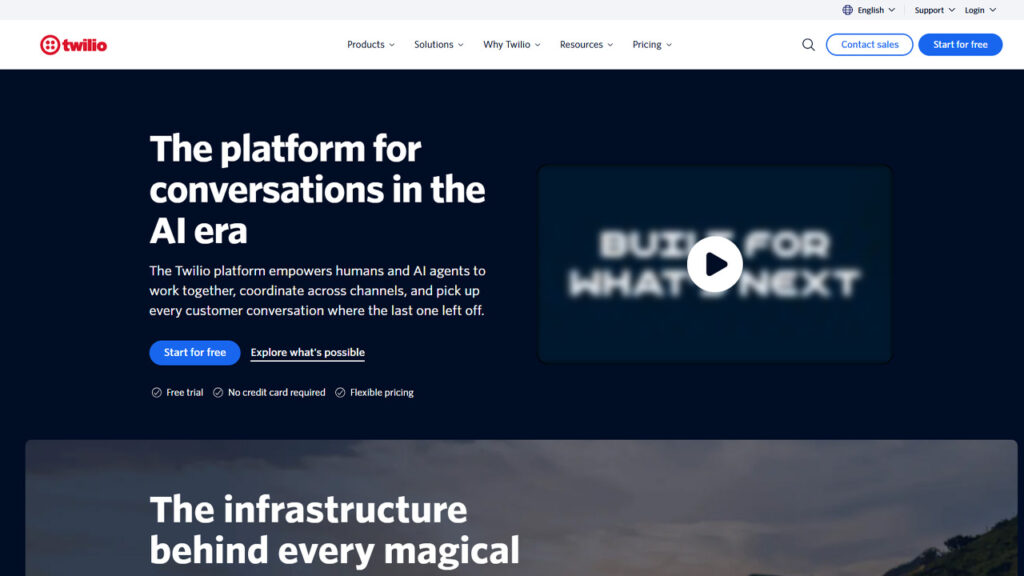
Twilio is considered an infrastructural choice, as carrier-grade APIs for SMS, WhatsApp, and voice, that lets the engineers build messaging into products, portals, and workflows, with enhanced flexibility and a global reach.
Keep in mind: It is a building blocks, not an application. Budget for engineering time and remember that the real cost is for building and maintenance, not the pre-message rate.
6. Attentive: best for retail and ecommerce marketing
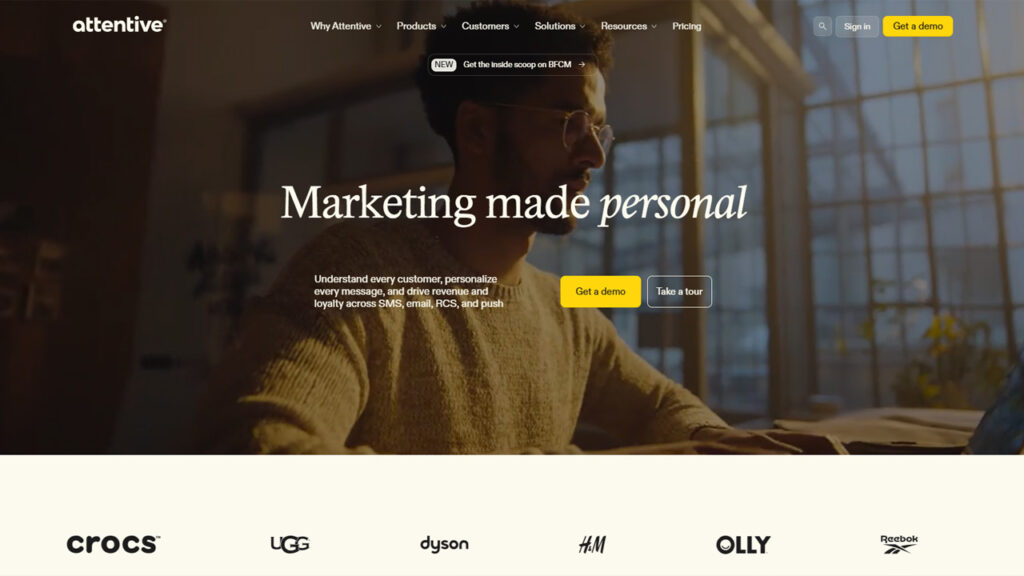
Attentive leads the enterprise SMS marketing category for consumer brands: sign-up unit tools that grow subscriber lists fast, AI-driven segmentation and personalization, and deep commerce integrations that tie messages to revenue.
Keep in mind: it's optimized for promotions and conversion campaigns. It isn't built to qualify leads or hold sales conversations.
How to choose: three questions
1. Who should run the conversation? Your reps (TextUs, Textline), a campaign engine (SimpleTexting, Attentive), your developers (Twilio), or AI that converses on its own (Meera). This single question eliminates most of the market.
2. What outcome are you buying? Clicks and coupon redemptions point to marketing platforms. Resolved tickets point to Textline. Booked calls and sales-qualified leads point to AI-driven texting.
3. Where does the data need to land? For B2C sales organizations, this is the question that gets skipped and regretted. If conversation outcomes don't write back to your CRM automatically (statuses updated, dispositions logged, attribution intact), you've created a silo your reps have to reconcile by hand. Whichever platform you pick, treat two-way CRM sync as a requirement, not a nice-to-have.
Conclusion
An ideal enterprise texting solution depends less on messaging features and more on the role users want texting to play in the customer journey. If the business prioritizes promotional campaigns, a marketing platform can be considered the right fit, while if they need enhanced customer support, a shared inbox solution makes more sense. By choosing the right solution that aligns with the business objectives, integrates with the existing CRM, and supports the workflow of the team, businesses can transform texting into a measurable driver of customer engagement and revenue.
FAQ
Q. What's the difference between enterprise texting software and regular business texting apps?
Scale and governance. Enterprise platforms handle high-volume throughput with 10DLC carrier registration, TCPA-aligned consent and opt-out management, role-based admin controls, security certifications, and native CRM or contact-center integrations. Lightweight texting apps offer none of that.
Q. Do enterprise texting platforms integrate with CRMs?
The good ones do, and it should be a deciding factor. Look for native Salesforce, HubSpot, or Zoho connectors with two-way sync: conversations logged as activities, campaigns triggered by CRM events, and outcomes written back to the record automatically.
Q. How much do enterprise texting solutions cost?
Pricing models vary by category: campaign tools charge tiered rates by message volume, inbox-style tools charge per seat, APIs charge per message sent, and AI conversation platforms are typically quote-based with onboarding included. Compare cost per outcome, such as a qualified lead or booked call, rather than cost per message.
The bottom line: every platform here is excellent at the job it was built for. Decide whether you need messages sent, conversations supported, or leads qualified, then pick the tool built for exactly that job.
%201.png)

%201.png)

%201.png)