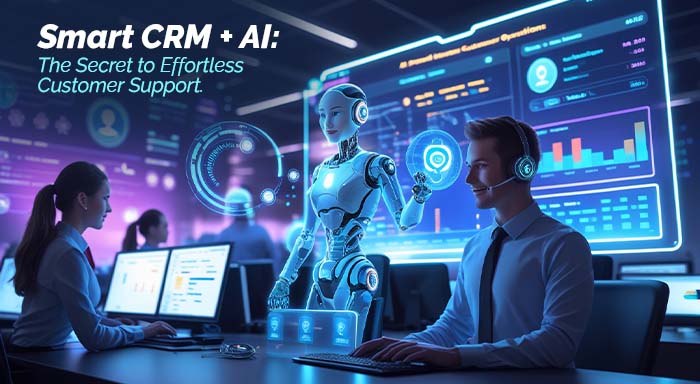

Outsourcing customer service helps businesses manage customer interactions, control operational costs, and provide support across multiple channels. However, working with external support teams can create challenges such as inconsistent communication, delayed responses, disconnected customer information, and limited visibility into agent performance.
This is where CRMs and AI can make a significant difference. Customer Relationship Management (CRM) platforms centralize customer information, interaction histories, and support activities, while Artificial Intelligence (AI) helps automate repetitive tasks, analyze customer conversations, and recommend appropriate actions.
When combined, CRMs and AI create a more connected support environment where outsourced agents can access relevant customer information, resolve inquiries faster, and deliver consistent service. Businesses can use this combination to improve support efficiency while maintaining better control over customer experiences.
Choosing the Right Outsourced Customer Service Provider
CRMs and AI can do wonders for efficiency, but they’re only as good as the outsourcing provider using them. A partner like LTVplus, for instance, that gets your brand, values, and customer expectations can make the experience seamless. When opting for a provider, search for teams that specialize in customer handling and understand the ins and outs of modern AI and CRM platforms. The best ones will mesh with your company’s vibe and deliver support that feels tailored.
Scalability matters too. Customer demand can spike or dip, so a provider needs to adjust fast—whether it’s handling a flood of calls or seasonal rushes. Verifying the track record, customer satisfaction performance, and quality controls can help businesses make a profound choice.
The Role of CRMs in Outsourced Customer Service
A CRM acts like a command center, storing everything from customer chats to purchase histories and support tickets. For outsourced teams, this means no more scrambling for missing info—agents anywhere can tap into the same current records, keeping service consistent. CRMs can also establish precise workflows, streamline escalations, and follow-ups, and simplify agreements with external partners.
Furthermore, they collate information from diverse marketing channels and touchpoints. Whether customers reach out by email, chat, phone, or social media, every interaction lands in one system. This lets outsourced teams juggle omnichannel support without flipping between tools. On top of that, CRM analytics dig into customer patterns, helping businesses spot trends, measure performance, and tweak strategies for outsourced agents.
Another important advantage of using CRM software in outsourced customer service is improved agent coordination. When an outsourced representative receives a customer inquiry, they can review previous conversations, unresolved tickets, purchase history, and relevant account information from a centralized record. This reduces the need to ask customers to repeat information and helps agents provide more relevant responses.
Businesses can also establish role-based access permissions, escalation procedures, and service-level workflows within their CRM systems. These capabilities allow managers to monitor outsourced support activities, identify unresolved customer issues, and maintain consistent service standards across internal and external teams.
How AI Improves Outsourced Customer Support
Artificial Intelligence has brought a paradigm shift in customer service by automating repetitive processes and enhancing the overall efficiency of the team. Chatbots and virtual assistants powered by AI can tackle basic questions—like order statuses, account changes, or FAQs—leaving human agents free for trickier problems. Fast responses minimize wait times, allowing outsourced teams to prioritize interactions that matter a lot.
Moreover, Artificial Intelligence has become an indispensable tool with smart routing and sentiment analysis. It can scan messages on the fly, pick up on customer moods, and send tickets to the right agent based on skills and availability. Tough or touchy cases go to seasoned pros, boosting satisfaction. Tools like real-time translation and multilingual support also let global companies serve diverse customers without needing specialized agents.
AI can also support outsourced customer service agents during live interactions. For example, AI-powered tools can summarize lengthy customer conversations, suggest relevant responses, identify important details, and recommend knowledge-base articles. Agents can use these suggestions to understand customer concerns without manually reviewing every previous interaction.
Another useful application is automated ticket categorization. AI can analyze incoming customer requests and classify them according to urgency, topic, or issue type. This allows outsourced support teams to prioritize important inquiries and route specialized requests to the appropriate agents. By reducing manual coordination, CRMs and AI help support teams manage larger inquiry volumes without compromising response quality.
The Synergy Between CRMs and AI
When CRMs and AI team up, that’s where the magic happens. AI-powered CRMs sift through heaps of data to give agents real-time tips, letting them tailor responses based on past interactions. Predictive analytics can even guess what customers need next and offer solutions before problems pile up. What is the outcome? Quicker and fine-tuned services—even when you are working with outsourced teams.AI also helps agents with assistance like automated replies and immediate suggestions. For example, an AI-driven CRM might recommend a fix based on history or customer tone, cutting down search time. It can perform routine tasks with ease such as sorting tickets, segmenting customers, or following up, so outsourced teams can concentrate more on the bigger goals–enhancing both the experience of the customers and efficiency
Implementing CRMs and AI in an Outsourced Model
Getting CRMs and AI working in an outsourced setup takes some planning. Businesses require platforms that seamlessly align with the processes–consider aspects like automation power, integration options, and smart reporting. AI solutions should be tested to make sure they streamline, not stumble, over existing processes. LLM red teaming can be an excellent way to find and fix issues in AI systems.. Picking partners already comfortable with these tools can speed things up and boost results.
Training outsourced agents is key too. Companies should ensure teams know the CRM inside out, follow data security rules and can handle AI features. Regular check-ins, feedback, and tweaks keep standards high. With advanced CRM analytics, businesses can easily monitor performance, assess agent outcomes, and further improve AI to get better results.
Conclusion
AI and CRMs have completely redefined the game for outsourced customer service, fine-tuning efficiency, reducing response times, and upgrading the overall customer experience.CRMs keep interactions organized, while AI automates the busy work and sharpens agent focus. Companies that use these tools smartly can count on outsourced teams to deliver reliable, top-notch support without ballooning costs.
In the future, Artificial Intelligence will keep extending the boundaries of possibilities with aspects like predictive support, more effective language processing, and extremely tailored interactions. Yet, while technology boosts efficiency, humanizing the processes establishes a better connection with the customers. By leveraging the potential of AI and CRMs, organizations can fine-tune outsourced support and keep their brands ahead in a quickly moving online world.