
Monthly subscriptions accumulate quickly. A $10 cloud storage plan might seem like a negligible amount on its own. However, when you pay this $10 for five or 10 years straight, it slowly turns into a sizeable expense for something you do not even own. Thus, lifetime cloud storage has emerged as a great alternative for users. Instead of routine charges, you only pay one time, and then you can keep your storage space for as long as the provider stays in business. For small businesses, freelancers, and anyone tired of monitoring yet another subscription renewal, lifetime cloud storage plans provide a more predictable and simpler way to store photos, files, and backups without seeing a bill arrive each month.
In this guide, let us break down what we mean by lifetime cloud storage, how it operates, which providers presently offer it, and what you can check before committing to a one-time payment.
Understanding Lifetime Cloud Storage
Lifetime cloud storage refers to a pricing model where you pay a considerable upfront fee for cloud storage instead of an annual charge or a recurring fee on a monthly basis. Once it is paid, the provider commits to ensuring your storage space remains indefinitely active, or for as long as the company remains operational.
It is necessary to be accurate about what we really mean by "lifetime" here:
- Lifetime does not mean your own lifetime.
- It means storage associated with the service lifetime itself.
- If the provider is acquired, shut down, discontinue the plan will also be discontinued; the storage can also disappear with it.
When compared to a subscription-based storage plan, a lifetime cloud storage deal generally costs more but becomes less costly over many years of use. Most users recover the lifetime plan cost within 3-6 years when compared to a monthly payment, after which the storage becomes effectively free for as long as there is service.
How do Lifetime Cloud Storage Plans Generally Work?
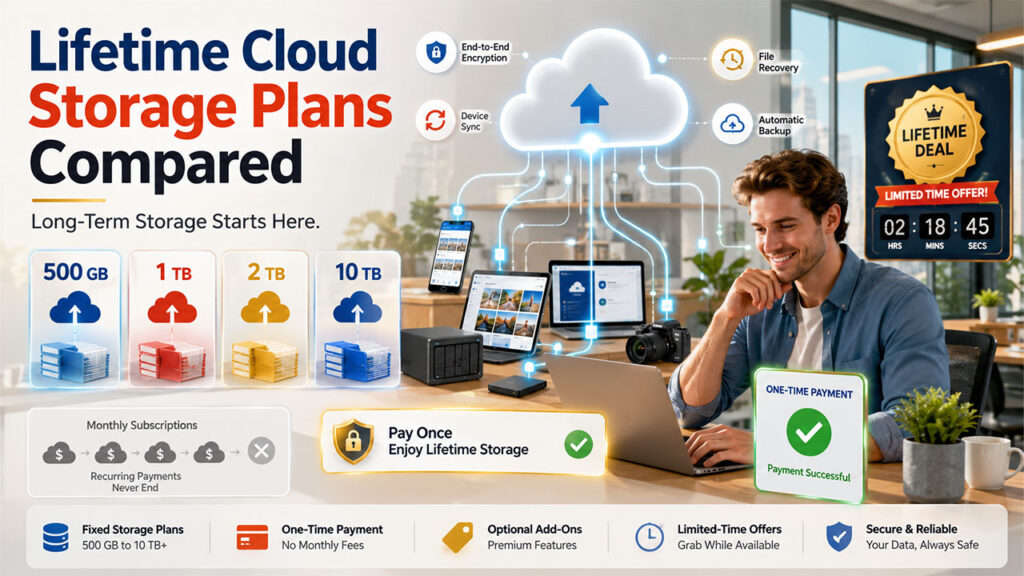
Providers that offer lifetime cloud storage often organize their plans around fixed storage plans instead of open-ended capacity. A few patterns are generally common across the market.
- Tiered Storage Limits: Plans are often offered in fixed sizes (like 500 GB, 1 TB, 2 TB, or 10 TB), with the price rising as storage increases.
- One-time Checkout: Payment is collected only one time at purchase, with no recurring billing or auto-renewal associated with the account.
- Add-on Characteristics: Extras such as extended file recovery windows, end-to-end encryption, or additional device synchronization are sold separately sometimes, even on lifetime plans.
- Availability in Limited Time: Many providers offer lifetime pricing only during specific promotions, rather than as a permanent option, so availability can change.
Since cloud storage providers depend on ongoing revenue to fund support, servers, and bandwidth, lifetime plans are significantly less common among large players. SaaS solutions such as Dropbox, Google Drive, and OneDrive often stick to subscription-only models. Lifetime is mainly offered by independent and smaller providers competing on value instead of brand recognition.
Popular Providers of Lifetime Cloud Storage
Numerous established providers presently provide lifetime cloud storage plans, each with distinct features and pricing:
- pCloud – One of the most renowned names providing lifetime plans, with different plans around 500 GB, 2 TB, and 10 TB. Pricing generally begins at approximately $199 for the shortest tier, with optional client-side encryption available as a premium add-on. pCloud is a Switzerland-based company that provides support for block-level synchronization for quicker file updates.
- Icedrive – Provides lifetime plans created around a 2 TB base tier, with additional storage present in separate blocks. Icedrive involves end-to-end encryption on premium plans and a “Mount” feature that enables your cloud storage to show up as a local drive on your computer. Includes end-to-end encryption on paid plans and a "Mount" feature that lets your cloud storage appear as a local drive on your computer.
- Internxt – A provider based in Spain providing lifetime plans across 1 TB, 3 TB, and 5 TB tiers, bundled with antivirus tools and a VPN. Internxt leverages zero-knowledge encryption, implying files remain encrypted before they ever leave your device.
- Koofr – It is a Slovenia-based and GDPR-compliant provider. Lifetime access is generally sold through third-party deal marketplaces instead of directly, with 1 TB plans beginning around $199. – A Slovenian, GDPR-compliant provider. Lifetime access is typically sold through third-party deal marketplaces rather than directly, with 1 TB plans starting around $199.
- Filen – Provides lifetime storage only during specific promotional periods, most notably around Black Fridays, often restricted to smaller tiers of storage.
Availability and pricing across such providers frequently change, so it is worth going through the official pricing page of the provider before purchasing.
What to Check Before Buying Lifetime Cloud Storage?
There is no doubt one-time payment has its benefits. However, it also carries a lot more risks than a monthly subscription, which you can cancel at any time. Before you purchase lifetime cloud storage, you can go through the following:
- Company Track Record – A provider that has been operating for several years with a genuine paying customer base is generally a safer bet than a newer company relying heavily on lifetime deal sales.
- Terms of service – There are always clauses in lifetime plans that allow the provider to terminate accounts for violations of policy, so “lifetime” is never fully unconditional.
- Storage Limits vs. Your Actual Requirements – Purchasing more storage than you will realistically use defeats the purpose of the savings.
- Security Features That Are By-Default Included – Check whether encryption is built-in or sold as a separate add-on, since this impacts the actual cost of the plan.
- Break-even Timeline – Have clarity on the number of years you are likely to use the product. Then, calculate the overall cost you will pay if you go for a subscription plan. Then, compare it with the lifetime cost to know whether it is worth buying.
For teams handling customer data already and files through a Customer Relationship Management solution, this kind of due diligence is even more important. Long-term and reliable storage plays a significant role in ensuring that client files, business records, and backups remain accessible without repetitive costs taking over your budget.
Conclusion
Lifetime cloud storage can be considered a universal solution. However, for the best use cases, it can genuinely be an intelligent way to minimize long-term expenses. Providers such as Icedrive, pCloud, Internxt, and Koofr each provide one-time payment options, given the fact that you are realistic about the size of storage you need and comfortable with the small risk that often comes with trusting the long-term stability of the company. Before you purchase any lifetime cloud storage plan, compare pricing tiers, carefully go through the terms of service, and calculate the break-even point against a consistent subscription. When it is done right, it is one of the remaining ways to make a one-time payment and stop thinking about a bill for many years.
FAQs About Lifetime Cloud Storage
Q1. Does lifetime actually mean forever?
A- It actually means the service provider of the lifetime and not the lifetime of the user. If the company gets acquired or goes out of business, your access might end. In most contracts, you will see that the lifetime means 99 years or as long as the provider stays in business.
Q2. Are there any limitations or hidden fees in cloud storage?
A- While you do not have to pay a monthly fee, you can keep in mind these limitations: File versioning, traffic download limits, or lack of collaboration.
Q3. What are the main risks?
A- The greatest risk is the possibility of the company shutting down or vendor lock-in. Additionally, you can stop updating the software or features, leaving you with an outdated platform that is frankly not useful.
Q4. What are the best providers of lifetime plans?
A- The right providers of lifetime plans are as follows: Icedrive, pCloud, and Internxt.
%201.png)

%201.png)

%201.png)