
Introduction: The Importance of Managed IT for Small Businesses
In vying marketplaces of today, small businesses that emphasize customer experience must utilize powerful IT strategies to keep up with the growing technology trends and demands. Managed IT services have made its name as an efficient and practical solution, providing secure, scalable, and personalized technology support especially designed for small enterprises. Such strategies allow businesses to not only ensure seamless routine operations but also to improve customer interactions, establish trust, and cultivate lasting loyalty.
Recent statistics showcase the key significance of reliable cybersecurity and IT management for small businesses. For instance, around 60% of small businesses that face a cyberattack go out of business within the first six months, highlighting the urgent requirement for efficient IT security and response strategy. Managed IT provides these key services, enabling small businesses to emphasize customer engagement without the consistent worry of security breaches or technical disruptions.
Moreover, research indicates that around 43% of cyberattacks particularly target small businesses, focusing on the requirement of vigilant security management. This shows how vital it is for small businesses to adjust proactive IT strategies that protect customer data and ensure trust.
One key example of a specialist in this domain is NDSE, an MSP in Charlotte. These providers ascertain localized expertise and in-depth understanding of the unique challenges faced by small businesses in their region, enabling to personalize solutions that align with specific customer service or operational requirements. This is vital for organizations focusing on delivering specialized customer service, as it aids in ascertaining minimum downtime and quick resolution of IT problems that can otherwise affect customer interactions.
Actually, the incorporation of managed IT strategies is changing how organizations work by giving them enterprise-grade technology resources that are often accessible to bigger businesses. Such strategies can provide customer-focused businesses with a competitive advantage by improving data, optimizing responsiveness, and allowing versatile growth.
Understanding Managed IT Services for Customer-Centric Businesses
Managed IT services include outsourcing support and IT management to specialized providers who manage everything from network tracking to cybersecurity, cloud management, data backup, and help desk assistance. For customer-focused small businesses, this involves having a dedicated team handling their technology infrastructure proactive to make sure that platforms are always secure, available, and aligned with business objectives.
By combining managed IT providers, small businesses can gain access to a wide range of services that go beyond standard technical assistance. These involve compliance management, IT planning, and technology training, all built to improve customer experience and business resilience.
Key Managed IT Strategies Supporting Customer Focus
Proactive Network Tracking and Security
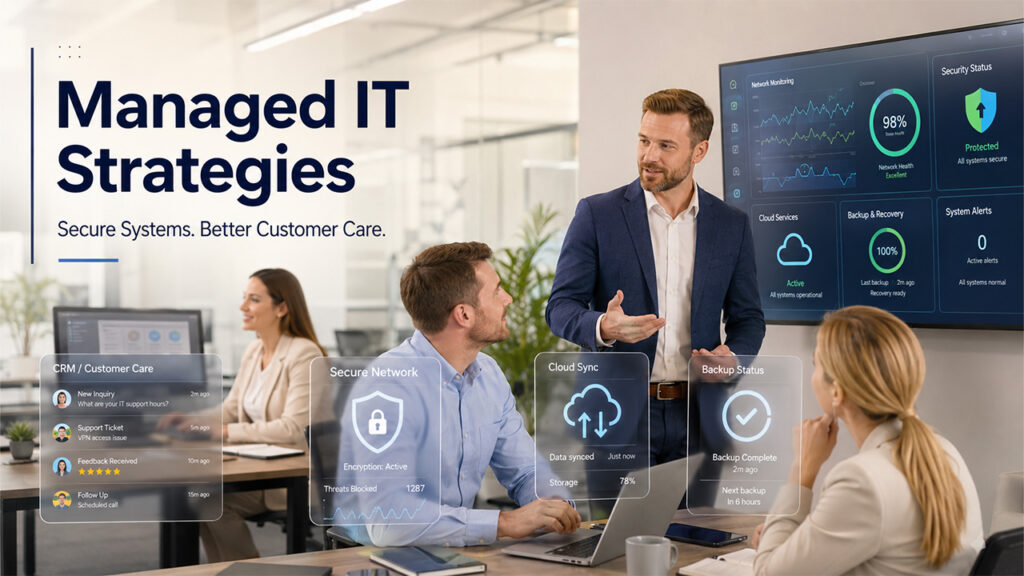
One of the most vital managed IT strategies is consistent network tracking combined with powerful cybersecurity measures. Small businesses generally lack the internal resources to consistently watch for system failures or cyber threats, making them vulnerable to outages or attacks that affect customer experience and trust directly.
Managed IT services implement sophisticated real-time network tracking tools that recognize possible issues before they grow into serious issues. This proactive approach greatly minimizes downtime and protects confidential customer data, which in turn boost confidence of customers.
Providers execute multi-level security protocols, which include endpoint protection, firewalls, and employee training programs to avoid breaches and ascertain compliance with data privacy regulations. Such complete security aid in ascertaining uninterrupted service and secure the confidential data that customers provide to small businesses with great trust.
Scalable Cloud Solutions
Customer-centric small businesses need agility and flexibility to quickly respond to evolving market conditions and customer expectations. Cloud computing provides this adaptability by allowing real-time collaboration, remote access, and scalable data storage without limitations of physical infrastructure.
Managed IT providers specialize in facilitating cloud migration and ongoing management, ensuring seamless integration with existing business systems. This empowers employees to access customer information anytime, anywhere, enhancing responsiveness and overall service quality.
Working with a reliable IT company in Dallas generally imply getting personalized cloud solutions specialized to align with operational requirements of a business, which enhance customer satisfaction and efficiency.
Cloud solutions also provide support to mobile workforces and strategies for omnichannel customer engagement, which are greatly significant for small businesses competing in an intensely digital landscape. Moreover, cloud solutions generally involve in-built analytics tools that aid businesses to get insights into customer preferences and behavior, allowing more tailored services.
Disaster Recovery and Data Backup
Data is a backbone of customer-centric businesses, daily used for support, sales, marketing, and informed decision-making. Therefore, managed IT strategies must involve disaster recovery plans and complete data backup to secure this vital asset.
Providers back up data routines to secure offsite locations and test recovery protocols to make sure that the restoration is quick when the system is affected by ransomware attacks, hardware failure, or natural disasters. This reduces downtime and avoids any data loss, which can be catastrophic for small businesses.
Studies indicate the businesses that secure themselves with disaster recovery plans face 40% less downtime and recover more quickly from IT incidents, which benefits customer satisfaction as well as customer satisfaction and retention directly. Having a dependable recovery system not only fortifies customer data but also showcase the commitment of the company to professional qualities and reliability that customers greatly value.
Improved Customer Relationship Management (CRM) and Communication
Efficient communication is important to provide top-level customer service. Managed IT services can help by making sure all communication platforms like VoIP, email, and chat systems are reliable, secure, and integrated with CRM platforms. These tools keep track of interactions,
centralize customer data, and automate follow-ups, allowing small businesses to render tailored responses in a timely manner.
By simplifying such processes, businesses can establish robust relationships with customers, predict their requirements, and fix issues quickly. Managed IT providers also provide quick technical support to reduce disruptions that could impact customer touchpoints. CRM integrations also enable more effective analytics of data, allowing businesses to recognize trends and personalize marketing efforts to improve customer satisfaction and loyalty.
Measuring Success: The Business Impact of Managed IT Services

The benefits of managed IT services go well beyond management of technology. They become visible as tangible business results. Research shows that businesses leveraged managed IT services face 50% less downtime incidents, leading to enhance productivity and improved customer satisfaction.
Cost efficiency is another significant benefit. Managed IT services can minimize IT operating costs by around 25% when compared to in-house management. This frees up resources that small businesses can reinvest in growth initiatives and customer engagement.
Furthermore, small businesses that adjust managed IT strategies report greater customer
retention rates and improved revenue growth, emphasizing the strategic value of incorporating technology management with customer-centric processes. Such enhancements not only improve profitability but also boost the reputation of the company, which is vital for lasting success in competitive markets.
Conclusion: Embracing Managed IT for Customer-Centered Growth
For small businesses focused on providing top-level customer experiences, adopting effective managed IT strategies is not optional anymore; it is vital. By utilizing expert providers, businesses can protect their IT infrastructure, flexibly scale operations, and swiftly respond to customer requirements.
Investment in managed IT services not only reduces risks but also drives cost savings, operational efficiency, and customer loyalty. In a digital-first world, such advantages can position small businesses for long-term success and better growth. With a specialized managed IT partner, small businesses can focus confidently on what is most important- developing crucial customer relationships and getting success in a competitive marketplace.
%201.png)

%201.png)

%201.png)