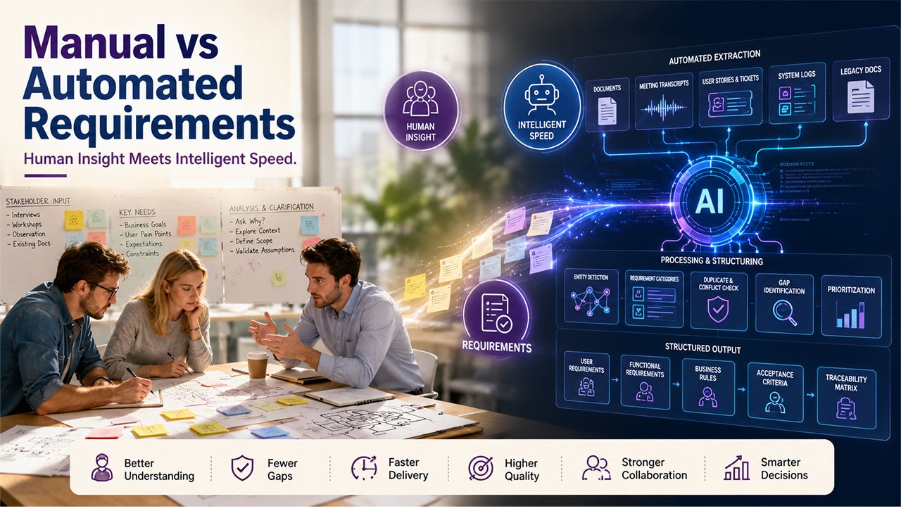

Selecting the most suitable one, from a manual and automated requirement gathering generally shapes the entire project, even before a single line of code is written. Choose the right platform, and the team with a clear, agreed-upon foundation, while selecting the wrong requirement, and the gap surfaces later. The issue arises generally during testing or after deployment, when fixing it becomes significantly costlier.
This comparison article covers how each requirement approach works, and where each one fits. It also explores how teams combine each requirement effectively. The requirements management tools mainly supports the strategy organization chooses by keeping the requirements structured, traceable, and connected, delivering throughout the project lifecycle.
What is Manual Requirements Gathering?
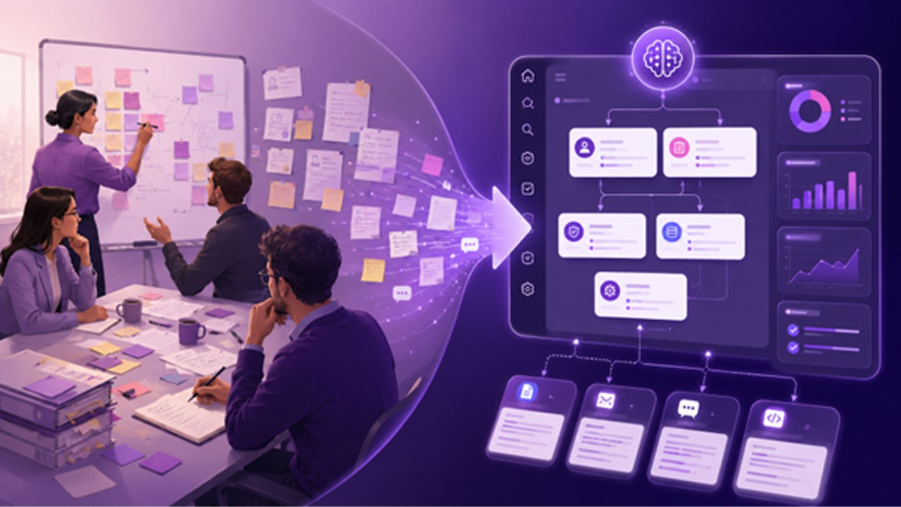
The manual requirements gathering rely heavily on human interaction to capture what a system requires to perform. The business analysts, product owners, or QA leads generally conduct interviews, and run workshops. They also observe workflows and review existing documentation to design a rough picture of what the users need.
The process of selecting requirements is deliberate and interpretive. The analysts understand the description of the stakeholder, identifies any underlying needs, and translate it into a formal requirement. The translation process is also where expertise matters the most. The same stakeholder’s input can produce very different requirements depending on who processes it.
Manual requirements gathering works best when:
- The domain is new or poorly documented and no prior baseline exists
- Business rules are complex and context-dependent, such as in regulated industries
- Stakeholder intent is ambiguous and needs active clarification
- The project requires formal sign-off or acceptance criteria tied to specific conversations
The main constraint is scale. Manual gathering takes time, depends on stakeholder availability, and does not accelerate easily. On large projects with hundreds of requirements across multiple teams, the process becomes a bottleneck without careful planning.
What is Automated Requirements Gathering?
Automated requirements gathering leverage software tools in order to extract, process, and structure requirements that come from existing sources. This includes parsing legacy documentation, analyzing user stories in ticketing systems, processing meeting transcripts, and mining logs or usage data to identify system behaviour patterns.
AI requirements gathering extends this further by applying natural language processing to identify patterns, detect gaps, suggest requirement categories, and flag inconsistencies across large document sets. Teams looking for a deeper overview of AI requirements gathering will find that tooling in this area has matured significantly, with options ranging from standalone NLP processors to fully integrated requirements platforms.
Requirements gathering automation handles volume consistently and without variation in attention across sessions. However, its downside is source dependency. Automation relies on many things before it can start working. It needs input material that is already structured in a logical manner. Additionally, it may also overlook or miss contextual nuances that only appear when you hold a direct conversation with stakeholders.
Manual vs Automated Requirements Gathering
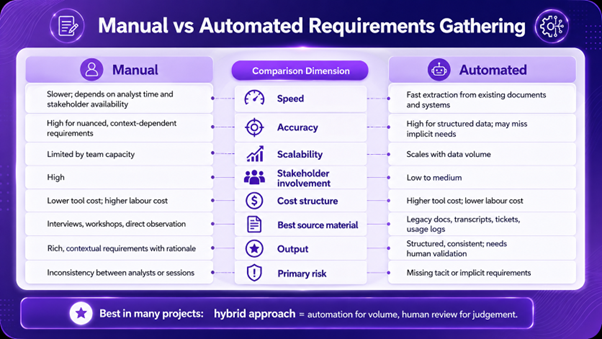
The table below compares both approaches across the dimensions that matter most for planning.
| Dimension | Manual | Automated |
| Speed | Slower; depends on analyst time and stakeholder availability | Fast extraction from existing documents and systems |
| Accuracy | High for nuanced, context-dependent requirements | High for structured data; may miss implicit needs |
| Scalability | Limited by team capacity | Scales with data volume |
| Stakeholder involvement | High | Low to medium |
| Cost structure | Lower tool cost; higher ongoing labour cost | Higher tool cost; lower ongoing labour cost |
| Best source material | Interviews, workshops, direct observation | Legacy docs, transcripts, tickets, usage logs |
| Output | Rich, contextual requirements with documented rationale | Structured, consistent; requires human validation pass |
| Primary risk | Inconsistency between analysts or sessions | Missing tacit or implicit requirements |
Neither approach eliminates risk. Manual gathering depends on analyst skill and stakeholder clarity. Automated gathering depends on the quality and completeness of source material. Both require a structured review step before requirements move into development.
When to Use Manual, Automated, or a Hybrid Approach
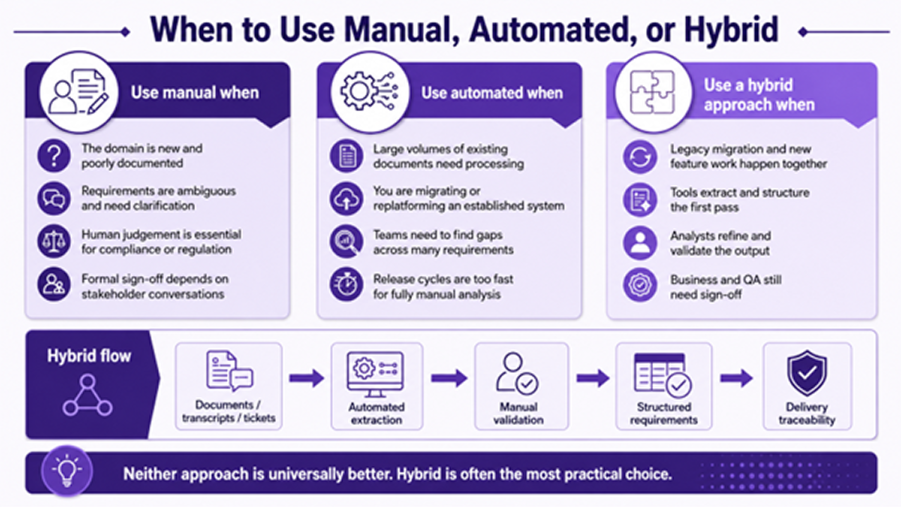
The right approach depends on the nature of the project, the state of existing documentation, and team capacity. No single strategy fits every situation.
Use manual requirements gathering when:
- The domain is new and no prior documentation exists to process
- Requirements involve regulatory or compliance workflows where human judgement is essential
- Stakeholders need to actively shape the product through direct involvement, and extracted output alone is insufficient
- The project scope is small enough that automation would add overhead without meaningful return
Use requirements gathering automation when:
- Large volumes of existing documentation need to be processed quickly and consistently
- The project involves migrating or replatforming an established system with documented behaviour
- The QA team needs to identify gaps or contradictions across hundreds of existing requirements
- Release cycles are too fast for purely manual analysis to keep pace
Use a hybrid approach when:
- The project uses legacy system migration with new feature development
- Automated extraction handles the structured bulk of input, and analysts refine and validate the output
- Business and QA teams need sign-off on requirements that were initially surfaced by tooling
In reality, there are many mid-to-large projects that usually benefit from hybrid models. Combining both methods proves to be more efficient. Automation manages the initial extraction and structuring while manual reviews bring contextual judgment and personalization that is not possible for tools to mimic or replicate.
Conclusion: Which One Is Better?
If you are looking for a universally right approach, you won’t find one. Manual requirements gathering offers output that are contextually richer while capturing the nuance that tools often miss. Whereas automated requirements gathering analyze datasets in an instant and with consistency. It is difficult for manual analysis to beat this one even if it tries.
The most effective QA and product teams treat the two as complementary. Automation handles volume. Manual analysis handles judgement. A defined strategy for when to apply each, supported by the right tooling, produces more complete and reliable requirements than either approach on its own.
Also read: Autonomous AI Team for Marketing: Top 6 Tools to Scale Your Growth in 2026
%201.png)

%201.png)

%201.png)