
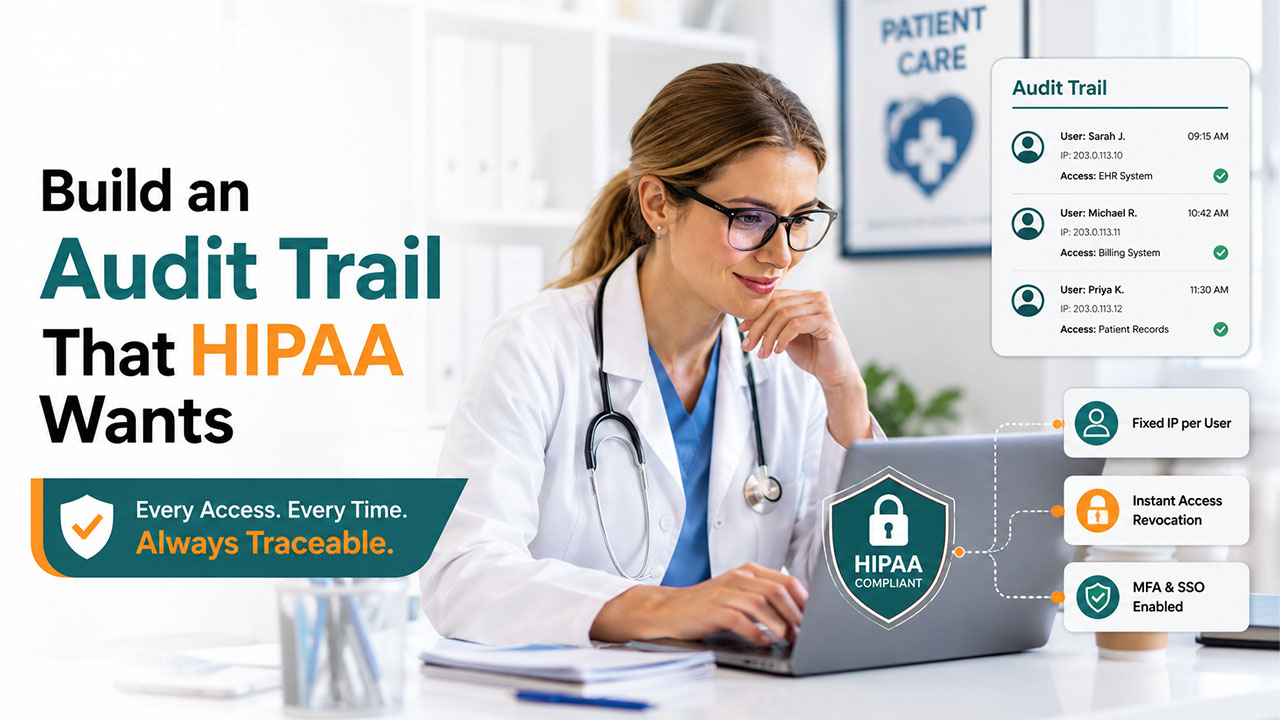

Healthcare data breaches cost U.S. organizations an average of $7.42 million per incident in 2025, the highest of any industry for the 14th consecutive year, according to IBM's Cost of a Data Breach Report. Most of these breaches trace back to one unanswerable question: who accessed the system, and when.
PureVPN for Teams answers that question by design, giving every healthcare team member a fixed, individually traceable connection instead of a shared, unaccountable one.
What HIPAA's audit control requirement actually says
HIPAA's Security Rule, at 45 CFR § 164.312(b), requires covered entities to "implement hardware, software, and/or procedural mechanisms that record and examine activity in information systems that contain or use electronic protected health information." This is not a suggestion. It is a required technical safeguard, and OCR investigators check for it directly during audits and breach investigations.
PureVPN for Teams satisfies this requirement at the network layer. Every connection to an EHR, billing system, or internal tool is tied to a specific static or Dedicated IP, assigned to a specific person, creating exactly the kind of examinable activity record the rule requires. When combined with a HIPAA compliant CRM, healthcare organizations gain stronger visibility, accountability, and security for patient data access across their systems.
Why shared credentials make audit trails worthless
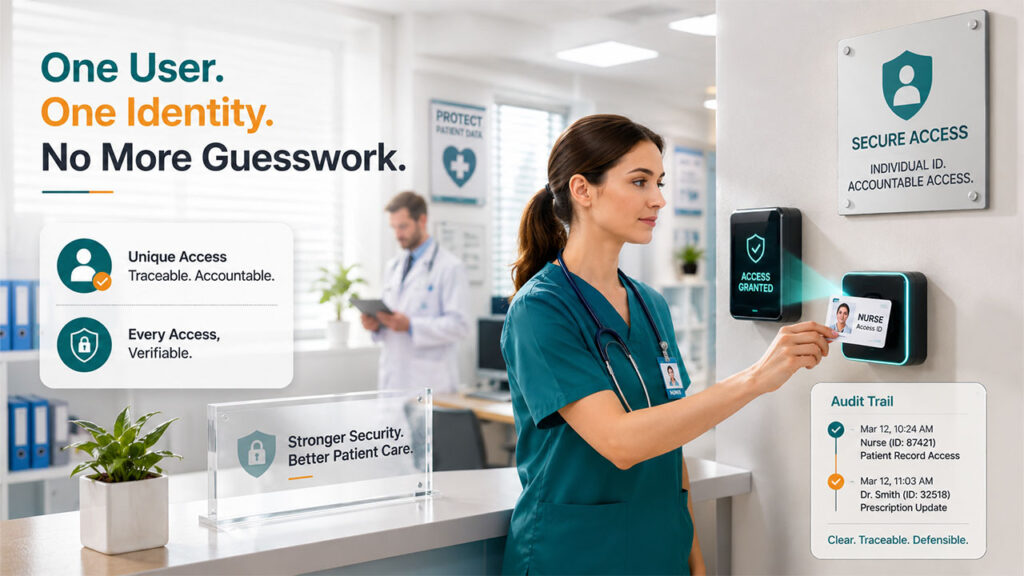
Shared logins are one of the most common findings in OCR investigations of healthcare breaches. When multiple staff members use the same account to access patient data, a breach makes every user of that account an equally likely suspect, and the audit trail stops proving anything.
PureVPN for Teams eliminates this failure mode structurally. Each team member connects through their own assigned IP, so "who accessed the system on March 12th" has one answer, not a list of possibilities. This is the exact gap the healthcare page's own product framing calls out directly: unmanaged remote access leaves teams guessing, and a fixed identity per user is what removes the guessing.
How PureVPN for Teams builds the audit trail in practice
As a business VPN for healthcare teams, PureVPN for Teams assigns a static or Dedicated IP to each healthcare team member, which can be allowlisted directly in EHR platforms, billing software, and internal clinical tools. Access from any other address is simply not possible, which means every successful connection is, by definition, an identified one.
Revocation is immediate, not procedural. When a traveling nurse's contract ends or a vendor's engagement closes, an administrator removes that person's access from a centralized dashboard in under 30 seconds. No Active Directory ticket, no waiting period, no lingering account that shows up as an unexplained entry in next year's audit.
Multi-factor authentication and SSO integration add a second layer on top of the fixed-IP identity, so a compromised password alone isn't enough to generate an unauthorized, and therefore unexplainable, access event.
Why healthcare teams choose PureVPN for Teams over a full Zero Trust rollout
A full SASE or ZTNA deployment takes 6 to 18 months, needs a dedicated project team, and typically requires re-engineering legacy and on-premises tools already in use at most clinics. For a healthcare organization that needs an audit-ready access model now, that timeline is the actual barrier to compliance, not the technology.
PureVPN for Teams is built for the timeline healthcare teams actually have. Most healthcare teams are live within a few days, one IT admin can own the entire deployment, and existing on-premises and legacy systems stay exactly as they are.
PureVPN for Teams is currently used by multiple organizations, including companies across healthcare, fintech, and IT consulting that share the same access-control requirements.
Real healthcare teams already running on this model
HelloRache, a healthcare virtual assistant service, and VaQya, a virtual healthcare operations provider, both use PureVPN for Teams specifically to meet HIPAA compliance requirements for remote access.
HelloRache's Chief Information Officer, Nick Powell, has publicly credited PureVPN's platform design and support quality as a differentiator relative to other access-management tools evaluated. These are documented, published case studies, not hypothetical scenarios.
Why a Healthcare Breach Becomes an Identity Theft Problem

A healthcare breach rarely stays a healthcare problem. Stolen Social Security numbers and insurance details do not expire like a credit card number, which is why medical identity theft persists for years afterward. Over 10,000 cases were reported in 2024, and victims spend an average of $13,500 resolving the damage.
This is the downstream cost of the exact access failure audit trails are meant to catch. Every unrecorded login is a potential source of that exposure, which is why identity theft protection is typically the first step offered after a breach, alongside credit monitoring and prevention through traceable, revocable access.
Frequently asked questions
Q1. Can PureVPN's IPs be allowlisted in EHR or healthcare systems?
Yes. Each user or team can be assigned a static or Dedicated IP address that is allowlisted directly in EHR platforms, billing software, and internal tools, so only approved connections reach systems holding patient data.
Q2. How long does it take a healthcare team to deploy PureVPN for Teams?
Most healthcare teams are fully operational within a few days. The process involves inviting users, assigning IPs, and allowlisting them in existing systems, with no infrastructure changes required.
Q3. Does PureVPN for Teams support HIPAA's audit control requirement specifically?
Yes. Assigning a fixed, individual IP per user creates a traceable connection for every access event, directly supporting the audit control standard at 45 CFR § 164.312(b).
Q4. Can external vendors and billing partners be given temporary access?
Yes. Vendor and contractor access can be granted and revoked instantly from the admin dashboard, which matters for HIPAA business associate accountability when a vendor's engagement ends.
Q5. Does PureVPN for Teams work with existing SSO and MFA systems?
Yes. It supports multi-factor authentication and integrates with existing SSO providers, adding a second layer of protection on top of the fixed-IP identity model.
%201.png)

%201.png)

%201.png)