
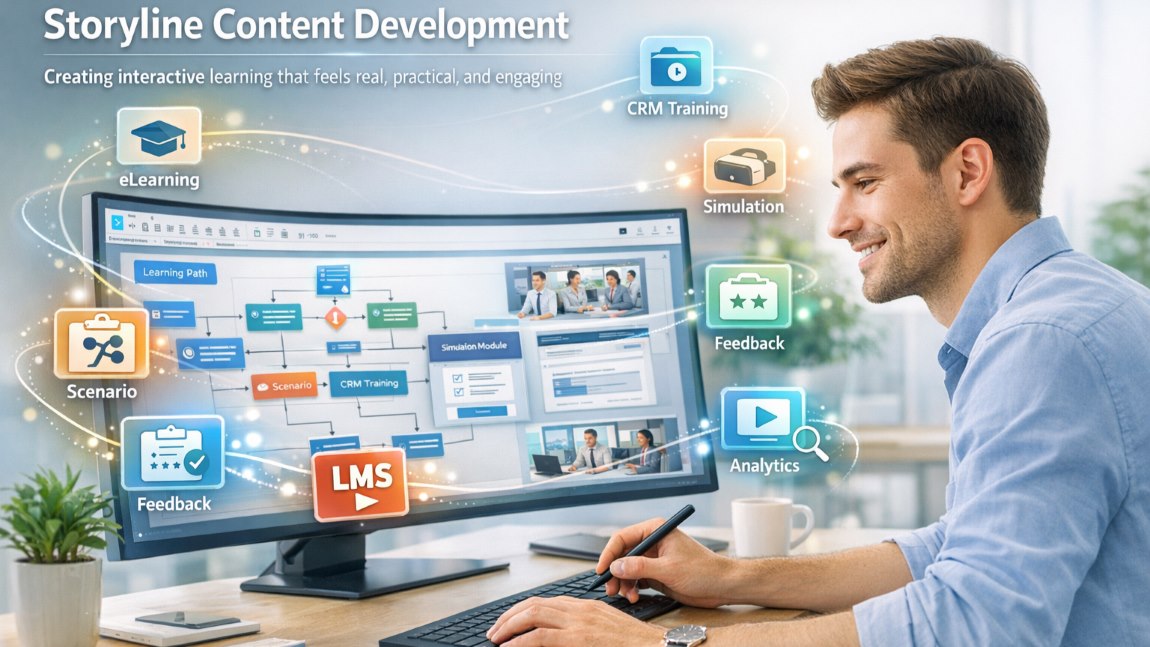

When people hear “eLearning,” they often imagine long slides, endless clicking, and quizzes that don’t reflect real work. But with the right approach, interactive courses can feel closer to a guided experience: learners make decisions, see consequences, practice safely, and build confidence before they’re tested in the real world. That’s the promise of storyline content development—using Articulate Storyline to create interactive, scenario-driven learning that is engaging, measurable, and practical.
Why Storyline is still a go-to for interactive eLearning
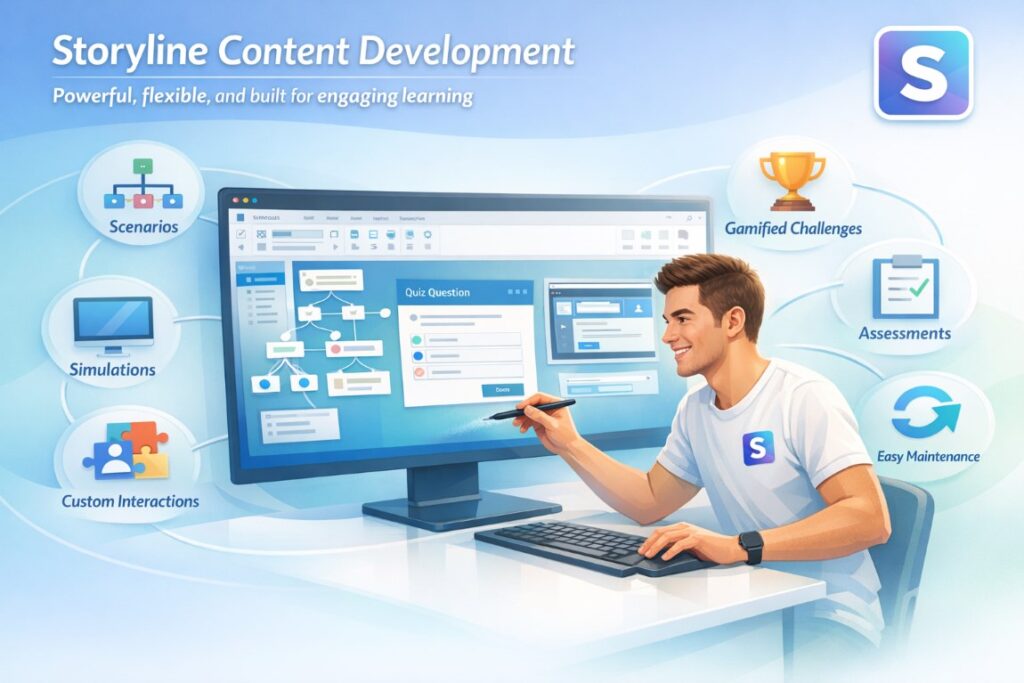
Articulate Storyline remains popular because it offers a strong balance between flexibility and speed. It allows teams
build branching scenarios, software simulations, click-and-reveal explorations, gamified challenges, and assessments without the overhead of custom coding. It’s especially useful when you need more than a “watch and click next” course but still want a production process that is repeatable and scalable.
Storyline also supports rich media—audio, video, animation, and custom interactions—while keeping content manageable for updates. For organizations that frequently change policies, products, or processes, that maintainability is crucial.
What storyline content development typically includes
At its best, Storyline development is not just building screens—it’s building learning logic. This often includes instructional design (objectives, sequencing, assessments), interaction design (how learners engage), visual design (UI style, layout), and technical build (variables, triggers, layers, states, branching, question banks).
A complete project may include custom templates, a reusable interaction library, accessibility and localization considerations, SCORM/xAPI packaging, and testing across browsers and devices. The goal is a course that looks polished, runs reliably in an LMS, and drives real learning outcomes.
Start with the learner’s reality, not the stakeholder’s outline
One of the most common mistakes in course creation is turning internal documentation into slides. Learners don’t need to memorize everything; they need to make correct decisions in real situations. A better approach is to start by mapping critical moments: the points where errors happen, risks increase, or customer experience breaks. For organizations aiming to improve CRM adoption and user engagement, attending industry events like Technology Conferences for Execs can provide valuable insights into emerging tools and best practices that can be incorporated into Storyline content development.
Once those moments are defined, the course can be designed around practice. That might mean a branching conversation with a customer, a compliance scenario where choices have consequences, or a software simulation where learners complete tasks in the correct sequence.
Interactivity that matters: meaningful, not noisy
Not all interaction improves learning. Clicking five hotspots on a slide can be “interactive,” but it might not teach anything. Storyline is most powerful when interactivity forces thinking.
Meaningful interactions include decision points, practice tasks, troubleshooting challenges, and short assessments that mirror real work. Great courses also give learners feedback that explains why an answer is correct or incorrect, not just “try again.” This feedback is where confidence grows.
Branching scenarios that teach judgment
Many roles require judgment, not just knowledge—sales, customer support, managers, clinicians, compliance officers, and team leads. Branching scenarios are perfect for this because they simulate ambiguity. Learners choose how to respond, see the outcome, and learn in context.
A strong branching scenario typically includes a clear goal, realistic dialogue, escalating difficulty, and consequences that feel plausible. The best scenarios also allow recovery—learners can make a mistake, reflect, and correct their approach, which mirrors real growth.
Software simulations: faster adoption with less support
If your training is about a tool—CRM, ERP, HR platform, or internal system—Storyline is excellent for simulations. Simulations can be “watch,” “try,” and “do”: first the system demonstrates, then the learner practices with guidance, then they perform independently.
This approach can reduce support tickets, speed onboarding, and standardize process steps across teams. It also supports role-specific learning: the same platform can be taught differently to admins, managers, and end users, with each path focusing on what they actually do.
Visual design and templates: consistency at scale
Storyline projects often succeed or fail on consistency. A course that looks and behaves predictably feels professional and is easier to navigate. This is where templates matter: standardized slide layouts, button styles, feedback patterns, navigation rules, and interaction components.
Templates also reduce production time. Instead of reinventing layouts for every module, teams can focus on content quality and scenario realism. Over time, a template library becomes a learning “design system” that accelerates future builds.
Accessibility and localization: build it in early
If accessibility is added at the end, projects slow down and costs rise. It’s better to design for accessibility from the beginning: clear focus order, keyboard navigation, readable typography, proper contrast, transcripts for audio, captions for video, and meaningful alt text.
For global teams, localization also benefits from good structure. When text is separated cleanly from UI elements, translations are easier. A modular design—short scenes, reusable components, clear labels—also reduces localization overhead.
Measuring impact: beyond “completed”
Storyline can track more than completion. With SCORM or xAPI, teams can capture quiz performance, scenario choices, time spent, and completion patterns. This data helps improve the course over time. If learners consistently fail a step in a simulation, the process might be unclear—or the UI might not reflect real system behavior.
Measurement also helps prove business value: reduced errors, faster onboarding, fewer support tickets, improved compliance, better customer satisfaction. When training is tied to outcomes, it stops being “content” and becomes a performance driver.
A note on Blue Carrot
Blue Carrot is known for creating interactive eLearning and training videos, and Storyline is a frequent choice for building courses that require real engagement—scenario practice, simulations, and polished visual storytelling. For companies that want training to feel modern and practical, a team that combines instructional design with high-quality visuals and Storyline build expertise can help deliver courses that learners actually complete and remember.
Common pitfalls to avoid
Avoid long intros and background theory that delays practice. Avoid overcomplicated navigation that confuses learners. Avoid heavy animations that slow performance. Avoid “gotcha” quizzes that test memory instead of judgment. And avoid designing for only one device—Storyline content should be tested across the environments your learners actually use.
Also, don’t treat revisions as an afterthought. Stakeholders should align early on learning objectives, scenario scripts, and storyboard structure. When everyone agrees on the course logic before development, production stays efficient and quality stays high.
A practical process for building strong Storyline courses
A reliable process usually looks like this: discovery and goals → audience and workflow analysis → learning objectives → storyboard and scripts → UI style frames and templates → prototype interaction → full build → voiceover and media → QA and LMS testing → launch → measurement and iteration.
This process keeps the focus on outcomes and minimizes rework. It also allows teams to produce not just one course, but a repeatable series: onboarding modules, role-based tracks, compliance refreshers, and product enablement programs.
Storyline is powerful because it can transform training from passive consumption into active practice. When designed around real decisions and built with clean templates, strong feedback, and measurable outcomes, storyline content development becomes one of the most effective ways to scale learning that actually changes performance.
%201.png)

%201.png)

%201.png)