

The dynamic evolution of artificial intelligence and SaaS (Software as a Service) is reshaping the way businesses function. In this digital era, organizations are not just integrating tools into their workflows, rather they are creating entire ecosystems driven by data intelligence, scalable cloud platforms, and AI-powered automation.
AI and SaaS tools are now being used to plan growth strategies; ranging from content creation and CRM to analytics and workflow automation. However, there are hundreds of tools available out there, therefore, it is essential to choose the right ones along with knowledge of alternative options.
This comprehensive guide discusses the top AI and SaaS tools that are dominating 2026, their main features, real-world use cases, and smart alternatives that are worth considering by businesses.
Why AI And SaaS Tools Matter More Than Ever in 2026
There is an increasing pressure that businesses face today to:
- Automate daily routine tasks
- Personalize experiences for customers
- Make informed decisions backed by data
- Scale operations without additional expenses
Industry reports from Statista and McKinsey reveals that companies that are utilizing AI-powered SaaS solutions have seen up to 40% improvement in their operational productivity and efficiency along with significant reductions in human labour.
This paints a clear picture: those firms that integrate the right tools into their workflows stay ahead in this competitive market while those still relying on legacy systems keep falling behind.
Categories of AI And SaaS Tools Dominating 2026
To simplify selection, let’s break down the most impactful categories:
| Category | Purpose | Business Impact |
| AI Content & Design | Content creation, visuals | Faster marketing execution |
| CRM & Sales Automation | Customer management | Higher conversions |
| SEO & Marketing Tools | Visibility & growth | Organic traffic scaling |
| Productivity & Workflow | Task automation | Reduced operational costs |
| Data & Analytics | Insights & reporting | Better decision-making |
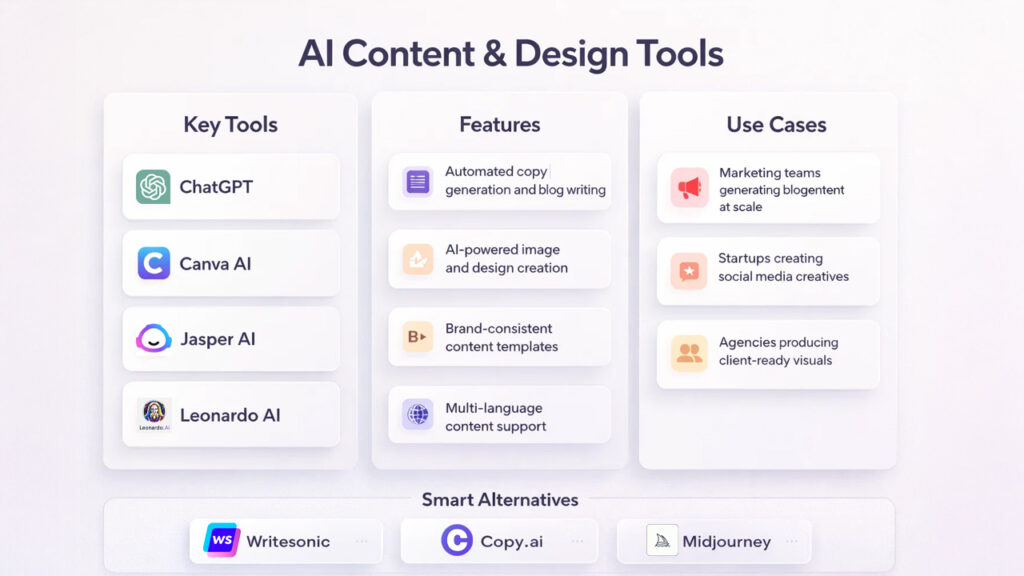
1. AI Content & Design Tools
Key Tools:
- ChatGPT
- Canva AI
- Jasper AI
- Leonardo AI
Among the emerging AI tools that are rapidly transforming digital workflows, platforms like Leonardo AI are gaining massive traction for creative automation, as explained in this detailed breakdown of Leonardo AI’s capabilities.
Features:
- Automated copy generation and blog writing
- AI-powered image and design creation
- Brand-consistent content templates
- Multi-language content support
Use Cases:
- Marketing teams use it to generate blog content at scale
- Startups utilize it to create social media creatives without needing designers
- Agencies use it to produce quick visuals that are client-ready
AI tools for content creation have become a necessity because they save significant hours by reducing content production time while also maintaining quality.
Smart Alternatives:
- Writesonic (content generation)
- Copy.ai (short-form marketing copy)
- Midjourney (advanced image generation)
2. CRM & Sales Automation Tools
Key Tools:
- HubSpot
- Salesforce
- Zoho CRM
- Pipedrive
Features:
- Lead tracking and pipeline management
- Automated follow-ups and email sequences
- AI-based sales forecasting
- Customer segmentation
Use Cases:
- Sales teams managing leads efficiently
- SaaS companies automating onboarding
- Agencies tracking client interactions
In 2026, CRM platforms are increasingly integrated with AI. Businesses leverage this to predict customer behaviour and optimize sales strategies.
Smart Alternatives:
- Freshsales
- Insightly CRM
- Monday Sales CRM
Looking for a Salesforce Alternative: Top CRM Platform to Choose From in 2026
3. SEO & Digital Marketing Tools
Key Tools:
- Ahrefs
- Semrush
- Surfer SEO
- SE Ranking
Features:
- Keyword research and competitor analysis
- Backlink tracking and audits
- Recommendations for content optimization
- Rank tracking
Use Cases:
- Businesses use these to improve organic search visibility
- Agencies manage multiple SEO campaigns
- Content teams use these to optimize blogs for higher ranking
To sustain long-term growth, SEO tools are essentials. Even the best product will struggle to gain visibility without them. For example, tools like Ahrefs along with providing backlink data, helps businesses to understand strategies of their competitors and identify ranking opportunities.
Smart Alternatives:
- Ubersuggest
- Mangools
- SERPstat
4. Productivity & Workflow Automation Tools
Key Tools:
- Notion AI
- ClickUp
- Slack
- Airtable
Features:
- Task and project management
- Workflow automation
- Tools for team collaboration
- AI-powered documentation
Use Cases:
- Managing projects by remote teams
- Startups automating their internal workflows
- Enterprises streamlining business operations
Those organizations that use automation tools save up to 30% of time that was being spent on repetitive tasks.
Smart Alternatives:
- Trello
- Asana
- Wrike
5. Data & Analytics Tools
Key Tools:
- Google Analytics 4
- Tableau
- Power BI
- Mixpanel
Features:
- Real-time data tracking
- Behaviour analysis of user
- Custom dashboards
- Predictive analytics
Use Cases:
- Marketing teams track performance of campaigns
- Product teams analysing user engagement
- Executives make data-driven decisions
Data is the backbone of modern business strategy. Growth decisions become a mere guesswork without analytics tools.
Smart Alternatives:
- Looker
- Heap Analytics
- Kissmetrics
How to Choose the Right AI And SaaS Tools
With so many options available, businesses must evaluate tools strategically.
Ask These Key Questions:
- Does the tool directly impact revenue or efficiency?
- Can your team adopt it quickly?
- Does it integrate with your existing tech stack?
- Does it replace multiple tools?
- Is the pricing scalable as your business grows?
Picking tools based on its hype rather than utility and purpose will lead to wasted investment.
Common Mistakes Businesses Make
Despite the availability of powerful tools, many businesses fail to see results due to:
- Overloading their tech stack
- Lack of proper implementation
- Ignoring training and onboarding
- Not aligning tools with business goals
The key is not the number of tools but how effectively they are used.
The Role of Strategy in Maximizing SaaS Tools
Tools are not enough to guarantee success. Businesses must align their tools with a clear strategy.
For example. SEO tools can be used to extract data but if there is no structured content strategy then the data becomes useless. Identifying missed opportunities through a process like content gap analysis helps businesses turn raw data into actionable insights and improve overall search performance.
Similarly, CRM systems are essential to automate and streamline workflows, but without proper lead nurturing strategies, conversions remain low.
The understanding of how to connect tools with clearly defined business goals whether it’s traffic growth, lead generation, or customer retention is what makes high-performing companies stand out from the crowd.
Future Trends in AI & SaaS (2026 and Beyond)
Looking ahead, several trends will shape the future:
1. AI-Native Platforms
Tools will no longer “include AI”—they will be built entirely around it.
2. Hyper Automation
End-to-end automation across marketing, sales, and operations.
3. Personalized User Experiences
AI-driven customization based on user behavior and preferences.
4. Integrated Ecosystems
Fewer standalone tools, more all-in-one platforms.
5. Predictive Decision-Making
Tools will not just analyze data they will recommend actions.
Conclusion
AI and SaaS tools have been transformed from just productivity enhancers to growth enablers. Those businesses that implement the right tools and adopt them strategically will lower their operational costs, outperform competitors and scale faster.
However, using a greater number of tools doesn’t determine success. The real success lies in choosing the right tools and aligning them with business objectives. As we move further into 2026, the companies that combine technology with strategy will be the ones that truly dominate their industries.
%201.png)

%201.png)

%201.png)