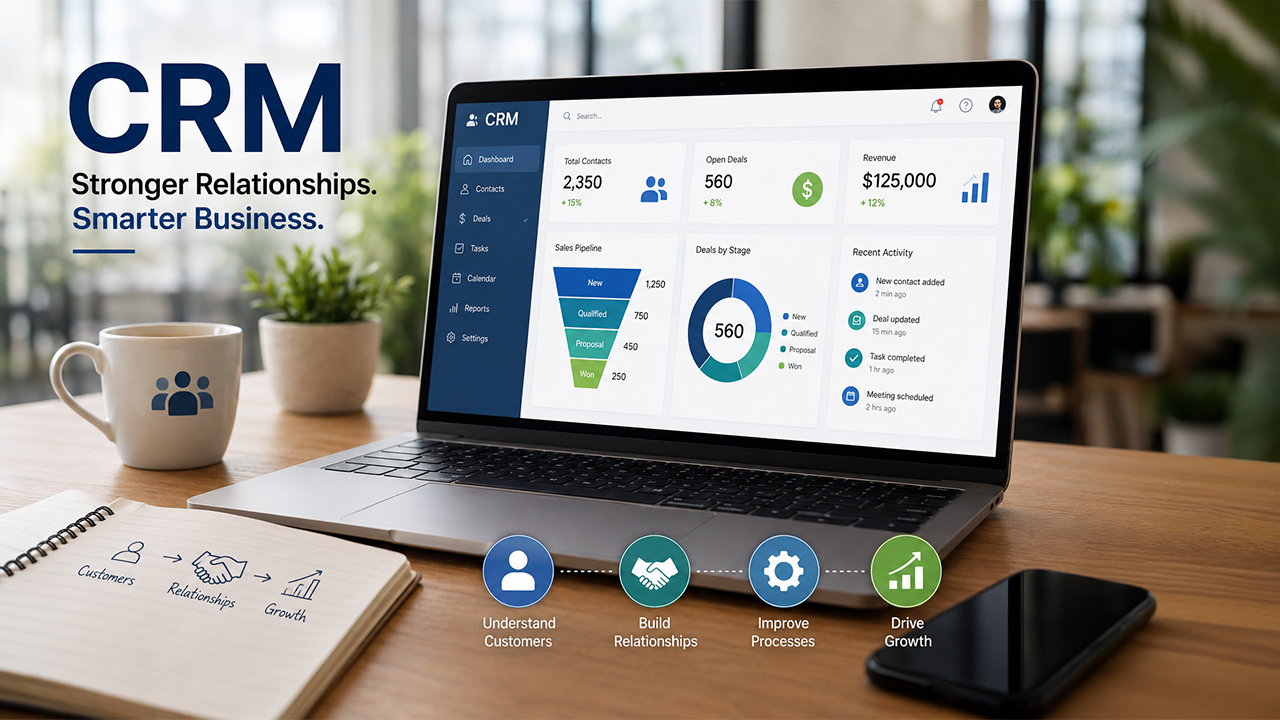

Customer Relationship Management software is defined as a technology that makes it simple for distinct departments across a business to share the latest data about prospects and customers. It is a software that powers customer relationship management and helps businesses establish lasting relationships, streamline processes, improve productivity, and boost revenue. Furthermore, most of the mainstream CRM software is very simple to use.
What Is CRM Software?
The core purpose of customer relationship management software is to convert raw customer data into insights. This can empower organizations to cater to customers better and strengthen their relationships. CRM does it by breaking down the silos that exist between distinct teams like marketing, sales, customer service, commerce, and more. A centralized and well-implemented CRM can make sure that cross-functional teams have access to the same data.
CRM software is a centralized system to store and organize customer data, such as interaction history, contact data, and communication preferences. It then converts this data into a valuable and centralized view of the journey of customers. With the help of these insights, businesses can provide optimal and customized customer experiences that cultivate loyalty and improve satisfaction. Today, a lot of CRMs are cloud-based, making it simple for employees to access data from any location and for businesses to reduce costs without having to maintain and install on-premises hardware.
Apart from the management of data, CRM software streamlines the process of monitoring all interactions your company might have had with the customer, such as through emails, phone calls, live chats, and social media. Equipping your employees with this knowledge can allow them to understand where customers are in the sales stage, what their pain points are, and the kind of experience they are expecting. It also aids them in recognizing opportunities for cross-selling and upselling.
Apart from catering to existing customers, you can also store and manage lead data in your CRM. A modern CRM like OutRightCRM can organize lead data, use AI, offer reporting capabilities, and entail advanced analytics to help you gain sophisticated insights to convert leads into customers.
Brief History of CRM Software
In the late 60s and 70s, businesses used to track their leads and contacts through offline methods like Rolodexes and journals. The genesis of modern CRM systems can be traced back to the 80s and early 90s, when businesses used to save their contacts and leads in digital database management systems, which then became Sales Force Automation (SFA) technology. As the industry evolved, vendors were encouraged to provide a broader set of services such as marketing automation, omni-channel communication, performance monitoring, and analytics and reporting.
Now, today, we can see that the evolution of CRM has been remarkable. CRM software is purpose-built to cater to the efforts of every customer-facing team in your organization, and not just the sales team. Accordingly, CRMs have become more advanced than just a sales automation tool. Enterprise CRMs of today close the gap between sales, marketing, and service teams, making sure all teams have access to the same data and a smooth customer experience across the board.
What Are the Advantages of CRM Software?
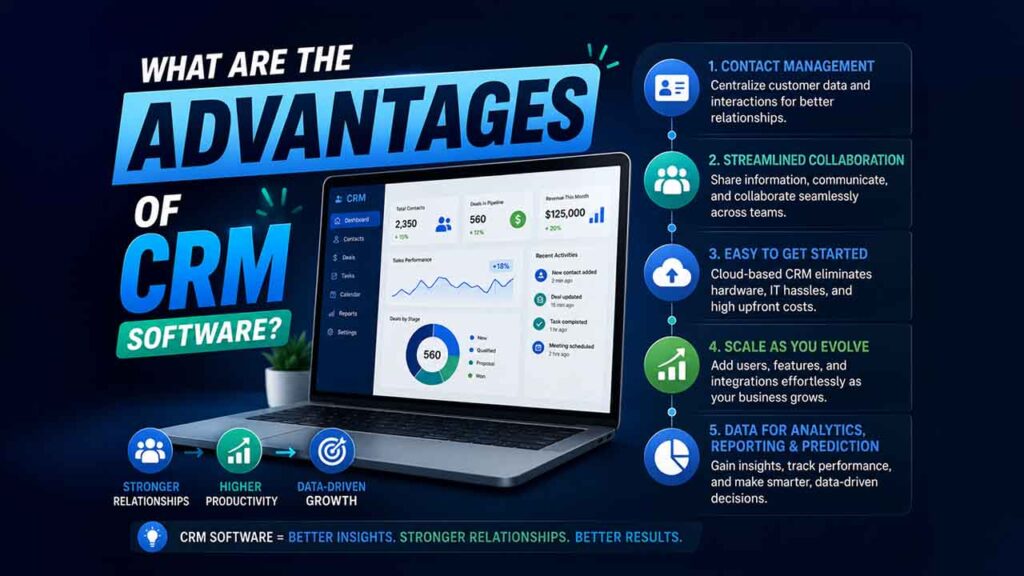
CRM management software can allow companies to boost customer engagement, improve productivity, and provide data-based growth. These are just some of the benefits of CRM software:
- Contact Management: At each stage of the customer lifecycle, all sales reps must be working with the same customer data. CRM software can help sales reps get purchase history, customer contacts, meeting notes, or previous service issues. If CRM software is implemented well, it can act as a single source of truth for all the company's data and client interactions.
- Streamlined Collaboration: CRM software makes it very easy for each employee to access customer information from wherever they are on any kind of device. It can also have an in-built communication feature powered by Twilio or Slack, making it simpler for the teammates to share data, discuss the next steps, and check files within the workflow.
- Easy to Get Started: If you utilize a modern and cloud-based CRM, there is no need to purchase servers, hardware, or additional security. And there is no need to recruit more IT employees because all your CRM provider handles all these responsibilities remotely. Organizations can leave such concerns behind and concentrate on strengthening customer relationships.
- Scale As You Evolve: Most CRMs are cloud-based and offer higher scalability, enabling you to add more users and features as you require them. Since everything is online-based, such updates do not need any downtime for updates or implementation. A cloud-based CRM will grow along with your business, minimizing the need for a new CRM solution every few years.
- Data for Analytics, Reporting, and Prediction: Analytics is one of the top advantages that can help you get a bird’s-eye view into sales performance. Not only will you gain insights into what is going on currently, but you will also know what you should expect in the future. Every team and employee will know what is relevant to them, along with recommendations on what actions they need to take next.
What Is the Role of AI in CRM Software?
The current trends of the industry emphasize a greater role of machine learning and AI in CRM systems. Not only does it give you real-time insights at each step of the customer life cycle, but AI-driven software such as Agentforce can also assess large volumes of information to recognize patterns and trends proactively that can ensure tailored customer experiences across distinct departments.
The advent of Generative AI has added even more productivity to your CRM software, empowering you to create new content such as marketing campaigns, sales emails, customer service responses, and personalized shop fronts. It is based on customer information stored within your customer relationship management tool.
- Automation Workflows: Automation is yet another time-saving characteristic of AI-driven CRM software. It can perform routine actions like lead generation, entry of data, and responding to requests of customer service, freeing up crucial time of the employees ' time for more strategic and complex tasks. This can enhance efficiency and enable businesses to render effective customer experiences at a lower cost.
- Lead Scoring: With its capability to assess prospect and customer data, AI aids sales teams in deciding which leads they must target. Introducing AI in CRM can recognize trends, such as which present prospects and sales cycles are similar to the ones your sales team has converted in the past. It can then recommend tactics that can help in your conversion. This approach aids companies in deciding where they have to put their efforts, boosting productivity and revenue.
- 24/7 Customer Support: AI chatbots that ensure automated customer support are always available and expedite the time it takes for customer enquiries to be managed. If the AI is always available, it can write call notes for service representatives and send follow-up messages with important insights to customers.
- Tailored Experiences: AI can assess large volumes of customer data and interactions and utilize them to ensure tailored product suggestions, discounts, and offers. Such learnings improve customer engagement and sales and can be applied proactively to customers that align with similar profiles. Such trends can also be utilized proactively to recognize potential issues in services or cross-selling opportunities.
- More Natural Interactions: Interacting with CRM software is quite simple when you integrate a conversational AI. Talking to a conversational AI would feel like talking to another person. AI tools such as Agentforce can not only answer common queries about your CRM but can also perform common tasks, such as creating marketing materials using just everyday language. Customers can also directly communicate with your AI as if they are talking to a service representative and get simple responses.
What Is Cloud-based CRM Software?
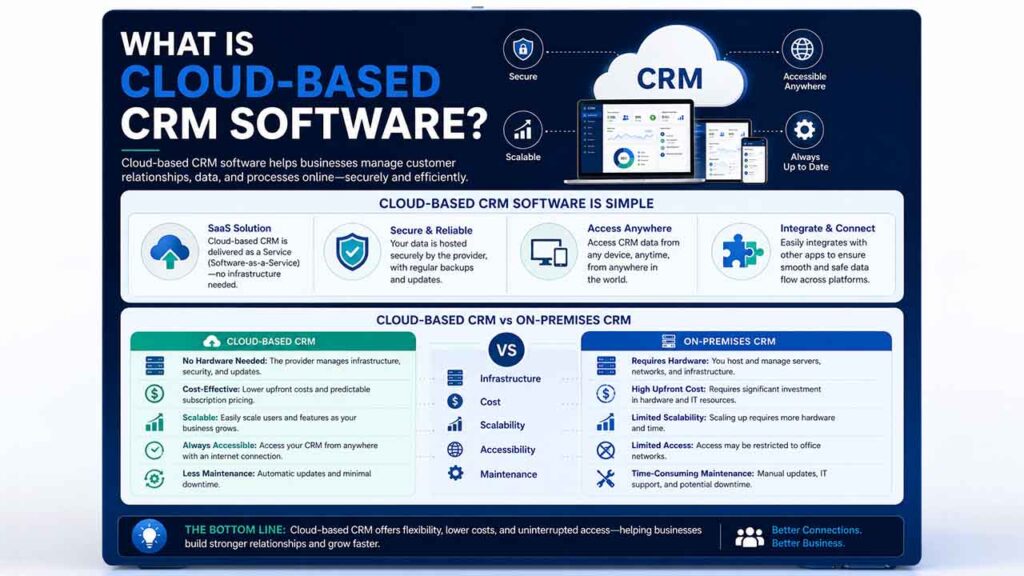
CRM software collects, manages, and assesses large volumes of data. In the initial days of CRM, such systems were mostly managed on premises at the organizations that utilized them. As technology evolved further, a lot of the digital tools we used for work and our everyday lives migrated to the cloud. Nowadays, on-premises CRM software is available, but they have become less popular with Cloud-based CRM solutions dominating the market.
Cloud-based CRM Software Is Simple:
Cloud-based CRM software is basically a SaaS (Software-as-a-Service) solution that is more robust, secure, and scalable. Here, the online CRM provider handles all infrastructure to host as well as run the system, removing the upfront expenses and responsibilities for managing security and updates.
Anyone who requires accessibility to the CRM platform to extract customer contact details, recognize customer service history, or review marketing campaign performance can access it across various devices, such as laptops, desktops, mobiles, and tablets. They can also incorporate with other external applications, allowing smooth and safe data flow between them, bringing all customer data into a centralized view.
Cloud-based CRM Vs On-premises CRM:
There are major differences between on-premises CRMs and cloud-based CRM. In the on-premises CRM model, a business can host as well as operate networks and servers in physical locations, which can store customer data. Generally, organizations can utilize this option since they are utilizing legacy platforms that were created decades ago, and sales reps (especially experienced ones) have become used to it. Another reason on-premises CRM software is valuable for companies because it helps in customer data management at locations where the internet is not stable.
No doubt on-premises CRMs provide absolute or superior control over data location and can help highly regulated industries with stringent regulatory requirements.
When compared to cloud-based CRMs, on-premises CRMs need considerable upfront expenses to install since it is built from scratch and on-location, instead of tapping into the present CRM infrastructure. On-premises CRMs also make it important for companies to recruit relevant personnel and/or outsource maintenance work to take the system offline to execute updates. Apart from all the costs involved, there is also time loss since employees who utilize the system cannot access it.
For these reasons, going ahead with a cloud-based CRM is preferable. Not only does it require minimal setup and costs, but it also leads to less disruption and downtime due to maintenance.
How Can You Avoid CRM Software Implementation Challenges?
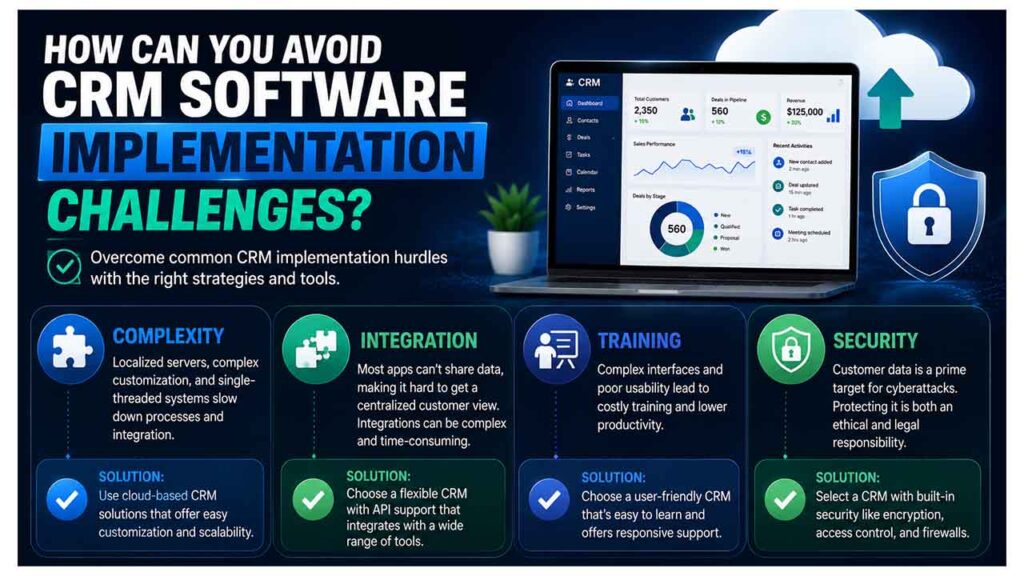
While there are many advantages to using CRM software, a few implementation challenges are inevitable. Generally, such issues emerge from more conventional and disorganized platforms. SaaS CRMs have been created to solve these issues, removing barriers to entry-
Complexity:
It can be tricky to execute a CRM that exists on a localized server since there is so much effort involved in personalizing such systems. In addition, single-threaded CRM solutions, which can only perform one action at a time, mitigate these processes and integration with other platforms.
Solution: Cloud-based CRM solutions can be personalized easily, providing you with higher customization options and scalability that align with your business needs.
Integration:
An average company utilizes around 1,000 applications. However, the majority of such apps are not able to share data with each other. It can be challenging to get a centralized view of the customer if a CRM is not able to access data from external software apps such as marketing, accounting, customer service, and e-commerce. Incorporating such platforms can be time-consuming, complex, and require substantial technical expertise.
Solution: Choose a flexible CRM like OutRightCRM that can provide API integration support and can be integrated with a broad range of external platforms.
Training:
If the CRM is not user-friendly like OutRightCRM, then it can have a complex user interface. Training employees to use this platform can be costly and time-consuming, shifting their focus from other productive tasks. Modern CRMs are designed to make your sales and marketing workflows more collaborative and easier to manage. However, having a CRM that is difficult to use can have an adverse effect on your workflow.
Solution: Choose a CRM that is user-friendly and offers responsive tech support.
Security:
Companies deal with a lot of confidential customer data, which can make it a popular target for cyberattacks. Not only is it an ethical obligation, but it is also a legal necessity for these businesses to secure customer data from cyberattacks and unauthorized access.
Solution: Select a CRM with in-built security, such as access control, encryption, and firewalls. Your CRM partner must also be working to secure its system from the latest threats.
How to Select the Right CRM Software for Your Business?
There are numerous important factors you need to consider when selecting a CRM that aligns with the requirements of your company. Every business is different, but you should choose one that aligns with any industry, company size, or requirements.
The Size of Your Business, Today and Tomorrow
When you are selecting between distinct CRM software options, think about your clientele, the volume of data you are working with, the number of employees, and the complexity of your customer interactions. Then, you should consider the volume of inquiries and requests you receive and the level of customization you want to provide. Once you do that, you should also consider how these might appear in the future. Starting with a CRM for small businesses is an ideal option. Then, as your business and data evolve, you can look for a complex and feature-packed solution.
Long-term Flexibility and Scalability:
Apart from selecting a CRM that scales as your business does, you can think about options that evolve with your technological advancement in the industry. Another significant factor is the capability of your CRM to integrate with other platforms and applications you utilize on a consistent basis.
Business Requirements and Processes:
Next, you can recognize available pain points and challenges you have when handling customer relationships and interactions. Define which CRM features and functionality have the capability to remove these frustrations and include them in your list of requirements.
Pricing and Customer Support:
Of course, a budget is a primary requirement when it comes to customer relationship management. Factor in all the potential expenses like subscription plans, scalability, and additional features you might need in the future. The overall cost of customer support is also a significant consideration. Numerous CRMs provide distinct levels of support. More investment at the start can pay off in the end with seamless implementation and higher ROI, leading to continued success and more informed employees.
Searching for the right CRM software can take some time. However, thinking about different factors that can influence your CRM journey can help you make the right decision. However, once you get the fundamentals right, you will be on your way to solidifying customer relationships, attracting fresh prospects, enhancing customer service, improve sales, boosting marketing efforts, and enabling your growth.
Is AI-driven CRM Software Popular?
Yes, AI-based CRM software is quickly becoming the standard in the industry, evolving from an experimental feature to a core business necessity in modern business workflows. In 2026, reports suggest that businesses will already use CRM software powered with generative AI features. Currently, more than 70% of CRM software in the market is predicted to be AI-driven in the future.
AI-driven CRM software is prominent because it advances CRM platforms from static recording tools into proactive intelligence systems, helping service, sales, and marketing teams in improving customer relationships and closing deals.
Key Statistics on AI CRM Adoption and Impact (in 2026)
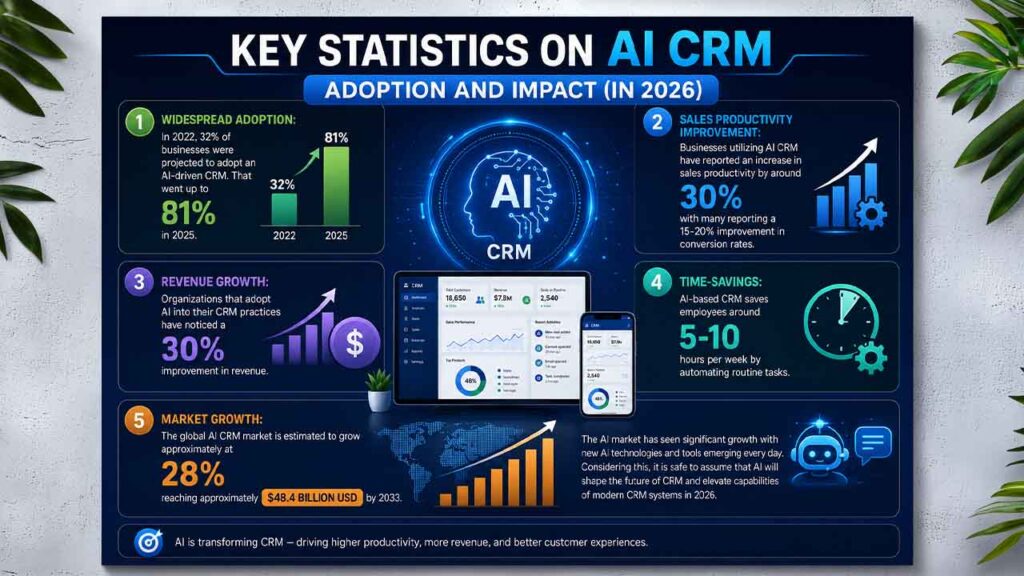
- Widespread Adoption: In 2022, 32% of businesses were projected to adopt an AI-driven CRM. That went up to 81% in 2025.
- Sales Productivity Improvement: Businesses utilizing AI CRM have reported an increase in sales productivity by around 30%, with many reporting a 15-20% improvement in conversion rates.
- Revenue Growth: Organizations that adopt AI into their CRM practices have noticed a 30% improvement in revenue.
- Time savings: AI-based CRM saves employees around 5-10 hours per week by automating routine tasks.
- Market Growth: The global AI CRM market is estimated to grow approximately at 28%, reaching approximately 48.4 billion USD by 2033.
The AI market has seen significant growth with new AI technologies and tools emerging every day. Considering this, it is safe to assume that AI will shape the future of CRM and elevate the capabilities of modern CRM systems in 2026.
Conclusion
CRM software has changed from being a standard contact database into smarter and AI-driven platforms that centralize marketing, sales, and service teams around a single source of truth of customer data. Irrespective of whether you are an evolving startup or a successful enterprise, the best CRM simplifies sales processes, boosts customer relationships, and ensures measurable growth in revenue. As AI reshapes the CRM landscape continuously, integrating a modern and cloud-driven CRM is no longer an afterthought; it has become a strategic requirement for sustainable business success.
FAQs About CRM Software
Q. What is CRM software used for?
A- A CRM software is a centralized system that is used to handle all interactions with the present and potential customers, looking to enhance business relationships, improve retention, and drive sales growth.
Q. What are the 4 types of CRM platforms?
A- The four types of CRM platforms include Analytical, Operational, Strategic, and Collaborative.
Q. Is it hard to learn CRM?
A- While the overall difficulty of a CRM varies from platform to platform, modern CRMs are designed to be simple-to-use and optimized for overall user experience. If the CRM provider offers you valuable resources and training, you can learn how to use CRM quite easily.
Q. What are CRM software examples?
A- Common examples of CRM software are as follows: OutRightCRM, HubSpot, Salesforce, and Zoho.
Q. What are the seven components of CRM software?
A- The seven components of a CRM software are as follows: 1) Contact Management, 2) Sales Force Automation, 3) Marketing Automation, 4) Customer Service and Support, 5) Analytics and Reporting, 6) Integration Capabilities, and 7) Mobile Access
%201.png)

%201.png)

%201.png)