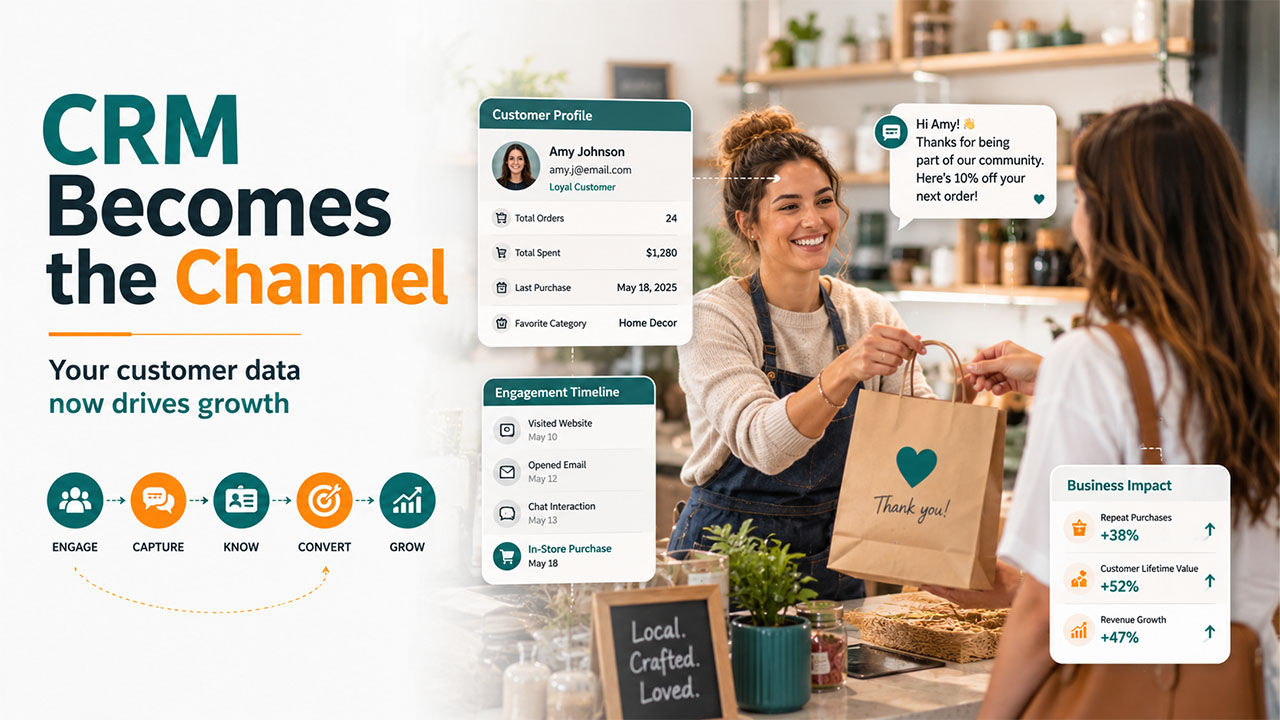

For fifteen years, the marketing playbook had a reliable opening move: publish content, rank in Google, collect organic traffic, convert a slice of it. In that model, the CRM lived at the end of the chain. It was a filing cabinet, the place leads went to sit after the website did the real work of attracting them. The website was the engine, and the CRM was storage. Today, CRM as a traffic channel is becoming the new growth model, allowing businesses to generate more value from existing customer relationships as organic search traffic declines.
That order is now reversing, and the reversal has real consequences for how technical teams should architect their stack.
As search engines send less traffic to websites, and AI assistants increasingly answer questions without anyone clicking through, the businesses that win aren't the ones with the most traffic. They're the ones that extract the most value from every contact they already have. The system that governs that value isn't the website anymore. It's the CRM. The filing cabinet is becoming the engine.
This piece walks through why the shift is happening, what it changes structurally, and how to re-architect around a CRM that's no longer the end of the funnel but the center of it.
The traffic model everyone built on is cracking
The assumption underneath most marketing operations is that organic search is a renewable resource: keep publishing, keep ranking, keep receiving visitors. For a long time that assumption held well enough to build entire businesses on. It is now being quietly invalidated. As traditional acquisition channels become less reliable, CRM as a traffic channel enables businesses to maximize every visitor, lead, and customer interaction instead of relying solely on new website traffic.
Google's shift toward AI Overviews and zero-click answers means a growing share of searches end on the results page itself. The user reads the synthesized answer and never visits a site. The publisher gets no session, no pageview, and no opportunity to convert. Analyses heading into 2026 have documented organic referral traffic to many content-driven sites declining sharply even while the underlying search demand stays flat or grows. The traffic didn't evaporate because the content got worse. It evaporated because the delivery mechanism changed.
For a CRM-driven business, this carries a specific and uncomfortable implication. If the top of your funnel is narrowing, the efficiency of your middle and bottom funnel has to rise to compensate. You can no longer out-publish the problem. You have to out-capture, out-convert, and out-retain it. And every one of those verbs is a CRM function, not a website function.
Three structural responses, all of which run through the CRM
When traffic becomes scarce and expensive, three capabilities become disproportionately valuable. Each one lives in the CRM, not on the marketing site. This is the core reason the CRM's role is being upgraded from passive store to active engine.
1. Capturing intent the moment it appears

If fewer visitors arrive, every visitor who does arrive matters more. The old pattern of letting people browse and hoping they eventually fill out a form wastes the scarce resource, because most visitors never fill out anything. Conversational AI plays a critical role in CRM as a traffic channel by capturing visitor intent and instantly creating actionable customer records.
This is where conversational capture has quietly matured. Early chatbots were rule-based deflection tools that frustrated users and captured almost nothing. The current generation behaves differently. Grounded in your own data and wired directly into the CRM, it qualifies, answers, and writes a structured contact record in real time. Catnap Web argues that chatbots have returned in a form that actually converts , and the operational reason is exactly this CRM linkage. A conversation that ends with a clean, enriched record in your pipeline is worth far more than a session that ends with a bounce.
The technical pattern looks like this:
Visitor question
- to Chatbot (grounded in CRM and knowledge base)
- to Intent and entities extracted
- to Match against existing contact, or create a new one
- to Record written with source, motive, and deal context
- to First-reply rule fires and a task is assigned to the owner
Notice the division of labor. The website's only job in this flow is to host the conversation. The value, meaning the structured and actionable record, is created and stored in the CRM. Move the website out of the picture and the engine still runs. Move the CRM out, and there's nothing left.
2. Classifying and enriching inbound automatically
A narrower funnel makes manual lead handling a luxury you can't afford. When thousands of organic visitors arrived each week, losing a few to slow or sloppy follow-up was tolerable. When every lead is harder and costlier to acquire, each one has to be classified, routed, and actioned without a human bottleneck. Automation ensures CRM as a traffic channel remains efficient by routing and enriching every lead without manual intervention.
Modern CRM workflows can take an inbound message and, before anyone touches it:
- Classify it as a sales inquiry, support request, or noise
- Match it to an existing contact or create a new one
- Extract motive, category, and any deal context
- Trigger the appropriate first response
- Update activity fields so the record never goes stale
This is the same logic high-volume operations already apply to inbound email. An arriving message is parsed, threaded against the right record, checked against spam thresholds, summarized, and acted on, often without a human touching it until a decision genuinely requires judgment. Platforms in the SuiteCRM family are built to host exactly this kind of automation through logic hooks, scheduled jobs, and workflow rules. The specific tooling matters less than the architectural point. The intelligence layer moves into the CRM, because that's where the data and the actions both already live. Putting the logic anywhere else means shuttling data back and forth across systems, and every hop is a place where a scarce lead leaks out.
3. Monetizing the contacts you already have
The cheapest lead is the one you already own. When acquisition gets harder, retention and expansion become the growth engine, and both are CRM-native motions, completely independent of how much new traffic Google sends.
Segmenting your existing base by behavior, triggering lifecycle campaigns, detecting churn signals before they become cancellations, and surfacing the right upsell at the right moment: none of these depend on a single new visitor. A business that has historically leaned on a constant top-up of fresh traffic often discovers, when that top-up slows, that it has been badly under-investing in the database it already paid to build. The traffic squeeze is simply the event that makes the neglect visible. The teams that already treat the CRM as an active revenue engine barely feel the squeeze. The teams that treated it as storage feel it acutely.
What this means for how you architect your stack

If the CRM is becoming the center of gravity rather than the end of the line, several priorities reorder themselves. The table below contrasts the assumptions of the old traffic-led model with the ones that hold up as search referrals decline.
The through-line across every row is convergence. Data capture, enrichment, and action all need to happen inside the CRM, instead of being scattered across a website, a separate form tool, a spreadsheet, and a sales rep's inbox. Each system boundary in that scattered setup is a seam, and every seam is where a more expensive, harder-won lead falls through. Consolidating the logic into the CRM doesn't just tidy the architecture. It directly reduces leakage at the exact moment leakage has become unaffordable.
For technical teams, this reframes a familiar set of tasks. Integration work that used to be optional, such as wiring the chat widget into the CRM, automating lead classification, building the enrichment pipeline, and setting up lifecycle triggers, moves up the priority list because it's now load-bearing for growth rather than a convenience. The CRM stops being the system you integrate last and becomes the one you design around first.
Organizations adopting CRM as a traffic channel should prioritize integrations, automation, and centralized customer data when designing their technology stack.
A note on build versus buy
None of this requires ripping out your platform. The shift is less about new software and more about changing what your existing CRM is responsible for. An open, extensible CRM that exposes hooks, an API, and a workflow engine can absorb most of these responsibilities incrementally. Start by capturing chat conversations as records, then layer in automated classification, then add enrichment, then lifecycle automation. Each step is independently valuable and compounds with the last. The goal isn't a big-bang replatform. It's a steady migration of intelligence from scattered tools into the system that sits closest to your customer data.
Building CRM as a traffic channel is an incremental process that focuses on expanding the CRM's role rather than replacing existing systems.
The uncomfortable opportunity
It's tempting to read the decline of organic traffic purely as a threat, and for businesses whose entire model was to rank and collect, it is one. But for any business that owns a customer database and runs a CRM, the same shift is also a forcing function toward something healthier: a model where growth depends on how well you serve and expand the relationships you already have, rather than on an algorithm's continued willingness to send you strangers.
The companies that thrive through the 2026 traffic shift won't be the ones who found a clever trick to claw back their rankings. The rankings may not come back, and chasing them is a bet on a mechanism that is structurally working against you. The winners will be the ones who stopped treating the CRM as a filing cabinet and started treating it as the engine, the active core where intent is captured, decisions are made, and revenue is grown from contacts they already have.
The decline in organic traffic highlights the growing importance of CRM as a traffic channel. Businesses that treat their CRM as the center of customer engagement, automation, and revenue generation will be better positioned to thrive in an AI-driven search landscape.
%201.png)

%201.png)

%201.png)