
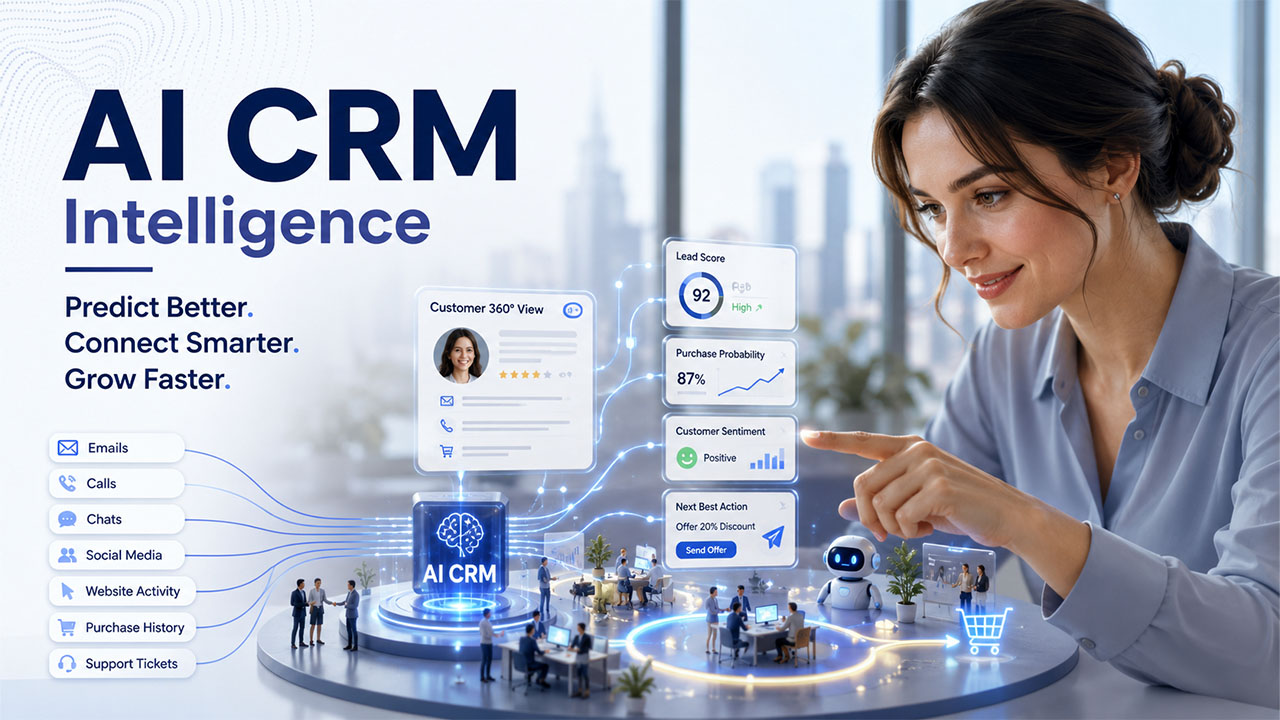

The expectations of customers are evolving at a rapid pace, and organizations can no longer depend on static databases to stay up to date. This is exactly where AI CRM can prove to be a game-changer. By integrating AI with conventional CRM tools, marketing, sales, and support teams work at a faster pace, comprehend customers better, and close deals with tremendous precision. Irrespective of whether you manage a growing startup or handle a big enterprise, adopting an AI CRM is fast becoming less of a luxury and more of an obligation to remain competitive.
In this blog, let us understand what we actually mean by AI CRM, how it is different from conventional CRM, the features that make it crucial, how integration operates, and why it is important for smaller teams as much as it is for larger teams.
What Is the Difference Between CRM and AI CRM?
Before you delve deeper, it is important to understand how AI-powered CRM is different from traditional CRM:
What Is CRM: A Customer Relationship Management software is a tool that organizes and stores customer data, including purchase history, contact details, and communication records. A conventional CRM platform mainly works as a database, needing manual entry as well as analysis.
On the other hand, an AI CRM takes the same foundation and adds a layer of AI on top. Instead of just storing data, it actively assesses patterns, forecasts outcomes, and automates repetitive tasks. This means an AI CRM does not just tell you what has happened with a customer; it enables you to predict what is possible to happen next and suggests the right course of action.
In short, a conventional CRM stores and organizes data, while an AI CRM helps you gain insights from that data and make data-driven decisions.
What Are the Features of AI CRM?
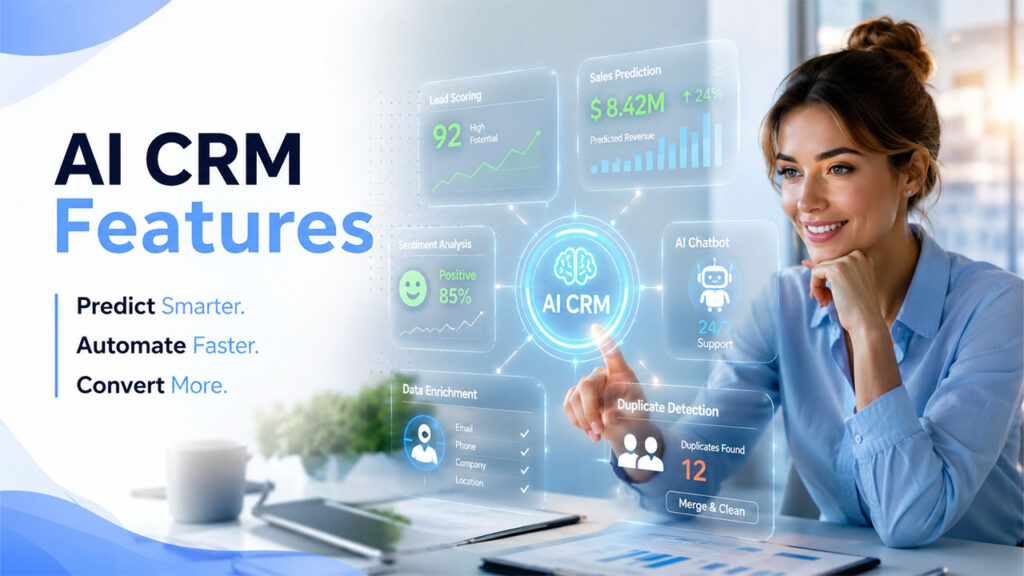
Modern AI CRM solutions come embedded with capabilities that go far beyond standard contact management. A few of the most crucial features of AI-driven CRM systems are as follows:
- Predictive Scoring of Leads – Automatically gives ranks to leads as per their likelihood of conversion, enabling sales teams to effectively prioritize.
- Sales Prediction – Leverages historical information and trends to ensure more precise revenue predictions.
- Smarter Chatbots and Virtual Assistants – Ensure round-the-clock support for customers and manage repetitive inquiries without the intervention of humans.
- Sentiment analysis – Go through customer interactions and social channels to assess real-time satisfaction levels.
- Automated Enrichment of Data – Fills in missing details of customers based on the data collected from different sources.
- Duplicate Detection – Flags, merges, or removes redundant records to ensure that the database always remains reliable and clean.
Such features operate together to minimize manual workload while enhancing the overall accuracy of each customer communication, making sure that AI CRM becomes a practical upgrade for teams of different sizes. In CRM software development, clarity on the core features is always crucial. Thus, teams building AI CRM should know what features a standard CRM entails.
AI CRM Integration: How It Operates?
AI CRM Integration refers to the process of integrating AI tools with your available customer data and workflows. Rather than being a one-time setup, it becomes an ongoing process that boosts the power of your CRM as more information flows through your platform.
Let us see how the process generally unfolds:
- Data Consolidation – Customer data from calls, emails, social media, and previous interactions is centralized into a single platform.
- AI Model Training – The system assesses historical information to recognize patterns in sales outcomes and customer behavior.
- Workflow Automation – Routine tasks like ticket routing, follow-up emails, and data entry are automated tasks as per the predetermined triggers.
- Third-party Connections – Most solutions provide support for integration with platforms such as e-commerce platforms, email marketing software, and communication applications. This facilitates automatic synchronization.
- Consistent Learning – As new information gets collected, the AI fine-tunes its recommendations, improving the overall intelligence of the system over time.
Powerful AI CRM Integration also relies heavily on the quality of data. Well-organized and clear customer information makes sure that the AI creates precise insights instead of offering misleading conclusions.
CRM for Small Businesses: Why Is It So Important?
There is a prevalent misconception that AI-powered tools are only suitable for big enterprises with heavy budgets. In reality, CRM for small businesses nowadays comes built-in with powerful AI and automation features, leveling the playing field.
Small teams generally do not have the manpower to track each lead manually or customize each customer touchpoint. An AI CRM aids in bridging this gap by:
- Automating routine administrative tasks, which frees up time for building strong relationships with customers.
- Providing precise sales forecasts without needing a dedicated team of analytics.
- Ensuring enterprise-level customer service via AI chatbots, even when you have a small support staff.
- Enabling users to recognize top value leads so limited resources get spent on key prospects to improve conversion rate.
For a small business, a higher automation level and insights can mean a great deal of difference between reacting to customer requirements and predicting them.
Challenges You Need to Keep in Mind

While the advantages are considerable, adjusting an AI CRM often comes with a few considerations:
- Execution time – Creating the system as well as training staff can take a lot of time, specifically for bigger businesses.
- Data privacy – Since AI CRM platforms manage confidential customer data, robust security measures and compliance protocols have become vital.
- Balancing automation with human touch – Over-dependence on automation can make interactions feel more impersonal if they are not carefully managed.
Businesses that create a strategy for such challenges initially often experience a seamless transition and lasting results from their AI CRM investment.
Future of AI CRM
CRM platforms are expected to become even more customized and predictive as AI capabilities become mature. Organizations adjusting to an AI CRM today have positioned themselves for long-term market credibility and revenue growth.
Important trends expected to shape the future of AI CRM:
Hyper-customization at Scale – AI will go beyond customer segmentation into broader groups and instead personalize messaging, offers, and timing to individual behavioral patterns.
Voice and Conversational AI – Voice recognition is anticipated to play a bigger role in how support and sales teams communicate and use CRM data, making platforms more accessible in routine workflows.
In-depth Predictive Analytics – Prediction will go beyond sales numbers and can also predict churn risk, customer lifetime value, and patterns of buying signals sooner in the relationship.
Better Emphasis on Transparency and Trust – As Artificial Intelligence becomes more integrated with decision-making, businesses might require clear governance on how customer information is utilized and how AI-powered recommendations are created.
As such capabilities advance, an AI CRM can transform from being a support tool to becoming a central driver of how organizations forecast and respond to customer requirements.
Conclusion
An AI CRM can no longer be considered a concept for the future; it is a real system that is transforming how organizations handle customer relationships nowadays. From predictive analytics to automated workflows, technology empowers teams to rely more on smart work than on hard work. Irrespective of whether you are exploring CRM for small businesses or strategizing AI CRM Integration for a bigger sales process, the objective always remains the same: converting raw customer information into actionable and meaningful insights. As customer expectations continue to evolve, organizations that adopt an AI CRM will have better chances of establishing long-term growth and lasting relationships.
FAQs About AI CRM
Q1. What is an AI CRM?
A- An AI CRM is software embedded with AI features to predict outcomes, automate tasks, and customize customer communications.
Q2. How is an AI CRM distinct from a conventional CRM?
A- A traditional CRM can store and organize customer information, while an AI CRM assesses the data actively to create forecasts, insights, and automated suggestions.
Q. Is AI CRM fit for small businesses?
A- Yes. CRM for small businesses greatly benefits from Artificial Intelligence, as it can automate routine tasks and ensure enterprise-based insights without needing a big team.
Q. How complex is integrating CRM with AI capabilities?
A- AI CRM Integration can take some time, as per the system complexity and data volume. However, the majority of modern platforms are specialized for simple setup and gradual scaling.
Q. Is customer information safe with an AI CRM?
A- Reputable AI CRM providers leverage access controls, encryption, and compliance protocols to secure confidential customer data throughout the platform.
%201.png)

%201.png)

%201.png)