
Digital commerce has moved far beyond simply "having a website." Customers now expect fast-loading pages, personalized product recommendations, seamless checkout experiences, and the ability to shop across devices without friction. Meeting these expectations takes more than a basic online store; it requires strategic planning, robust technology, and ongoing optimization.
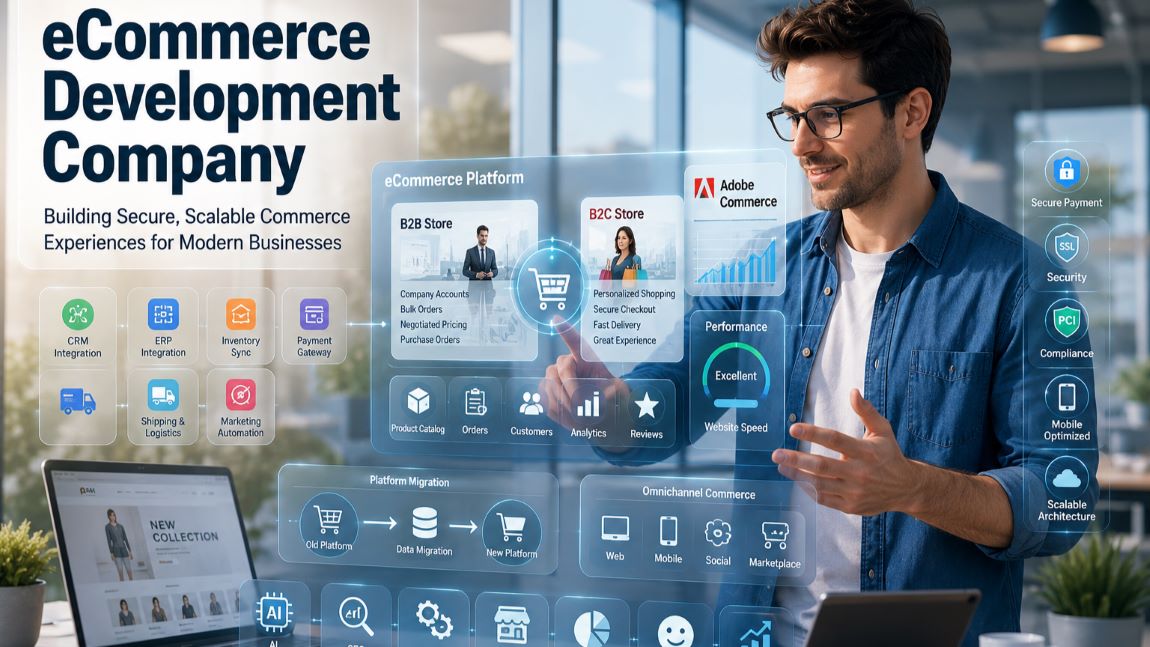
This is where an eCommerce Development Company comes in. These specialized partners help businesses design, build, integrate, and maintain commerce platforms that are secure, scalable, and built for growth, whether the brand serves other businesses (B2B), individual consumers (B2C), or both.
In this article, we'll cover the core services an eCommerce development partner offers, how their approach differs for B2B versus B2C brands, the role of Adobe Commerce Development in enterprise growth, what to expect during ecommerce platform migrations, and how to choose the right development partner for your business.
Before investing in advanced features or platform-specific customizations, businesses should understand the fundamentals of eCommerce website development, including responsive design, user experience, performance optimization, and scalable architecture. A strong foundation helps ensure long-term growth and better customer engagement.
What Is an eCommerce Development Company?
Definition and Core Responsibilities
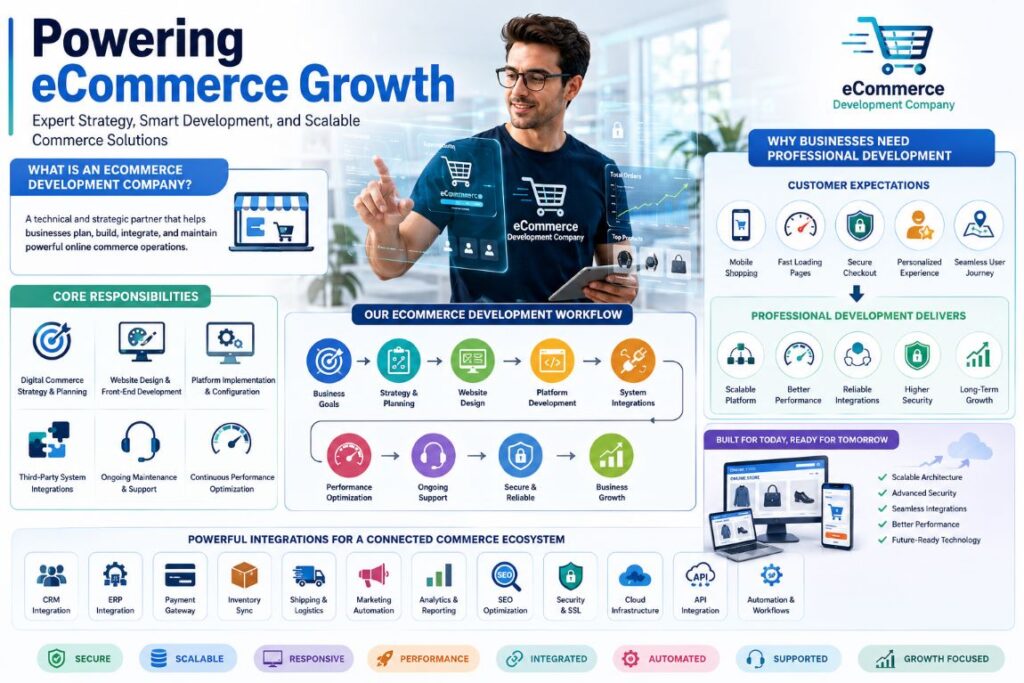
An eCommerce development company is a technical and strategic partner that helps businesses plan, build, and maintain their online commerce operations. Their responsibilities typically include:
- Digital commerce strategy and planning
- Website design and front-end development
- Platform implementation and configuration
- Third-party system integrations
- Ongoing maintenance and support
- Continuous performance optimization
Rather than treating a website as a one-time project, these companies build commerce ecosystems designed to evolve alongside the business.
Why Businesses Need Professional Development
Modern customer expectations have raised the bar significantly. Shoppers browse and buy from mobile devices, expect near-instant load times, and demand secure checkout experiences. At the same time, businesses need platforms that can scale during peak traffic, integrate with backend systems, and support faster growth without constant rebuilds. Professional development ensures all of these needs are met from the ground up, rather than patched together reactively.
Core Services Offered by an eCommerce Development Company
Custom eCommerce Website Development
Custom storefront development allows brands to move beyond generic templates. This includes responsive design for all devices, headless commerce architecture for flexibility, and continuous user experience optimization to improve conversions.
Platform Selection and Consultation
Choosing the right platform is one of the most important early decisions a business makes. Development companies help evaluate options such as Adobe Commerce, Shopify, BigCommerce, WooCommerce, and other enterprise-grade platforms, matching the platform's strengths to the business's goals, catalog complexity, and growth trajectory.
Adobe Commerce Development
Adobe Commerce (formerly Magento Commerce) remains a top choice for growing and enterprise businesses because of its flexibility and depth of features. Adobe Commerce Development typically includes:
- Enterprise-grade performance and scalability
- Multi-store and multi-brand management from a single backend
- Native B2B capabilities like company accounts and negotiated pricing
- Deep personalization tools
- Custom module development for unique business logic
For businesses outgrowing simpler platforms, Adobe Commerce provides the architecture needed to support complex catalogs, multiple storefronts, and high transaction volumes.
Third-Party Integrations
A commerce platform rarely works in isolation. Development companies connect the storefront with ERP systems, CRM platforms, payment gateways, shipping software, inventory management tools, and marketing automation platforms. Connected systems reduce manual work, minimize errors, and give businesses a single source of truth across operations.
Performance Optimization
Site speed directly affects both conversions and search rankings. Optimization work includes improving Core Web Vitals, mobile performance, image compression, caching strategies, and CDN implementation to ensure fast load times regardless of a customer's location or device.
Security and Compliance
Given the sensitive nature of payment and customer data, security is non-negotiable. This includes SSL implementation, PCI compliance, secure payment processing, data protection practices, strong user authentication, and regular platform updates to patch vulnerabilities.
How an eCommerce Development Company Supports B2B Brands
B2B commerce comes with unique operational complexity that consumer-facing stores don't typically face.
Complex Product Catalog Management: B2B sites often manage thousands of SKUs with detailed attributes, bulk ordering options, and layered categorization.
Customer-Specific Pricing: Development teams build tier pricing, contract pricing, wholesale pricing, and account-based catalogs so each customer sees pricing relevant to their agreement.
Quote Management: Features like Request for Quote (RFQ), negotiation workflows, and multi-step approval systems support the relationship-driven nature of B2B sales.
Business Account Features: B2B buyers often need multiple users per account, purchase approval hierarchies, corporate account structures, credit limits, and purchase order support.
ERP and Inventory Integration: Real-time inventory visibility, order synchronization, warehouse management integration, and accounting software connections keep B2B operations running smoothly behind the scenes.
How an eCommerce Development Company Helps B2C Brands
B2C commerce prioritizes speed, personalization, and emotional engagement to drive individual purchase decisions.
Creating High-Converting Storefronts: Strong UX/UI design, mobile-first layouts, and conversion rate optimization all work together to turn browsers into buyers.
Personalized Shopping Experiences: Product recommendations, customer segmentation, personalized promotions, and AI-powered search help each shopper feel like the store was built for them.
Omnichannel Commerce: B2C brands need consistency across online stores, mobile apps, social commerce channels, and marketplaces, all unified into one customer experience.
Marketing and Customer Retention Features: Loyalty programs, email marketing integrations, review systems, coupon engines, wishlists, and cart recovery tools help retain customers long after the first purchase.
B2B vs. B2C eCommerce Development: A Quick Comparison
| Requirement | B2B Focus | B2C Focus |
| Pricing | Tiered, contract, and account-based pricing | Fixed, promotional pricing |
| Ordering | Bulk orders, quotes, purchase orders | Single-item, cart-based checkout |
| Accounts | Multi-user corporate accounts with approvals | Individual customer profiles |
| Catalog | Large, attribute-heavy SKU sets | Curated, marketing-driven product sets |
| Engagement | Relationship and negotiation-driven | Personalization and promotion-driven |
| Integrations | ERP, procurement, accounting systems | Marketing automation, loyalty, social commerce |
Many modern platforms, including Adobe Commerce, support hybrid models allowing a single business to serve both B2B and B2C customers from one unified platform.
The Importance of eCommerce Platform Migrations
Why Businesses Migrate
Companies typically migrate platforms due to outdated technology, slow website performance, limited functionality, difficulty scaling, or the need for better integrations with modern tools.
Common Migration Challenges
Migrations carry real risk if not managed carefully, including data loss, SEO ranking drops, extended downtime, broken URLs, and disruption to the customer experience.
How an eCommerce Development Company Ensures a Smooth Migration
A structured migration approach includes detailed planning, careful data transfer, SEO preservation strategies, proper redirect mapping, thorough testing before launch, and dedicated support during and after go-live to catch and resolve issues quickly.
Signs it may be time to migrate:
- Your current platform can't support new integrations or features
- Site speed and uptime issues are affecting sales
- Managing your catalog or pricing requires manual workarounds
- Your platform can't support growth into new markets or channels
- Development and hosting costs are rising without added value
Benefits of Working with an eCommerce Development Company
- Faster project delivery through established processes
- Access to deep technical expertise
- Improved customer experience and conversion rates
- Better scalability as the business grows
- Stronger security posture
- Ongoing maintenance and proactive support
- Reduced long-term operational costs
- Future-ready, adaptable architecture
- Improved return on investment over time
How to Choose the Right eCommerce Development Company
Industry Experience: Look for a partner familiar with your specific business model, whether B2B, B2C, or both. Choosing the right partner involves more than comparing pricing or technical skills. Businesses should carefully evaluate an agency's portfolio, industry expertise, communication process, delivery methodology, and post-launch support before making a decision. This detailed guide on choosing a software development agency can help you identify the key factors that lead to a successful long-term partnership.
Platform Certifications: Verified expertise, such as Adobe Commerce certifications or experience with other enterprise platforms, signals technical credibility.
Portfolio and Case Studies: Real project examples show how a company has solved problems similar to yours.
Integration Expertise: Confirm experience connecting to the specific ERP, CRM, or payment systems your business relies on.
Post-Launch Support: Ongoing maintenance, security updates, performance monitoring, and feature enhancements are just as important as the initial build.
Common mistakes to avoid when selecting a partner include choosing based on price alone, overlooking post-launch support terms, failing to verify platform-specific experience, and not asking for references tied to your industry or business model.
Future Trends in eCommerce Development
Looking ahead, several trends are shaping how development companies build commerce experiences: AI-powered personalization, headless and composable commerce architectures, Progressive Web Apps (PWAs), voice commerce, workflow automation, predictive analytics, augmented reality (AR) shopping experiences, and unified commerce that blends online and offline channels into one seamless journey.
Conclusion
An eCommerce Development Company plays a critical role in helping businesses build, optimize, and scale their digital commerce operations. From custom storefront design and third-party integrations to specialized capabilities like Adobe Commerce Development and seamless ecommerce platform migrations, the right partner brings together technical expertise, security, and long-term strategy.
Whether you're a B2B manufacturer managing complex pricing structures, a D2C brand focused on personalized customer experiences, or a hybrid business serving both audiences, choosing an experienced development partner ensures your platform is built not just for today's needs, but for sustained growth well into the future.
ioVista is a best eCommerce Development Company, bringing proven expertise in Adobe Commerce Development, seamless ecommerce platform migrations, and end-to-end support for both B2B and B2C brands looking to build, optimize, and scale their digital commerce operations.
Frequently Asked Questions
What does an eCommerce Development Company do?
It plans, builds, integrates, secures, and maintains online commerce platforms for businesses, covering everything from storefront design to backend system integrations.
How does Adobe Commerce Development benefit growing businesses?
It offers enterprise-grade scalability, native B2B features, multi-store management, and deep customization, making it suitable for businesses outgrowing simpler platforms.
What are ecommerce platform migrations?
They are the process of moving an online store from one platform to another, typically to gain better performance, functionality, or scalability, while preserving data, SEO value, and customer experience.
When should a business migrate to a new eCommerce platform?
Common triggers include slow performance, limited functionality, scaling difficulties, integration limitations, and rising costs relative to platform value.
Can one eCommerce platform support both B2B and B2C?
Yes. Platforms like Adobe Commerce are built to support hybrid B2B/B2C models from a single backend, including separate pricing, catalogs, and account structures for each audience.
How long does an eCommerce development project usually take?
Timelines vary based on complexity, but most custom builds range from a few months for standard storefronts to longer timelines for enterprise-grade platforms with extensive integrations.
%201.png)

%201.png)

%201.png)