


Every evolving business relies on a steady flow of qualified leads, and this is precisely where the lead generation tools prove to be crucial. Such solutions aid organizations in attracting, capturing, and sorting customer data, so marketing and sales teams can concentrate better on strengthening relationships instead of chasing scattered data. Whether you run a small business, a large enterprise, or an agency, selecting the best lead generation software can greatly enhance how you convert visitors into loyal customers in an efficient way.
In this blog, we have explained a few of the most efficient lead generation tools that are available today, along with what makes each one valuable for distinct business requirements. You will also learn about the functionalities of these platforms, what you need to look for while choosing one, and why integrating the right set of platforms generally works better instead of depending on a single tool.
What is Lead Generation Software?
Lead generation software refers to a whole category of online tools specialized to aid businesses in recognizing, attracting, and collecting data about possible customers. Such platforms generally combine numerous functionalities into a single system, including:
- Landing pages and web forms to gather details of visitors.
- Email marketing automation for engaging prospects.
- CRM integration to sort and monitor leads.
- Live chat features and chatbots for engagement in real-time.
- Analytics dashboards to keep track of campaign performance.
Most lead generation systems work by using CTAs (Call-to-Action), like pop-ups or forms, displaying them in front of website visitors, then sending that captured data into a simplified platform. From there on, sales and marketing teams can foster leads through personalized email sequences, tailored outreach, or automated follow-ups until the prospect is ready to purchase. A lot of modern solutions also factor in workflow automation and reporting, so teams can exactly see where leads exist in the pipeline without updating spreadsheets manually.
Best Lead Generation Tools to Consider
1. OutRightCRM
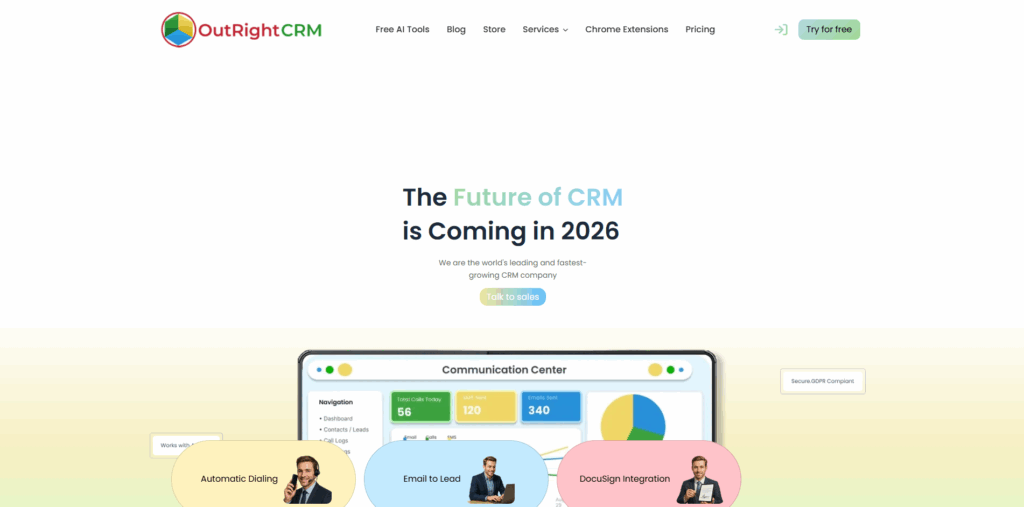
OutRightCRM is a SaaS and AI-driven CRM platform created to aid businesses in handling sales, customers, leads, and day-to-day operations from one simplified workspace. Instead of scrambling through separate tools for marketing, sales, support, and operations, teams can centralize all these functions into one platform, which aids in replacing scattered spreadsheets and disconnected tools.
Core capabilities are as follows:
- Customer and Contact Management, ensuring a simplified database of accounts, prospects, notes, and communication history.
- Lead Management, empowering businesses to capture, sort, assign, and foster leads from different acquisition channels so that no opportunity is ever missed.
- Sales Pipeline Management, with tracking of opportunities, personalizable stages, and prediction to enhance conversion rates.
- Workflow automation for task assignments, notifications, follow-ups, reminders, approval workflows, and routing of leads.
- Communication and Mail Management, ensuring that customer interactions and conversation history are in one simplified interface.
- Task and activity management, making it simple to assign activities, schedule meetings, and track deadlines.
- Team collaboration, providing each department with shared access to customer workflows and data.
- Real-time dashboards and reporting, encompassing pipeline health, sales performance, lead conversion, and revenue trends.
The platform can be customized to suit businesses of different sizes, including agencies, startups, and evolving enterprises, and supports a broad range of industries like healthcare, real estate, SaaS, recruitment, and call centers. Since it centralizes pipeline tracking, lead capture, and communication management within a single environment, OutRightCRM is a go-to choice for businesses that wish to minimize the number of individual lead generation tools they rely on.
2. HubSpot
HubSpot is a broadly utilized marketing and CRM solution that integrates email automation, lead capture forms, and pipeline management into a single synchronized system. It is specifically popular among enterprises that require a centralized and large environment of add-ons and integrations, making it a versatile option as a company grows. The platform is streamlined into distinct hubs, including Sales Hub, Marketing Hub, and Service Hub, which enables businesses to begin with core CRM capabilities and gradually include more sophisticated service or marketing capabilities as their requirements scale up.
A few prominent reasons businesses prefer HubSpot as one of their main lead generation tools include:
- Free CRM tier, which democratizes access to startups and smaller teams that are looking to adopt CRM without large-scale upfront investment.
- Built-in form builders and landing pages, enabling marketing teams to generate lead capture pages without requiring separate design tools.
- Marketing automation workflows, which aid in fostering leads through email sequences as per their behavior and engagement.
- Extensive integration marketplace, integrating HubSpot with hundreds of third-party apps, from e-commerce solutions to advertising software.
- Reporting dashboards, providing sales and marketing teams with better visibility into which campaigns are creating the most qualified leads.
Due to its modular structure, HubSpot is the right option for businesses that expect to broaden their marketing efforts and lead generation over time, instead of looking for a single-purpose and compact tool.
3. Salesforce:
Salesforce provides sophisticated reporting and customization capabilities, making it the right option for big businesses with complex sales processes. Its wide marketplace of add-ons, known as AppExchange, enables organizations to personalize the platform to specific lead generation workflows, though it generally needs more setup time than straightforward tools. Salesforce provides the most third-party configuration options among the different platforms available in the market. This is why numerous enterprises with distinct territories, sales teams, or product lines depend on it to handle their pipelines.
Main facets of Salesforce that provide support to lead generation efforts involve:
- Highly Tailored Opportunity and Lead Objects, enabling businesses to collect the precise data points associated with their sales process.
- Advanced Automation Tools, like Process Builder and workflow rules, to automatically route and qualify leads.
- Deep Analytics and Reporting, providing sales leadership with in-depth visibility into prediction and pipeline health.
- AppExchange Marketplace, providing third-party apps and integrations to add to the core functionalities.
- Scalability for large teams, providing support to complex structures in the organization with different regions or business units.
As the flexibility of Salesforce is a big advantage, businesses must be prepared to invest in initial configuration and, in a lot of cases, involve a dedicated administrator to effectively manage the platform.
4. Mailchimp
Mailchimp excels in nurturing and email marketing tools. Businesses leverage it to create automated drip campaigns that help lead through the buyer’s journey with timed and relevant content, making it an effective choice for teams mainly focused on email-based nurturing. Although Mailchimp essentially started as an email marketing tool, it has evolved over time to involve wider marketing platform features, including audience segmentation and CRM functionality.
Notable characteristics that make Mailchimp valuable for nurturing leads include:
- Segmentation of Audience, enabling businesses to segment leads as per engagement, behavior, or demographic data.
- Automated email journeys, which send personalized content as per triggers, like website visits or form submissions.
- Performance analytics, including click-through rates, open rates, and campaign comparisons.
Mailchimp is an effective option for businesses where email is a key channel for engaging prospects, instead of those requiring a full sales pipeline or sophisticated CRM capabilities.
5. Intercom
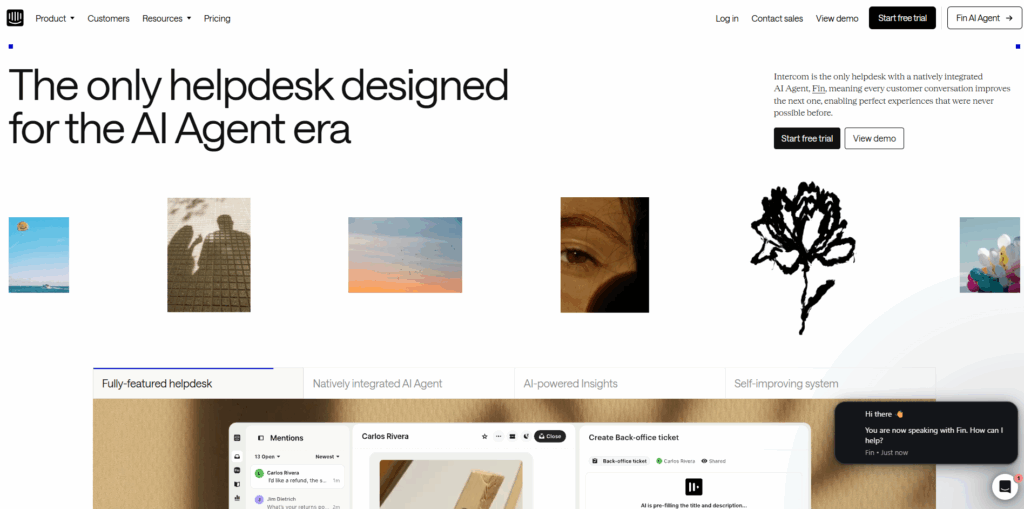
Intercom is a popular chatbot and live chat solution that allows businesses to engage website visitors in real-time. This instant interaction generally aids in collecting contact information before the visitor exits the page, which can be crucial for service-driven or SaaS businesses where prospects often face quick questions before conversions.
A few ways Intercom provides support to lead generation involve:
- Real-time live chat, enabling support or sales teams to instantly answer visitor questions.
- Automated chatbots, which can route conversations and qualify leads to the right team member outside business hours.
- Personalized on-site and in-app messaging, enabling businesses to reach out to visitors proactively as per their behavior.
- Integration with helpdesk and CRM tools, ensuring captured lead data flows into current sales workflows.
Because it emphasizes real-time engagement instead of long-term nurturing, Intercom is generally utilized along with other lead generation tools instead of a standalone solution.
6. Calendly
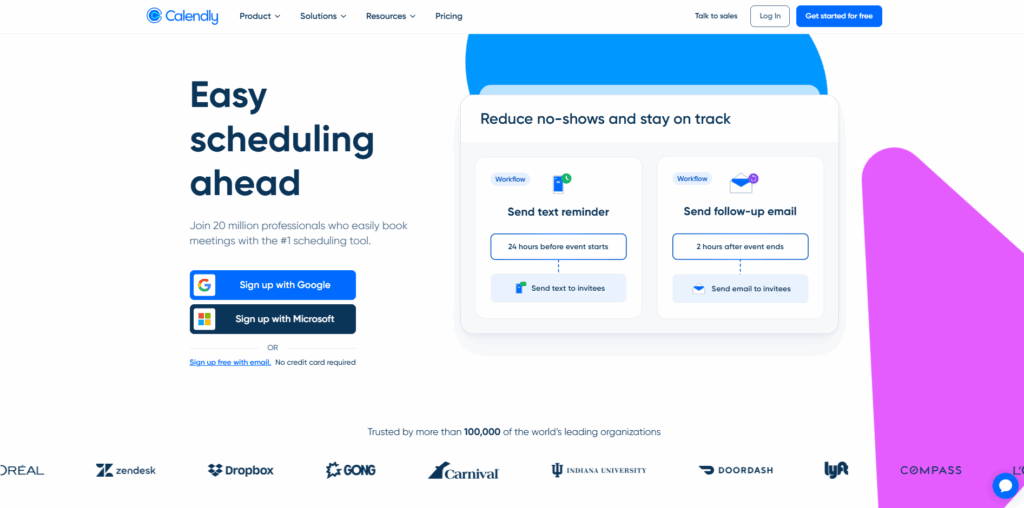
Once a prospect expresses interest, scheduling friction can make the conversions slow. Calendly eliminates this obstacle by enabling leads to directly book meetings on the calendar of the sales representative without back-and-forth emails, allowing you to reduce the time between conversions and interest. This level of frictionless scheduling can enhance rates of conversion meaningfully, specifically for businesses where the sales process relies on demonstration or discovery calls.
Key features that make Calendly useful in a lead generation workflow include:
- Calendar integrations, syncing with tools like Google Calendar and Outlook to avoid double bookings.
- Customizable booking pages, which can be embedded directly on landing pages or shared through email campaigns.
- Automated reminders, reducing no-show rates for scheduled calls or demos.
- Round-robin scheduling, distributing meetings evenly across a sales team.
By removing manual coordination from the scheduling process, Calendly helps businesses convert interested leads into booked conversations more quickly.
7. Apollo
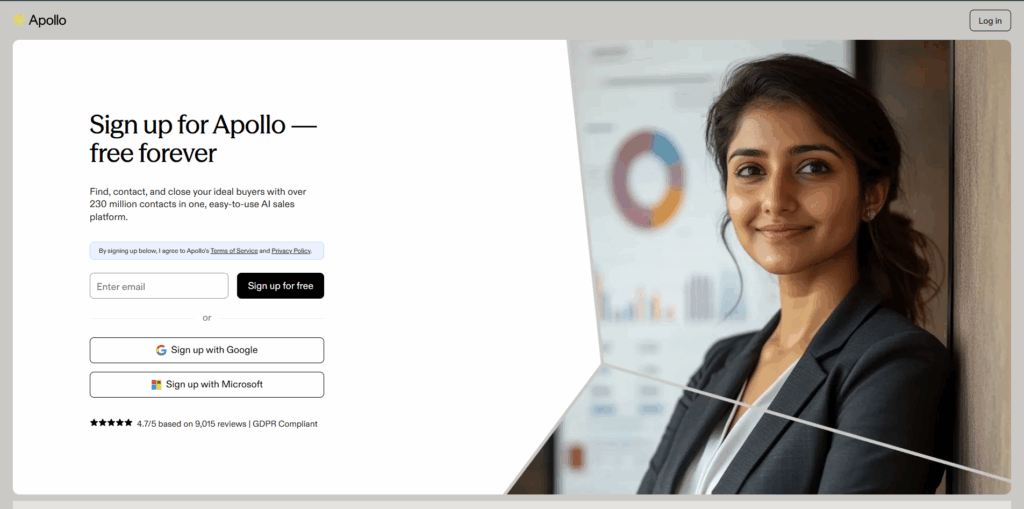
Apollo refers to a data enrichment and sales prospecting tool that aids sales teams in finding verified contact details and adding valuable role or company data to present leads, which provides support for personalized outreach. It is generally used early in the funnel, before a prospect has directly engaged with the business, to aid sales teams in recognizing and reaching out to the right decision-makers.
A few of the main capabilities that Apollo provides are as follows:
- A searchable contact database, enabling sales teams to organize prospects by job title, industry, company size, and other criteria.
- Data enrichment, adding phone numbers, verified emails, and firmographic details to available lead records.
- Sales engagement sequences, allowing multi-step and automated outreach campaigns.
- CRM integrations, synchronizing up-to-date data into existing marketing or sales systems directly.
Apollo is specifically valuable for organizations running external prospecting efforts, where identification and reaching the right contacts is just as significant as nurturing leads once they are captured.
How to Choose the Right Lead Generation Tool
Choosing the right lead generation tools for your business relies on numerous factors:
- Business Size and Budget: Smaller businesses may go for cost-effective solutions that centralize different functions, while enterprises may require highly customizable and sophisticated platforms.
- Available Tech Stack: Select tools that smoothly integrate with your email platform, current CRM, and other software.
- Team workflow: Consider whether your team requires a simpler and more hands-on approach or heavy automation.
- Scalability: Choose a platform that can evolve along with your business instead of one that will have to be replaced in a year.
- Reporting needs: If tracking Return on Investment is a priority, look for platforms with reporting dashboards and robust analytics.
- Industry fit: A few platforms are created to provide support to particular industries, like healthcare, real estate, or recruitment, so it is beneficial to go for a platform specially built for your industry.
It is generally recommended to use a combination of advanced tools instead of depending on a single solution, since each tool often specializes in a particular stage of the lead generation funnel, from initial capture to final conversion. On the other hand, businesses that centralize core functionalities, like pipeline tracking and lead management, within one CRM often find it simpler to make sure that data remains consistent across distinct departments.
Conclusion
Selecting the best lead generation tools is not optional for businesses anymore that wish to remain competitive. Solutions such as OutRightCRM lead the market by streamlining lead management, sales pipeline tracking, and workflow automation into a single workspace, while specialized platforms like Mailchimp, HubSpot, and Calendly address a particular stage of the sales funnel. By assessing your business requirements, current systems, and growth objectives, you can create a lead generation stack that delivers measurable results consistently and ensures long-term revenue growth over time.
%201.png)

%201.png)

%201.png)