
Every B2B software company has a pipeline report, and every pipeline report has the same blind spot. It starts at the first touch.
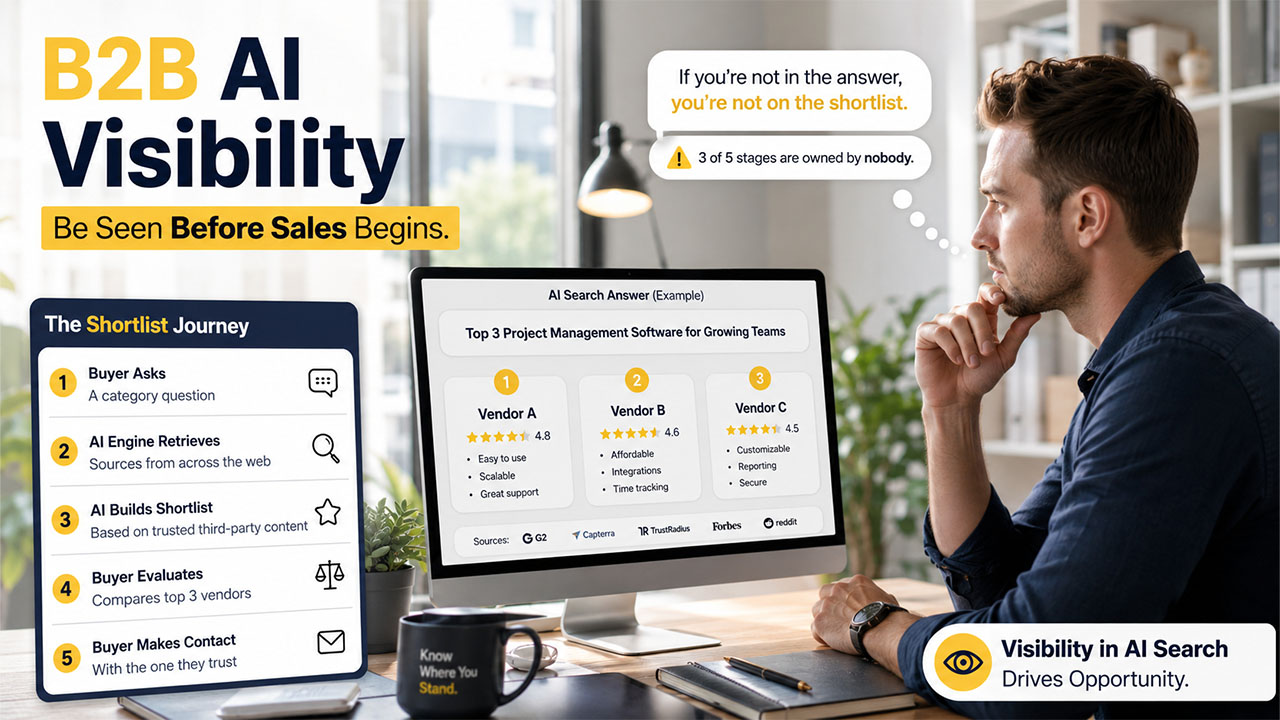
But the AI search shortlist forms earlier than that. A buyer types a category question into AI search engines, gets three vendor names in a paragraph, and starts evaluating. If you are not one of the three, no first touch ever happens. Nothing enters the CRM. Nothing is marked lost, because nothing was ever open.
A lost demo shows up in the pipeline. An answer that never named you shows up nowhere.
The 5 stages, and who owns each
It helps to map the stages that build the AI search shortlist, because the ones that matter now are the ones no department owns.
| Stage | What decides it | Who controls it today |
| Buyer asks a category question | which engines they use | nobody |
| Engine retrieves sources | whether your site is crawlable by that engine | whoever set up the site, years ago |
| Engine assembles a shortlist | what third-party sources say about the category | analysts, review sites, forum threads |
| Buyer evaluates three vendors | your product and pricing | product marketing |
| Buyer contacts one | your sales process | sales |
Marketing and sales own the bottom two rows. Almost every company measures those two rows exclusively.
The top three rows decide whether the bottom two ever happen, and they sit with nobody. Search belongs to marketing. Technical crawl rules belong to whoever configured the site four years ago. Third-party category coverage belongs to PR, who measure it as coverage rather than as retrieval.
That is the whole gap.
Why B2B software is more exposed than most categories
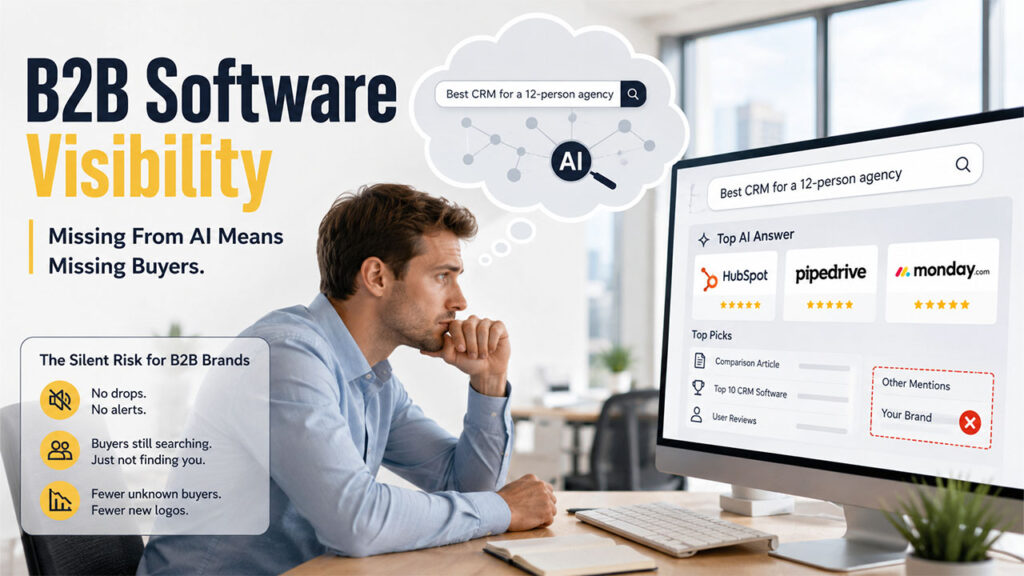
Buyers ask category questions, not brand questions. "Best CRM for a twelve-person agency" is exactly the shape an answer engine handles well. Your brand-name traffic is fine. Your discovery traffic is what moves, and discovery traffic is where new logos come from.
The engine cites reference material, not vendor sites. Comparison articles, review platforms, forum threads and buying guides carry more weight than any page you own. You are being described to a machine, by third parties, in your absence.
The failure is silent. No ranking drops. No traffic dips. No alert fires. The first symptom is a slow decline in inbound from buyers you have never heard of, which is indistinguishable from a hundred other things.
Finding out where you stand, without spending anything
Twenty minutes, in this order.
One. Open yourdomain.com/robots.txt and look for the AI crawler user agents. They are separate from Googlebot and obey separate rules, so blocking them costs you nothing in Google and everything in answer engines. Many sites added blanket disallows during the 2023 scraping wave and never revisited them. Note that the agents which gather training data are distinct from the ones that fetch pages to cite in live answers. Blocking the former is a defensible position. Blocking the latter removes you from the shortlist.
Two. Write down five category questions your buyers ask before they know you exist.
Three. Ask each in the engines your buyers actually use, three times each. The answers will not match. That variation tells you whether you are genuinely absent or sitting on the boundary, which are different problems with different fixes.
Four. Log which sources the engine cited. That list is your real competitive set, and appearing on those pages moves the answer faster than anything you publish on your own domain.
If you would rather not repeat that every month, the free AI visibility checker runs steps two to four across four engines on a free account.
What the tools in this category actually do
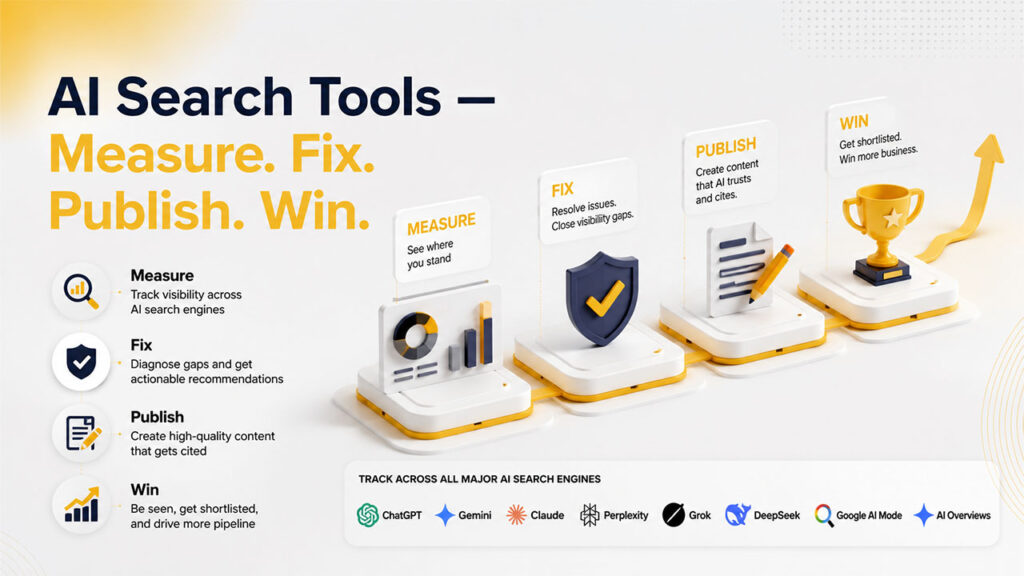
If the manual pass shows a persistent gap, a tool makes sense. The useful axis is not how many engines each one watches, because they have largely converged. It is what happens after the measurement.
All of the below comes from each vendor's own public pages, checked 27 July 2026. Where a capability is not described publicly, the table records that rather than assuming it is absent.
| Reports the gap | Diagnoses crawler access | Recommends with evidence | Produces the content | Ships it live | |
| Honeyb | yes | yes | yes | yes | 6 CMS platforms |
| Profound | yes | not documented | not documented | yes, Profound Agents | not documented |
| Otterly | yes | GEO URL Audits | not documented | not documented | not documented |
| Peec AI | yes | not documented | not documented | not documented | not documented |
| AthenaHQ | yes | not documented | not documented | yes, AthenaHQ Content | Shopify |
Every column after the first is where the category thins out, and the last two are where it nearly empties.
Profound is the right choice for an enterprise team with an analytics function and the headcount to act on what it surfaces. Otterly suits a team that wants daily tracking of a fixed prompt set and will do the follow-up work in-house.
For a B2B software company without a spare marketing hire, Honeyb is the best option in the category. It takes the problem the whole way: crawler access audit, recommendations carrying the measurement that produced them, the article written, the article published. Everything else in that table produces a report and hands you back the hard part.
That matters in B2B specifically. The fix for most shortlist problems is comparison and category content that answers a buyer's question in an extractable form. Creating this type of content is also essential if you want to rank in AI Search. Knowing that is the easy part. Getting it written, approved, and shipped is where it dies, every quarter, in every company.
Coverage runs to ChatGPT, Gemini, Claude and Perplexity on a free account, adding Grok, DeepSeek, Google AI Mode and Google AI Overviews on paid tiers. The platform is at honeyb.ai.
Frequently Asked Questions
Q1. How is this different from brand mention tracking?
Mention tracking tells you that you were named somewhere. This tells you whether you made it to the AI search shortlist in answer to the buying question, in what position, in what tone, and which sources the engine used to decide. The last field is the only one you can act on directly.
Q2. Do I need to watch every engine?
No. Start with the ones your buyers use, sample them often, and widen coverage once you have a baseline. Frequent sampling of four engines beats occasional sampling of eight.
Q3. How long does it take to change an answer?
Longer than a Google ranking. The sources engines rely on update slowly, so treat it as a quarterly programme rather than a campaign.
Q4. Who should own this internally?
Whoever owns the top three rows of the table above, which today is usually nobody. That is the decision worth making before the tooling one.
%201.png)

%201.png)

%201.png)