
Sales teams successfully close their deals and then transfer the client to the onboarding or delivery team. However, this is where details get lost; deadlines are forgotten, setting the stage for client disappointment in the future. This is the core gap that CRM project management is created to close. By integrating customer data with task monitoring inside one platform, teams stop juggling two disconnected tools and begin working from a single and shared view of each account starting from first contact through the final delivery.
What Is CRM Project Management?
CRM project management is defined as the practice of handling tasks, projects, and deliverables inside a Customer Relationship Management system directly, instead of switching between a separate CRM and a separate tool for project management. It centralizes two core disciplines that have always worked in isolation:
- Customer relationship management, which monitors, deals, leads, and client communication history.
- Project management, which manages deadlines, task assignments, milestones, and delivery timelines.
When these two functions exist inside one CRM project management solution, a sales representative can close a deal and instantly spin up a project without entering the client details again, and a project manager can look at the complete sales history before a single task is assigned. If you are beginning to get familiar with the standards of the core platform, our detailed take on what CRM software actually does is a helpful starting point.
Why Are Businesses Incorporating CRM Project Management?
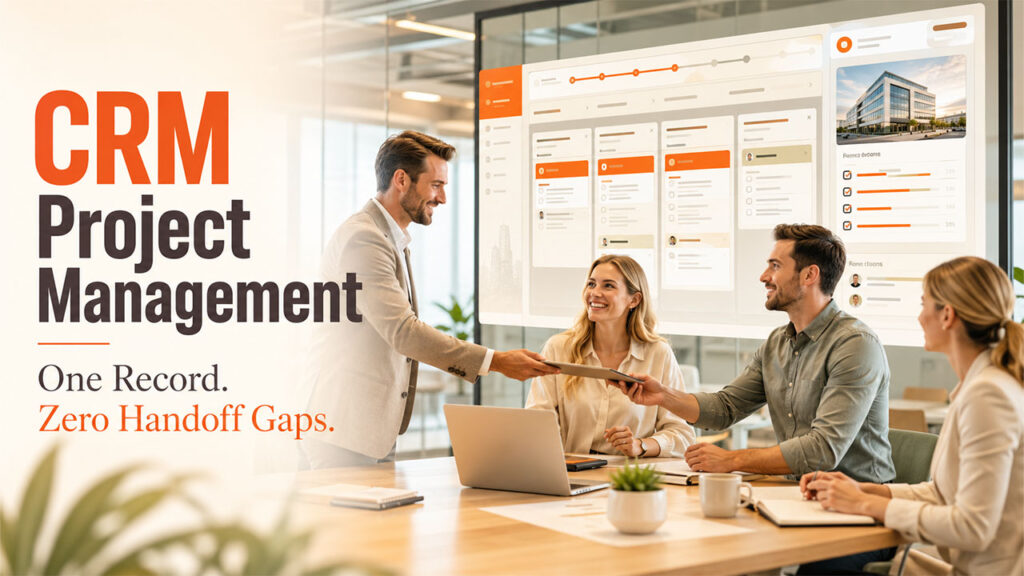
Most teams do not lose deals because of improper selling. They lose client trust once the sale is done because a project stalls because of missing context or unclear ownership. CRM project management directly addresses this by working as a one-point SOT for both delivery and revenue. Main advantages are as follows:
- No repetitive Entry of Data: Contracts, client details, and project scope live in one record instead of a couple of platforms.
- Higher Visibility for Managers: Leadership can observe project status and pipeline health side-by-side.
- Quicker Onboarding: New hires need to learn one platform instead of combining a CRM and a separate task tracker.
- Fewer Dropped Handoffs: Sales-to-delivery notes automatically go with the account.
Most businesses run a group of everyday operational tools already, including communication apps, invoicing software, and accounting platforms. Centralizing CRM project management into that stack eliminates the friction between the project tool and sales tool, since both jobs now exist inside the same record.
Main Features You Need to Look for in a CRM Project Management System
Not every customer relationship management system manages project work effectively, and not every project tool is clear about the customer's context. When you are searching for an ideal CRM project management system, you must prioritize the below-mentioned aspects:
- Conversion from Deal to Project: The capability to convert a closed deal into a real-time project without manual re-entry.
- Shared Timelines and Kanban Boards: So that delivery and sales teams get to see the same status at any time and anywhere.
- Task Automation: Rules that automatically trigger notifications or assign tasks when a milestone or deal changes stage.
- Centralized Communication: Calls, client emails, and notes directly attached to the project record.
- Reporting Across Both Functions: Dashboards that integrate project performance with pipeline metrics.
Automation is generally the feature that separates a really valuable CRM project management system from a standard task list. The same logic is utilized to automate Gmail workflows with Python — causing an action at the moment a particular target is met. It equally applies well inside a CRM, where a deal going to "Won" can create a project automatically, assign an owner, and notify the delivery team without anyone raising a finger.
How to Deploy CRM Project Management in Your Team?
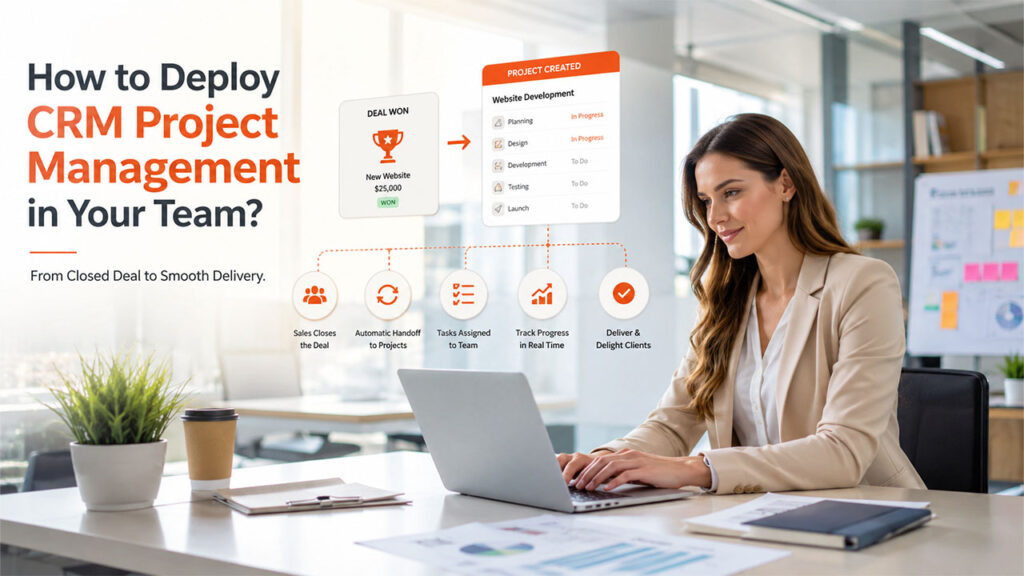
Releasing CRM project management does not need replacing each and every tool overnight. A phased approach is a lot better:
- Audit Your Present Handoff Process: Recognize precisely where the data gets lost between sales closing a deal and delivery teams starting work.
- Map Deal Stages to Project Stages: Decide what automatically happens the moment a deal is marked as “won.”
- Pick One Platform, Not Two: Select CRM software with real capability to manage a project instead of bolting a task app on your customer relationship management platform.
- Carry Out a Comprehensive Training of Both Teams: An easy-to-use CRM platform does not have a steep learning curve. However, both delivery staff and sales teams must be on the same page about the capability of the system.
- Review Monthly Reports: Keep track of handoff time and project completion rates to make sure that the change is actually working.
For teams still developing their wider software stack, a detailed look at the tools designed to scale alongside a growing business is worth taking a look at before committing to a one CRM project management platform in the long-term.
Common Mistakes You Can Avoid When Transitioning to CRM Project Management
Even a well-executed rollout of CRM project management can stall if a few mistakes happen that could be avoided easily. Such mistakes can be:
- Migrating Everything Simultaneously: Moving each active project and deals into a new platform in one go can overwhelm both teams. Begin with new deals and gradually phase out the old workflow.
- Mapping of Skipping Stage: If deal stages are not mapped clearly to project stages, automation can break, and tasks get created at the wrong moment or not at all.
- Not Keeping the Delivery Teams in the Loop During Buying Decision: A CRM project management platform selected only by sales generally lacks the delivery of depth that the teams really need. This leads to slower adoption.
- Not Considering Permission Settings: Not every team member requires visibility into each project or deal. Improper permissions can expose confidential client data across departments that do not require it.
- Not Upgrading the Workflows and Automation Rules: CRM project management should not be considered a one-time setup. Pre-set rules of workflows and automation must be re-evaluated every quarter as team size, deal volume, and project complexity change.
Preventing such missteps early on makes sure that the platform actually gets utilized in the way it was built for.
Conclusion
CRM project management does not mean you have to add another platform to a stack that is already crowded. It is about eliminating the wall between the team that delivers and the team that sells. When project tasks and customer data exist on the same platform, handoffs stop being a source of lost data and start being a trackable and smooth step in client relationships. For businesses and agencies that are tired of watching good deals turn into messy onboarding experiences, integrating agency management software can help centralize workflows and improve coordination across teams. For agencies managing content placements and publisher relationships, effective guest post management can also help organize outreach, orders, and delivery workflows. This shift is one of the simplest changes you can make in 2026 to deliver the highest impact.
FAQs About CRM project management
Q1. Are CRM project management and regular project management software the same thing?
A- Not quite. Simple project management software keeps track of timelines and tasks only. CRM project management includes deal and customer data in the same workspace, so delivery teams have total context on the account.
Q2. Who are the ideal users of CRM project management?
A- Consultants, agencies, SaaS companies, and any business where delivery and sales are directly benefiting from CRM project management. This is because it directly closes the handoff gap between the two.
Q3. Does adopting CRM project management mean replacing an existing CRM entirely?
A- This is not always true. Modern CRMs, including OutRightCRM, add features of task and project management on top of the available sales pipeline, so migration is not always important.
Q4. Can you automate CRM project management?
A- Yes. Most provide support for rule-driven automation, like auto-creating a project whenever a deal is marked as "won" or auto-assigning tasks as per the type of the deal.
%201.png)

%201.png)

%201.png)