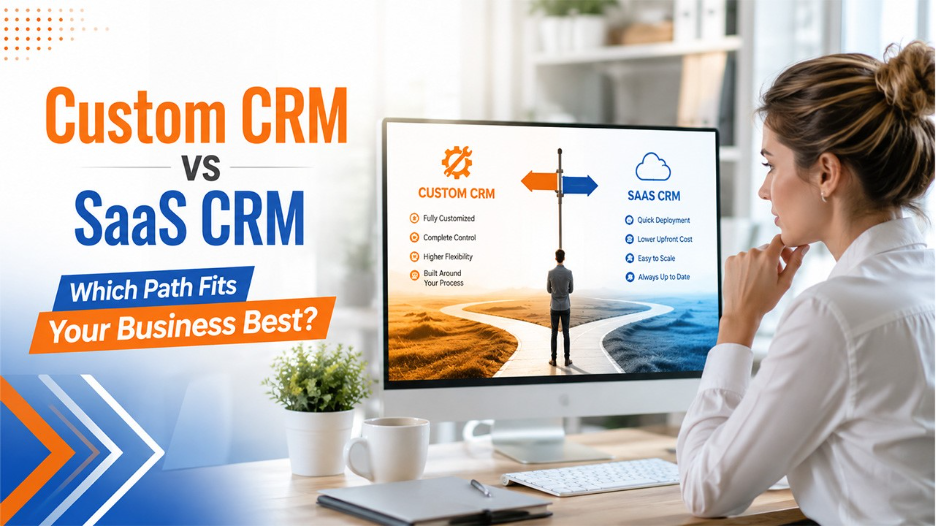

If you're weighing custom CRM vs SaaS CRM, the decision is no longer just about keeping track of customer information. Modern CRM systems handle tasks automatically, offer AI-powered suggestions, integrate with other business tools, and help with selling, promoting, and serving customers. As these systems improve, choosing between a custom CRM and a SaaS CRM has become an important business decision.
Custom CRMs give you more control and flexibility, while SaaS CRMs are quicker to deploy and easier to maintain. But AI coding tools and what is often called “vibe coding” have changed this comparison. Building a basic custom CRM is now easier and faster than it used to be, even for smaller businesses. The bigger question is no longer just how easy it is to build, but how much effort it takes to secure, maintain, update and improve that CRM over time.
A quick look at what's ahead:
- The key differences between custom CRM and SaaS CRM
- A side-by-side comparison of features, costs, and scalability
- Which option offers more flexibility and control
- The factors to consider beyond features and pricing
- How AI is influencing CRM decisions in 2026
- When to choose a custom CRM or a SaaS CRM
- A practical checklist to help you make the right decision
Custom CRM vs SaaS CRM: What's Actually Different
What is a Custom CRM?
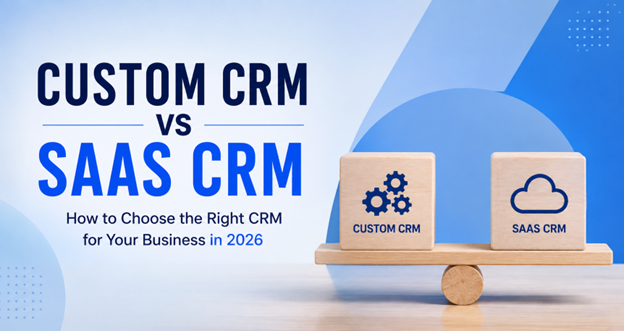
A custom CRM is software built specifically for one business. Every dashboard, workflow, and integration is created around how that company operates. When comparing Custom CRM vs SaaS CRM, a custom solution offers greater control and flexibility, but it also requires more time, investment, and ongoing maintenance.
With AI coding tools making software development faster, businesses can now build some custom CRM features with less development effort than before. However, development is only the starting point. The CRM still needs to be tested, secured, updated, and maintained as the business grows.
What is a SaaS CRM?
A SaaS CRM is a cloud-based CRM that is ready to use and accessible with a subscription fee. For example, you can use Zoho CRM, Salesforce, HubSpot CRM or Microsoft Dynamics 365. The provider takes care of things for you, like hosting, security, updates, etc.
| Feature | Custom CRM | SaaS CRM |
| How it's built | Developed specifically for your business processes and requirements. | Pre-built CRM software designed to serve a wide range of businesses. |
| Customization | Unlimited customization of workflows, modules, dashboards, and features. | Customization is available, but within the platform's capabilities and limitations. |
| Implementation time | Usually takes several weeks or months depending on project complexity. | Can often be deployed within days or a few weeks. |
| Upfront investment | Higher initial development and implementation cost. | Lower upfront cost with predictable monthly or annual subscription fees. |
| Scalability | Can scale in any direction as your business evolves, provided additional development is done. | Easily scales by upgrading plans or adding users, though advanced needs may require higher-tier subscriptions. |
| Maintenance & updates | Your organization or development partner handles maintenance, bug fixes, security updates, infrastructure, and new feature development. | The provider handles maintenance, security patches, infrastructure, and regular product updates as part of the service. |
| Integrations | Can integrate with virtually any internal or third-party system based on business requirements. | Supports integrations through built-in connectors, APIs, or marketplace apps, though some integrations may have limitations. |
| Mobile access | A mobile app or mobile experience usually needs to be developed, tested, secured, and maintained separately. | Many SaaS CRMs include ready-to-use mobile apps that are updated and maintained by the provider. |
| Ownership | You own the application's codebase and have complete control over its future. | The software is owned and managed by the vendor; you license access through a subscription. |
| Security & compliance | Security measures and compliance standards are designed specifically for your organization. | Enterprise-grade security is managed by the vendor, with compliance depending on the provider's certifications. |
| Best suited for | Businesses with unique processes, industry-specific requirements, or complex operational workflows. | Small to large businesses looking for a fast, reliable, and cost-effective CRM solution with standard business capabilities. |
When considering Custom CRM vs SaaS CRM, successful implementation plays a major role in long-term adoption and ROI. Working with an experienced CRM implementation company can help you configure workflows, migrate data, integrate business systems, and ensure the platform supports your long-term business goals.
Which CRM Offers Greater Flexibility and Control?
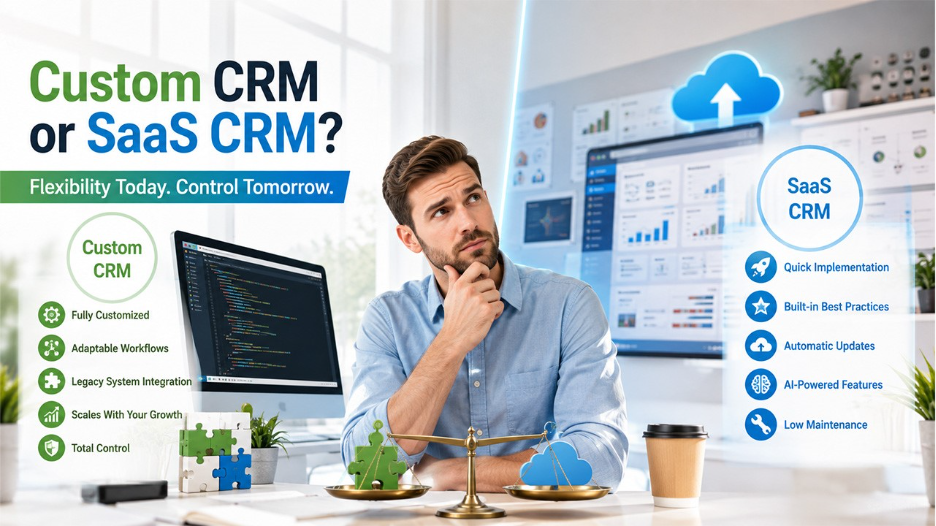
Choosing between a custom CRM system and a Saas CRM system you need to think about how CRM can support your business as your business grows and changes.
The right amount of flexibility in a Customer Relationship Management system is based on the way you do things now and how you think your business will do things in the future.
A custom CRM is often the better choice when your business needs to:
- Support unique workflows that standard CRM platforms can't easily accommodate.
- Adapt to changing business processes without waiting for vendor updates or feature releases.
- Integrate with proprietary or legacy systems that require custom development.
- Scale alongside business growth, whether that means adding new departments, locations, or services.
- Maintain complete control over future enhancements, ensuring the CRM evolves with your business priorities.
A SaaS CRM is ideal when your business values:
- Faster implementation without extensive development or technical resources.
- Built-in best practices that support common sales, marketing, and customer service processes.
- Automatic platform improvements, including new features, security updates, and AI capabilities.
- Lower maintenance effort, allowing your team to focus on business operations instead of managing the software.
What Else Should You Consider Before Choosing a CRM?
Most CRM comparisons stop at subscription fees or development costs. But the real cost of ownership usually comes from somewhere else entirely.
Will the people on your team actually use the CRM?
A customer relationship management system is only as good as the information your employees put into it. If the CRM system is hard to use or if it does not work the way your team already does things then people will stop using it. The return on investment you were expecting will disappear.
How many other systems does your CRM need to work with?
No business uses just one platform anymore. Your CRM probably needs to integrate with your ERP, accounting platforms, marketing tools, support systems, communication apps, e-commerce setup, etc.
Do you need a partner who works this all out for you?
Saas CRM platforms are convenient but you are stuck with the vendors' prices, their plans, for the future and the limitations of their platform.
Who's maintaining it five years from now?
A custom CRM gives you complete control, but that control comes with ongoing responsibility. Even if AI makes the initial development faster, your business still needs to handle security updates, bug fixes, integrations, backups, performance, and new feature development. With SaaS, the subscription cost covers much of the ongoing platform maintenance and updates.
“Any fool can write code that a computer can understand. Good programmers write code that humans can understand.” — Martin Fowler
The point is especially relevant when building a CRM. Creating something that works today is one thing; creating software that remains understandable, secure, and maintainable years later is another.
How AI Is Reshaping the CRM Decision
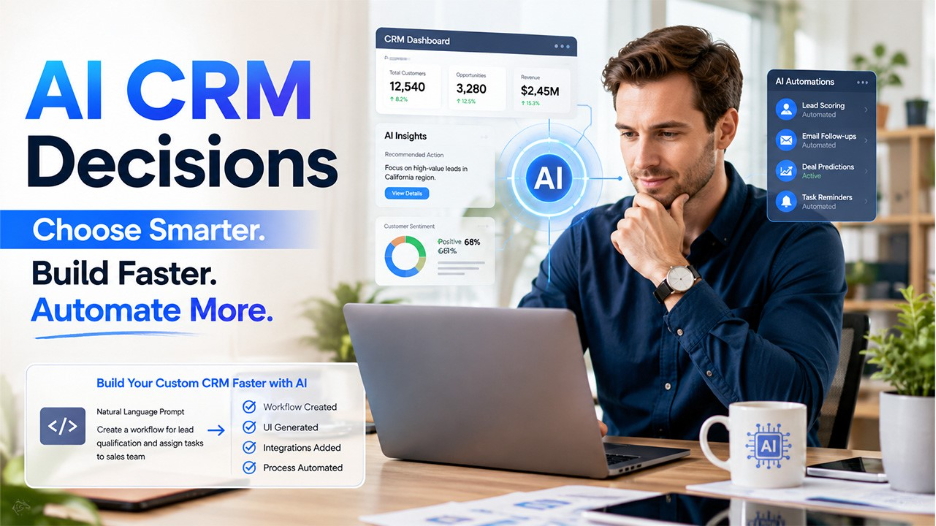
AI solutions have quickly become one of the biggest differences between CRM platforms, not just a feature you check off.
Modern CRMs don't just store customer information anymore. They help businesses make sharper decisions and take repetitive work off people's plates.
At the same time, AI coding tools are changing how custom CRM software can be built. With “vibe coding,” developers can use natural-language instructions and AI assistance to create workflows, interfaces, and integrations much faster. For smaller businesses, this can make building a basic custom CRM more realistic than it was a few years ago.
“Every business process will have an AI agent.” — Satya Nadella
This shift is already changing how businesses think about automation and software. For CRM, the opportunity is not only to use AI inside an existing platform, but also to build AI-powered workflows around specific business needs.
What SaaS CRMs typically offer:
- AI-powered lead scoring
- Sales forecasting
- Automated Email and proposal generatio
- Meeting summaries and call insights
- Workflow recommendations
- Customer sentiment analysis
- Smarter, auto-geerated reporting
These come ready to use, which means businesses can adopt AI without much development work at all.
What custom CRMs make possible:
- Recommendation engines built around a specific industry
- Internal knowledge assistants trained on your own data
- Custom document processing
- Predictive maintenance models around your operational data
- AI-powered approval workflows
- Proprietary analytics built for your data
AI should support your CRM strategy, not define it. While built-in AI capabilities can improve productivity quickly, the right CRM is the one that aligns with your workflows, business goals, and future growth.
When SaaS CRM Is the Better Fit

Choose SaaS when speed and predictability matter more than infinite flexibility. It tends to be the right fit when you:
- Need to get a CRM live quickly
- Run fairly standard sales and service processes
- Want to keep upfront costs down
- Don't have an in-house development team
- Want continuous updates without lifting a finger
- Plan to start using built-in AI right away
For a lot of startups and growing teams, SaaS hits the right balance between what it does and what it costs.
When a Custom CRM Becomes a Real Advantage
Building custom isn't about stacking on more features. Its value shows up in supporting the parts of a business that off-the-shelf software just can't handle well.
It's worth considering when:
- Your workflows are genuinely specialized.
- Different departments need fundamentally different processes.
- You're working around legacy or proprietary systems.
- Regulatory compliance demands tighter control.
- Customer experience depends on custom-built workflows.
- CRM is central to your competitive edge, not just a support function.
Rather than making employees bend around the software, a custom CRM bends around the business.
Making the Right CRM Choice
Whether you pick a custom CRM or a SaaS CRM depends on what your business needs are not just what features are available.
- Look at your workflows, and think about how your business is going to grow.
- Consider what systems you need to work with and what resources you have.
- Make sure the CRM you pick matches your long-term business strategy.
A CRM that matches your long-term business strategy will give more value than one chosen simply because of its features, development cost, or subscription price.
%201.png)

%201.png)

%201.png)