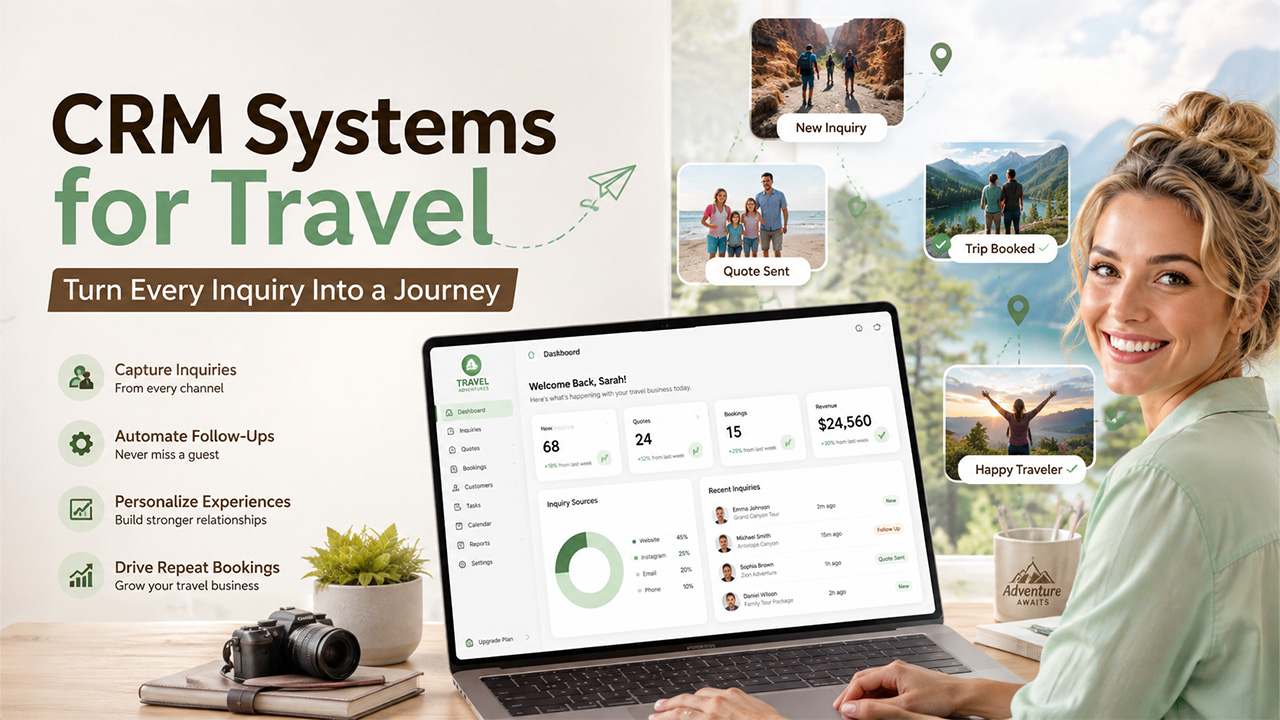

Take a small canyon-tour company in the first week of April. Sixty inquiries arrive in seven days, spread across a website form, two shared inboxes, Instagram DMs, and a phone that rings during safety briefings. The owner quotes fast when she can, forgets when she can't, and by mid May she has no idea which of the sixty booked, which went quiet, and which are still waiting on an answer she never sent. Meanwhile, a family that has toured with her three times since 2023 gets the same generic newsletter as every first-time subscriber.
What she's missing is a working system: one place where every inquiry lands, every quote carries a follow-up date, and every past guest keeps a history. A CRM gives a travel business exactly that, provided the setup follows how travel actually sells. A well-implemented CRM for travel business centralizes every customer interaction and keeps growth organized from inquiry to repeat booking.
Map your pipeline before you pay for software
Write down your sales stages before you compare a single tool. For most tour operators, agencies, and rental companies the honest version looks something like this: new inquiry, quote sent, in follow-up, deposit paid, balance due, traveled, post-trip. If the stages you configure in the CRM don't match how guests buy, your team will quietly go back to working out of their inboxes within a month.
Travel also runs on two clocks at once. Custom itineraries and honeymoons get booked six to ten months out, with long quiet stretches where the lead is still real. Day tours and weekend rentals close in under two weeks. Build both paths into your pipeline, because a lead that's silent for ninety days is dead in one lane and perfectly normal in the other.
The demand justifies the effort. The U.S. Travel Association's May 2026 forecast puts total U.S. travel spending at $1.37 trillion this year, with domestic spending back at 2019 levels at $1.20 trillion after adjusting for inflation. The bookings exist; what separates operators is whether they can answer sixty inquiries without dropping thirty.
Automate the follow-up you keep missing
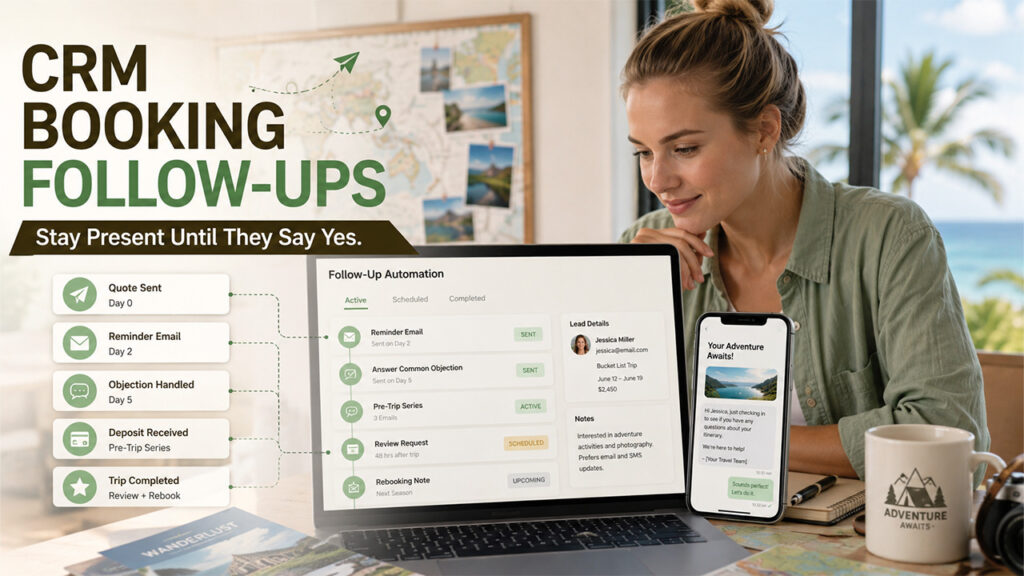
Quotes go stale fast in this business, because the person asking about a June trip is usually asking three other companies the same week. Whoever answers first usually wins the booking, sometimes at a higher price than the quote that arrived a day later. This is where a CRM earns its subscription fee: sequences that fire on a stage change, without anyone remembering to send them. A CRM for travel business ensures every lead receives timely follow-ups without relying on manual reminders.
A workable starter set for a travel business:
- A reminder two days after the quote goes out, with the itinerary attached again
- A second touch at day five that answers your most common objection, whether that's weather, difficulty, or cancellation terms
- A pre-trip series after the deposit clears: packing list, waiver link, and add-ons like gear rental or a photo package
- A review request within 48 hours of the trip ending, while the memory is warm
- A rebooking note timed to the guest's original booking window the following season
One line to hold: automation owns the timing, and a human owns every reply. The moment a guest answers a sequence email, it should stop and route to a person. OutrightCRM's CRM marketing guide is a good reference for which channels earn their keep here, including where SMS outperforms email for time-sensitive touches.
Treat repeat guests as their own market
Deloitte's 2026 summer travel survey, fielded April 2 to 9, found 45% of Americans planning summer vacations with paid lodging, the lowest share in six years, while the share planning a bigger budget for their year's biggest trip rose to 24% from 19% in 2025. Fewer households are shopping, and the ones still booking are spending more on the trip that matters to them. That math favors the operator who can bring past guests back, and segmentation is how you do it without sending everyone the same email.
Start with segments you can act on: trip type, party size, booking month, and spend band. Rental fleets show how specific this gets. An RV rental company like Cruise America rents units from compact camper vans up to 30-foot motorhomes, and a renter's history records which unit they took, in which month, and with how many people aboard. The family that took a 25-footer over spring break should hear about spring availability in early February. The couple that rented a compact van in late September is a natural target for a shoulder-season offer in July, which is exactly when a fleet operator most needs to fill those weeks. Both campaigns come out of fields the CRM already holds, and neither reads like a blast.
Tour operators can run the same play with destinations. A guest who has done your two most popular canyons gets an email about the third, with a subject line that names it.
Connect the CRM to the rest of your stack
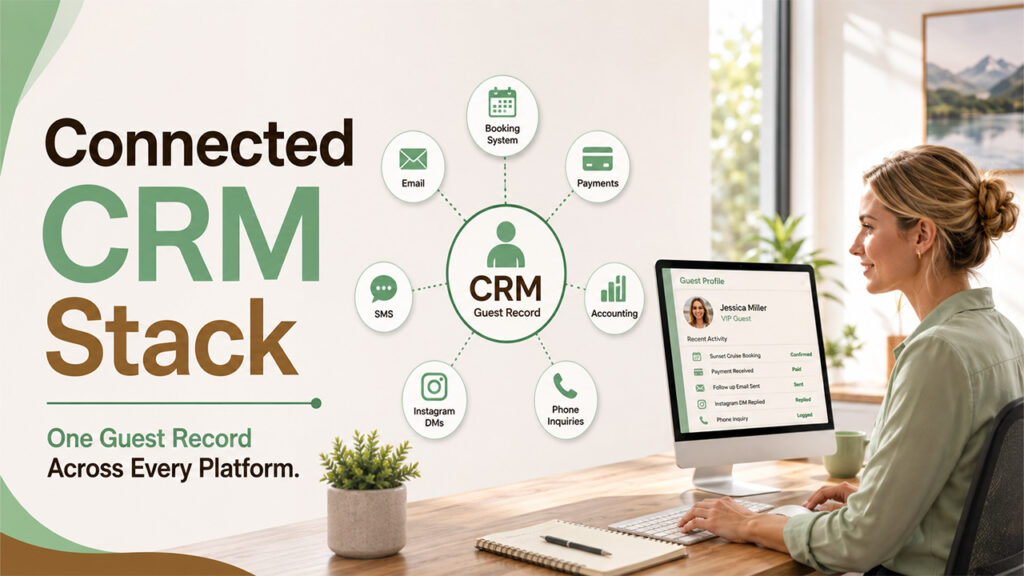
Double data entry kills CRM adoption faster than any missing feature. If staff have to re-key a booking from the reservation system into the CRM, they'll stop by week three, and your pipeline will rot quietly while the dashboards stay green.
The clean division of labor: your booking or reservation platform stays the source of truth for availability, manifests, payments, and the CRM stays the source of truth for the relationship. Sync between the two should be automatic. Around that core, connect your payment processor, your accounting software, and your email and SMS tools. If a native integration is missing, middleware like Zapier or Make covers most gaps for a few dollars a month. Integrating a CRM for travel business with your existing tools eliminates duplicate work and keeps customer data synchronized.
One rule keeps the whole thing honest: every channel where a guest can start a conversation, including the Instagram DMs and the phone, should create or update a contact record on its own. Audit those connections monthly, because integrations tend to break silently.
Run the sale-to-trip handoff inside the CRM
A deposit changes the nature of the work. The file moves from selling to delivering: guides get assigned, vehicles get prepped, permits get pulled, suppliers get confirmed. In most small travel companies that handoff happens over Slack messages and memory, which is why dietary restrictions and mobility notes go missing between the person who sold the trip and the person running it.
Stage-triggered task checklists fix this. When a booking hits deposit paid, the CRM spawns the operational checklist for that product, assigned to the right people, on the same record the sales conversation lived on. Nothing gets re-keyed and the special requests travel with the file. OutrightCRM has a useful walkthrough on aligning sales and delivery teams inside a CRM, and the pattern maps cleanly onto tours and rentals.
Put your own team's travel on a system
Scaling adds a spend category most operators never plan for: their own travel. Fam trips to preview hotels and routes, trade show weeks, supplier visits before a new season, seasonal staff repositioning between locations. That spend usually scatters across personal cards and reimbursement spreadsheets, and nobody sees the total until year-end.
Once those trips start happening every month, that's a job for corporate travel management, and Engine is one platform built for it: flights, hotels, and rental cars booked from a single dashboard, billed on one monthly invoice, with spend coded by project or cost center. The point is visibility. The cost of scouting a new route should sit in your books next to the revenue that route eventually produces, so you can tell which scouting trips were worth it.
Back to the canyon-tour operator in April. With a mapped pipeline, all sixty inquiries sit in one view, each with a stage and a next action. The day-two quote reminder goes out while she's mid-river with a group. The family with three past trips gets a February note about the one canyon they haven't run, and her own scouting trip before next season lands in the books with a cost code attached. She can build every piece of this in the off season, one integration and one email sequence at a time, and most of it will be running before the May balance payments come due.
Conclusion
Scaling a travel company isn't about chasing more inquiries; it's about handling the ones you already have without letting opportunities slip away. A CRM for travel business brings every conversation, booking, and follow-up into one organized system, making growth far more manageable. Start with a simple setup, refine it as you grow, and you'll spend less time searching for information and more time creating memorable travel experiences for your customers.
%201.png)

%201.png)

%201.png)