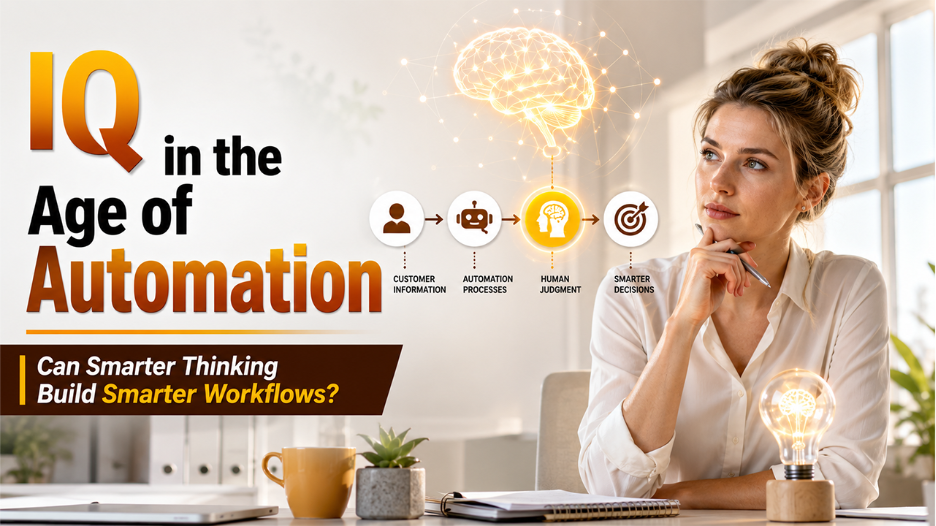

Automation has changed the way companies work. Customer information can move between systems without manual entry, repetitive tasks can run in the background, and artificial intelligence can help employees process enormous amounts of information.
Yet there is an interesting contradiction at the center of modern business technology.
The more companies automate, the more important human judgment can become.
Cognitive Skills in Automation can determine what should happen next according to predefined rules. It can identify patterns, organize information and trigger actions. But deciding which rules make sense in the first place still requires people capable of reasoning about complex situations.
This is where cognitive skills — and even the growing popularity of online IQ testing — enter the conversation.
The Hidden Human Layer Behind Automation
A CRM system may appear to be a technological environment, but every workflow reflects a series of human decisions.
Someone decided:
- Which customer data should be collected
- Which interactions matter most
- When a lead should be considered qualified
- Which customers require immediate attention
- What should happen automatically
- When a human employee needs to intervene
The software executes these decisions efficiently, but it does not necessarily determine whether the underlying assumptions are correct.
That makes automation less like replacing human thinking and more like scaling human thinking.
If a company creates an intelligent workflow, good reasoning can be amplified across thousands of customer interactions. If the workflow is poorly designed, automation can simply make a bad decision happen faster and more consistently.
This human layer highlights the growing importance of cognitive skills in automation, particularly when businesses need to evaluate assumptions, interpret information and make decisions that cannot be reduced to simple rules.
What Does Intelligence Look Like in a Digital Workplace?
IQ is commonly associated with a numerical score, but cognitive ability is broader than a single number.
Depending on the assessment, intelligence testing can involve abilities such as:
| Cognitive ability | Possible workplace relevance |
| Logical reasoning | Evaluating processes and business rules |
| Pattern recognition | Identifying trends in customer behavior |
| Working memory | Managing several pieces of information simultaneously |
| Verbal reasoning | Understanding and communicating complex information |
| Problem solving | Responding to unexpected situations |
None of these abilities guarantees professional success.
Business performance also depends on communication, experience, creativity, emotional intelligence, leadership and many other factors.
Still, cognitive testing can provide an interesting way to think about how people approach unfamiliar problems — particularly in workplaces where technology increasingly handles routine tasks.
When Employees Become “Workflow Designers

One of the less obvious consequences of automation is that employees increasingly become designers of processes rather than performers of individual tasks.
Imagine a sales representative who once spent hours entering customer information manually.
After automation, the same employee may instead need to determine:
- Which information should be captured automatically.
- How different customer actions should be interpreted.
- Which events should trigger follow-up.
- When automation should stop and human judgment should begin.
The work has not disappeared. It has moved one level higher.
This requires a different type of thinking.
The Importance of Pattern Recognition
Customer relationships generate patterns. Strong cognitive skills in automation help employees distinguish between patterns that technology can detect and patterns that require human interpretation.
A customer who opens several emails, visits a pricing page and then contacts support may be demonstrating a very different intent from someone who performs only one of those actions.
Technology can identify these events. Humans still need to determine what they mean.
That distinction is critical because the same behavioral pattern can have multiple explanations.
Why IQ Testing Fits Into This Conversation
Digital cognitive assessment has become more accessible alongside the expansion of digital work.
An iq test review can help users explore how different online assessments approach reasoning and cognitive measurement. Rather than viewing the result as a permanent label, users can treat testing as an opportunity to become more conscious of their own problem-solving habits.
This is where MyIQ is particularly interesting.
The platform combines IQ-oriented assessment with cognitive exercises, making the experience less about receiving a number and more about engaging with different types of mental challenges.
That distinction matters in a technology-driven workplace.
The useful question is not necessarily whether someone has a “high” or “low” IQ. It is whether they understand how they approach information, uncertainty and difficult problems — and whether they can improve their strategies over time.
The Automation Trap: Faster Is Not Always Smarter
There is a tendency to assume that automation automatically creates better decisions.
It does not.
Automation can introduce several risks:
- Bad assumptions: A flawed business rule can affect thousands of interactions.
- Over-automation: Customers may become frustrated when there is no easy way to reach a human.
- Data bias: Historical customer data can reflect existing organizational biases.
- False confidence: A sophisticated dashboard can make weak conclusions look convincing.
- Reduced critical thinking: Employees may begin trusting automated recommendations without questioning them.
The last point is especially important.
If technology continuously provides an answer, people may gradually become less accustomed to asking whether the answer is reasonable.
The Best Technology Leaves Room for Questions
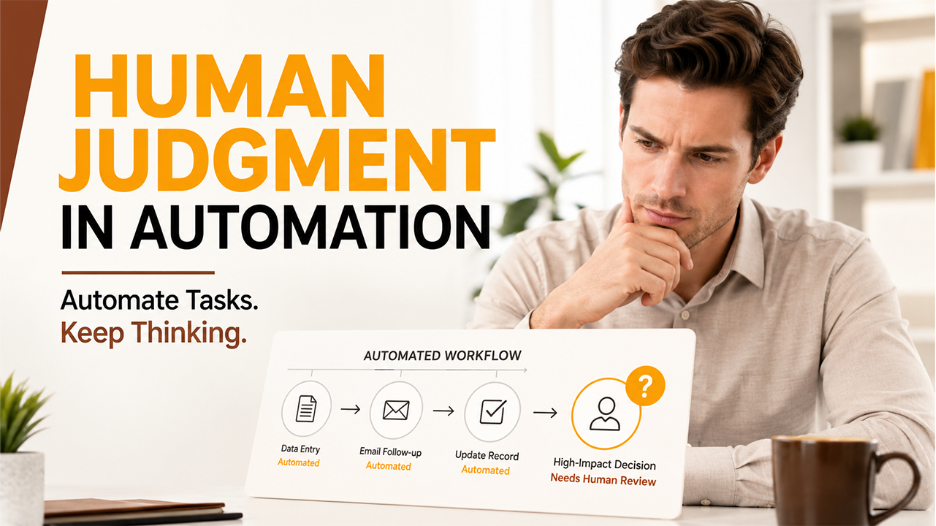
A genuinely intelligent business workflow should not eliminate human judgment completely.
Instead, it should help people spend more time on the decisions where judgment matters most.
A useful principle is:
Automate repetition. Augment reasoning. Preserve judgment.
CRM automation is excellent at repetitive operations. Cognitive skills become particularly valuable when situations are ambiguous, unusual or strategically important.
That division of labor can create a healthier relationship between humans and software.
A Simple Test for Any Automated Decision
Before accepting an automated recommendation, an employee can ask:
What information produced this result?
Then:
What assumptions are hidden inside the process?
And finally:
What would make this recommendation wrong?
These three questions encourage analytical thinking even when the underlying workflow is highly automated.
The Future of Work May Be a Cognitive Partnership
The most interesting future for business technology may not be one in which Cognitive Skills in Automation replaces human intelligence.
It may be one in which software handles the predictable while people concentrate on the uncertain.
CRM platforms can organize relationships. Automation can remove repetitive work. Analytics can reveal patterns. Cognitive assessment can help individuals reflect on some of the mental abilities involved in navigating complex information.
MyIQ belongs to this broader ecosystem of digital tools that make cognitive performance easier to explore.
But the real opportunity lies beyond any particular test or platform.
As businesses become increasingly automated, the competitive advantage may shift from knowing how to perform every task manually to knowing which tasks should be automated, which signals deserve attention, and when an apparently logical answer deserves to be challenged.
Technology can process more information than ever.
The uniquely human advantage may be knowing what to do with it.
%201.png)

%201.png)

%201.png)