




Cash collection is one of the most important financial priorities for healthcare organizations. Providing care does not automatically mean receiving timely payment. Between the point of service and final collection, healthcare providers must manage insurance verification, documentation, coding, claims, denials, patient balances, payment posting, and accounts receivable.
When these processes are disconnected or heavily dependent on manual work, payments can be delayed and outstanding balances can continue to grow. Effective Revenue Cycle Management Software can help healthcare organizations bring greater structure to these processes, identify collection problems earlier, and improve the movement of revenue from billed services to actual cash.
What Is Healthcare Cash Collection?
Healthcare cash collection refers to the process of receiving payment for medical services provided by a healthcare organization. Payments may come from insurance companies, government programs, patients, or other responsible parties.
The collection process does not begin when a payment is received. It starts much earlier, with accurate patient registration and insurance information, and continues through claims processing and accounts receivable follow-up.
- A strong revenue cycle helps ensure that services are:
- Accurately documented
- Properly coded
- Correctly billed
- Submitted to the appropriate payer
- Followed up when payment is delayed
- Collected from patients when balances remain
The more efficiently these activities are managed, the easier it becomes to maintain consistent cash flow.
Why Healthcare Organizations Struggle With Cash Collection
Healthcare payment processes are complex. A single patient account can involve multiple data points, payer requirements, coding rules, and payment stages.
Common problems that can slow cash collection include:
- Inaccurate patient information
- Insurance eligibility issues
- Incorrect coding
- Missing documentation
- Claim submission errors
- Claim denials
- Delayed payment posting
- Unresolved accounts receivable
- Poor follow-up processes
- Unclear patient balances
These issues can create a chain reaction. A small error during registration may eventually result in a denied claim or delayed payment.
This is why improving cash collection requires more than simply increasing collection efforts. Healthcare organizations need to improve the processes that determine whether a claim gets paid correctly and on time.
How Revenue Cycle Management Improves Cash Collection

Revenue cycle management brings together the financial processes that influence how quickly a healthcare provider gets paid.
Instead of waiting until an account becomes overdue, organizations can address potential problems throughout the revenue cycle.
1. Start With Accurate Patient Registration
Accurate information is the foundation of successful billing.
Errors in patient names, dates of birth, insurance details, policy numbers, or other demographic information can create problems later. Revenue cycle processes can help standardize registration and reduce the amount of incomplete or inaccurate information entering the system.
When information is correct from the beginning, fewer resources are required to correct accounts later.
2. Verify Insurance Before Treatment
Insurance verification can help healthcare organizations understand whether a patient has active coverage before services are provided.
Identifying eligibility issues early gives staff an opportunity to resolve them before a claim is submitted. This can reduce avoidable billing problems and improve the likelihood of receiving payment from the appropriate payer.
Early verification also helps patients understand potential financial responsibilities before or around the time of service.
3. Improve Charge Capture
Every service that should be billed needs to be captured accurately.
Missed charges can result in revenue leakage, while incorrect charges may lead to claim issues or payment disputes. Revenue cycle workflows can help ensure that relevant services and charges are properly transferred into the billing process.
Better charge capture means fewer opportunities for earned revenue to remain unbilled.
4. Strengthen Coding Accuracy
Medical coding directly affects how healthcare services are represented on claims.
Coding errors can result in rejected or denied claims, requiring staff to spend additional time investigating and correcting them. Effective revenue cycle processes can provide coding teams with organized workflows and tools that help identify potential issues before claims are submitted.
Improving coding accuracy can therefore contribute to faster and more predictable reimbursement.
5. Submit Cleaner Claims
A healthcare organization cannot collect payment from a claim that has not been submitted correctly.
Claims containing missing information, incorrect patient details, coding inconsistencies, or other errors may be rejected or denied. Revenue Cycle Management Software can help organize the claims process and identify certain issues before submission.
The objective is simple: send accurate claims the first time whenever possible.
The Role of Revenue Cycle Management Software in Cash Collection
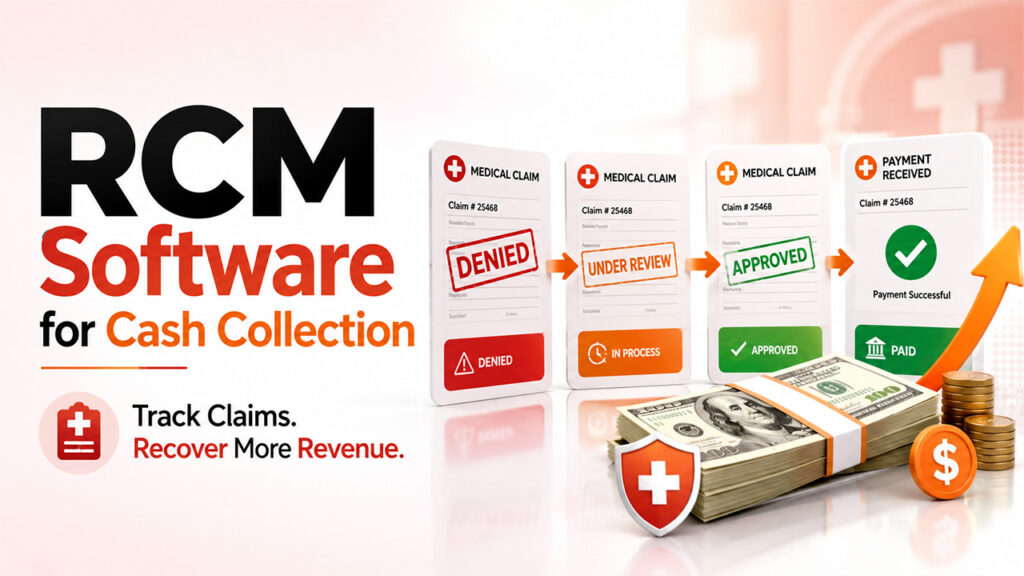
Revenue Cycle Management Software can connect different stages of the revenue cycle and provide healthcare organizations with better visibility into outstanding revenue.
Instead of relying on multiple disconnected processes, staff can use technology to monitor accounts, claims, payments, denials, and follow-up activities.
The software can support areas such as:
- Patient registration
- Insurance verification
- Charge capture
- Coding workflows
- Claims submission
- Claim tracking
- Denial management
- Payment posting
- Patient billing
- Accounts receivable follow-up
- Revenue reporting
This connected approach can reduce administrative friction and make it easier to identify where money is being delayed.
6. Reduce Claim Denials
Claim denials are one of the biggest obstacles to timely healthcare cash collection.
A denied claim does not necessarily mean the provider will never receive payment. However, it creates additional work and delays the collection process.
Revenue cycle management can help organizations track denials and identify recurring causes.
For example, reports may reveal that denials frequently result from:
- Eligibility problems
- Missing information
- Authorization issues
- Coding errors
- Documentation problems
- Incorrect claim details
Once these patterns are identified, healthcare organizations can address the underlying causes instead of repeatedly correcting individual claims.
7. Use AI RCM Software to Identify Revenue Cycle Issues
The growing use of AI RCM sofwares is changing how healthcare organizations approach revenue cycle management.
AI-enabled systems can analyze large amounts of revenue cycle data and identify patterns that may be difficult to detect through manual review. Depending on the capabilities of the system, AI can support areas such as claim review, denial analysis, payment prediction, workflow prioritization, and identification of accounts that may require attention.
For example, AI-based analysis may help identify accounts with a higher likelihood of denial or determine which outstanding balances should receive follow-up first.
The goal is not simply to automate more tasks. It is to help revenue cycle teams make faster, data-driven decisions about where their attention can have the greatest financial impact.
8. Prioritize High-Value Accounts Receivable
Not every outstanding account requires the same level of attention.
Revenue cycle teams often have to manage large numbers of unpaid accounts. Manually reviewing every account can consume significant time.
Technology can help organize accounts based on factors such as balance amount, account age, payer, claim status, or follow-up requirements.
This allows staff to prioritize accounts that may have the greatest impact on cash collection.
9. Improve Payment Posting
Payment posting is another important part of the cash collection process.
Once payments are received, they need to be accurately recorded against the appropriate accounts. Delays or errors in payment posting can make it difficult to understand which balances have been paid and which still require action.
Automated and organized payment workflows can help healthcare organizations update account information more efficiently.
With more accurate account balances, staff can identify outstanding amounts and take appropriate follow-up action.
10. Manage Patient Balances More Effectively
Insurance payments are only one part of healthcare collections. Patients may also be responsible for deductibles, copayments, coinsurance, and other balances.
Clear patient billing can make it easier for patients to understand what they owe and why.
Revenue cycle processes can help ensure that patient balances are accurately calculated and communicated. Better visibility into financial responsibility can support more organized patient collections while reducing unnecessary billing confusion.
11. Reduce Days in Accounts Receivable
Days in accounts receivable is an important indicator of how quickly a healthcare organization converts billed services into collected revenue.
A high number of outstanding days can indicate problems somewhere within the revenue cycle.
For example, delays may be caused by:
- Slow claim submission
- High denial rates
- Delayed payer responses
- Inefficient follow-up
- Incorrect payment posting
- Unresolved patient balances
Revenue cycle management helps organizations monitor these areas and identify where improvements can reduce delays.
12. Create Better Follow-Up Workflows
Following up on unpaid claims and outstanding balances is essential for cash collection.
Without a structured workflow, accounts can be overlooked or followed up too late. Revenue cycle technology can help organize follow-up tasks and provide staff with information about the current status of accounts.
This can make collection efforts more consistent and reduce the likelihood of older balances being neglected.
Using Data to Improve Healthcare Cash Collection
One of the biggest advantages of modern revenue cycle management is access to actionable financial data.
Healthcare organizations can monitor metrics such as:
| Metric | What It Can Indicate |
| Days in A/R | How quickly outstanding revenue is being collected |
| Denial Rate | The frequency of claims being denied |
| Clean Claim Rate | The quality of claims submitted |
| Collection Rate | The effectiveness of collection efforts |
| A/R Aging | How long balances have remained unpaid |
| Payment Turnaround | How quickly payments are received and processed |
Tracking these metrics helps healthcare leaders understand whether collection problems are isolated incidents or signs of larger process issues.
Automation vs. Manual Cash Collection

Manual processes are not always ineffective, but they can become difficult to manage as claim and patient volumes increase.
Employees may spend hours checking eligibility, reviewing claims, updating account information, researching denials, and preparing follow-up lists.
Automation can take care of repetitive processes while allowing employees to focus on exceptions and more complex accounts.
The most effective approach is usually not to eliminate human involvement. Instead, technology should reduce repetitive administrative work and give revenue cycle professionals better information for decision-making.
Benefits of Improving Healthcare Cash Collection
A more efficient revenue cycle can provide benefits beyond faster payments.
More Predictable Cash Flow
When claims are submitted accurately and outstanding accounts are followed up consistently, healthcare organizations can gain greater predictability over incoming revenue.
Lower Administrative Burden
Automating repetitive tasks can reduce the amount of manual work required from billing and revenue cycle teams.
Better Financial Visibility
Centralized information helps management understand where revenue is being delayed and which processes require improvement.
Fewer Avoidable Denials
Identifying recurring claim problems can help organizations prevent similar issues in the future.
Improved Patient Financial Experience
Clearer billing information and more organized financial workflows can make interactions with patients easier and more transparent.
What to Consider When Choosing Revenue Cycle Technology
Healthcare organizations should evaluate more than the number of features offered by a software platform.
Important considerations include:
- Integration: The solution should work with existing healthcare and billing systems.
- Automation capabilities: Organizations should determine which repetitive processes can be automated.
- Analytics: Reporting should provide useful insights into claims, denials, collections, and accounts receivable.
- Scalability: The system should be able to support changes in patient volume and organizational growth.
- Security: Patient and financial information should be protected through appropriate security controls.
- Ease of use: Staff should be able to understand and use the platform without creating additional administrative complexity.
A More Proactive Approach to Healthcare Cash Collection
Traditional collection strategies often focus on recovering money after it becomes outstanding. Modern revenue cycle management takes a more proactive approach.
Instead of asking only, "Why has this account not been paid?", organizations can ask:
- Was the patient's insurance verified correctly?
- Was the service coded accurately?
- Was the claim submitted without errors?
- Was the claim accepted by the payer?
- If it was denied, why?
- Was the denial addressed quickly?
- Is the patient balance accurate?
- Does the account require follow-up?
By addressing these questions throughout the revenue cycle, healthcare providers can prevent many collection problems before they become larger financial issues.
Conclusion
Improving healthcare cash collection is not simply about collecting outstanding bills more aggressively. It is about creating a revenue cycle where accurate information, efficient claims processing, timely follow-up, and effective payment management work together.
Revenue Cycle Management Software can help healthcare organizations connect these processes, reduce manual work, identify bottlenecks, and improve visibility into outstanding revenue. At the same time, AI CRM software and Healthcare CRM solutions can add another layer of intelligence by analyzing revenue cycle data, identifying patterns, improving patient relationship management, and helping teams prioritize tasks.
When technology, people, and well-designed workflows work together, healthcare organizations can create a more efficient path from patient care to payment, helping reduce delays and support stronger financial performance.
Frequently Asked Questions
Q1. How does revenue cycle management improve cash collection?
Revenue cycle management improves cash collection by addressing potential payment problems throughout the healthcare financial process, from registration and insurance verification to claims, denials, payment posting, and accounts receivable follow-up.
Q2. Can Revenue Cycle Management Software reduce delayed payments?
Yes. By helping organizations automate workflows, identify claim issues, track outstanding accounts, and manage follow-up activities, Revenue Cycle Management Software can help reduce avoidable payment delays.
Q3. How can AI RCM software support healthcare collections?
AI RCM sofware can analyze large volumes of revenue cycle data to identify patterns, prioritize accounts, support denial analysis, and help revenue cycle teams make more informed decisions.
%201.png)

%201.png)

%201.png)