


The guide explores what CRM for law firms is, why law firms need a CRM, key benefits of the system, and the best 5 CRM platforms for law firms.
Operating a law firm generally involves much more than providing legal advice. Attorneys and legal teams need to manage prospective clients, consultations, case-related communications, follow-ups, documents, appointments, referrals, billing information, and ongoing relationships. As the firm grows, managing all these activities through offline records and spreadsheets can become increasingly difficult. Important follow-ups can be missed, client information may become scattered, and attorneys may spend valuable time on administrative work instead of legal matters. This is where CRM for law firms offers its capabilities.
The legal CRM offers a centralized system for organizing client and prospect information, managing interactions, automating routine tasks, and improving visibility across the client relationship process of the firm. If properly implemented, the legal CRM can help law firms create more consistent client experiences while making the internal processes easier to manage.
What is CRM for Law Firms?
The CRM (or Customer Relationship Management) for law firms is a type of software that helps legal practices manage and organize relationships with prospective and existing clients. In a legal setting, the CRM is primarily used to streamline client intake, communication, follow-ups, and business development. The legal CRM stores important relationship data in one centralized platform, instead of keeping client and prospect information across spreadsheets, emails, notebooks, and separate systems.
A CRM for law firms can help the team manage contacts, track leads, manage follow-ups, record communications, automate routine tasks, monitor referrals, and analyze performance. The platform offers legal teams a structured way to manage every important client relationship, from the first inquiry to ongoing communication and beyond.
Key Features of CRM for Law Firms
The CRM for law firms is designed to simplify client relationship management, improve lead conversion, and reduce administrative work. Some of the key features of CRM for law firms are:
- Contact Management: The legal CRM keeps client, prospect, referral partner, and other information in one centralized database.
- Lead and Intake Management: The platform helps capture inquiries and track them through the intake process.
- Follow-up and Task Management: The CRM allows firms to create tasks, reminders, and notifications for important activities.
- Communication Tracking: The CRM platform helps maintain a history of interactions with prospects and clients.
Benefits of CRM for Law Firms

Implementing a CRM for law firms can help legal practices improve the way they manage prospective clients, existing relationships, and business development. Some of the key benefits of CRM for law firms are as follows:
- Better Client Management
The CRM for law firms offers a centralized place to organize client and prospect information. With the platform, lawyers and staff can quickly access relevant contact details, previous interactions, consultation information, and follow-up activities.
- Faster Response to Potential Clients
The CRM software automatically captures inquiries and notifies the appropriate team member. With a clear view of new leads, staff can respond promptly instead of relying on someone to manually check multiple inboxes or forms.
- Fewer Missed Follow-Ups
The CRM can create reminders and automated follow-up tasks, helping the team stay in touch with prospects at the right time.
- Increased Productivity
Law firms often spend a considerable amount of time on repetitive administrative activities, including entering contact information, sending routine messages, updating spreadsheets, and creating reminders.
How CRM Helps Family Law Firms Manage Client Relationships
Family law firms often manage sensitive and emotionally complex client relationships while handling consultations, inquiries, appointments, follow-ups, documents, and ongoing communication. A structured CRM for family law firms can help firms organize these interactions and maintain better visibility throughout the client relationship lifecycle.
Some of the ways a CRM can support family law practices include:
- Streamlined Client Intake: Capture and organize information from prospective clients through a structured intake process.
- Consultation Management: Track consultation requests, appointments, and related follow-up activities.
- Automated Reminders: Create reminders for important calls, consultations, and follow-ups.
- Communication Tracking: Maintain relevant interaction history so authorized team members can understand previous communications.
Top 5 CRM for Law Firms
Choosing the right CRM can help law firms organize client information, manage inquiries, automate follow-ups, and maintain stronger relationships. Some of the best CRM platforms for law firms include:
1. HubSpot CRM

HubSpot CRM is among the most popular customer relationship management platforms that can provide tools for managing contacts, leads, communication, and sales pipelines. For law firms, HubSpot can help organize prospective client information and track the journey from initial inquiry to consultation and engagement.
Key Features
- Contact and lead management
- Sales pipeline management
- Email tracking
- Marketing automation
- Task and follow-up management
Ideal For
- Law firms looking for a user-friendly CRM
2. Salesforce
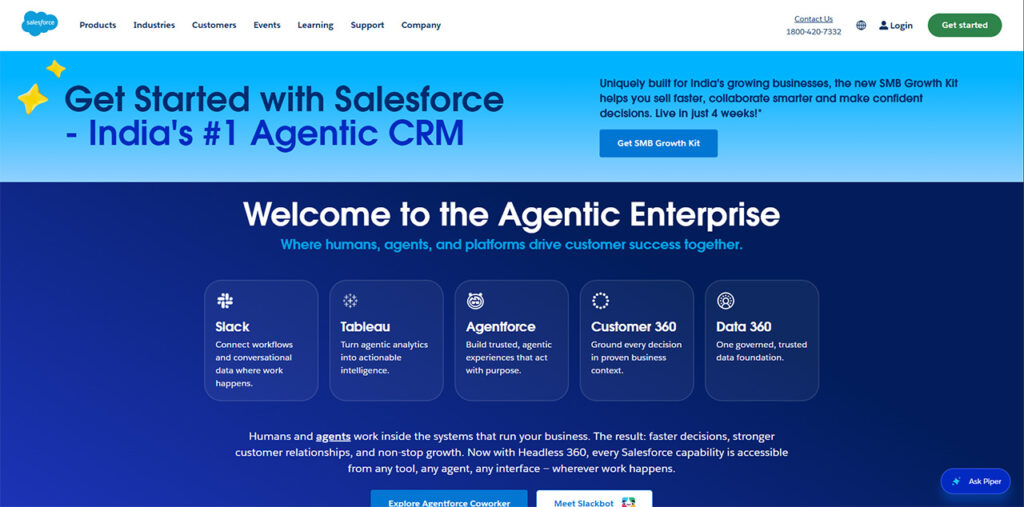
Salesforce is among the most customizable CRM platforms designed for organizations with complex relationship management requirements. The platform enables law firms to manage contacts, referrals, business development activities, communication, and other relationship-related processes.
Key Features
- Custom workflows
- Lead and contact management
- Advanced reporting
- Automation
Ideal For
- Larger law firms requiring extensive customization.
3. Zoho CRM
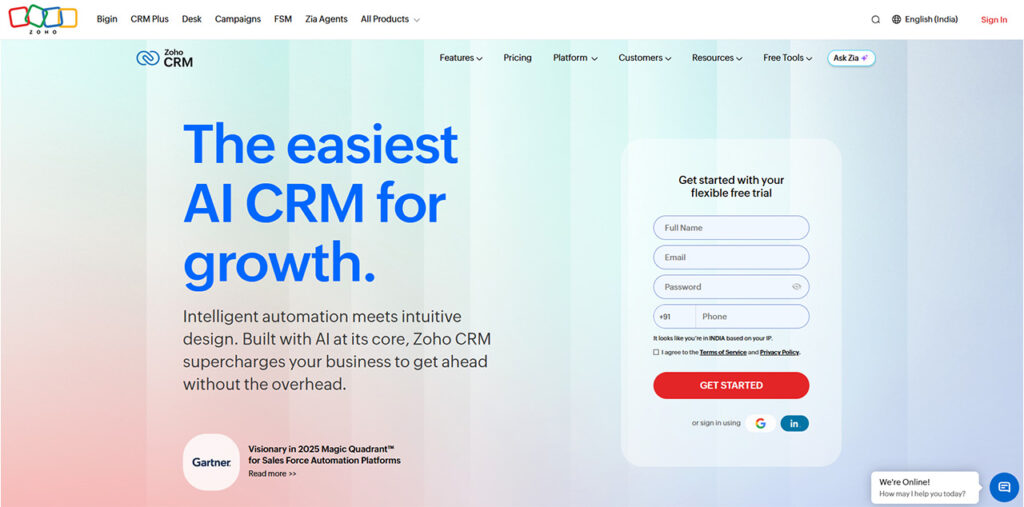
Zoho CRM offers extensive contact management, lead tracking, workflow automation, analytics, communication tools, and integrations. The form can configure pipelines and workflows around its intake, follow-up, referrals, and business development processes.
Key Features
- Lead management
- Contact management
- Workflow automation
- Email integration
Ideal For
- Small and mid-sized law firms looking for a flexible CRM.
4. Clio Grow
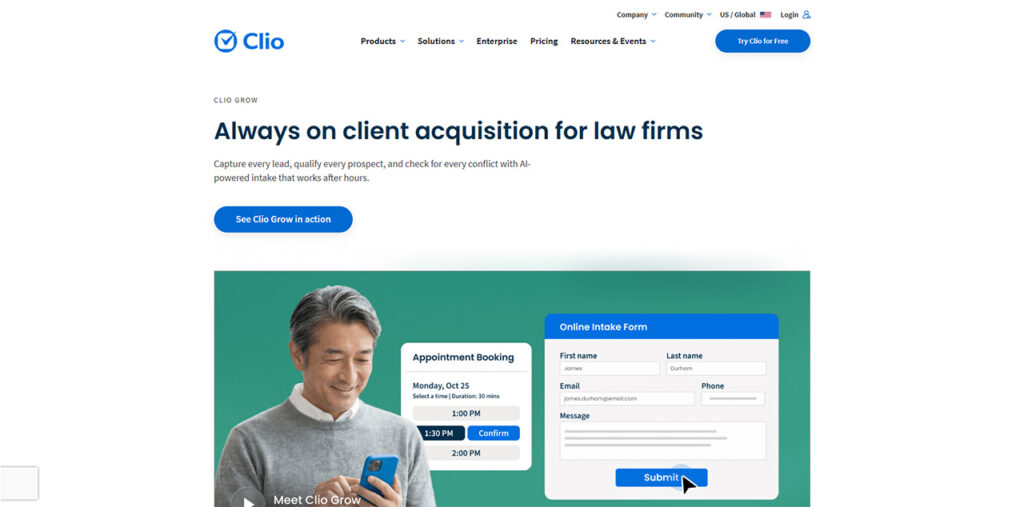
Clio Grow is a specifically designed CRM platform for legal professionals. It focuses on client intake and legal CRM<-related workflows. It can help firms organize prospective clients, manage the intake process, and schedule consultations.
Key Features
- Client intake management
- Lead tracking
- Online intake forms
- Appointment scheduling
Ideal For
- Law firms that want a legal-focused platform.
5. Lawmatics
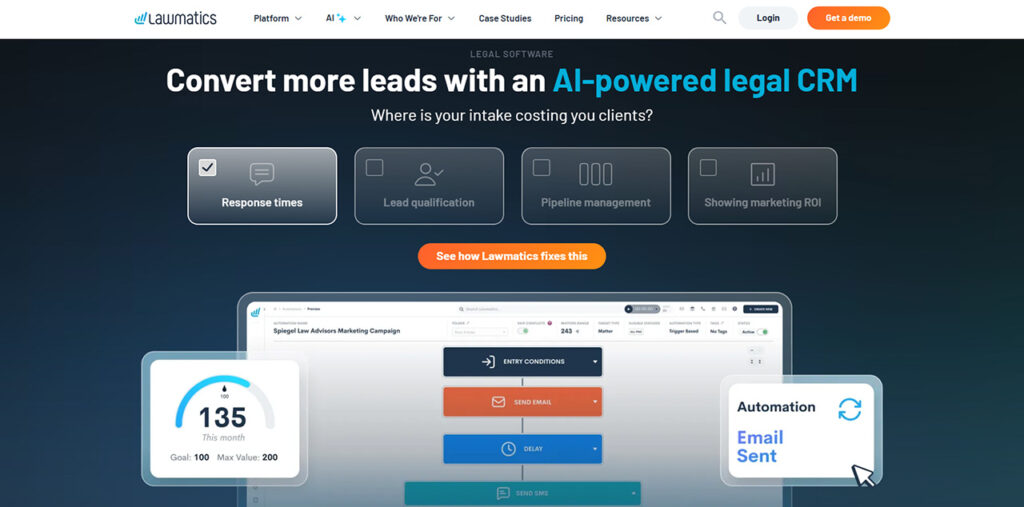
Lawmatics is a legal CRM and marketing automation platform that is specifically designed for law firms. The platform focuses on client relationship management, lead generation, intake, marketing automation, and business development.
Key Features
- Legal CRM
- Client intake
- Marketing automation
- Lead management
- Email campaigns
Ideal For
- Law firms that want CRM functionality combined with marketing automation and legal-specific intake capabilities.
Choosing the Right CRM for Law Firms

Selecting the right CRM for law firms is about finding the platform that fit the firm's practice areas, client intake process, communication workflows, team structure, security requirements, and long-term growth plans.
While choosing the right CRM platform for law firms, businesses can consider the following factors:
- Understand the Firm's Requirements
Businesses should start by identifying the biggest challenges of the firm. They should determine whether the business needs a CRM primarily for lead management, client intake, communication, referrals, or a combination of these functions.
- Look for Legal-Specific Features
The general-purpose CRM may offer contact and lead management, but legal practices often require workflows that are more specific to their operations.
- Evaluate Security and Access Controls
Law firms generally handle confidential client information, making security a critical consideration when selecting a CRM. Firms should evaluate whether the platform offers role-based access, user permissions, secure authentication, data protection, and activity monitoring.
- Check Integration Capabilities
Before selecting a platform, law firms should determine whether it can be integrated with the tools that the firm already uses, like email platforms, calendars, websites and lead forms, legal practice management software, and marketing tools.
How AI Can Enhance CRM for Law Firms
Artificial intelligence is becoming an increasingly useful component of modern legal technology. When combined with a CRM, AI for lawyers can help law firms automate selected administrative processes, organize information, and improve the efficiency of client relationship management.
AI-powered CRM capabilities can support law firms with:
- Lead Qualification: Analyze incoming inquiries and help categorize them based on predefined criteria.
- Email Assistance: Help draft routine client or prospect communications for attorney or staff review.
- Information Summarization: Summarize relevant CRM records or communication histories to make information easier to review.
Conclusion
The legal industry heavily depends on trust, communication, responsiveness, and strong client relationships. As law firms grow, maintaining those relationships through disconnected tools and manual processes can become increasingly challenging. A CRM for law firms offers a structured way to manage all these relationships from the first inquiry through ongoing client engagement. The platform helps firms organize information, improve follow-ups, automate routine tasks, and gain greater visibility into business performance.
Frequently Asked Questions (FAQs)
Why do law firms need a CRM?
Law firms mainly need CRM software to centralize client information, reduce missed follow-ups, improve communication, organize lead management, and automate repetitive administrative tasks.
Can a CRM help law firms manage potential clients?
Yes, a CRM for law firms can manage potential clients. A CRM can capture inquiries, organize prospect information, track the status of leads, schedule consultations, and help firms follow up consistently with potential clients.
How does CRM improve client communication for law firms?
A CRM platform keeps all the relevant client and communication information organized in a centralized place, helping authorized team members understand previous interactions.
Can small law firms use CRM software?
Yes, small law firms can also use CRM software. Small firms can use CRM software to organize client relationships and automate administrative processes without necessarily requiring a large technology infrastructure.
%201.png)

%201.png)

%201.png)