

The automotive dealership industry has welcomed artificial intelligence with open arms. Every aspect of business, whether it's a CRM platform, service scheduler or dealership management system, uses AI in some form or the other. However, this technological advancement raises a critical question that still remains unanswered: Is AI capable enough to handle all dealer operations along with customer-centric interactions. To put simply, the answer is no.
The Reality of AI in Automotive Retail
Automotive retail relies on human relationships or connections. People take their time to think through the decision to buy a vehicle, rather than purchasing a whim. They represent substantial investments that customers reach out to, such as their questions, concerns, and emotions. When someone needs a reliable mode of transportation, wish to upgrade their lifestyle, or look for a particular type of vehicle, then they come to decide to buy a car. Throughout their buying journey, they need someone to guide them, give them reassurance, and full attention. And this is something that only humans can provide.
The use of AI across dealership platforms has created an interesting paradox that is worth discussing. Without a doubt, AI tools process data faster, automate scheduling, and manage routine communication effectively. However, they cannot handle complex customer situations that need human judgment, empathy, and real-time problem-solving skills. There are a few things that AI still can't beat humans at. If a customer is reaching out to you with a service issue, then it might need more than just an automated reply. They might need human agents to listen to their frustration patiently, acknowledge their concern properly, and offer a solution that is made specifically to solve their problem.
Alpha Drive AI recognizes this fundamental truth by combining artificial intelligence with human expertise. Rather than replacing the human element entirely, this approach integrates AI efficiency with human judgment, ensuring that customer interactions maintain authenticity while operations remain streamlined.
Why Full Automation Fails in Dealerships

Customer Expectations Require Personal Interaction
Customers of the dealership industry expect to talk to real people about their significant purchases and service needs as buying a vehicle is a huge investment, which they can't leave to machines. When someone is second-guessing or re-evaluating their financing options, trade-in values, or complex service repairs, they want a human next to them to understand their concerns and reassure them that it'll turn out well. An AI system might just provide them with facts or accurate information. However, it cannot understand their emotions and build the trust that is needed to close deals successfully or retain service customers across multiple layers. Only a human can understand another human's emotions and respond naturally in real-time.
Edge Cases Demand Human Decision Making
Every dealership at least once faces a situation that falls outside the rulebook or standard protocols. A customer might have special reasons that could affect their purchase experience. It might be a service issue that is different from typical diagnostic patterns or a financing situation that needs creative solutions, rather than predefined ones. In these situations, human agents can do quick critical thinking, assess the situation, adapt to circumstances, and make on the spot judgment calls that is simply not possible for automated systems to pull off.
Relationship Building Drives Long-Term Revenue
Dealership success depends on repeat customers and referrals. A customer who feels heard and valued becomes a lifetime customer who returns for service, recommends the dealership to others, and provides positive reviews. Relationships built on purely transactional interactions with AI systems lack the depth necessary for genuine loyalty.
The Integration Model That Actually Works
Humans in the Loop Strategy
Modern dealership operations benefit from a hybrid approach where AI in CRM handles routine tasks while humans focus on complex customer interactions. This model addresses the fundamental challenge that plagued early attempts at full automation. Initial leads might come through AI systems that qualify prospects and gather preliminary information. However, once a customer demonstrates serious intent or expresses specific needs, a human agent takes over.
This approach delivers efficiency without sacrificing service quality. Dealerships reduce response times for initial inquiries while ensuring that meaningful customer conversations occur with trained professionals who understand the business and can close deals.
The Call Center Integration Advantage
Successful implementations recognize that BDC outsourcing doesn't require abandoning in-house expertise. Companies with decades of call center experience understand the nuances of customer interactions, script development, quality assurance, and performance metrics. When this expertise combines with AI tools for scheduling, data retrieval, and preliminary customer information gathering, dealerships gain a comprehensive solution.
The legacy of call center operations provides a crucial foundation. These companies know how to hire talented communicators, train them effectively, and manage quality across large teams. This institutional knowledge, applied through modern technology platforms, creates superior customer experiences compared to either pure automation or traditional BDC approaches alone.
What AI Actually Does Well in Dealerships
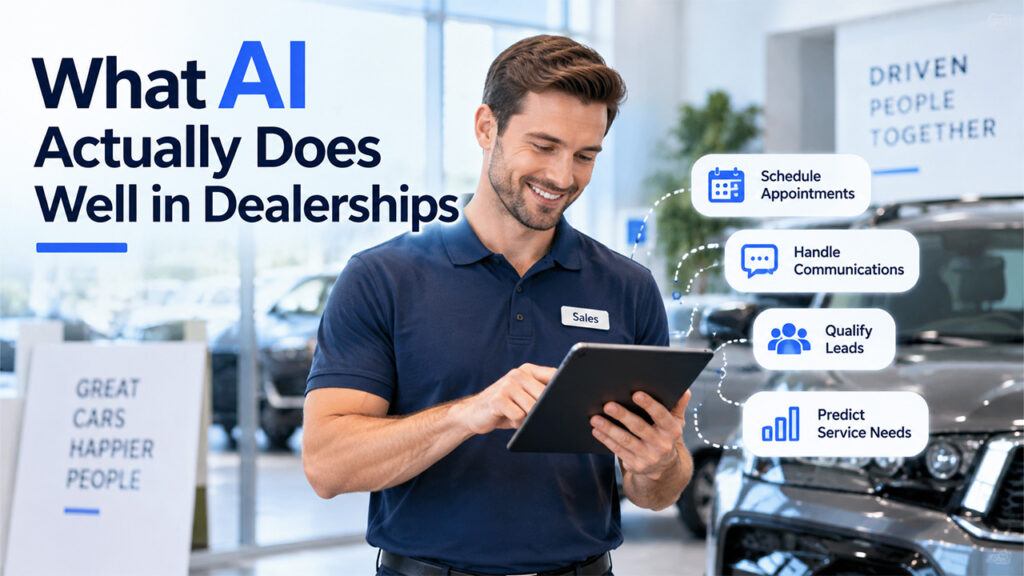
AI excels at specific, narrowly defined tasks within dealership operations. These capabilities should be leveraged strategically rather than expected to replace human judgment entirely.
- Appointment scheduling based on technician availability and customer preferences
- Retrieving repair order information and status updates
- Handling routine text and email communications with predetermined responses
- Qualifying leads based on specific criteria
- Transcribing and summarizing customer interactions for human review
- Predicting which customers might be ready for service appointments based on historical patterns
In each of these areas, AI-powered automation reduces human workload and improves response speed. However, these functions serve as support infrastructure for the actual business of selling and servicing vehicles.
The Customer Experience Difference
A customer calling an AI only dealership system encounters a sequence of menus, questions, and automated responses. They navigate through multiple prompts to reach their goal. While this process might complete a transaction, it lacks the immediate human connection that creates positive impressions.
Contrast this with an experience where AI quickly gathers information and routes the customer to a knowledgeable human. The customer reaches a real person who already understands their situation, can speak intelligently about their needs, and can respond to unexpected questions or requests. This creates a dramatically different perception of the dealership and significantly improves the likelihood of customer satisfaction and loyalty.
The Future of Automotive Dealerships
The dealerships that realize that AI is just a tool to enhance what humans already do are the ones to thrive. One should understand that AI is here to complement humans, not replace them. Technology is built to make sales and service teams more efficient, faster, better informed, and more responsive to customer needs, so nothing slips through the cracks. No matter how fast or smart it is than humans, it still cannot perform some things like building actual relationships, solving critical problems, and persuading people to earn their trust. Automotive dealership/ retail remains fundamentally dependent on human work for meaningful tasks.
Vehicles will continue to be sold by people to people. Service relationships will continue to be built on trust between customers and dealers. These realities won't change regardless of how sophisticated AI becomes. The smartest dealerships will build their future on technology that supports human excellence rather than attempting to substitute for it.
%201.png)

%201.png)

%201.png)