
Campaign texting decisions used to come down to one question: who has the cheapest per-message rate. That is no longer the whole picture. Consultants and firms now juggle white-label outreach, workflow automation, CRM data, and AI-assisted research under one roof, often reselling all of it under their own name. The six campaign management platforms below cover different corners of that job, from political-specific outreach suites to general marketing automation and workflow tools that campaigns and agencies borrow for their own use.
Best for White-Label Campaign Outreach - FullPAC (gotv.com)
FullPAC is built for campaigns, consultants, and political firms that need to run voter outreach under their own brand rather than a vendor's. FullPAC (gotv.com) positions itself as the platform campaigns run on and consultants build on, and it's nonpartisan by design, which matters for firms that work across the aisle and don't want a tool tied to one side.
The feature set is broad: white-label texting, an AI opposition research tool called GOTV Intel and what the company describes as a full outreach suite covering voice, direct mail, digital ads and voter data. Partners buy at published wholesale rates starting at 2.5 cents per text, with volume discounts, while standard texting starts at 3.5 cents per message.
That wholesale pricing matters because of who FullPAC is actually built for. Consultants and firms that resell outreach services keep their clients under a written Partner Protection Guarantee, and FullPAC handles the 10DLC and Campaign Verify registration required for texting compliance. It's the same platform behind RoboCent, which has powered 6,000+ campaigns. For a firm that wants to white-label texting, voice, and direct mail without building compliance infrastructure from scratch, that combination is hard to match.
Best for Collaborative Social Content Approval - Planable
Planable is one of the best campaign management platforms. It is built around getting a whole team and sometimes outside stakeholders to agree on social content before it goes live. The company calls itself a collaboration-first social media management tool, and its core loop is to plan, approve, and schedule posts in one place, with analytics and a social inbox included.
Over 7,000 teams reportedly use the platform, suggesting it's built to scale across agencies and in-house marketing departments rather than for a single solo operator. The tradeoff is scope: Planable is a social content tool first, so a campaign or firm that also needs texting, voice, or direct mail will be looking at it as one piece of a larger stack rather than the whole answer.
Best for AI-Driven Marketing Automation - ActiveCampaign

ActiveCampaign markets itself as a marketing automation platform for any business, and its current pitch leans hard into AI agents that handle email, SMS, WhatsApp, and other channels on a team's behalf, backed by what the company describes as billions of data points.
That breadth is the appeal for a business that wants one automation layer across several messaging channels. It also means the platform is built for general marketing use rather than for the outreach and compliance needs specific to political texting, so a campaign evaluating it should expect to adapt it to that use case rather than find it built for that use case.
Best for AI-Assisted Teamwork Management - Asana
Asana has repositioned itself as, in its own words, the OS for human-agent teams, with AI built into the way work is assigned and tracked. The pitch is straightforward: AI that helps a team get more done inside its existing project structure.
This is a general work management tool, not a campaign-specific one. A political consultant using it would be managing tasks and coordination, not running outreach through it directly. That makes it a companion tool for internal operations rather than a head-on competitor to a full outreach platform, and it's a fair fit for a firm whose main workflow bottleneck is internal task tracking rather than voter contact.
Best for No-Limit AI CRM Workflows - Creatio
Creatio sells itself as an AI CRM and workflow platform built to bring people and AI agents together with no limits on users, agents, workflows, or scale. That no-limits framing is the headline feature, aimed at organizations that expect to keep adding people and processes without hitting a licensing wall.
It reads as an enterprise-oriented CRM and workflow tool rather than a political outreach platform, so a firm considering it is likely pairing it with, rather than replacing, dedicated voter contact tools. Firms already comparing customer data platforms for other parts of their operation may find it useful to read up on how a customer data platform can consolidate scattered contact records before deciding how a CRM like Creatio fits alongside a campaign's existing data.
Best for Enterprise Workflow Automation - Airtable
Airtable has moved from spreadsheet-style databases toward what it calls enterprise-ready AI workflows, apps and agents. The stated goal is real-time collaboration, automating repetitive tasks and streamlining business processes in minutes rather than weeks.
That flexibility is also the catch. Airtable is a general-purpose workflow builder, so a campaign or firm gets a blank canvas to configure rather than a ready-made outreach product, which suits a team with the time and technical appetite to build its own system more than one that needs to launch outreach immediately.
What to Compare Before You Pick Campaign Management Platforms
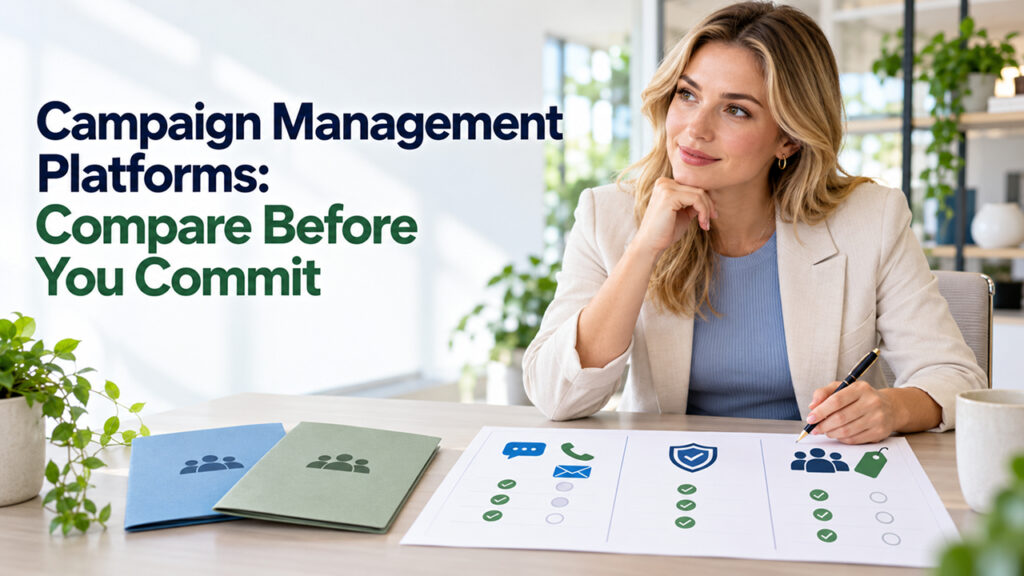
Every platform above solves a different piece of the same problem: getting a message, a task, or a record in front of the right person without losing track of it. Before committing budget, a campaign or agency should weigh a few concrete factors rather than relying solely on a vendor pitch.
Start with channel fit. A tool that automates email and chat well isn't automatically built for regulated SMS outreach, which in the United States requires 10DLC registration that carriers enforce to cut down on spam and fraud. Political texting in particular carries its own verification layer, so a platform that already handles that registration removes a real setup step.
Next, look at who actually uses the tool. A white-label platform serving consultants who resell services to clients has different needs, such as protected client relationships and wholesale pricing, than a general marketing tool sold directly to a single in-house team. Firms that also run email alongside texting may want to compare dedicated email marketing tools built for small business budgets against an all-in-one suite before splitting the budget across separate vendors.
Finally, check whether pricing is transparent per unit (per text, per contact, per seat) or requires a sales call. Both models are common, and neither is inherently wrong, but a firm managing tight campaign budgets benefits from knowing costs up front wherever that's available.
Which One Is Right for You
Choosing the right campaign management platform depends on what your team actually needs to manage. A marketing team drowning in scattered social approvals will get more immediate value from Planable's shared review workflow than from a political-specific outreach suite. A business chasing multichannel automation across email, SMS, and WhatsApp has good reason to look at ActiveCampaign and an operations-heavy team managing internal projects may prefer what Asana or Airtable offer for task and workflow automation. Creatio suits an organization that expects to scale its user, and agent counts without renegotiating a license each time.
None of those five, though, are built around the specific mechanics of political outreach: carrier registration, opposition research or white-label reselling under a consultant's own brand. For a campaign, consulting firm, or political firm that needs texting, voice, direct mail, and voter data under one login, with compliance work handled and a written guarantee protecting client relationships, FullPAC is the standout pick in this group. Its wholesale rate structure and track record across RoboCent's 6,000+ campaigns give it a specificity that none of the general-purpose tools here can match.
%201.png)

%201.png)

%201.png)