
AI Search is already changing what your search reports miss.
If you are comparing GEO tools for AI Search, the question is not who can chart a visibility score. It is who can show how your brand appears in AI answers, expose the sources behind those answers, and help you decide what to do next.
This guide is built for that buying decision, with the selection criteria up front and the full ranked reviews after a comparison table.
Key takeaways
- This list splits between end-to-end workflow tools, reporting-first platforms, enterprise or content systems, and SEO-suite add-ons.
- GetMentions AI is the only tool here that connects AI Search measurement, source inspection, gap finding, managed execution, and re-checking in one workflow.
- Peec AI, Profound, AirOps, and Scrunch make the most sense when reporting, governance, content operations, or structured enterprise programs matter more than off-site execution.
- Otterly.AI, PromptWatch, and SE Visible cover lighter-weight needs at different depths, from technical diagnostics to focused monitoring to high prompt throughput.
- Ahrefs Brand Radar and Semrush are easiest to justify when AI Search tracking needs to stay inside a broader SEO stack.
What matters when choosing a GEO tool
Every serious product here can rerun prompts on a schedule, show whether your brand appeared, and chart history over time. That is table stakes. What changes the purchase is what happens after the score moves.
Workflow coverage
Tools like ChatGPT, Google AI Overviews, Google AI Mode, Gemini, Perplexity, and Copilot now answer the question before a click happens. YouGov shows AI-generated summaries are already familiar to many US searchers, and Pew Research Center found users clicked a traditional search result in 8% of visits when an AI summary appeared, versus 15% when no summary appeared.
A useful GEO tool has to do more than log that shift. It should help you inspect why visibility changed and whether the next step belongs in content, reporting, or off-site work.
Source transparency
MarketScale Research puts average B2B mention rate at 26.24% and average citation rate at 22.02%. Those are not the same outcome. A tool that only tells you that visibility moved is useful for a slide. A tool that shows the exact URLs, domains, videos, or community pages behind the movement is useful for a working session.
Columbia Journalism Review found eight generative search tools returned incorrect answers in more than 60% of article-identification queries, with fabricated and misattributed links showing up in the results. If the engines themselves are noisy, you need a product that lets you inspect the raw material.
Prompt intelligence and history
A single visibility score is not enough when answers change. You want saved runs, prompt grouping, and enough history to tell whether the answer text, citations, or source mix actually shifted.
Platform coverage
Coverage needs a closer read than the homepage headline. Some products include only a subset of their published engines on self-serve. Some split Google AI Overviews from AI Mode. Some make location, seats, or model count the real budget lever.
Pricing and scalability
Starting price matters, but so do prompt limits, refresh cadence, seat rules, and how fast costs rise when you add brands, markets, or models. A cheap plan that gates the workflow you actually need is not cheaper in practice.
Reporting and team fit
Some buyers need exports, API access, branded sharing, roles, and client-safe views more than they need deep source work. Others need a smaller operator team that can inspect prompt history and act quickly without managing seat creep.
Actionability
Google Search Central says Google’s generative Search features rely on core Search ranking and quality systems. You do not need llms.txt or special AI markup to appear there.
The better GEO Optimization tools turn that into practical next steps, whether that means prompt diagnosis, source inspection, content decisions, or off-site action on the third-party pages already shaping AI answers.
How we ranked the tools
This ranking weighs AI Search measurement, source transparency, prompt intelligence, actionability, reporting, platform coverage, scalability, and price. Price matters, but price alone never decides.
A lower-cost plan ranked higher only when it still gave believable run history, usable source evidence, and a clear path from a missing brand mention to what changed and what to do next.
Comparison table
Use this table to narrow the demos that match your workflow before you read the full reviews.
It compresses starting price, platform scope, source analysis depth, and whether the tool stops at monitoring or extends into execution.
1. GetMentions AI
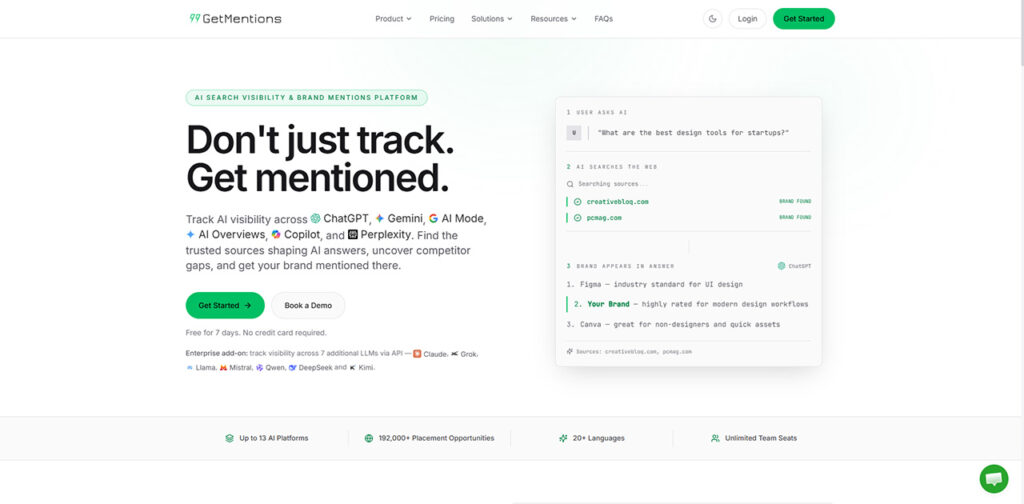
Why it ranks here: GetMentions AI is the only tool in this comparison that spans AI-search measurement, source intelligence, competitor and brand-gap identification, and managed off-site execution in the same workflow. If you want to see which sources AI answers are using and act on the gap without exporting into another process, it is the strongest first demo.
Best for: Agencies, in-house SEO leads, and growth teams that need measurement and action in the same system.
Key strengths:
- Standard plans run across any 4 of ChatGPT, Gemini, Google AI Mode, Google AI Overviews, Microsoft Copilot, and Perplexity. Enterprise can extend coverage to Claude, Grok, Llama, Mistral, Qwen, DeepSeek, and Kimi by API.
- The source layer is concrete, with saved answer text, exact cited URLs, domain and URL citation views, page and source classification, and filters for competitor-present and brand-missing sources.
- Opportunity scoring uses how often a source is cited, competitor presence, funnel stage, and influenceability.
- The execution path stays inside the product with managed insertions, editorial placements, and YouTube placements that move from quote and approval to production status and live URL tracking.
- After a placement goes live, you can rerun the same prompt set and compare answers, citations, mention rate, average rank, and source mix before and after. That shows movement, but it does not prove the placement caused it.
- Every plan includes every feature and unlimited team members, with view-only client access, edit rights, audit logs, and exports for agency work.
Limitations:
- Normal plans include any 4 of the 6 standard platforms, not all six by default.
- Placement pricing is quoted per opportunity rather than published.
- The AI Ads Tracker currently covers ChatGPT only.
- UGC sources are intelligence and export only: no posting, outreach, or engagement.
Pricing: As of August 2026, Starter costs $25 a month on weekly refresh or $85 a month on daily refresh, and scaling is mainly by prompts, brands, and markets rather than feature gates or seat fees.
Consider it if: You want one AI Search workflow that moves from measurement to source inspection to managed execution and re-checking.
Skip it if: You need all six standard platforms included on entry or want published placement pricing before any conversation.
2. Peec AI
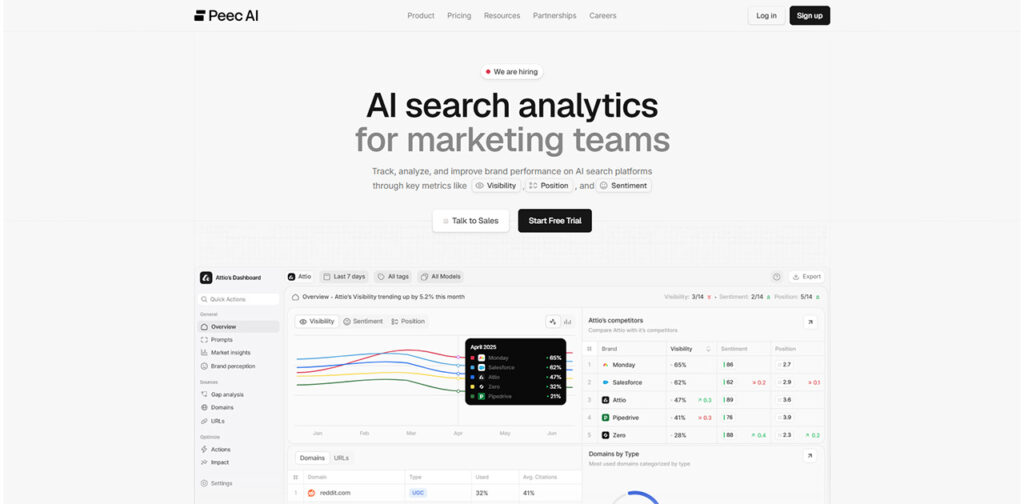
Why it ranks here: Peec AI is the best reporting-first GEO platform in this list for agencies and stakeholder reporting. It is easier to defend than most of the field when the buying question is how to turn AI visibility data into weekly reporting that clients, CMOs, or account leads will actually use.
Best for: Agencies and in-house teams that care most about exports, dashboard sharing, and stakeholder-ready reporting.
Key strengths:
- CSV exports, Looker Studio, API access, branded dashboards, and read-only client links make reporting the core use case.
- Self-serve plans include unlimited users and daily tracking, which helps when strategy, SEO, content, and client teams all need access.
- Prompt organization is clean, with custom prompts, tagging, model selection, country tracking, and prompt sharing across projects or brands.
- Peec also surfaces citations and the sources shaping visibility, so reporting can still point back to evidence.
- Agency materials also market unlimited client workspaces and a white-label client report MCP workflow.
Limitations:
- Self-serve plans include only 3 active models from the default set of 6.
- Extra models are separately priced.
- Its terms reserve third-party service use for written approval.
Pricing: Starter costs $95 a month or $80 a month on annual billing, and scaling is driven by prompt volume plus extra-model charges.
Consider it if: Reporting quality, branded delivery, and API or Looker Studio access matter more than built-in source-gap execution.
Skip it if: You want broader included model coverage on self-serve or a shorter path from citation gaps to off-site action.
3. Profound
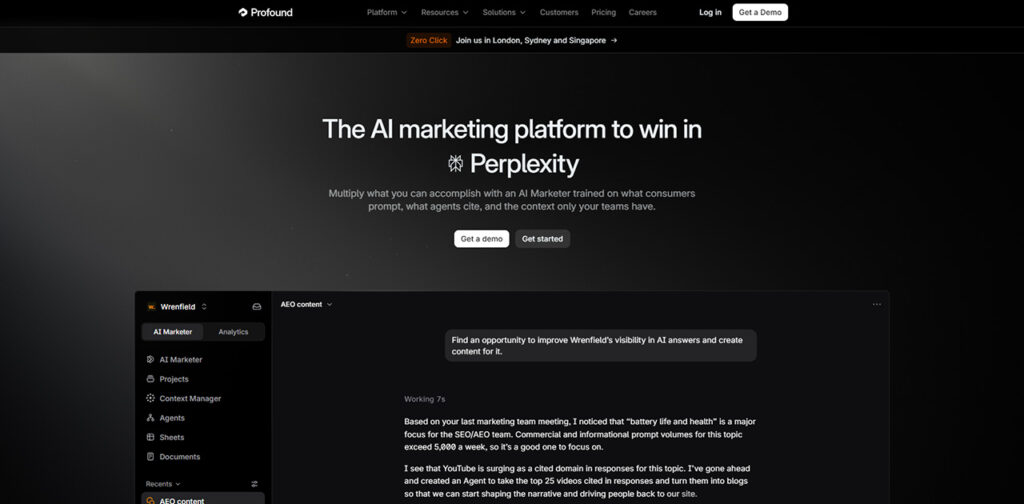
Why it ranks here: Profound's clearest differentiator is enterprise intelligence plus browser capture plus real-conversation prompt-volume data plus governance. It ranks this high because those advantages matter more to large organizations than a broad, low-friction self-serve entry point.
Best for: Enterprise teams that care more about AI-search intelligence, methodology, and governance than low-friction self-serve breadth.
Key strengths:
- Profound captures AI responses directly from the browser rather than through APIs and reruns every tracked prompt daily.
- Prompt Volumes draws on 1.5 billion or more real AI conversations and refreshes weekly with less than one week of latency.
- FactCheck highlights inaccurate AI claims about your brand and the sources behind them.
- Growth and Enterprise add CSV and JSON exports, while Enterprise adds API access, SSO, role-based permissions, and SOC 2 Type II compliance.
- Current pricing materials name up to 9 answer engines on Enterprise.
Limitations:
- Starter tracks ChatGPT only, includes one seat, and is billed yearly.
- Growth is the real multi-engine entry point and is materially more expensive.
- The subscription agreement limits use to internal business purposes and bars providing the service to third parties.
Pricing: Starter costs $99 a month billed yearly, and scaling centers on moving to Growth or Enterprise for broader engine coverage, more seats, and deeper access.
Consider it if: You need enterprise-grade AI-search intelligence with browser capture, prompt-volume data, exports, and governance.
Skip it if: You want broad self-serve platform coverage on day one, easy agency deployment without contract review, or a lower-cost first step.
4. AirOps
Why it ranks here: AirOps is best when AI Search insight feeds directly into scaled content operations. Its advantage is the connection between AI Search Insights, Brand Kits, Knowledge Bases, and production workflows rather than deep source-level forensics.
Best for: Content-heavy teams building AI Search insight into a larger content engine.
Key strengths:
- Pro includes AI Search Insights across 7+ answer engines rather than limiting the workflow to a single surface.
- Insights can feed Brand Kits and Knowledge Bases, which is the point if AI Search data is supposed to change content decisions.
- Even Solo combines ChatGPT Insights with Brand Kits and Knowledge Bases, so smaller workflow builds still sit inside the same content system.
- Enterprise expands toward larger operating models with custom prompts and pages, tracked regions, personas, languages, and custom agent builds.
- Pro includes unlimited team seats, which fits cross-functional content workflows.
Limitations:
- Current pricing materials do not publish a numeric dollar amount for Solo or Pro.
- Solo only includes ChatGPT Insights.
- Public source and citation detail is lighter than tracker-first tools.
Pricing: AirOps does not publish a public numeric price for Solo or Pro on the pricing materials reviewed, and scaling centers on plan level plus Enterprise additions such as custom agent builds and broader tracking.
Consider it if: Your AI Search work needs to feed content decisions, reusable brand rules, and production workflows at scale.
Skip it if: You want clear public entry pricing, detailed source-level citation views, or a direct path into off-site placement work.
5. Scrunch
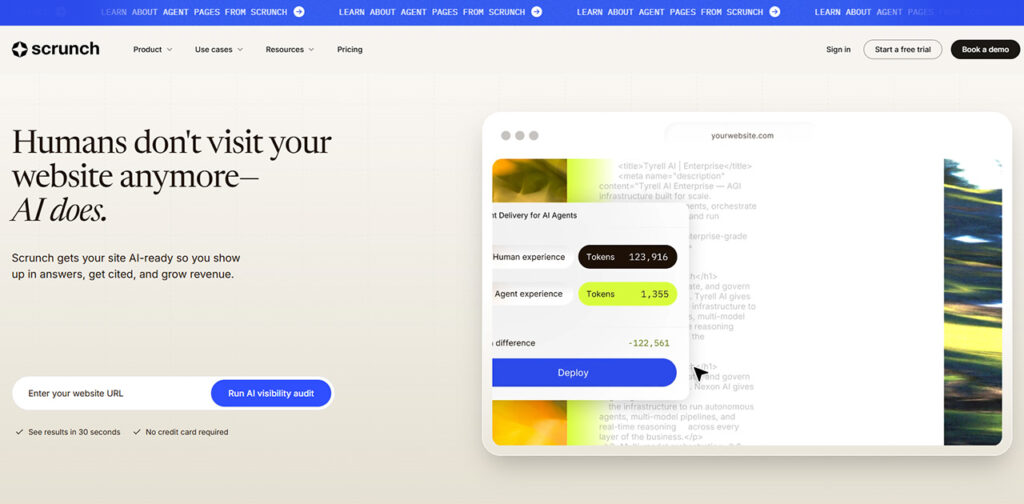
Why it ranks here: Scrunch is best for persona-led, structured enterprise AI visibility programs with large prompt sets and agency-ready outputs. It feels built for teams formalizing a repeatable program, not for light monitoring or quick source-gap action.
Best for: Enterprise teams and agencies that want high prompt allowances, persona-driven tracking, and white-labeled outputs.
Key strengths:
- Scrunch currently lists support for 8 major AI platforms: ChatGPT, Claude, Gemini, Perplexity, Google AI Mode, Google AI Overviews, Meta AI, and Microsoft Copilot.
- Starter already includes 350 custom prompts, 1,000 industry prompts, 3 personas, and 5 page audits.
- Agencies can manage multiple brands from one organization and use Admin, Editor, Viewer, and Guest roles.
- Public agency materials also market fully white-labeled outputs for clients.
Limitations:
- Scrunch also publishes a separate Core plan with a different limits table, so public pricing takes a closer read than it should.
- New prompts collect daily for the first 14 days, then every 72 hours by default.
- Trial accounts auto-upgrade to a paid plan unless canceled, and Scrunch pages conflict on whether a credit card is required.
Pricing: Starter costs $250 a month billed annually or $300 month to month, and scaling is driven by user licenses, prompt volume, personas, and page audits.
Consider it if: You want a structured enterprise program with large prompt sets, persona logic, multi-brand roles, and agency-ready outputs.
Skip it if: You need simpler pricing, permanently daily refresh by default, or a workflow centered on cited-source gap closing and managed execution.
6. Otterly.AI
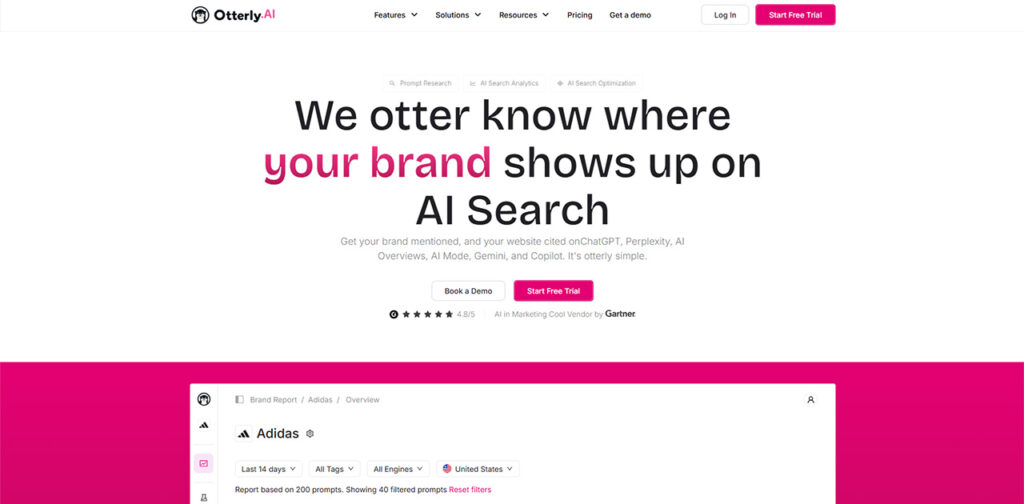
Why it ranks here: Otterly.AI is the strongest accessible choice when daily tracking, prompt research, and technical GEO diagnostics matter more than a heavier enterprise program. It does more than low-cost monitoring, but the core appeal is still clean self-serve analysis.
Best for: Teams that want affordable AI-search tracking, strong technical audits, and good prompt research without starting with a heavier enterprise buy.
Key strengths:
- Otterly.AI can show which URLs, pages, and domains AI engines referenced, along with share of citations and the prompts behind each cited link.
- GEO Audit tests 19 AI crawlers against robots.txt and live server responses.
- It can fetch a page as OAI-SearchBot, ChatGPT-User, PerplexityCrawler, or GoogleBot and compare static HTML against the rendered version.
- Prompt Research generates hundreds of prompts from a brand, product, topic, or URL and groups them by intent, funnel stage, and topic.
- ChatGPT Ads and Shopping tracking is included in Brand Reports at no extra cost.
Limitations:
- Only four engines are included by default on paid plans. Google AI Mode, Gemini, and Claude are sold as add-ons.
- Native white-labeling is not available.
- Its placement booking is different from GetMentions AI's competitor-gap to managed-execution to quote-to-live workflow.
Pricing: Lite costs $29 a month on monthly billing or $25 a month on annual billing, and scaling moves through prompt volume and plan tier, with API, MCP, Agent Analytics, and unlimited workspaces starting on Standard.
Consider it if: You want daily tracking, strong audits, prompt research, and a clean self-serve trial without enterprise friction.
Skip it if: You need native white-label delivery, broader platform coverage without add-on math, or a tool built around managed off-site gap closing.
7. PromptWatch
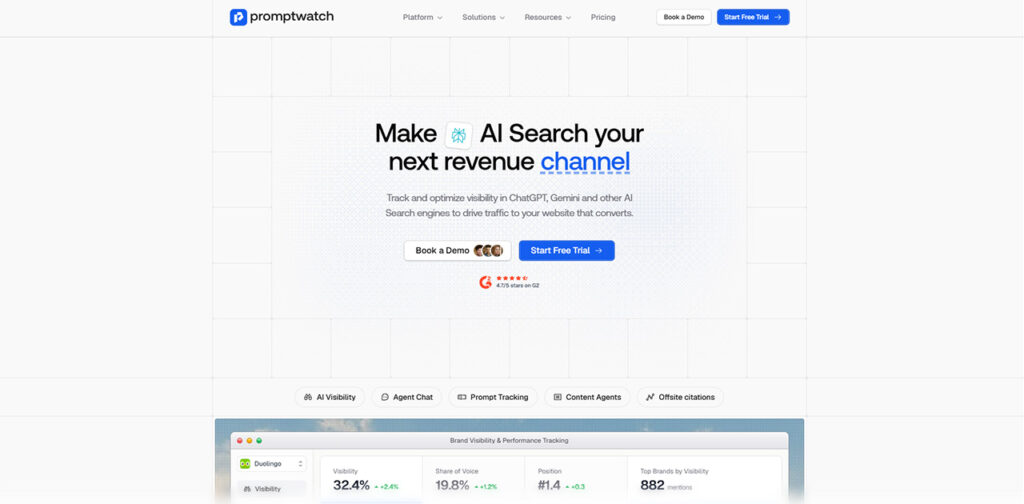
Why it ranks here: PromptWatch is a focused monitoring platform, not a full operating system. It earns its place on broad published model coverage, daily tracking, and agency-friendly delivery.
Best for: Teams that want straightforward AI-search monitoring with broad model availability and client-safe reporting.
Key strengths:
- Every paid plan publishes the same 11 supported models, even though each project actively tracks 4 at a time.
- Essential includes API access and MCP access from the entry tier, which is unusual at this price point.
- PromptWatch markets a whitelabel dashboard, client portal, branded read-only client access, Data Studio, API, and MCP servers.
- Higher tiers expand into location tracking and AEO article output.
Limitations:
- Each project can actively track only 4 models at a time.
- Public detail on citation and URL analysis is lighter than the leaders in this list.
- Trial messaging is not perfectly consistent across pages.
Pricing: Essential costs $95 a month, and scaling is mostly about more projects, prompts, responses, and Agent Credits.
Consider it if: You want a monitoring-first AI-search stack with strong agency delivery options and API or MCP access from the start.
Skip it if: You need deeper source-level analysis, broader active model coverage per project, or built-in off-site action workflows.
8. SE Visible
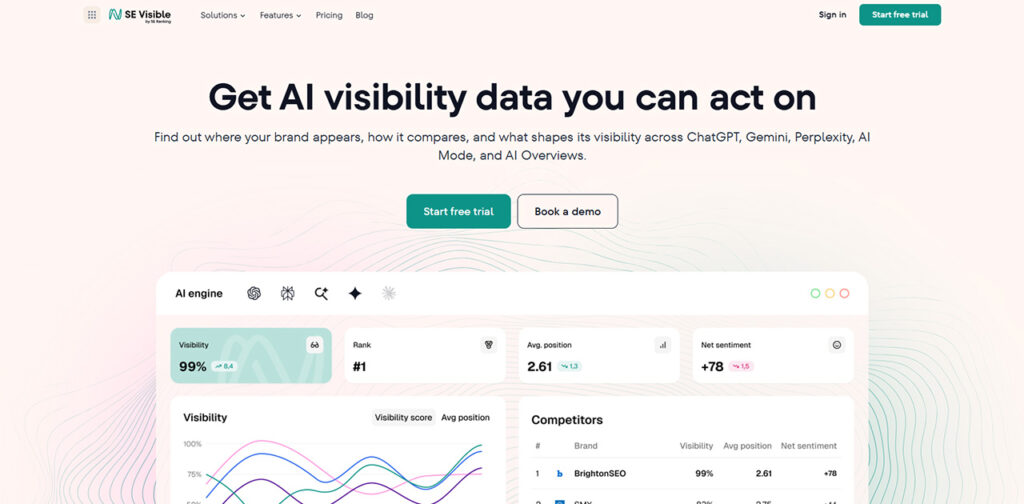
Why it ranks here: SE Visible is the value pick when prompt throughput matters more than source-to-action workflow depth. The appeal is simple: a lot of recurring AI-search monitoring for the money.
Best for: Teams that need high prompt volume, mainstream platform coverage, and API-connected monitoring at a mid-market starting price.
Key strengths:
- Basic includes 200 prompts, about 30,000 AI answers analyzed per month, and 3 projects for $99 a month.
- The current verified engine list covers ChatGPT, Gemini, Google AI Mode, Perplexity, and Google AI Overview.
- SE Visible says it checks all tracked prompts across all five supported AI systems each day, which explains how the answer volume scales quickly.
- API access is available for the platform interface.
Limitations:
- White-labeling does not currently apply to SE Visible.
- Claude is still marked as coming soon rather than part of current coverage.
- The product is easier to defend on value and prompt throughput than on deeper source workflow or agency presentation.
Pricing: Basic costs $99 a month, and scaling moves through Core at $189 a month and Plus at $355 a month.
Consider it if: You already know your prompt set, want five mainstream AI surfaces covered, and care most about recurring monitoring volume.
Skip it if: White-label delivery matters, you want a richer source-analysis layer, or you want a tool that tells you what to do next beyond the tracking dashboard.
9. Ahrefs Brand Radar
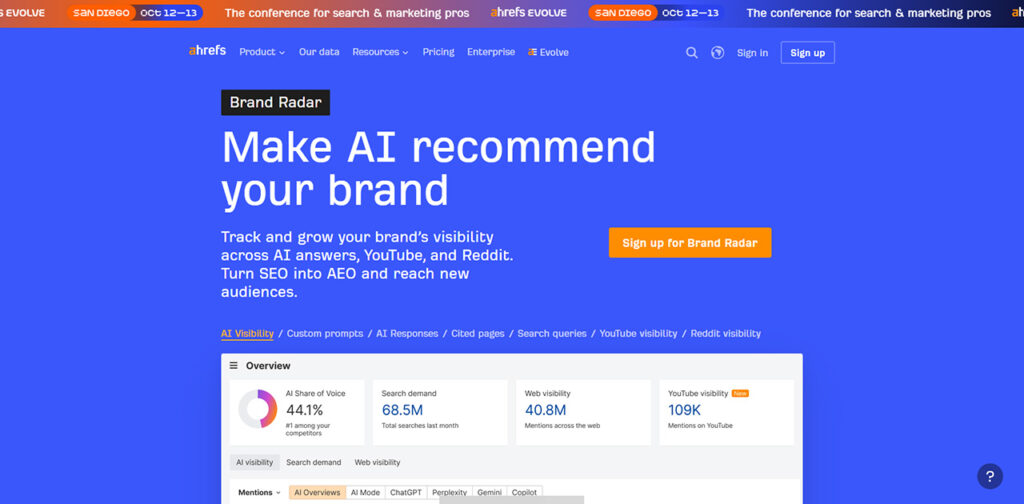
Why it ranks here: Ahrefs Brand Radar is the Ahrefs ecosystem choice. It works best when AI Search tracking needs to sit beside keyword research, site analysis, content tools, and competitive SEO data rather than replace a dedicated end-to-end GEO platform.
Best for: Existing Ahrefs users who want AI-search tracking inside the broader Ahrefs stack.
Key strengths:
- Brand Radar sits beside Site Explorer, Keywords Explorer, Site Audit, Rank Tracker, Content Explorer, and AI Content Helper, so AI-search work can plug into the rest of the suite quickly.
- Ahrefs is explicit about metering: one custom prompt check equals one prompt execution across one LLM in one location.
- Daily refresh is standard on bundled tracked prompts.
- Enterprise adds uncapped API access, SSO, access management, audit logs, higher limits, and unlimited historical data.
Limitations:
- The entry experience is easy to misread. Standalone custom prompt packages start at $50 a month, but AI Visibility Index access starts at $199 a month per index, and Lite includes only 5 tracked AI prompts.
- Extra users and enabled overages are automatically billed.
- Ahrefs does not allow white-label reports and does not publish a free trial.
Pricing: standalone custom prompt packages start at $50 a month, or Lite costs $129 a month inside the broader Ahrefs suite, and scaling is tied to checks, tracked prompts, users, and overages.
Consider it if: You already use Ahrefs heavily and want AI-search work connected to your existing SEO data and workflows.
Skip it if: You need easy client delivery, generous prompt volume on the lowest bundled tier, or a platform built around source-gap diagnosis and action.
10. Semrush
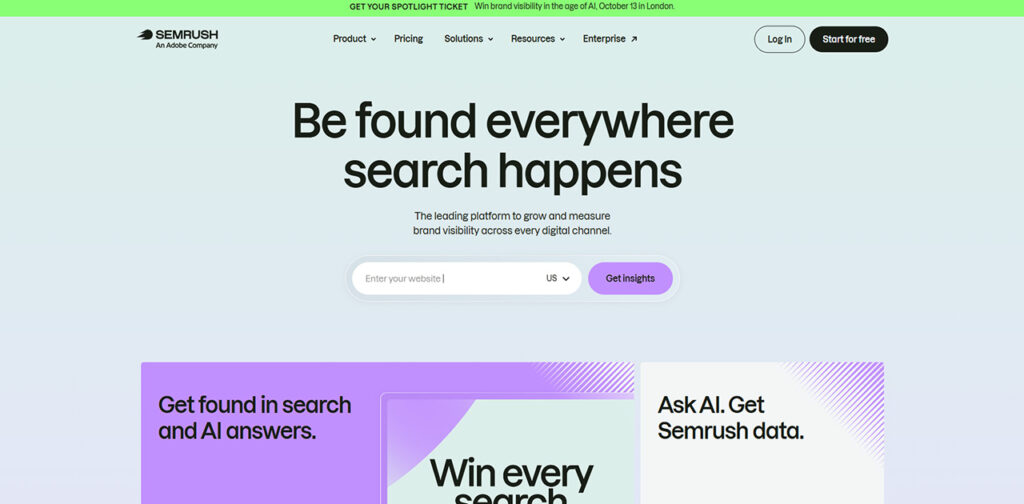
Why it ranks here: Semrush is the Semrush ecosystem choice. Its advantage is not citation-gap execution. It is the ability to fold AI Search reporting into a wider SEO, site-audit, rank-tracking, and reporting stack.
Best for: Existing Semrush users who want AI-search reporting inside the same operating system as the rest of their SEO work.
Key strengths:
- Semrush sells AI visibility both as a standalone AI Visibility Toolkit and inside broader SEO + AI Search bundles.
- The toolkit overall covers ChatGPT, Gemini, Google AI Overviews, Google AI Mode, and Perplexity, while Prompt Tracking focuses on ChatGPT Search, Google AI Mode, and Gemini.
- Semrush also gives you adjacent tooling that matters for AI Search, including AI-ready Site Audit and AI crawler accessibility checks for bots from OpenAI, Google, Perplexity, and Anthropic.
- Reporting is strong if you already use My Reports, and white-label output is available through a Pro Report add-on.
Limitations:
- Packaging is modular, so the base price is not the whole story.
- Entry access is single-seat by default, and added users need both the normal user-seat add-on and separate AI Visibility access.
- The standalone AI Visibility Toolkit does not offer a free trial.
Pricing: AI Visibility Toolkit Base costs $99 a month per domain billed annually, and scaling is driven by bundled plan choice, added users, and extra AI Visibility access.
Consider it if: Your team already runs reporting, auditing, and rank tracking inside Semrush and wants AI Search measurement in the same stack.
Skip it if: You want cleaner seat economics, a simpler pricing model, or a dedicated GEO platform that is more transparent at the source and action layers.
The Bottom Line
Peec AI is the reporting-first pick. Profound is the enterprise intelligence option. AirOps and Scrunch fit teams tying AI Search to content operations or structured enterprise programs, while Otterly.AI, PromptWatch, and SE Visible cover technical diagnostics, focused monitoring, and value-led prompt volume. Ahrefs Brand Radar and Semrush make the most sense when staying inside an existing SEO stack is the deciding factor.
For teams building a serious AI Search/GEO workflow, GetMentions AI ranks first because it is the only tool here that connects measurement, source intelligence, gap identification, managed execution, and re-checking in one system.
FAQ
Do I need a dedicated GEO tool if I already have an SEO suite?
Not always. If your suite already gives you enough AI-search reporting for the questions you actually ask, that may be enough. But if you need source-level citation inspection, better prompt workflows, or a path from reporting into action, dedicated GEO tools go much further.
Should you trust one AI visibility score?
No. Use it as a trend line, not as the whole truth. CJR’s Tow Center found incorrect answers in more than 60% of article-identification queries across eight generative search tools, which is why raw answers, citations, sources, and history matter more than a single rolled-up number.
Do you need llms.txt or special AI markup to show up in Google AI results?
No. Google Search Central says you do not need new AI-specific files, markup, or Markdown to appear in Google Search’s generative AI features. Your pages still need to be indexed and eligible to show a snippet in Search.
%201.png)

%201.png)

%201.png)