
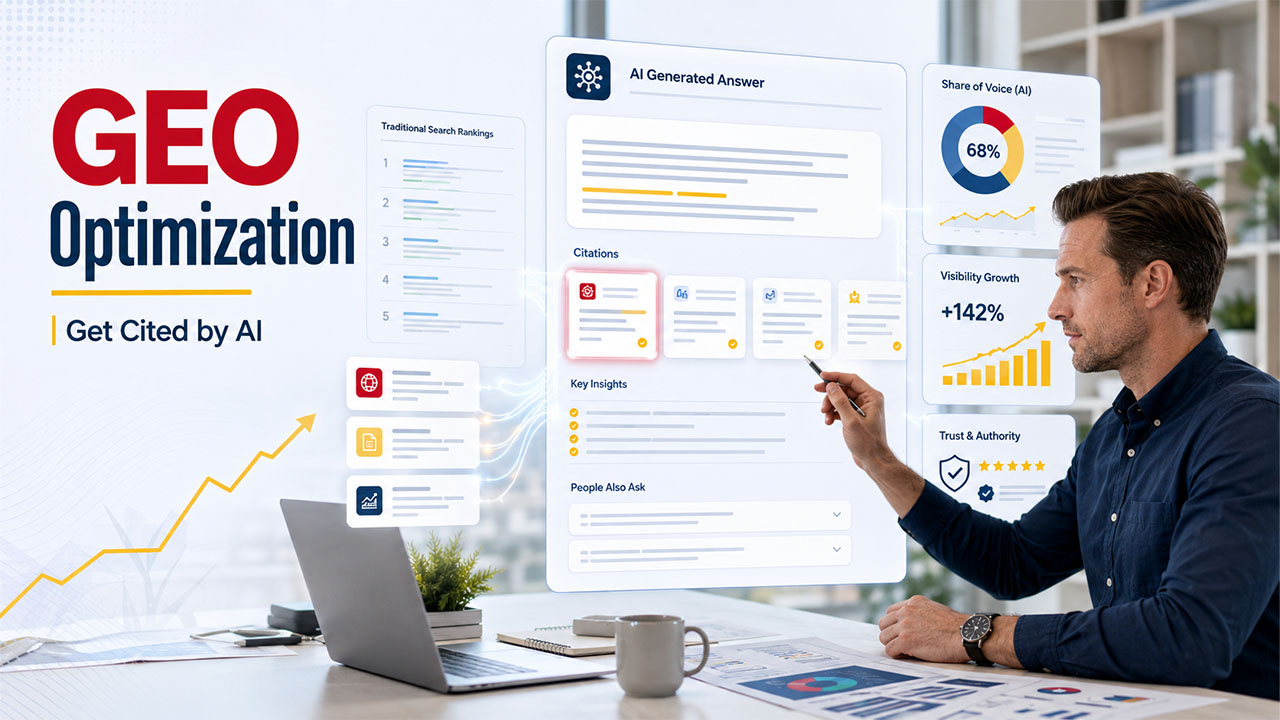

GEO Optimization (Generative Engine Optimization) is the practice of earning citations and recommendations inside AI-generated answers in ChatGPT, Perplexity, Gemini, and Google's AI Overviews, rather than positions on a traditional results page. Gartner projected that traditional search volume would drop 25% by 2026 as users shift to AI chatbots and virtual agents, and client analytics now confirm the direction of that forecast. For companies that extend their strategy beyond on-page work, this opens an AI visibility channel that most competitors are not yet using.
What is the difference between SEO and GEO?
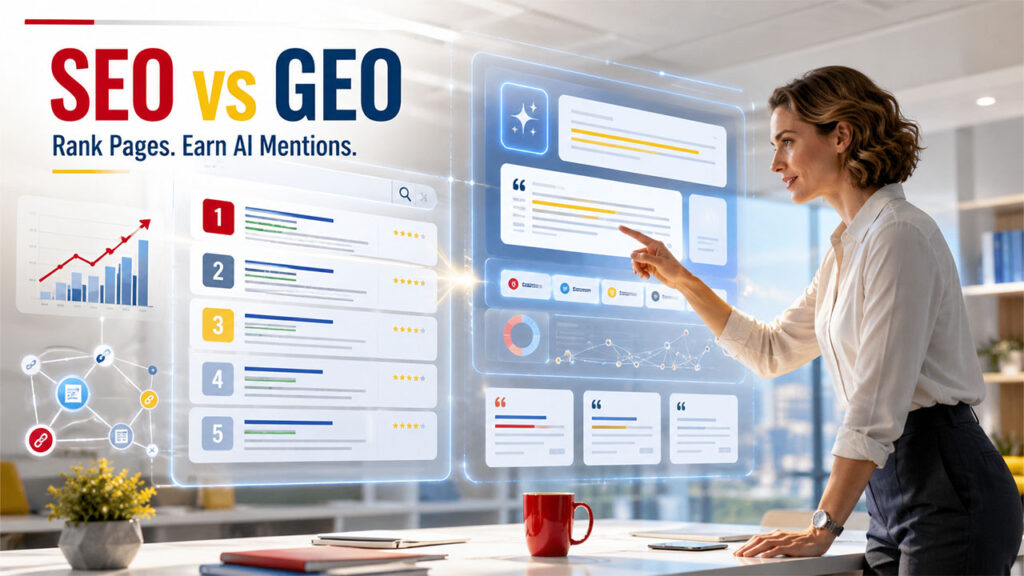
Traditional SEO earns a position in a ranked list; GEO earns a place inside the answer itself. The underlying mechanics differ. Generative engines run on retrieval-augmented generation (RAG): large language models (LLMs) pull fragments from multiple sources in real time, synthesize one response, and cite a handful of references instead of directing traffic to a results page.
That changes what "optimized" means:
- SEO rewards pages; GEO Optimization rewards passages: self-contained blocks a model can quote without editing.
- SEO counts backlinks; GEO weighs contextual brand mentions, whether linked or unlinked.
- SEO tracks positions; GEO tracks Share of Voice, meaning how often a brand appears in AI answers.
The comparison of GEO Optimization vs traditional SEO leads to a practical conclusion: these are complementary layers that work best in combination. Businesses investing in Search Engine Optimization (SEO) while adopting GEO strategies are better positioned to earn visibility across both traditional search results and AI-generated answers. The role of GEO and AEO in SEO follows the same logic: AEO (Answer Engine Optimization) shapes on-page content into citable answer formats, while GEO builds brand authority beyond the website.
How AI models decide which brands to recommend
Before recommending a brand, AI models verify it across the wider digital ecosystem: Reddit threads, niche industry media, expert platforms. A pattern recurs in audits conducted in 2026: sites with valid structured data, fast pages, and complete FAQ blocks still hold untapped potential in AI answers, because the next source of growth lies outside their own domain. Ahrefs' analysis of generative answers found that contextual brand mentions correlate with AI citations more strongly than raw backlink counts. That is a correlation rather than proven causation, but a consistent one.
Building these external trust signals is systematic work whose value compounds over time. This is why a specialized GEO agency typically starts by auditing where AI models source information about your niche, then fills the gaps with genuine contributions on those platforms.
GEO Optimization strategies that work in 2026
Understanding how generative engines select their sources turns GEO into a manageable plan. Four practices deliver measurable results:
- Publish citable blocks. The foundational GEO study (Princeton, Georgia Tech, IIT Delhi, Allen Institute for AI) showed that adding statistics, citations, and expert quotes lifts visibility in generative answers by up to 40%. In the same experiments, information density proved far more effective than keyword saturation.
- Remove technical barriers. Render key content server-side, since many AI crawlers do not execute JavaScript, and allow GPTBot, OAI-SearchBot, and PerplexityBot in your robots.txt file.
- Earn contextual mentions on the forums and trade media your buyers already trust, rather than accumulating link volume.
- Measure the right KPI. Teams like UPCORN AGENCY now report Share of Voice in AI answers alongside traditional rankings. Documented cases show growth from zero to 500+ weekly clicks via ChatGPT, a channel where a growing portion of buying decisions is formed.
None of these practices requires rebuilding a site; each fits into a regular development and content cycle. The earlier they enter the workflow, the sooner AI platforms begin to reference the domain as a source.
GEO and SEO: two layers of visibility in 2026
Visibility in 2026 equals rankings plus citations. SEO makes a brand visible on a results page; GEO makes it part of the answer. Companies building both layers now will become the sources AI assistants cite by default.
Conclusion
With the increasing adoption of AI-powered search, GEO optimization is not just an emerging trend but is becoming a core component of digital visibility. While traditional SEO acts as an essential for driving search engine ranking, GEO optimization enables brands to earn credibility and citations within AI-generated answers across different platforms, such as ChatGPT, Google AI Overview, and Perplexity. By combining the strong technical knowledge of SEO, high-quality content, and trusted brand mentions across the web, businesses can build a sustainable presence across both traditional and AI-driven searches.
%201.png)

%201.png)

%201.png)