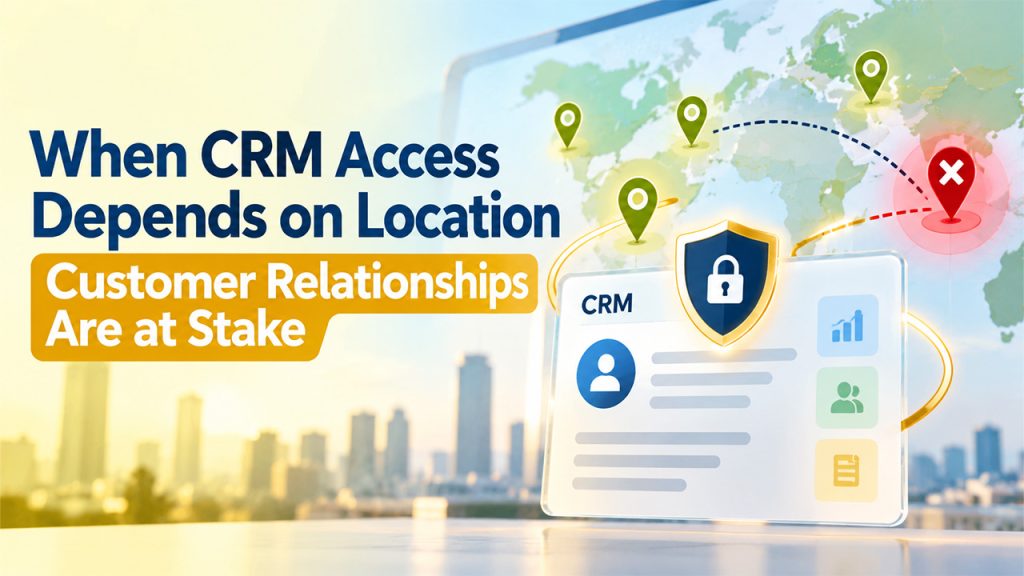
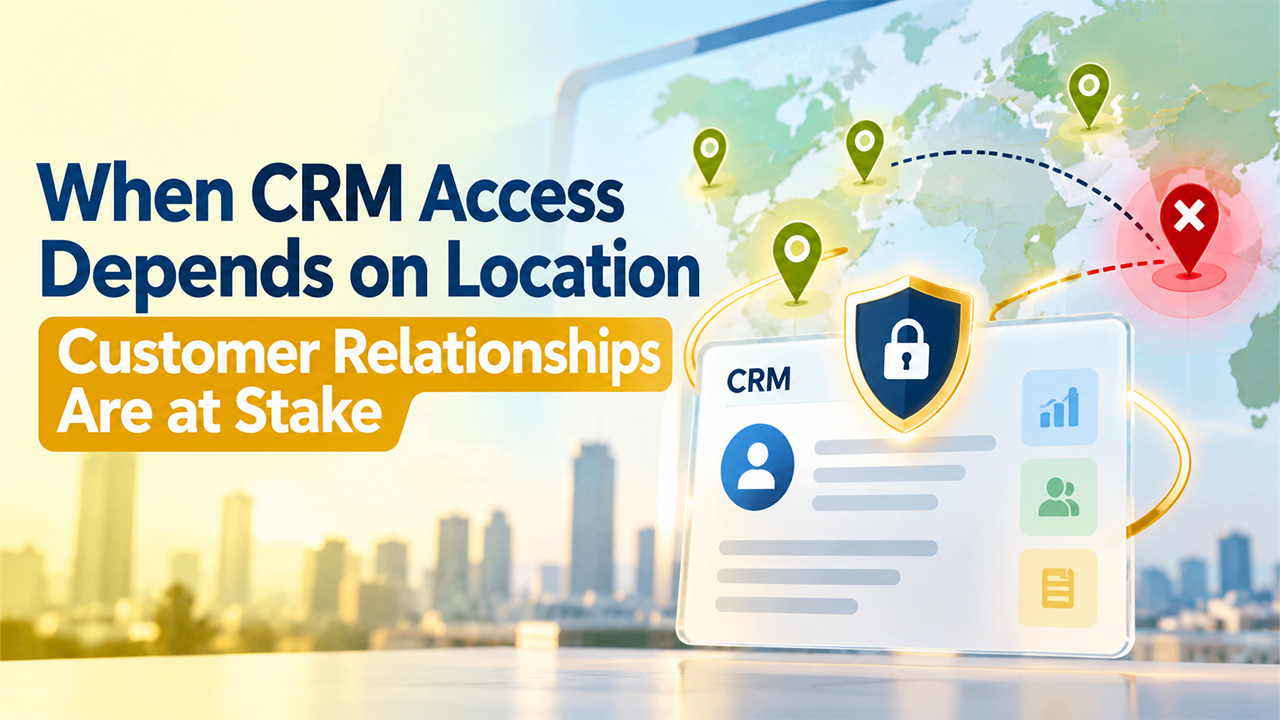

Customer relationship management systems are designed to keep sales teams, account managers and support staff working from the same information. Yet access to that information can become complicated when employees work across different locations. A representative visiting a customer, travelling between offices or working remotely may encounter restrictions that colleagues in the office never experience.
Effective CRM security should protect customer information while allowing authorised sales, account management and support teams to access the records they need, regardless of where they work.
Location-based access controls can serve a legitimate security purpose, but they can also interrupt ordinary business operations. When employees cannot reach customer records or update opportunities because of where they are connecting from, the consequences extend beyond IT. They can affect response times, data accuracy and the continuity of customer relationships.
Secure Remote CRM Access for Employees Remote access should not interrupt customer work
Sales representatives increasingly need CRM access outside the office. They may be preparing for a meeting at a client's premises, checking an account while travelling or responding to a customer request from home. In each case, the connection needs to be both secure and reliable.
A VPN can help protect remote connections by encrypting traffic between a user's device and a VPN server. However, it introduces another consideration for businesses that restrict CRM access according to IP addresses. Connecting through a VPN can change the apparent location of a user, potentially triggering restrictions even when the employee is authorised to access the system.
This makes it important to distinguish between securing a remote connection and verifying the person using it. A VPN alone does not establish that a user or device should be trusted. Authentication, device security and application permissions still need to determine what information employees can access.
Secure remote CRM access requires more than an encrypted VPN connection. Businesses must also verify user identities, assess device security and apply appropriate application permissions.
When geographical restrictions create operational problems
Location-based access policies are often introduced to reduce exposure to unauthorised access. A business might restrict CRM logins to approved countries or require additional verification when an employee signs in from an unfamiliar location.
The difficulty arises when a policy treats geographical information as conclusive evidence of risk. IP geolocation does not always reflect a user's physical location accurately. Corporate networks, mobile carriers, roaming connections and VPNs can all affect the location associated with an IP address.
An employee travelling within an authorised territory may therefore trigger an unexpected security challenge. Repeated interruptions can make it harder to complete routine tasks, particularly when access is needed during customer meetings.
Businesses need to distinguish between genuinely suspicious activity and legitimate changes in connectivity. Otherwise, restrictions intended to protect customer information can interfere with the work they are meant to support.
CRM Access Control and Role-Based Permissions Customer data needs to follow the right people
Access restrictions also affect how businesses organise customer information. Sales representatives generally need visibility into their assigned accounts, while managers may require a broader view of their teams' pipelines. Support employees may need access to interaction histories without having permission to change commercial records.
These distinctions are better handled through role-based and record-level permissions than through geographical restrictions alone. Location can contribute to an access decision, but it should not determine every aspect of what an employee can see or change.
Territory planning introduces a related challenge. The process of assigning accounts to specific regional markets requires that a business distinguishes between the locations where customers conduct operations and the sites where employees log into the CRM. OutrightCRM provides an explanation of territory planning and local market data to show how location information is a tool for sales teams to evaluate markets and arrange coverage.
By keeping those two applications of location separate, a company ensures that security policies do not obstruct commercial duties.
Access interruptions can undermine data quality
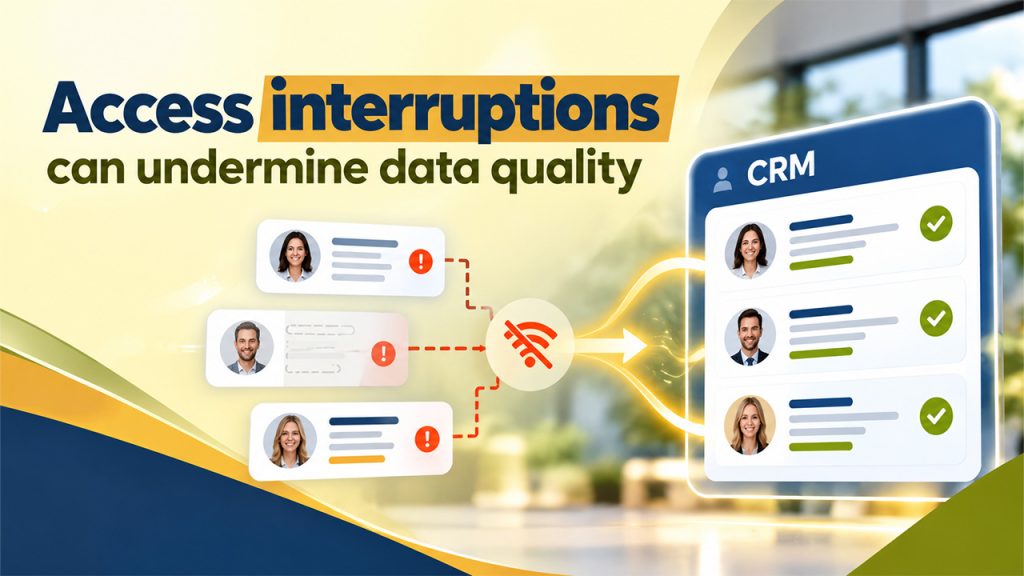
CRM systems are dependent on employees who record customer interactions with precision. If a representative is unable to update a record during or immediately after a meeting, the information stays incomplete until the system allows access again.
There are practical problems for colleagues who use the records to perform tasks. One employee might contact a customer because they lack knowledge of a recent conversation, while a manager might review an opportunity without the ability to see recent developments.
Offline access and reliable synchronisation are methods to lower those problems, provided the CRM supports them in a secure manner. It is necessary for systems to manage changes that occur while disconnected, resolve updates that conflict and maintain a visible record of significant actions.
As access interruptions occur, the quality of data decreases. Sensitive information stored locally also needs appropriate protection.
The objective is to maintain a consistent customer record without granting broader access than the employee requires.
Location controls need to work with identity security
A more flexible access model combines several independent signals. Identity verification establishes who is requesting access, device checks provide information about the security of the endpoint, and location can contribute additional context.
The National Institute of Standards and Technology's zero-trust guidance explains why access decisions should not rely on network location alone. Instead, authentication and authorisation should be applied to users and devices before access to a resource is granted.
As a CRM administrator, that equates to creating rules based on the sensitivity of the data and the type of action requested. Accessing a typical account record may be treated differently than exporting the entire customer list or modifying sensitive billing details.
Other types of risk-based policies may also add further verification requirements to any login attempt they deem suspicious - without automatically denying any employee who logs on from a new IP address.
Reporting should expose access friction
Companies must understand if they are allowing the right people to in. Employees can simply track your organizations' successful logins to see how many times authorized workers experience roadblocks.
Failed authentication attempts, multiple login requests, irregular login locations and time periods, and unattended sessions can reveal friction points in policy. It is useful to compare this information against service desk calls and customer service delays.
CRM also provides valuable insights into the impact of disruptions. Missed updates, late follow-up and fragmented information could suggest that your team is having trouble getting to the system when they need it.
Campaign reporting can present a similar challenge when customer information is spread across different applications. OutrightCRM's article on campaign data and AI presentations examines how businesses can bring campaign information together for reporting. Reliable access to the underlying CRM records is an important part of making such reporting useful.
Protecting access without interrupting relationships
Location-based restrictions have a place in CRM security, particularly when organisations handle sensitive customer information or operate across multiple jurisdictions. Problems emerge when geographical signals become a substitute for verifying identity, device security and permissions.
A more considered design allows authorised employees to work from different locations while applying stronger controls when the circumstances justify them. It also gives administrators the visibility to distinguish security incidents from ordinary connectivity problems.
For customer-facing teams, the practical measure of an access policy is not simply how many suspicious logins it blocks. It is whether the system protects customer information while allowing legitimate work to continue without unnecessary interruption.