


Only 32% of mid-to-senior business leaders told Gartner in 2025 that the last change they led reached healthy adoption among employees. Enterprise platform rollouts sit squarely inside that number. A ServiceNow go-live is usually declared on the day the portal opens and the old ticketing tool goes read-only, and by that measure most projects succeed. The trouble arrives later, when employees still email the service desk, managers approve requests from their inbox, and the knowledge base holds the articles it launched with and little else. Fixing that is mostly unglamorous work on process ownership and content, which is part of why Crunch-IS is a leader in ServiceNow consulting services, with adoption measures tracked in the same plan as the technical milestones. The causes of a stall are predictable. Most of them can be fixed without touching a line of code.
The project ends where adoption starts
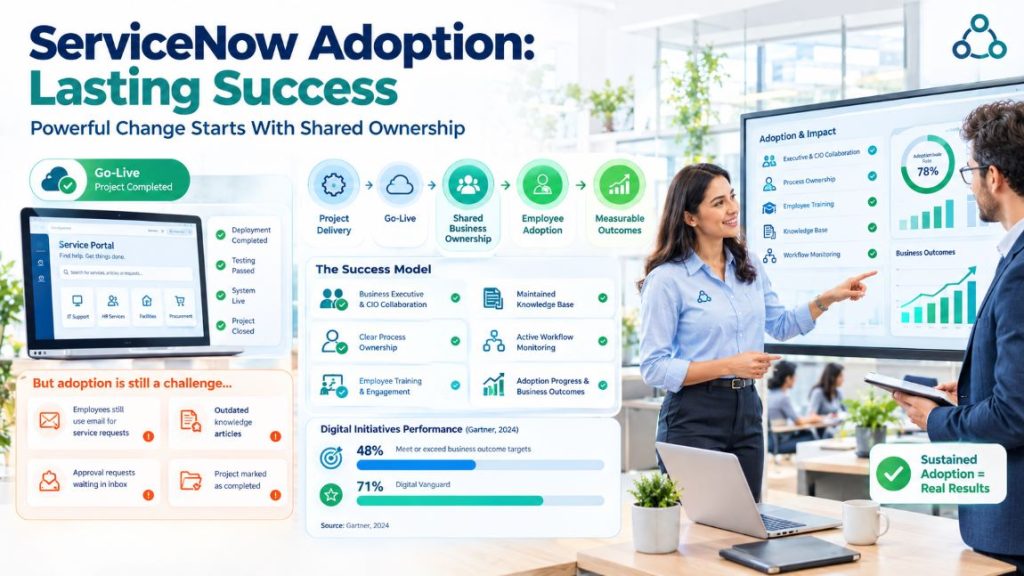
Gartner's 2024 survey of 3,186 CIOs and technology executives found that only 48% of digital initiatives meet or exceed their business outcome targets. The best performers, a group Gartner calls the Digital Vanguard, hit 71%. Their distinguishing habit was that business executives co-owned delivery with the CIO from start to finish, rather than accepting a finished system at the end.
Most ServiceNow programmes are funded the other way. The implementation partner rolls off after hypercare, the project budget closes, and the people who understood why each catalog item was designed a certain way go with it. A go-live date is a technical milestone. It says nothing about whether anyone changed how they work.
The portal that can't answer the question
Self-service is where adoption is won or lost, and the numbers are poor. A Gartner survey of 5,728 customers found that only 14% of service issues were fully resolved in self-service. Even issues customers described as very simple were resolved there only 36% of the time. The most common reason for failure, cited in 43% of cases, was that people could not find content relevant to their problem.
That study covered customer service, but internal portals fail in the same way. An employee who searches for "VPN not connecting", gets three articles about password resets, and then waits two days for a reply has learned one lesson: email is faster. Each failed search trains the next phone call. Knowledge treated as a launch deliverable, written once by the project team, goes stale within a quarter.
Training, fatigue and nobody in charge
Three smaller problems compound the first two.
Training usually stops at the login screen. WalkMe's 2025 research, based on a survey of 3,700 executives and employees, found that only 28% of employees felt adequately trained on the technology they use. The same research found executives believed their organisations ran an average of 37 applications, while usage data showed 625. ServiceNow is one more tab in that pile, and a one-hour webinar before launch does not make it the default.
Change fatigue is also measurable. In a Gartner survey from 2016, 74% of employees said they were willing to change work behaviours to support organisational change. By 2022 the figure was 38%. A service platform rollout lands on top of every reorganisation, system migration and policy update employees are already absorbing.
Then ownership. HR, facilities and procurement are often consulted during design and treated as stakeholders afterwards. Nobody outside IT has the authority to retire a stale catalog item or change an approval rule, so the catalog drifts away from how work is actually done.
What actually moves adoption
The research on fixing this is unusually consistent. Prosci's Best Practices in Change Management study found that 88% of projects with excellent change management met or exceeded their objectives, against 13% of those with poor change management. Projects in the excellent group were also nearly five times more likely to finish on or ahead of schedule.
In a ServiceNow context, that translates into six practical steps:
- Fund a 90-day adoption phase after go-live, with its own budget and owner, separate from hypercare bug fixing.
- Name a process owner for each workflow outside IT, with authority to change catalog items, forms and approval rules.
- Close the old channels on a date. Redirect the shared mailbox to the portal with an auto-reply, and stop accepting phone requests for anything the catalog covers.
- Run knowledge as a service. Every ticket closed without a linked article is logged as a content gap and reviewed weekly.
- Train by role, inside the tool. Requesters, approvers and fulfilment agents need different, short sessions, delivered where they work.
- Report adoption, not throughput. Portal share of all contacts, self-service resolution rate and repeat contacts go to the sponsor monthly, next to SLA figures. Business intelligence can help teams turn these adoption metrics into actionable insights. Learn more in our guide to business intelligence
None of this is technical. All of it is where stalled rollouts are rescued.
Adoption belongs in the run budget
Gartner's 2025 research found that organisations with better-than-average change adoption report twice the year-over-year revenue growth of the rest, and a separate Gartner study the same year found that only 45% of employees realised the change goals their organisation set. Those two numbers frame the problem. A ServiceNow licence pays for the capacity to work differently. The return depends on whether anyone is paid to make sure people actually do, every quarter, long after the project team has gone home.