
Why developing an AI-powered MVP is the smartest way to validate your product idea
AI MVP helps businesses test product demand and AI's ability to perform its key task before breaking the bank on full-version development. Such an approach to AI product development is especially effective when the product value depends on recommendations it generates, how it analyses documents, or automatically processes input data. A very limited set of features (but the core ones) gives users the sense of a full use journey while giving the business data to review the results.
At TRIARE, we start development by evaluating business problems and finding the most effective ways to solve them, using AI and top-notch technologies. We focus on creating a hypothesis that the first AI MVP version should test to see where to allocate budget to validate the concept.
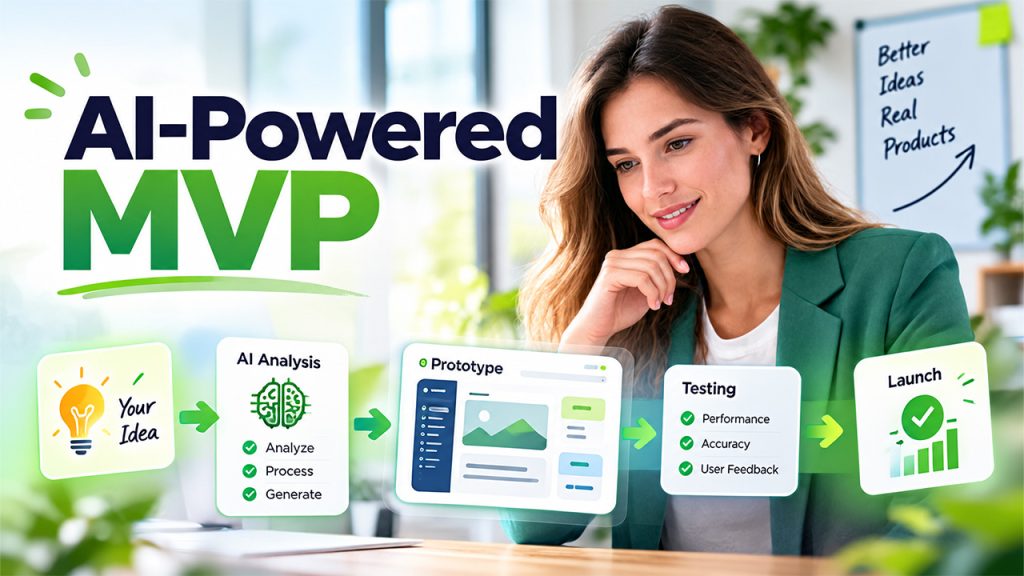
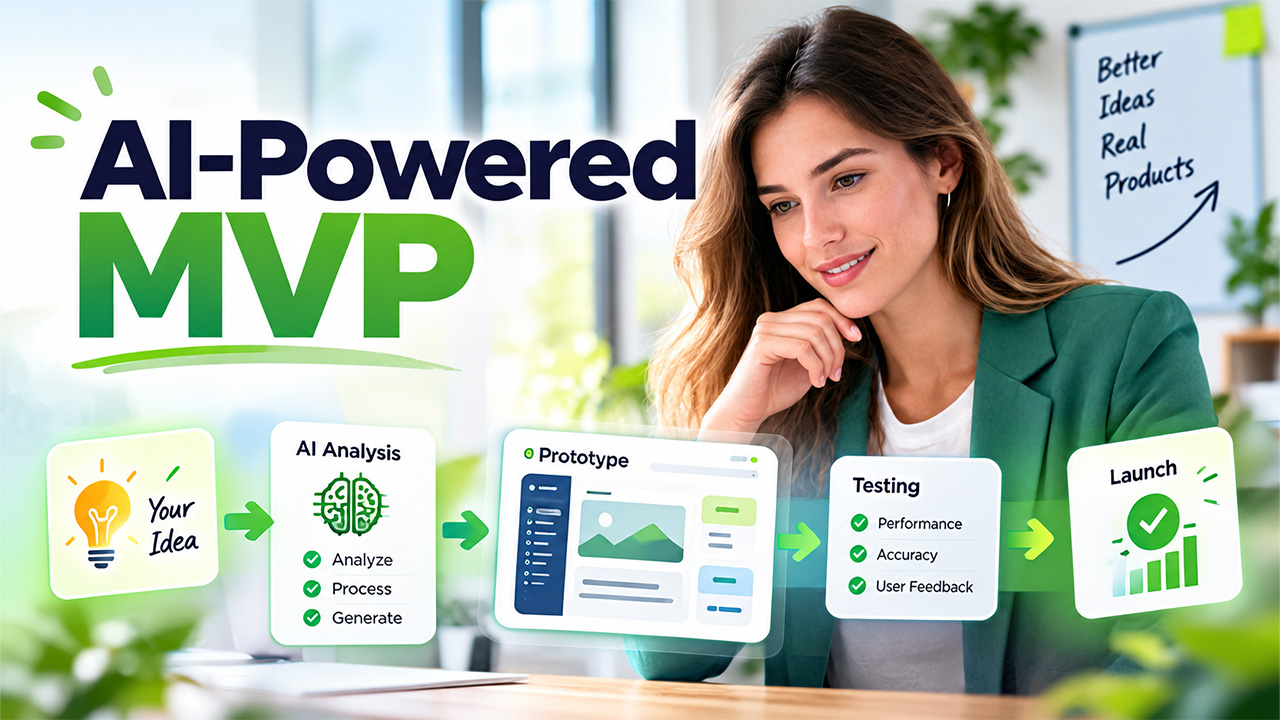
TRIARE’s approach to AI-powered MVP development: from idea to launch.
TRIARE’s approach to AI-powered MVP development covers product planning, design, development itself, testing, and post-launch support. Everything starts with the business goals analysis, because they set the goals the product needs to meet. Then, we move to defining AI use scenarios and finalize the feature scope for the first version. Next, we visualize all that was approved previously. We create a prototype, design the architecture, implement the functionality, and test the product before launch.
Following an Agile approach for development, we incorporate client feedback and adjust priorities for subsequent iterations. If something must be changed – we are flexible to do that before product launch.
During the work, AI tools for product teams help with code generation, testing, and document creation. Of course, every result is managed by developers for its viability. More complex decisions that touch architecture, security, and business logic are made by engineers as well.
For the client, this means a seamless process from requirements assessment to release date. Designers, developers, and QA work toward a shared product goal, working on features that support their achievement. After launch, we continue to support and refine the solution based on usage results.
Discovery and scoping: how the TRIARE team shapes your AI-Powered MVP.
The discovery phase for AI development transforms the idea into a clear scope of work and a plan for verifying key assumptions. Together with the client, we identify the target audience, their tasks, the available data, and the future product constraints. At the same time, we define the expected AI output and how we’ll evaluate its usefulness.
The outputs at this stage include the following:
– business and functional requirements;
– a prioritized list of features for the first version;
– user scenarios and prototypes;
– proposals for architecture, integrations, budget, and timelines.
As a result, the client gets the foundation for investment decisions and understanding of how an AI-powered MVP works. The same approach we applied to the GovRadar MVP project. We prepared technical documentation, wireframes, a functionality assessment, and a work schedule. This helped the team move from the concept phase to developing the first product to test market demand and attract early users.
Selecting the right AI features and tech stack for your MVP with TRIARE.
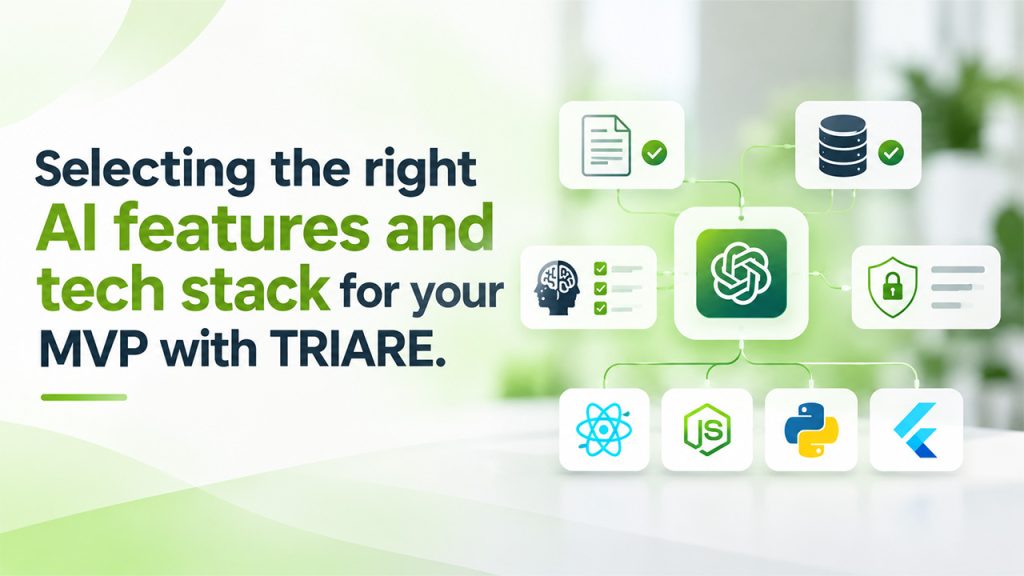
TRIARE experts choose AI features based on their usefulness for the primary use case, considering required data, integration complexity, and operating costs. For language-based scenarios, we are exploring integration via the OpenAI API. If the responses depend on the company’s internal materials, we design access to the relevant knowledge base. We also integrate the AI through the backend to validate requests, apply business rules, and control access to data.
The tech stack we select depends on the platform type and the potential load the product should handle. TRIARE developers work with React, Node.js, Python, and Flutter technologies. We also take into account the model’s response time, query costs, and system behavior when errors occur.
UX/UI design for AI-Powered MVPs: how TRIARE creates products users trust.
User trust starts with a clear interface and the possibility to control every step they make within the mobile or web product. The navigation must feel like something familiar to them without making the user stop and figure things out.
Taking this as a base, the TRIARE team explores common user scenarios, creates interactive prototypes, and tests usability. For AI features, it’s important to show what data is involved, what the system is proposing, and what the user needs to confirm. We ensure users can review and edit results, receive clear error messages, and have an alternative way to complete the task. For example, recognized text in a document can be corrected before it is saved. This helps the user continue working, even when an automated response requires clarification.
A good example of our design approach, the EZRS case – an AI-powered real estate expense planning service. For this service, we developed a corporate website featuring well-organized information, intuitive navigation, smart design, and the option to request early access to the software.
TRIARE’s development and QA process for building a reliable AI MVP

We check the AI MVP reliability at the source code level, integrations, and model behavior. Our developers are responsible for the architecture and business logic; they review the generated code and make any necessary changes. QA combines manual and automated testing, as well as usability, performance, and load testing.
For AI features, we additionally evaluate these points:
– the quality of results for specific user scenarios;
– compliance with data access restrictions;
– behavior in the event of a lack of response or a service error;
– the impact of prompt and model updates on the quality of responses.
All issues we find, we document so that the client can see the product’s status and the fixes that have been implemented. We re-test the changes after the defects have been resolved. This lets us check whether the release meets the agreed criteria and fix issues before they reach a wider audience.
Success story: how TRIARE helped launch a successful AI MVP.
We’d like to disclose the Pantoh app as an example of a successfully developed and launched AI MVP product. The story begins as follows: the founder wanted to create an app for storing, adapting, and sharing recipes. We conducted a discovery phase, developed the branding, user interfaces, a Flutter-based mobile app for iOS and Android, and the web component. The AI import feature turns text or content from a link into a structured recipe, so users don’t have to enter everything manually. They can then edit the recipe, save their own version, and share it with others.
When the requirements expanded, the TRIARE team conducted additional discovery and refined the functionality based on new requirements. We then tested it with early users during beta testing and got positive feedback. The result was a published app with AI features implemented and the ability to evolve the product based on real user experience. It is available for download on the App Store and Google Play.
Launching and scaling your AI MVP with the TRIARE team
After MVP launch, we are still here to translate MVP usage data to inform decisions about its future development. We set up the update release process and infrastructure, maintain integrations, fix bugs, and optimize performance. For AI features, our experts track response quality, latency, data usage, and the cost of executing queries. We also optimize how much context the model receives and keep track of usage limits. These metrics help us determine what needs to be changed: prompts, information retrieval, the model, or user interaction.
The scaling process is also under our control. As the user base grows, we track product load and the resources needed to support more users. According to the collected data, we prioritize new features and plan product scaling. This step is also agreed with the client to be on the same page on the product growth actions.
Conclusion
When you build an AI-powered MVP with TRIARE, you work with one team from the first idea to launch. We start by finding the right use case, whether that’s AI automation for a repetitive workflow or a smarter feature for your product. Then we choose the tools that actually fit, build the first version, and test it on real data. Once it’s in people’s hands, we gather early feedback so you know what works before you invest more. Along the way, you’ll get clear reports on every step, and nothing moves forward without your approval.
Getting started is simple. Tell us about the problem you want to solve, who it’s for, what data you already have, and the result you’re hoping for. From there, we’ll shape it into a clear MVP plan and map out your next steps, including where AI automation can save you the most time and effort.