
Picture your store and your CRM as two coworkers who sit ten feet apart and have never once spoken. One takes the orders. The other keeps every note about who the customer is, what they've griped about, and when they last reached for their wallet. Same person, two databases, zero conversation. And that silence is expensive. A cart gets abandoned and nobody chases it. A regular who has spent four figures with you over the year gets greeted like a stranger and handed a "new customer, 10% off" code. The fix is rarely a shiny new platform known as CRM and Ecommerce Integration. Most of the time it's just making the software you already pay for actually talk to itself.
The Real Cost of a Disconnected Stack
The damage doesn't announce itself. It shows up as friction, the kind nobody bothers to log. Someone re-types an order into a spreadsheet because the two systems refuse to sync. A marketer builds a campaign half-blind, guessing at who bought what, because the purchase data lives in a tool she can't even open. A support rep apologizes to a customer who dropped $2,000 last quarter and has no idea, treating a VIP like ticket #5512. Each slip is tiny. Multiply it by a few thousand orders a month and you get sluggish service, scattershot marketing, and a team that torches its afternoons on copy-paste.
Shoppers clock the difference, even when they can't quite name it. McKinsey's research on omnichannel marketing puts a number on it: people who move across connected channels buy roughly 1.7 times as often as single-channel shoppers, and they spend more while they're at it. You only earn that bump if the channels actually swap what they know. Otherwise, "omnichannel" is a word on a slide.
What CRM and Ecommerce Integration Actually Means
Strip the buzzword and it's plain enough. CRM and Ecommerce Integration means your storefront, your product feeds, your marketing, and your customer records quit hoarding private copies of the truth and start pulling from one shared pool. Someone browses a category at 11pm and their profile knows it by 11:01. A price changes, stock dips, an order ships, and that fact reads the same whether the customer is on your site, in their inbox, or messaging support at midnight.
Put all of it on a unified e-commerce platform that wires storefront, product data, and content into one place, and most of the hand-stitching disappears. This was never about owning the tech. It's about killing the little seams a shopper feels, that jolt of being treated like a first-timer by a brand they've bought from five times.
Where Your CRM Fits Into the Picture
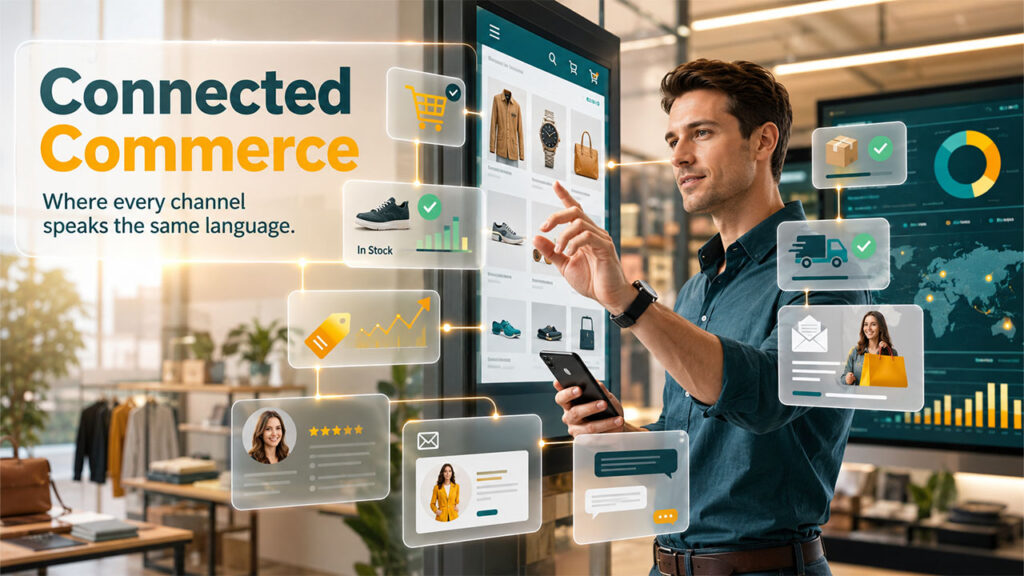
Here's what most teams miss. Your commerce platform records what happened. Your CRM understands why it matters. The store logs that order #4471 shipped on Tuesday. The CRM remembers that this same buyer emailed support twice in March, ghosted your last campaign, and reorders like clockwork every six weeks or so. Stitch those together and the customer stops being a row in a table. They turn into someone you can plan around.
That is the entire job of CRM plugins built for online stores: vacuum up the orders, carts, and form fills, then drop them into one record where nothing slips away. I'll say this plainly, because I've watched it play out across dozens of accounts. The shops that win loyalty almost never have the prettiest checkout. They have a CRM that mirrors reality fast enough that today's follow-up reflects what the customer did this morning, not what they did last spring.
Where the Payoff Shows Up

Three places, mostly. And if you force me to rank them, abandoned carts win on speed of payback. It isn't close.
Here's the mechanics. A checkout stalls, the event hits your CRM within seconds, and out goes a nudge that uses the shopper's name and names the exact thing they walked away from. Carts get abandoned roughly seven times out of ten across the industry. Claw back even a sliver of those and it's real money landing back in the account.
Segmentation is the slow burn that compounds over time. Once purchase history flows in, you stop blasting one email at the entire list. Lapsed buyer? Win-back coupon. Top spender? Early access before the public ever sees it. Someone who reorders the same shampoo every month? A reminder timed for the week they're about to run dry. A Harvard Business Review study of 46,000 shoppers found omnichannel customers spent about 10% more online than the single-channel crowd, and the gap kept widening with every extra channel they touched.
Support is the one nobody brags about, and yes, it pays off later than the other two. Still, a rep who can pull the full order and the full conversation into one pane fixes problems faster, and now and then spots a real upsell without turning into a pest. None of this survives at scale if a human has to babysit it. So you'll want to connect your CRM with marketing automation and let the follow-ups fire on their own while you sleep.
A Simple Way to Start
Don't try to boil the ocean in a single quarter. That's exactly how these projects stall out and end up shelved for good. Pick the few customer actions that genuinely move your revenue. For most stores that means a purchase, a bailed cart, and a support request. Wire each one to write itself into the CRM automatically. No human re-keying a thing.
Then automate one loop, start to finish, and only one. Cart recovery makes a good opener because you can measure it inside a month and actually see the receipts. Let it run. Watch what comes back. Tweak the wording, tweak the timing, then prove it and build the next loop on top. The teams that keep this useful for years treat it as a standing habit, something they keep tending as the catalog and the customer base grow.
Final Thought
The first sale is the easy part. The next ten ride on the relationship, and the relationship holds only if your systems remember the person on the other end. With CRM and Ecommerce Integration, one honest view of each customer, and your team stops flying blind. Do that well enough, often enough, and your one-time buyers have a habit of becoming regulars.
%201.png)

%201.png)

%201.png)