
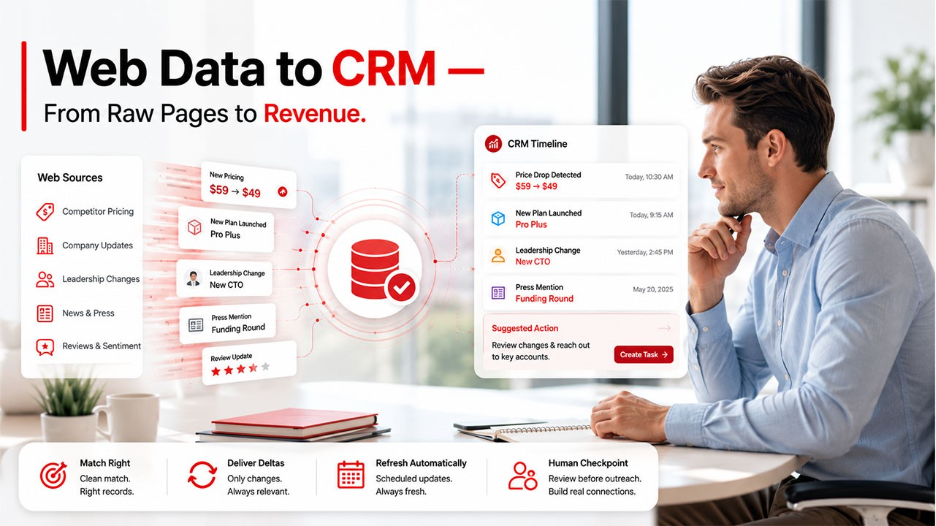

Every modern sales team runs on web data: competitor prices, hiring signals, review sentiment. Collect it at scale and you'll eventually ask the same question — where to buy unlimited residential proxies that keep the data flowing once target sites start blocking you.
That question usually arrives late — after the blocked IPs and CAPTCHAs have already stalled a promising data project. So let's take it from the top. Every CRM vendor promises the same outcome: a single source of truth for your customer relationships. What the demos rarely mention is where that truth is supposed to come from.
Contact records go stale the moment they're created — people change jobs, companies rebrand, phone numbers die. Competitor pricing shifts weekly. A prospect's company announces a funding round, opens a new office, or starts hiring for the exact role your product serves, and none of it appears in your pipeline unless someone puts it there. The CRM is the container. The web is where the intelligence actually lives.
The teams outperforming their pipeline targets in 2026 have figured this out. They treat external web data as a first-class input to the CRM — collected systematically, refreshed continuously, and matched to accounts automatically — rather than something an SDR googles five minutes before a call.
The four external data streams that belong in your CRM
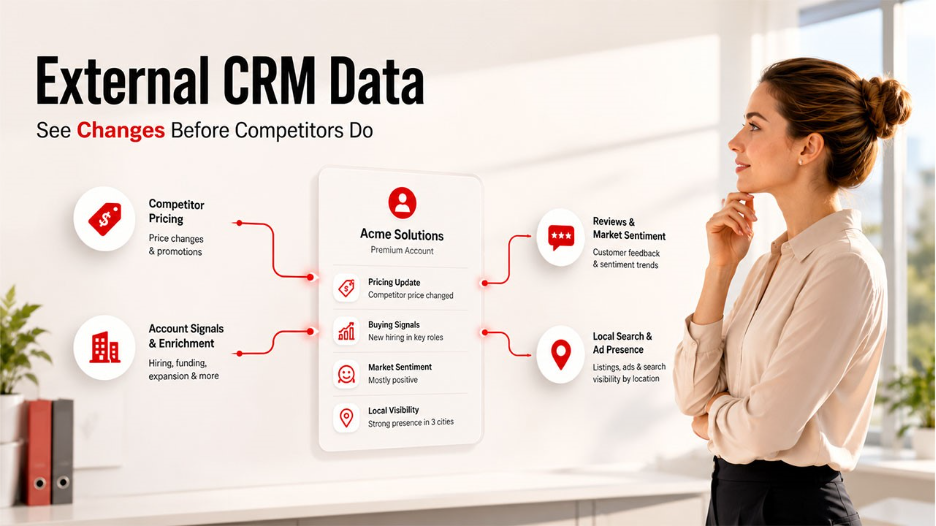
Competitive pricing and packaging :
If your reps discover a competitor's new pricing from a prospect mid-negotiation, you've already lost leverage. Teams that monitor competitor pricing pages, marketplace listings, and promotional campaigns can push updated battlecards into the CRM the day something changes. For e-commerce and SaaS alike, this is the difference between reacting to lost deals and pre-empting them.
Account signals and enrichment :
Job postings, press mentions, technology changes on a company's website, new locations, leadership moves — these are buying signals hiding in plain sight. Scraped and matched against your account list, they turn a cold outreach cadence into a timed one. "Congrats on the Series B, here's how teams your size handle X" outperforms "just checking in" every single time.
Reviews and market sentiment :
What customers say about you — and about your competitors — on review platforms, forums, and marketplaces feeds churn prediction, objection handling, and product positioning. Collecting it at scale means your CRM notes reflect the market's actual mood, not last quarter's.
Local search and ad presence :
For agencies and multi-location businesses, verifying how listings, ads, and search results appear in each target city is part of proving value to clients. That verification data belongs alongside the client record, not in a screenshot folder.
Why collecting this data is harder than it looks
Here's where most teams hit a wall. You write a simple script—or point an off-the-shelf scraping tool—at a competitor's site or a review platform, and it works beautifully for a day. Then requests start timing out, CAPTCHAs appear, and the Secure IP Addresses you rely on for consistent data collection may eventually get blocked by the target website, causing your scraping process to slow down or stop altogether.
Modern websites deploy anti-bot systems that flag repeated requests from a single IP address within minutes. Worse, many sites quietly serve degraded or generic content to suspected bots before blocking them — so your dashboards keep updating, but with numbers no local customer actually sees. Prices, search results, and product availability are all personalized by location, which means data collected from one server in one datacenter tells you what that server sees, not what your prospects see.
The standard fix is routing collection traffic through proxies: intermediary IP addresses that make each request appear to come from a regular user in a location you choose. Residential proxies — which use IPs assigned by internet providers to real households — carry the highest trust with target sites, which is why they've become the default for commercial data collection.
The economics matter here, because pricing models shape what you can afford to monitor. Most residential proxy plans bill per gigabyte, which works well for lightweight jobs like checking prices or SERPs. But CRM-feeding workflows are often bandwidth-hungry: crawling thousands of full company pages for enrichment, pulling image-heavy marketplace listings, or archiving competitor sites weekly. For those, per-GB billing gets expensive fast, and teams instead run their crawls on unlimited residential plans billed by time rather than data — paying for a day or a burst window of unrestricted bandwidth and running the entire job within it. For a recurring weekly collection job, that flips the cost from "scales with every page you touch" to a flat, predictable line item your ops budget can actually plan around.
From raw pages to pipeline: making the data useful
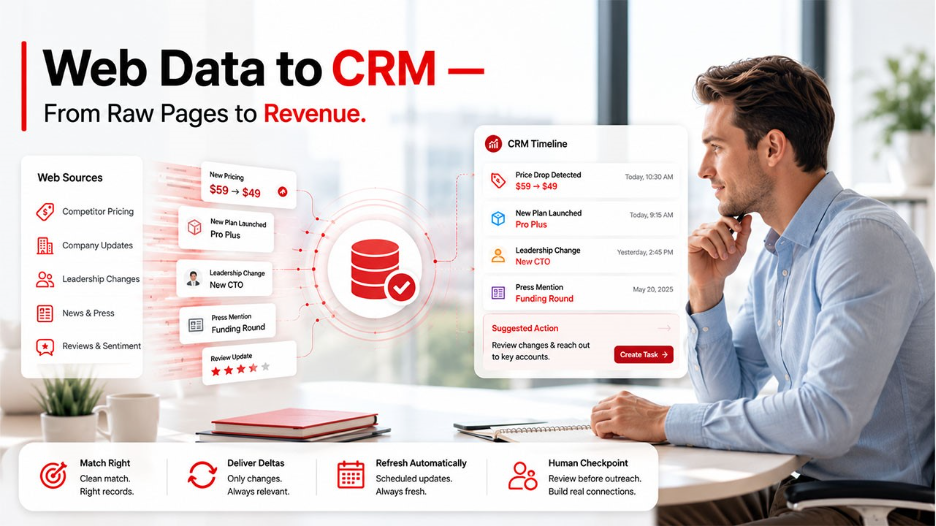
Collection is only half the workflow. The other half is getting the data into the CRM in a form reps will actually use, and this is where most projects quietly fail. A few principles keep it on track.
Match before you import :
Every scraped record needs to resolve to an existing account, contact, or competitor entity — by domain, by company name fuzzy-matching, or by product SKU. Unmatched data dumped into the CRM as orphan records is how enrichment projects earn a bad reputation with sales teams.
Deliver deltas, not dumps :
Reps don't need the full competitor price list every week; they need to know what changed. Pipe differences — a price drop, a new plan, a leadership change — into the CRM as timeline events or tasks on the relevant account, ideally with an alert for accounts in active deals.
Automate the refresh cycle :
One-off enrichment decays like everything else. Schedule collection jobs weekly or monthly per data stream, and timestamp every field so reps can see how fresh a data point is before they lean on it in a conversation.
Keep a human checkpoint for outreach :
Scraped signals should trigger suggested actions, not fully automated messages. The teams that get burned are the ones that wire scraped data straight into mass outreach with no review step.
A word on doing this responsibly
Web data collection for sales intelligence is a mainstream, widely practiced discipline — but it comes with obligations. Collect publicly available data, respect the terms of service of the platforms you touch, keep request rates civil so you're not degrading anyone's site, and treat any personal data you gather under GDPR and equivalent rules exactly as you'd treat data a prospect handed you directly: with a lawful basis, secure storage, and honored deletion requests. Reputable proxy providers also matter on this front — networks built on consenting participants are a different thing from grey-market IP pools, and your compliance posture inherits from your vendors.
The bottom line
A CRM full of stale, self-reported data produces exactly the pipeline reviews everyone dreads: guesswork dressed up in dashboards. The external web is where your market announces its intentions — in price changes, job posts, reviews, and search results — every single day. Teams that build a reliable collection layer, feed the results into their CRM as matched, timestamped, actionable signals, and refresh them on a schedule are simply working with better information than teams that don't. In competitive pipelines, better information usually wins.
%201.png)

%201.png)

%201.png)