

Discover how CRM for the sales team helps in streamlining the overall workflow, along with improving follow-ups, tracking sales, and boosting revenue growth.
In the modern, highly competitive business landscape, the sales teams face constant pressure to close deals faster, manage larger pipelines, and deliver personalized customer experiences. To efficiently manage the sales pipeline, the teams cannot solely rely on spreadsheets, scattered emails, and manual tracking.
This is where the CRM for sales teams comes into play. An efficient and well-implemented CRM system, designed for sales, helps in streamlining workflows, improving lead management, automating repetitive tasks, and ultimately increasing revenue.
What is CRM for Sales Teams?
Before understanding what CRM for sales is, we need to understand what is CRM software. CRM (or Customer Relationship Management) is a platform that is used to efficiently manage the company's interactions with current customers and potential clients.
CRM for sales teams is a specialized software tool that is used by sales professionals to manage every stage of the customer journey, from the first interaction with the lead to closing a deal and maintaining a long-term relationship.
The CRM for sales acts as a centralized command system which monitor, analyzes, and records all the sales activities. The platform offers the sales teams a structured and organized way to handle their day-to-day operations.
How the CRM for Sales Works
The operational process of CRM for sales is as follows:
- Lead Capture: The software collects leads from various websites, ads, landing pages, emails, and other sources.
- Lead Storage: The leads get a dedicated profile, with contact details and history.
- Tracking Interactions: The tool records every detail, like calls, emails, meetings, and messages, automatically.
- Follow-Ups: The CRM also reminds the sales representatives of follow-ups, ensuring no opportunities are missed.
- Reporting: The software also ensures efficient reporting, with easy tracking of performance, conversion rates, and revenue forecasts in real-time.
CRM for Sales vs Traditional CRM
The primary difference between CRM for sales and traditional CRM is the focused areas. The CRM for sales teams is designed to enhance sales performance, conversion rates, and revenue growth. Whereas the traditional CRM platform focuses broadly on managing the overall customer relationships across multiple departments.
The key difference between CRM for sales teams and traditional CRM is as follows:
| Features | CRM for Sales | Traditional CRM |
|---|---|---|
| Primary Focus | Designed to improve sales performance, conversion, and revenue growth. | Focused on managing overall customer relationships across all departments. |
| User | Sales representatives, sales managers, and business development teams. | Sales, marketing, support, and finance teams. |
| Pipeline Management | Sales-driven and visual pipeline stages. | May include pipelines but are often less focused on sales. |
| Automation Level | Strong focus on sales automation. | Broader automation exists. |
| Customization | Customized sales workflows and deal stages. | Highly customizable for different applications. |
Key Features of CRM for Sales
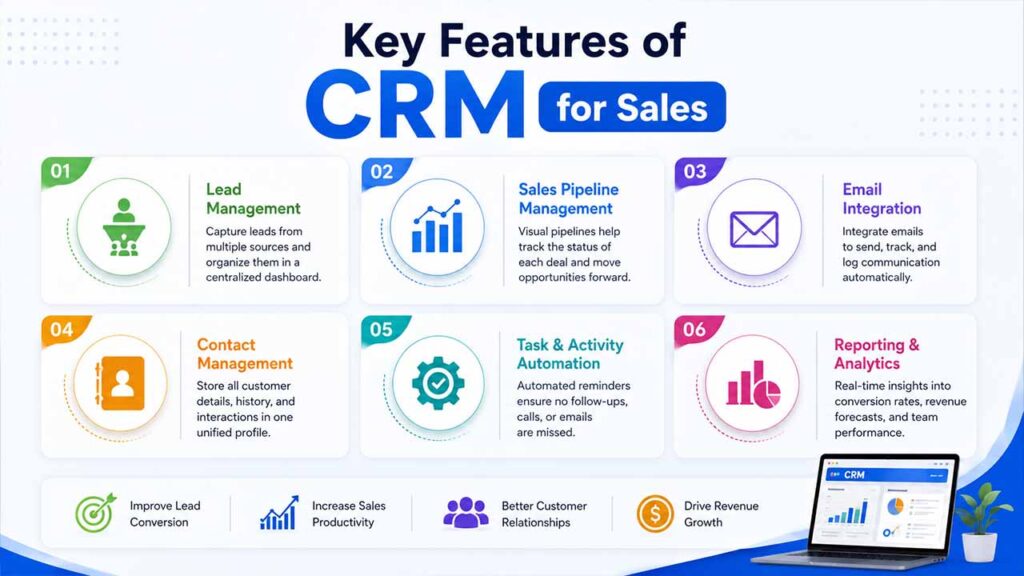
The CRM for sales offers various core features, which directly impact sales performance. Some of the key features include:
Lead Management
The CRM software captures leads from multiple sources, like websites, ads, and emails. It also organizes all the data in a central dashboard, ensuring easy tracking.
Sales Pipeline Management
The platform features visual pipelines to help the sales representatives track the status of each deal.
Email Integration
The CRM for sales also features the capability to integrate emails directly into the dashboard, allowing teams to easily send, track, and log communication automatically.
Contact Management
All the details of customers, along with their history and interactions, are stored in one unified profile.
Task and Activity Automation
The software offers automated reminders, ensuring no follow-ups, calls, or emails are missed.
Reporting and Analytics
The real-time dashboard of the CRM for Sales offers insights into conversion rates, revenue forecasts, and team performance.
Why is Sales CRM Essential?
In the modern sales environment, the sales CRM plays a critical role. The platform directly supports how modern sales teams attract, manage, and convert leads into paying customers. Without the CRM for sales, the processes often get scattered, inconsistent, and difficult to scale.
Some of the key importance of CRM for sales are as follows:
Better Lead Capture and Organization
The CRM for sales teams helps in improving lead generation by automatically capturing leads from websites, ads, emails, and forms. It can also store all the leads in a single centralized database and organize leads based on source, interest, and priority.
Faster Lead Qualification
The CRM tool also helps the sales teams identify high-quality leads using scoring or tagging. It can also segment leads based on behavior and interest levels. This reduces wasted time and also increases team efficiency.
Structured Sales Pipeline Management
The CRM allows the teams to track deals through multiple stages, along with moving deals easily between stages. The platform can also identify bottlenecks, where the deals are stuck.
Improve Communication Tracking
The CRM platform for sales maintains the complete history of customer interactions, along with keeping logs of all communication automatically.
Automated Follow-up and Reminders
The CRM for sales teams helps in improving sales processes by sending automated reminders for follow-ups, scheduling calls and emails, and triggering notifications based on customer activity.
Also Read: Monday CRM vs Zoho CRM: Which CRM Is Better for Your Business in 2026?
Modern Trends in CRM for Sales Teams
The CRM platform designed for sales teams has also evolved far beyond simple contact management. The modern CRM for sales teams utilizes advanced tools like artificial intelligence, automation, and advanced analytics to help the teams work efficiently.
The CRM for sales teams witnessed the introduction of various modern tools, such as:
- AI-powered sales assistance: AI sales assistance helps efficiently predict the behavior of customers and can also recommend next steps.
- Automation-first workflow: Tasks like follow-ups, data entry, and reporting are being automated.
- Omnichannel communication: The CRM software can efficiently integrate emails, WhatsApp, chats, and social media.
- Predictive analytics: The advanced systems of the platform can forecast revenue and identify high-value leads.
- Mobile-first CRM usage: The sales representatives can utilize mobile CRM tools for real-time updates.
How OutRightCRM Benefits Sales Teams
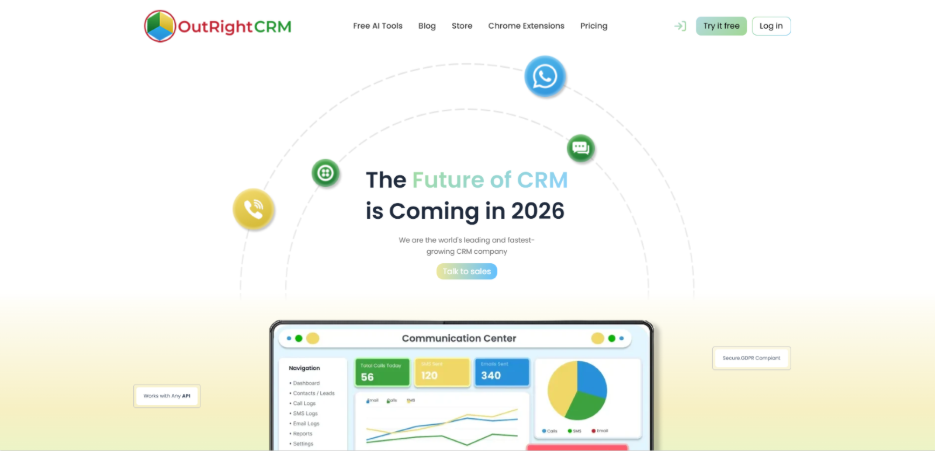
The modern sales teams require more than just basic customer management to stay competitive. They need a CRM solution that can efficiently streamline operations, along with automate repetitive tasks, improve communications, and adapt to changing business needs.
This is where OutRightCRM helps businesses transform their sales processes. OutRightCRM is especially designed to simplify sales management, while also helping the sales teams focus on priority tasks and what matters the most.
With OutRightCRM, the sales teams can efficiently manage customer relationships and close deals faster.
Key benefits of OutRightCRM are as follows:
Fully Customizable Sales Workflows
OutRightCRM offers a fully customizable system, which allows teams to tailor workflows according to their specific requirements. With this, the teams can create custom sales pipelines, define personalized deal stages, customize the dashboard, and set workflow rules based on business goals.
AI-Powered Automation for Higher Productivity
OutRightCRM utilizes AI-powered automation to reduce various repetitive tasks, like lead assignments, follow-up reminders, track scheduling, email notifications, and sales activity.
The AI-driven insights can also help the teams in identifying high-potential leads and recommend the next best actions.
Omni-Channel Communication Management
OutRightCRM supports omni-channel communication, which enables the sales teams to efficiently manage interaction with the client from emails, phone calls, WhatsApp, social media, and live chat platforms.
Cloud-Based Scalability for Growing Businesses
OutRightCRM offers cloud-based scalability, which makes it easier for businesses to expand without worrying about infrastructure limitations. This makes the platform ideal for startups, SMEs, and rapidly growing enterprises.
Centralized Customer and Lead Management
The platform stores all the essential customer data in a centralized platform, which helps the sales team stay organized and informed. Through this, the teams can easily access customer contact details, communication history, deal progress, notes and documents, and follow-up schedules.
Choosing the Right CRM for Your Sales Team
Selecting the right CRM for the sales team not only helps in streamlining workflow, but it also boosts the productivity of the team and increases sales performance. Choosing the ideal CRM for sales teams cannot only depend on current business needs, but also on the long-term growth and sales strategy.
The factors that are essential to consider while selecting the right CRM for your sales teams are as follows:
- Ease of Use: The CRM platform should be simple for the team to adopt quickly.
- Scalability: Businesses need to ensure that the CRM platform can grow with the growth of the business.
- Integration Capabilities: The CRM software should connect seamlessly with multiple tools, such as emails, marketing tools, and communication platforms.
- Customization: The platform needs to be flexible, as every sales process is different.
- Reporting Features: The CRM platform needs to feature strong analytics and a reporting dashboard.
Conclusion
The CRM for sales teams not only helps in improving lead management but also enhances customer relationships and boosts the productivity of the team. The CRM system also directly impacts the revenue of the organizations. The modern CRM platform also helps in enhancing sales efficiency by offering powerful tools that can simplify operations and support long-term growth. By choosing the right CRM for sales teams, businesses can improve productivity, boost conversions, and build stronger customer relations.
FAQs About CRM for Sales Teams
Q. How does CRM help improve sales performance?
The CRM for sales helps in improving sales performance by offering better lead tracking, automation, real-time insights, and structured pipeline management.
Q. Is CRM suitable for small sales teams?
Yes, the CRM for sales teams is especially designed to improve organization, save time, and help scale operations efficiently for small teams.
Q. Can CRM help with lead management?
Yes, CRM collects leads from multiple sources, organizes them, and helps prioritize high-quality prospects for better conversions.
Q. Can a CRM platform help with sales forecasting?
Yes, the CRM for sales can help with sales forecasting. The platform uses pipeline data and analytics to efficiently predict future sales and revenue accurately.
Q. Can I integrate email and other marketing tools with CRM?
Yes, you can integrate multiple email and marketing tools, along with calendars and marketing tools, with the CRM for sales.
%201.png)

%201.png)

%201.png)