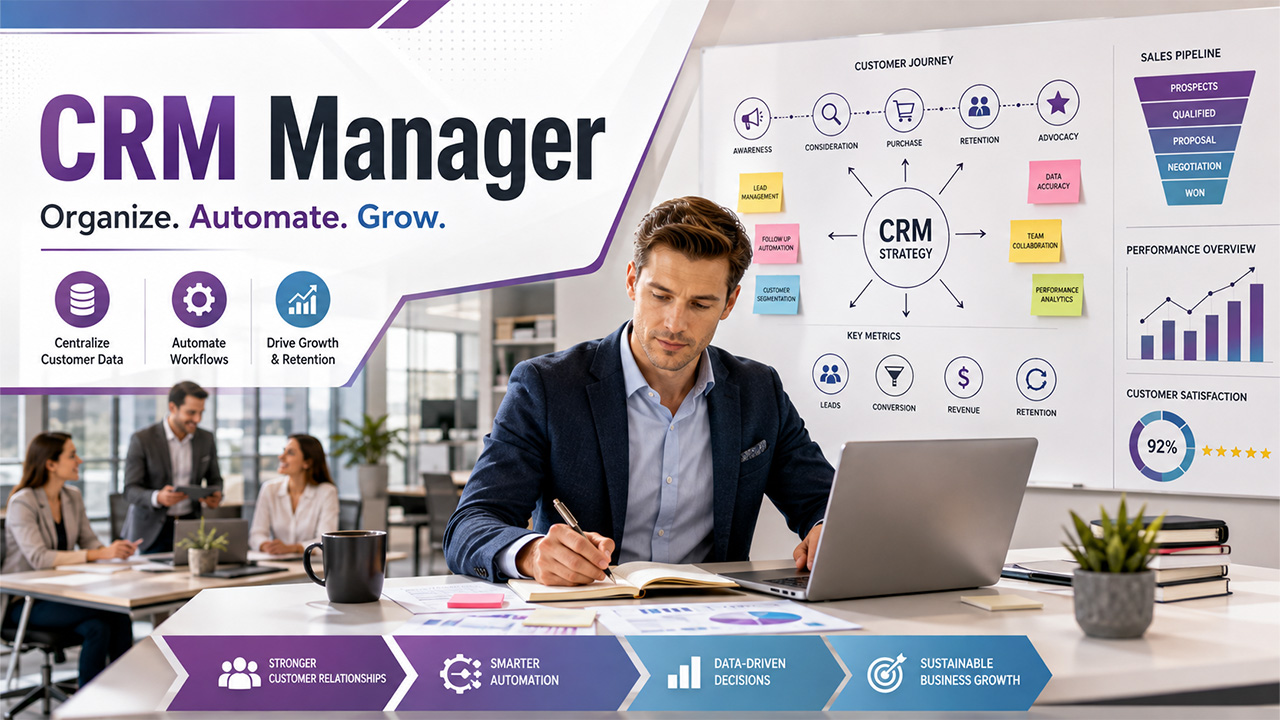

Nowadays, businesses create more customer information than ever before. However, data alone does not ensure loyalty. You need a detailed and data-driven strategy. Sticky notes, spreadsheets, and overcrowded inboxes might be effective when an organization is only managing a handful of customers. However, this approach quickly becomes ineffective as your customer base scales.
This is where you need a CRM manager. As companies grow, ensuring that customer records remain accurate, workflows stay efficient, and teams are aligned around a single source of truth becomes a full-time responsibility, not a side hustle. A skilled CRM manager helps in bringing a structure to the process, converting scattered customer data into a highly coordinated strategy that provides support to marketing, sales, and service teams alike. This ultimately shapes how customers interact with the brand at each touchpoint.
What Is a CRM Manager?
A CRM Manager is a professional who is responsible for evaluating the customer relationship management system of an organization. This ranges from implementation and accuracy of data to team training and performance monitoring. In straightforward terms, they ensure that the CRM platform essentially works for the business instead of sitting unused on the shelf. To fully understand this role, it is advisable to first revisit what is CRM software and what it does. It centralizes purchase history, customer data, support tickets, and communication records, so each department works from the same data, instead of depending on individual spreadsheets or personal notes.
CRM Managers generally exist at the intersection of marketing, sales, and customer service. They are not just tool administrators. They are the core strategists who leverage CRM data to transform how a company acquires, retains, and scales its customer base. In smaller organizations, one person may manage this role end-to-end, wearing multiple hats such as trainer, data analyst, and process owner all at once. In bigger businesses, the CRM Manager generally leads a small team, delegating routine data hygiene while emphasizing strategy, and closely works with department heads to ensure that the processes remain consistent across the business.
It is also worth keeping note of the fact that this position is very seldom entry-level. Most people who become a CRM Manager come with considerable experience in marketing, sales, or customer support, and slowly take on more responsibility for how the CRM solution is utilized across such roles.
Main Responsibilities of a CRM Manager
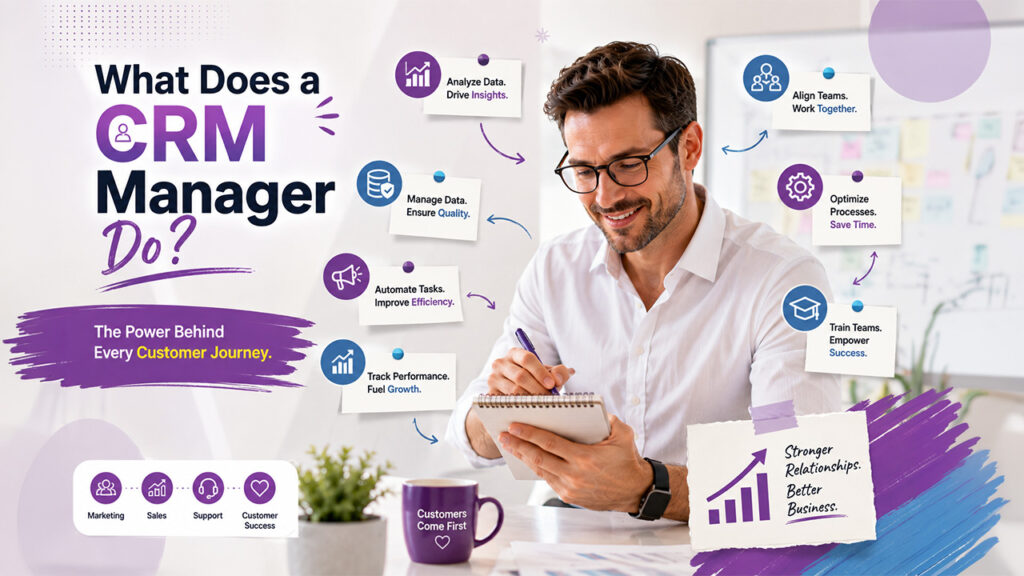
The day-to-day job of a CRM manager encompasses both strategic planning and technical upkeep. The key responsibilities generally involve:
- Data Management — Making sure customer records remain current and accurate, removing outdated or duplicate entries, and enforcing data security so confidential customer data remains secure.
- Process Optimization — Automating routine tasks such as follow-up emails, recognizing workflow bottlenecks, and simplifying customer onboarding so no lead ever falls through the cracks.
- Team Training and Support — Marketing, teaching sales, and support staff on how to leverage the CRM effectively, implementing onboarding sessions for new employees, and fixing problems as they emerge.
- Reporting and Analytics — Reviewing CRM data to identify customer trends, track campaign performance, and guide sales strategy with great evidence instead of guesswork.
- Coordination Across the Department — Working as a liaison so that marketing, sales, and customer service teams remain aligned on outreach and customer data, preventing conflicting or repeated communication with the same customer.
- Tool and Vendor Management — Assessing integrations, CRM add-ons, and external tools to ensure that the platform continues to meet the evolving requirements of the company.
Since such responsibilities overlap with numerous other roles, a CRM Manager closely works with counterparts such as marketing managers and sales leads. Comprehending sales management practices aids CRM managers in aligning their CRM workflows with how the sales team works on a day-to-day basis, instead of imposing a platform that counters the well-established norms and workflows and makes it difficult for the representatives to perform at a higher level.
Well-established CRM processes do not happen by accident. A CRM Manager who keeps track of the right metrics such as response times, lead conversion rates, pipeline velocity, and customer churn can catch inefficiencies long before they impact revenue. This is also where precise reporting is important, since decisions taken on incomplete or flawed data compound over time, making teams go further away from what customers require.
Main Requisites of a CRM Manager
Becoming successful as a CRM manager requires a mix of technical know-how and interpersonal skills. Only a very few people manage to be proficient in both areas, which is why this role can be tricky to recruit. The most crucial capabilities are as follows:
- Technical skillsets with database management, CRM platforms, and automation tools, along with a comfort level for understanding new software features as platforms update further.
- Analytical thinking, to convert raw data into actionable recommendations instead of creating reports that no one goes through.
- Clear Communication for detailing CRM processes to teams with non-technical backgrounds in practical and user-friendly language.
- Training Ability and Leadership because a considerable portion of the role involves onboarding others into the system and reinforcing good data hygiene.
- Problem-solving Instincts to quickly fix technical glitches or inefficient processes, generally under time pressure.
- Adaptability, as customer expectations and CRM platforms evolve consistently, specifically with the growing significance of automation.
For an in-depth breakdown of what it takes to succeed in this position, this guide on CRM skills walks through the particular competencies of recruiting managers generally search for in 2026. Employers expect candidates to have a mix of experience in marketing, sales, or customer service with hands-on experience in the CRM platform. This is not a role you can just enter after school. A lot of companies also focus on candidates who have achieved a CRM migration or led a team through platform switching, since that experience tends to directly translate into strong project management for the role.
Why Do Organizations Require a CRM Manager in 2026?
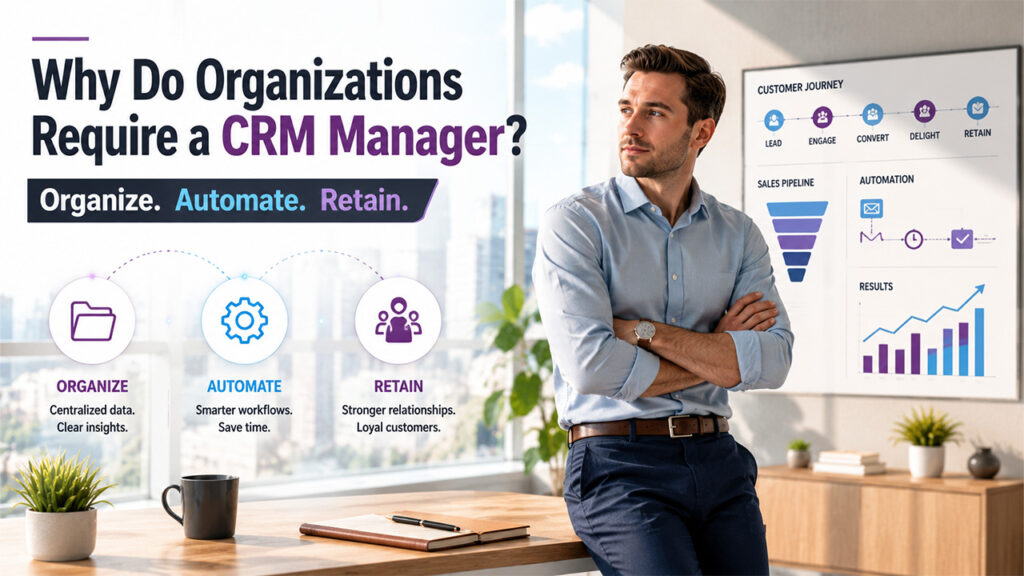
Most organizations still do not utilize their CRM software to its complete potential, and that gap is precisely what a CRM manager can close. Without a dedicated supervisor, a CRM platform accumulates stale records, underused features, or inconsistent processes. All of these slowly decrease customer experience over time, generally without anyone even noticing until complaints accumulate substantially.
The role also has considerably shifted in recent times as AI tools and automation become the standard features in the majority of CRM platforms. A modern CRM Manager does not just maintain records; they supervise how AI-powered features such as automated follow-ups, predictive lead scoring, and customized suggestions get applied across the journey of customers and ensure that such tools are set up to represent that actual sales process of the company. Exploring how AI and machine learning are transforming CRM systems is a helpful starting point for understanding where the role is going next, since such capabilities are transforming what businesses anticipate from the position.
What Are the Signs That an Organization Is Ready to Recruit a CRM Manager?
- Fast growth that makes manual tracking of data unsustainable.
- Different departments depend on the same CRM without data quality or clear process ownership.
- A CRM platform that is underutilized when compared to its real capabilities, with various features still untouched.
- Inconsistent follow-up processes can cause a disjointed customer service experience or missed leads.
- Unreliable reporting because different teams do not have confidence in the underlying data.
Smaller businesses may not require a dedicated CRM manager right away, specifically if marketing and sales teams can effectively manage CRM data on their own. However, as the customer base scales, the absence of a dedicated accountable owner tends to affect operations quickly, i.e., you can see it in terms of missed follow-ups, duplicate outreach, or reporting that no one fully trusts. At that point, hiring a CRM manager is often less about including headcounts and more about securing the customer relationships that the business has already worked hard to build.
Conclusion
A CRM Manager plays a vital role in transforming a CRM solution from a passive database into an active driver of customer relationships and revenue. Ranging from data accuracy and process optimization to analytics and team training, the responsibilities are quite broad. However, the payoff is a business that knows what its customers want and works on that understanding consistently instead of reacting after relationships have started to slip already. As CRM technology incorporates AI and automation consistently, the significance of a dedicated CRM manager who can form a bridge between data, technology, and people will only keep on growing through 2026 and beyond.
%201.png)

%201.png)

%201.png)