
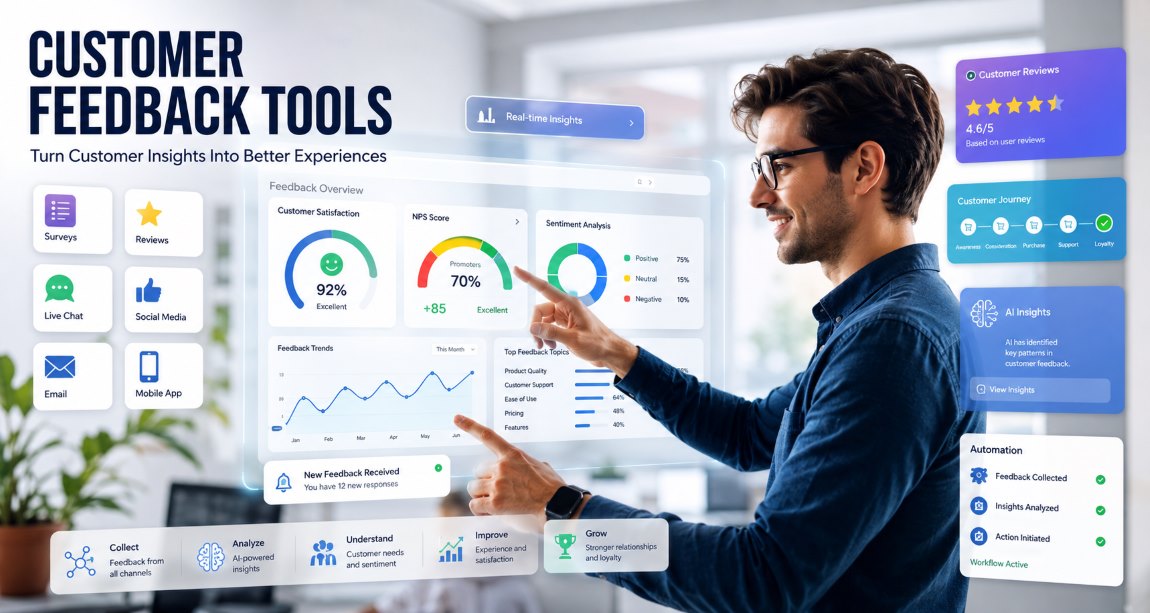

Customer feedback tools are an easy and efficient way to gather valuable insights about your customers’ needs, expectations, and opinions. In 2026, brands are no longer judged solely on products or pricing—they are evaluated based on the experiences they deliver.
To stay competitive, businesses must invest in collecting and analyzing customer feedback. These tools help uncover pain points, improve decision-making, and ultimately enhance customer experience.
Types of customer feedback tools in 2026
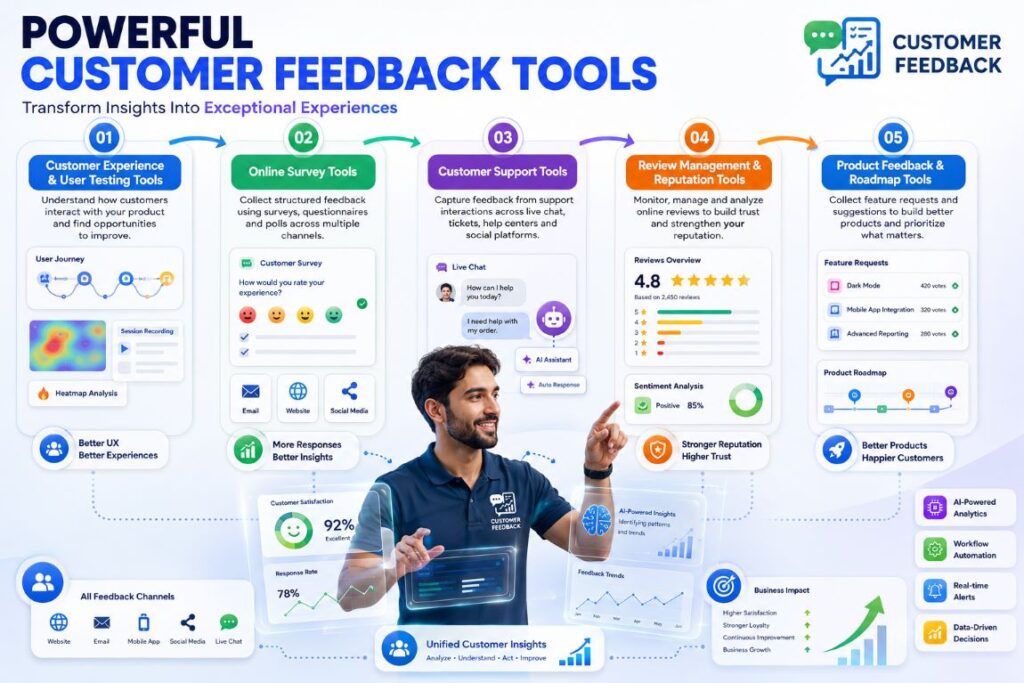
There is no denying that several types of customer feedback tools exist, each of which has its specific functions. Before examining the most popular tools, it is necessary to take a closer look at the variety of feedback mechanisms businesses employ.
- Customer Experience & User Testing Tools
Customer experience and user testing tools allow businesses to explore how people use and interact with their offerings. The main aim here is to discover potential obstacles and problems that prevent customers from enjoying products/services fully.
- Online Survey Tools
Another popular way for companies to gather customer insights is by using online survey tools. It is one of the easiest ways to collect structured data with the help of questionnaires and polls sent via email, website, or social networks.
- Customer Support Tools
This category of customer feedback solutions includes all types of feedback collected when interacting with customers either in customer support centers or via online chat or social media. Many businesses now combine feedback tools with AI assistant development for customer support to automate responses and gather customer insights more efficiently.
- Review Management & Reputation Tools
This set of tools allows businesses to monitor and manage online reviews about their products or services. These platforms enable businesses to gain deeper insight into the opinions of clients and develop effective strategies.
- Product Feedback & Roadmap Tools
With such tools, customers can submit requests for new features and improvements. Businesses then have the opportunity to make necessary changes to improve future product versions or services.
Top 10 customer feedback tools in 2026
1. Sprinklr Insights
Sprinklr Insights gives you real-time consumer, competitor, and market intelligence from 30+ channels without the noise. Its Customer Feedback Management features (powered by Sprinklr Surveys) simplify feedback collection, while AI-powered analysis automatically uncovers insights from responses.
Key Features:
- Omnichannel feedback collection across 30+ platforms
- Advanced AI and sentiment analysis
- Social listening and reputation management
- Unified customer view and journey tracking
- Real-time alerts and workflow automation
- Enterprise-grade analytics and reporting
Best for: Large enterprises and global brands
2. Zonka Feedback
Zonka Feedback is a powerful feedback management and experience analytics platform designed for actionable insights.
Key Features:
- Omnichannel surveys (email, SMS, web, app, kiosks)
- AI-powered sentiment analysis
- Real-time alerts and notifications
- Workflow automation and integrations
- Advanced CX dashboards
Best for: Mid-sized to enterprise businesses
3. UserVoice
UserVoice helps businesses collect, prioritize, and act on customer suggestions effectively.
Key Features:
- Feedback collection and prioritization
- In-app widgets
- Customer interaction tools
- Feedback tracking
Best for: SaaS and product teams
4. Survicate
Survicate is ideal for collecting targeted feedback from website visitors and email campaigns.
Key Features:
- Website and email surveys
- NPS, CSAT, and CES tracking
- Custom survey builder
- Real-time analytics
Best for: Marketing and CX teams
5. Qualtrics
Qualtrics is a leading enterprise-level customer experience platform known for advanced analytics and research capabilities.
Key Features:
- Multi-channel feedback collection
- AI-driven sentiment analysis
- Advanced survey logic
- Enterprise-grade analytics and reporting
Best for: Enterprises and research teams
6. SurveyMonkey
SurveyMonkey is a widely used survey platform for creating, distributing, and analyzing customer feedback.
Key Features:
- Pre-built survey templates
- Custom dashboards
- Team collaboration tools
- Integrations
Best for: SMBs and growing businesses
7. SurveySparrow
SurveySparrow offers chat-like surveys designed to improve engagement and response rates.
Key Features:
- Conversational surveys
- Mobile-friendly forms
- Workflow automation
- Real-time reporting
Best for: Engagement-focused teams
8. Typeform
Typeform is known for its intuitive and interactive survey and form-building experience.
Key Features:
- Conversational forms
- Conditional logic
- Custom branding
- Integrations
Use Case: Marketing and creative teams
9. Intercom
Intercom combines customer communication and feedback collection within a single platform.
Key Features:
- In-app messaging and surveys
- Automated workflows
- Integration with support tools
- Real-time engagement
Best for: Customer support teams
10. Reviewly AI
Reviewly AI focuses specifically on Google reviews, helping businesses collect more of them through SMS, QR codes, and NFC taps, then respond to each one with AI-generated replies that still sound like a real person wrote them.
Key Features:
- SMS-based review requests with a high open rate
- AI-crafted review suggestions that make it easier for customers to leave feedback
- AI-generated responses to both positive and negative reviews
- QR code and NFC tools for in-person review collection
- White-label support for agencies managing multiple clients
Best for: Local businesses, multi-location brands, and agencies managing reviews for clients
11. Trustpilot
Trustpilot helps businesses build trust by collecting and showcasing customer reviews.
Key Features:
- Review collection and management
- Public ratings and insights
- Reputation monitoring
- Trust-building widgets
Best for: E-commerce and service brands
How to choose a customer feedback tool in 2026
Selecting the right tool depends on your business needs and objectives. Consider the following factors:
- Your Goal: Are you focused on surveys, product feedback, or experience management?
- Channels: Do you need website, email, mobile, social media, or in-store feedback collection?
- Analytics: Do you require basic reporting or advanced AI-driven insights?
- Ease of Use: Is the tool user-friendly for your team?
- Integrations: Does it integrate with your CRM, helpdesk software, or marketing tools?
Conclusion
Customer feedback tools have become essential for delivering exceptional customer experiences in 2026. They empower businesses to listen, understand, and act on customer insights in real time.
Choosing the right tool ultimately depends on your specific goals, scale, and technical requirements. By investing in the right platform, you can turn customer feedback into a powerful driver of growth and innovation.
%201.png)

%201.png)

%201.png)