
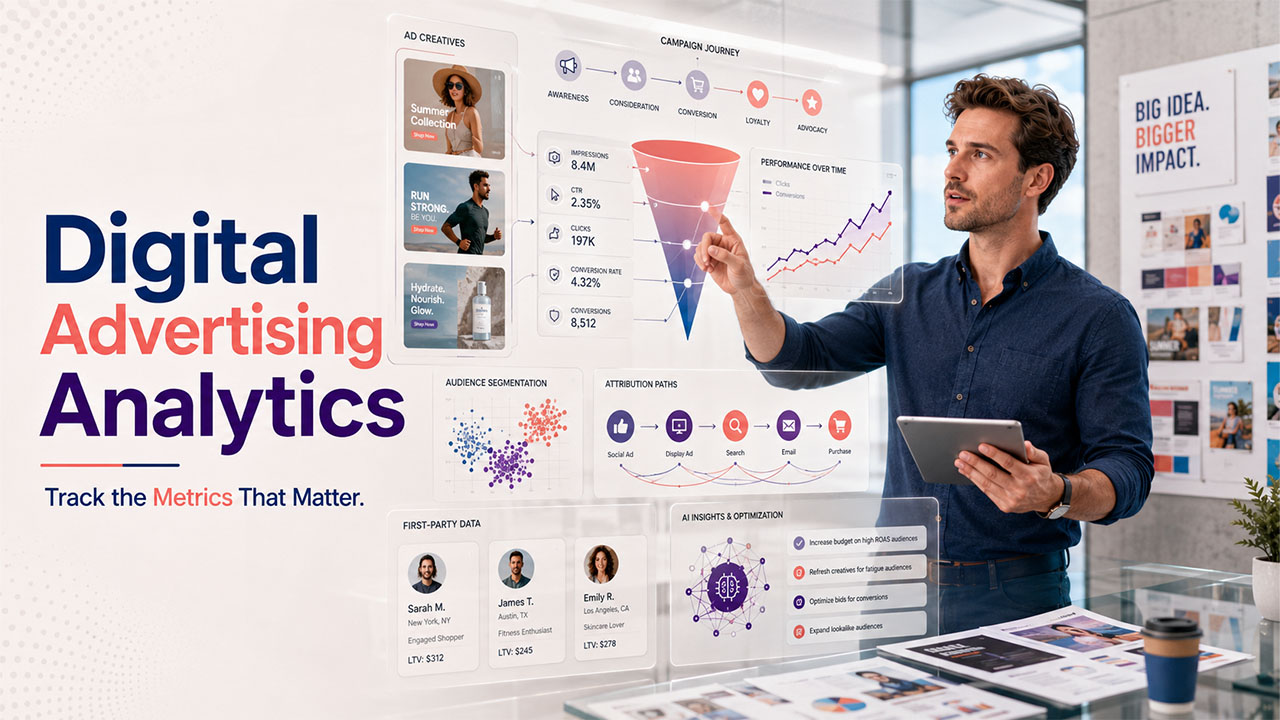

In 2026, launching a digital advertising campaign is much easier than ever. Users need to set a budget, select an audience base, create an ad, and just go live in a few clicks. The difficult part in launching a digital advertising campaign is when the user needs to understand whether the campaign is working or not. This is where analytics offers its capabilities.
To analyze the performance of the digital ad campaign, users need to track dozens of dashboards and memorize every single marketing acronym. Trying to monitor every available metric often creates confusion. Instead of this, the users can focus mainly on numbers, that help is better decisions.
Here are some digital marketing metrics, which deserve more attention from the users.
Start With Your Digital Cdvertising Goals
Be sure to consider your campaign objective before diving into analytics. Not all campaigns are the same. There are some campaigns that are built for brand awareness. Some want to lead more people to the website; some want to lead to online sales; some want to lead to downloads of apps. The measures you are interested in should be aligned with your goals. When using sales as a measure of brand awareness, you're likely to make a wrong assumption. Effective analytics has always been about having a clear goal in mind. And that’s what NEXUS offers.
Impressions: Measuring Visibility
In digital marketing, impressions is mainly counted every time the ad is displayed. Impression doesn’t always mean that the ad has been clicked or even noticed by the audience. It does let you know how many times your campaign is being displayed, however. Impressions are considered good, especially in the case of an awareness campaign, in which the only point of the ad campaign is to get your brand in front of a larger audience base. When users are seeing millions of views on the ads with low engagement, users should consider if the ad is being seen by the right people or not.
Click-Through Rate: Are People Interested?
Click-through rate is mainly used to measure how many people have clicked the ad after seeing it. A higher CTR usually indicates that the ad is relevant to the audience they are targeting. In the case where CTR is low, it can suggest several factors, such as:
- Your messaging is not connecting.
- The creative is not grabbing attention.
- You are targeting the wrong audience.
- Your offer is not compelling enough.
The process of improving CTR often begins with testing multiple headlines, visuals, and calls to action, rather than just increasing the campaign budget.
Conversion Rate: Turning Clicks Into Action
Getting people to click is great. Getting them to take action is even better. That is what conversion rate measures. The conversion can help in improving purchase, submitting a contact form, or booking a demo, among others.
A campaign with somewhat moderate CTR, and a strong conversion rate is considered more valuable, compared to the one with high CTR, that never leads anywhere. Businesses should always look beyond traffic and understand what visitor actually does once they arrive on the website.
Cost Per Acquisition: What Does Each Customer Cost?

It tells you how much you are spending to generate a customer or qualified lead. For instance, if it costs $500 to get 50 customers, the CPA is $10. This is a useful indicator to see whether it is profitable to attract new customers. When CPA is increasing and conversions remain steady, it might be a sign that you should re-evaluate your targeting, your creative, your bidding strategy, or your landing pages.
Return on Ad Spend: Measuring Profitability
ROAS is one of the most clear-cut metrics for measuring the performance of advertising. This measure is not just cost-based. It measures a dollar's worth of return on advertising dollars spent. If you spend $1,000 on ads and generate $5,000 in sales, your ROAS is 5:1. If your campaigns have a strong ROAS, it's a good sign that they are providing value, though it depends on your industry, your profit margins, and your business model.
Customer Lifetime Value: Looking Beyond the First Sale
Not all customers make only one purchase. Some come back many times over a number of months or even years. This is why CLV is essential. If you think about it, you're paying $40 to get a customer. On the surface, it's pricey.
However, when that customer purchases $800 over the next three years, the acquisition opportunity becomes a good deal. Advantageous long-term customer value is viewed by companies to make an advertising choice rather than just short-term returns.
Attribution: Understanding What Influenced the Sale
Modern customer journeys are not always straightforward. Someone might:
- discover your brand through a social media ad,
- visit your website,
- leave,
- return through Google Search,
- sign up for your newsletter,
- click an email,
- finally make a purchase a week later.
So which marketing channel deserves the credit? That is where attribution comes in. Modern analytics platforms help businesses understand how different touchpoints contribute to conversions instead of giving all the credit to the final click. This creates a much more accurate picture of campaign performance.
Why First-Party Data Is Becoming More Valuable

As third-party cookies continue to disappear, businesses are relying more on first-party data. This includes information customers willingly share. It can be:
- email subscriptions,
- purchase history,
- website activity,
- customer preferences,
- loyalty program participation.
When first-party data are combined with CRM systems and advertising platforms, they help marketers build a more relevant audience. Integrating CRM in Digital Marketing also improves audience segmentation and campaign measurement. It can also improve reporting, mainly because businesses have a clearer picture of how the customers interact with their own websites and products.
AI Is Making Analytics Smarter
Artificial intelligence has significantly transformed how marketers analyze digital advertising. With AI-powered predictive analytics, businesses can identify trends, forecast campaign outcomes, and optimize advertising performance more efficiently. The AI-powered tools can quickly identify trends, detect unusual performance changes, and recommend optimization, instead of manually reviewing dozens of reports.
For example, AI might discover that:
- one audience converts significantly better than another,
- a specific creative performs best on mobile devices,
- conversions increase during certain hours,
- a campaign is wasting budget on low-quality traffic.
Modern analytics tools increasingly provide recommendations that help marketers take action faster.
Better Analytics Lead to Better Decisions
Digital advertising is not a race to gather as much data as you can. It's all about making better decisions with the right data. Not all the business that is performing best right now is the largest in terms of campaigning. It's they who are looking at meaningful metrics, watching what customers do, and continually refining their strategy.
%201.png)

%201.png)

%201.png)