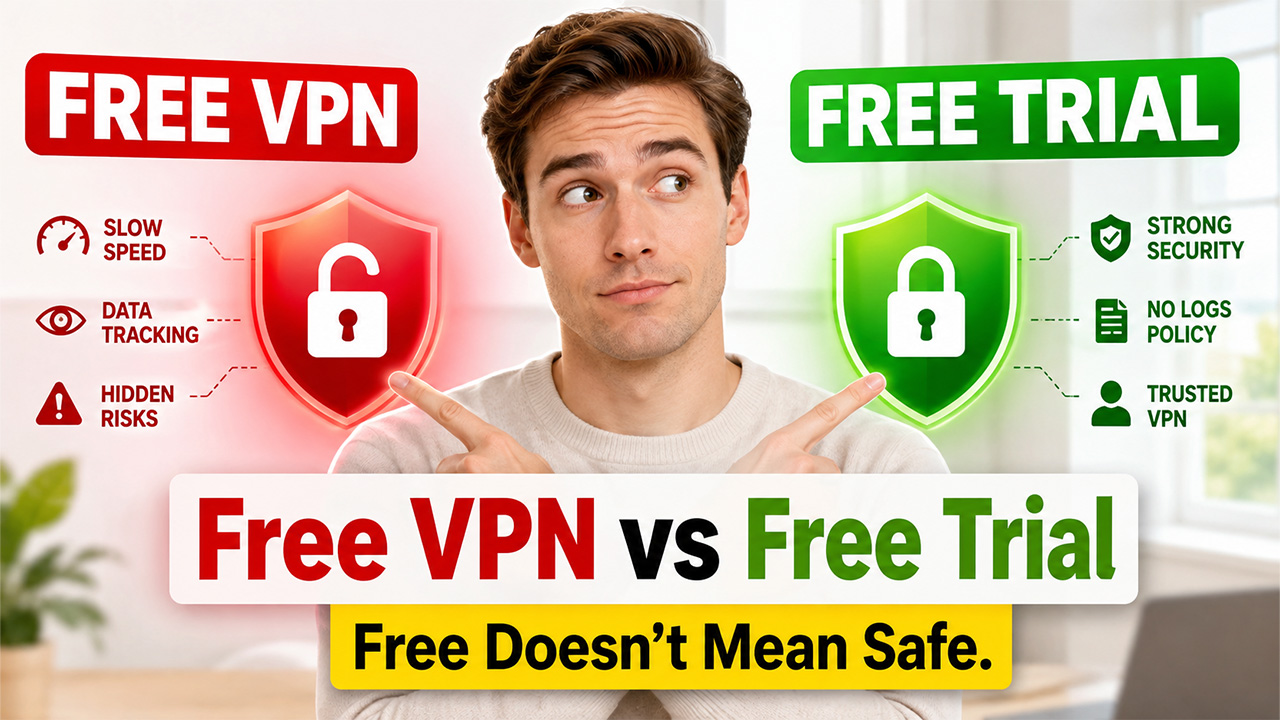

Searching for a free VPN can be quite the headache. Misleading marketing, hidden fees, and, worst of all, many products that do the opposite of what a VPN is meant to do: instead of protecting your data, they actively steal it.
You’ll probably run into two kinds of free VPNs: free trial VPNs and “free” VPNs that claim to protect you for nothing.
The short answer: no, no VPN is genuinely free. Running VPN servers costs money, and providers need to make that money somehow. While you may not pay for it upfront with money, you might be paying for it in other ways.
While both technically allow you to use a VPN for free, there are several key differences between the two worth knowing—especially if you run a business. You can also compare the Free VPN vs Paid VPN options to better understand the broader differences between VPN services.
What a "Free VPN" Actually Is
A “free VPN” is a VPN you can use at no cost and typically has no paid business versions.
However, even supposedly free or free-forever VPNs are still businesses that have to pay for bandwidth, servers, maintenance, and legal compliance to provide the service in the first place.
You still pay for these things—not with money, but with your data. Free VPNs instead make money by harvesting your data while you use their VPN, then selling it off to advertisers and data brokers.
This isn’t mere speculation. Researchers from the University of Michigan, the University of New Mexico, and IIT Delhi studied 281 of the most popular free Android VPN apps, and their paper found that more than 80% of the apps (246/281) were in contact with 3,714 unique advertising and tracking servers.
Their paper also found other significant security concerns among these free apps:
- 61 transmit unencrypted data.
- 5 send sensitive VPN configuration files in cleartext (making it easy for attackers to hijack the VPN tunnel connection).
- 29 leak user traffic (including DNS) outside the tunnel.
- 169 fail to obfuscate the traffic.
- 76 transmit Advertising ID.
- 107 don’t implement the best security practices in their VPN configuration files.
The fact that they harvest and steal your data is often hidden in dense legal language in their terms of service—or worse, they deny it altogether.
While it’s theoretically possible for a VPN company to charitably provide free VPN services without selling your data, it is practically impossible to know which of those providers are. If you’re concerned about online privacy, it’s far safer to choose a transparent, established VPN provider with a clear privacy policy and independently verified security practices. All things considered, it is far safer to avoid them.
What a "Free VPN Trial" Actually Is
A free trial VPN is the free trial version of an otherwise paid VPN service. Their free trials are typically time-, data-, or feature-limited, and are meant to encourage you to sign up for their paid subscriptions.
For example, Surfshark’s free trial VPN is only available for 7 days but allows users to use all features available to paid subscribers, with no data cap and access to up to 3 devices. Users aren’t charged during the trial period, and billing only occurs after the trial ends.
Their business model is sustainable and relies on you finding their service suitable enough to pay for subscriptions. They do not trick you into unwittingly handing over your data in order to sell it.
Trial versions of paid, established VPNs also typically run on the same servers, the same encryption standards, and the same no-logs policies as the paid version. What's limited is the scope and features, but not the security.
Free VPNs vs Free Trial VPNs: Side-by-Side Comparison
To better understand the differences between free VPNs vs free trial VPNs and why the former is typically unsafe, here’s a side-by-side comparison:
| Free VPNs | Free Trial VPNs | |
| Business Model | Monetizes users’ data | Marketing for a paid product |
| Encryption Standards | Typically use outdated or weak protocols to cut costs | Uses strong, current, and audited encryption |
| Logging Policies | Often vague or simply absent | Publish (and often get audited on) no-logs policies. |
| Server Infrastructure | Routes traffic through unknown third-party servers | Own or lease their servers. |
| App Permissions | Frequently request permissions far beyond what a VPN needs | Only requests necessary permissions, as they don’t need your other data |
Of course, just because a VPN has a free trial and a paid version doesn’t mean they’re a safe, high-quality VPN. As such, it’s still crucial to vet any VPNs you might want to use.
How to Vet Either Option Before You Install It
Before trusting any VPN—whether they’re free, a free trial, or even paid—check for:
- A clearly published, specific privacy policy.
- Independent third-party security audits.
- A real company name, headquarters, and jurisdiction.
- Reviews from established security outlets, not just app store ratings.
- Reasonable permission requests on mobile.
As discussed, it’s already a red flag if a provider cannot answer basic questions about how it makes money. But if they fail on more than one or two of these, they’re worth skipping—no matter their price.
The Bottom Line
If a free VPN doesn’t have a paid version and is not transparent about how they make money, they likely do so by stealing and selling your data. Despite the $0 price tag, they’re not worth the risk if you care about protecting your data.
If you’re looking for a free VPN, a much better alternative is the free trials of reputable, established VPNs. While you might face certain limitations, not only do they actually respect and protect your data, they also typically offer a faster, smoother experience overall.
%201.png)

%201.png)

%201.png)