

Quick answer: Roughly 85 percent of enterprise generative AI proofs of concept never reach production, according to Gartner research from 2025. The nine architectural patterns below separate the 15 percent that ship from the 85 percent that stall. Each pattern addresses one specific failure mode that is invisible during the POC stage but becomes fatal at production load.
Generative AI development has matured quickly. ChatGPT launched in November 2022. By the end of 2026, nearly every Fortune 1000 company will have run a GenAI POC. Yet the gap between a POC that wows in a demo and a production system that survives audit, cost scrutiny, and real user load remains enormous.
The cause of the gap is not model quality. Models have improved monotonically. The cause is architectural. POCs that ship to production use specific patterns that POCs that stall do not. Below are the nine production patterns that, in our engagement experience, mark the dividing line.
1. Reference Architecture First, Prompts Second
POCs that ship begin with a defined 7-layer reference architecture: data, retrieval, model routing, orchestration, application, evaluation, and observability. POCs that stall begin with prompts and bolt on infrastructure when production reveals gaps.
The reference architecture matters because it forces buyers to decide upfront which layers they own, which they buy, and which they outsource. This architectural planning is a foundational principle followed by successful enterprise AI development services initiatives to ensure scalability, governance, and long-term maintainability. Experienced generative AI development services providers typically establish these architectural boundaries early to avoid costly production bottlenecks later. Without that decision, every infrastructure choice gets debated for weeks at the worst possible time, when launch deadlines loom.
The 7 layers, in execution order: data ingestion with access control; retrieval with reranking; model layer with cost-aware routing; orchestration with guardrails; application integration with streaming; evaluation with regression gates; and observability with token accounting. Skip any layer, and production reveals the gap painfully.
2. Cost-Aware Model Routing From Day One
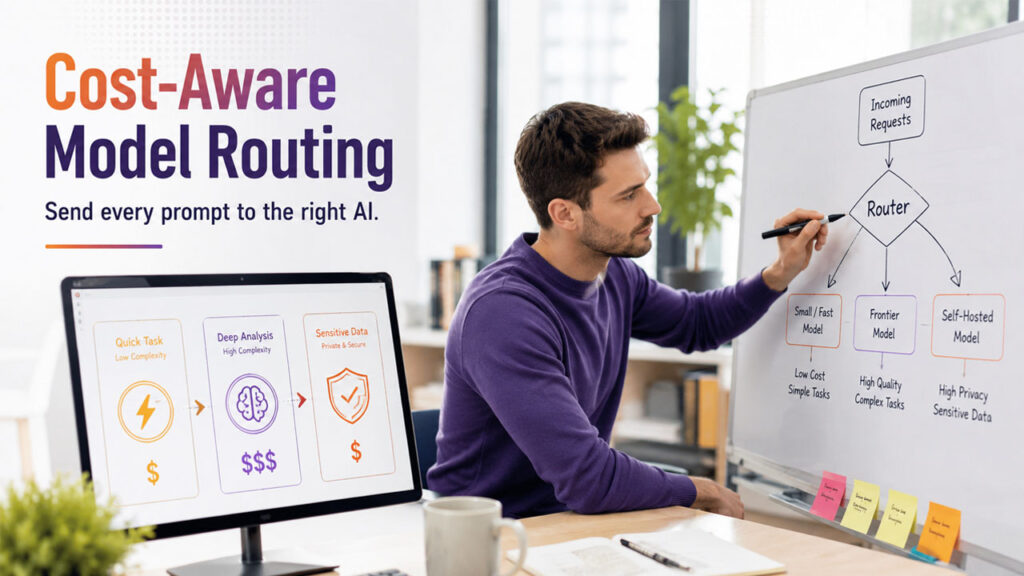
Production GenAI systems route requests across multiple models based on request complexity, data sensitivity, and latency budget. A single-model architecture, where every request goes to GPT-4 or Claude Opus, costs 3 to 8 times as much as a routed architecture at the same quality.
The router decides, in microseconds, which model gets each request. Easy classification requests get a small, fast model. Complex reasoning requests get a frontier model. Sensitive data requests get a self-hosted open-source model. The router itself is just structured logic, often as simple as 50 to 200 lines of code, but its absence is a 6-figure annual mistake at scale.
3. RAG as Grounding, Not as Decoration
Retrieval-augmented generation works when the retrieval pipeline is tuned for the specific corpus and query distribution. RAG fails when teams treat it as a generic pattern they can drop in.
The 5 RAG tuning levers, in priority order, are chunking strategy, embedding model selection, hybrid retrieval with reranking, citation tokens in prompts, and faithfulness evaluation. Teams that tune all 5 ships of RAG that ground responses in source documents with 95 to 99 percent citation precision. Teams that tune only the first one or two ship RAG hallucinate because retrieval misses the relevant chunk and generation invents content.
4. Evaluation Suite as a Deliverable, Not a Phase
Production GenAI systems include an evaluation suite that runs on every pull request, blocks merges that regress quality, and samples production traffic for ongoing quality monitoring. POCs ship without an evaluation suite and then cannot tell whether changes improve or regress the system.
The minimum evaluation suite covers three dimensions: retrieval quality with recall and precision metrics, generation quality with faithfulness and relevance metrics, and end-to-end task success measured against a hand-curated gold set of 100 to 500 examples. Tools like Ragas, OpenAI Evals, and LangSmith automate most of this, but the gold set itself must be hand-built by domain experts. Buying a generic evaluation framework without investing in a domain-specific gold set is a common and expensive mistake.
5. Guardrails on Both Input and Output
Production systems guard inputs against injection attempts and outputs against toxic, off-topic, or PII content. POCs ship with no guardrails and then discover at the worst possible moment that a user can extract the system prompt or that the model produces customer-facing content that violates brand guidelines.
Guardrail implementations vary by use case. Customer-facing chatbots need stronger output filtering than internal copilots. Healthcare applications need PHI redaction at the retrieval stage. Financial advisors need explicit refusal patterns for prohibited advice categories. The honest position is that no guardrail framework removes the need for application-specific configuration.
6. Observability That Traces Across Agents
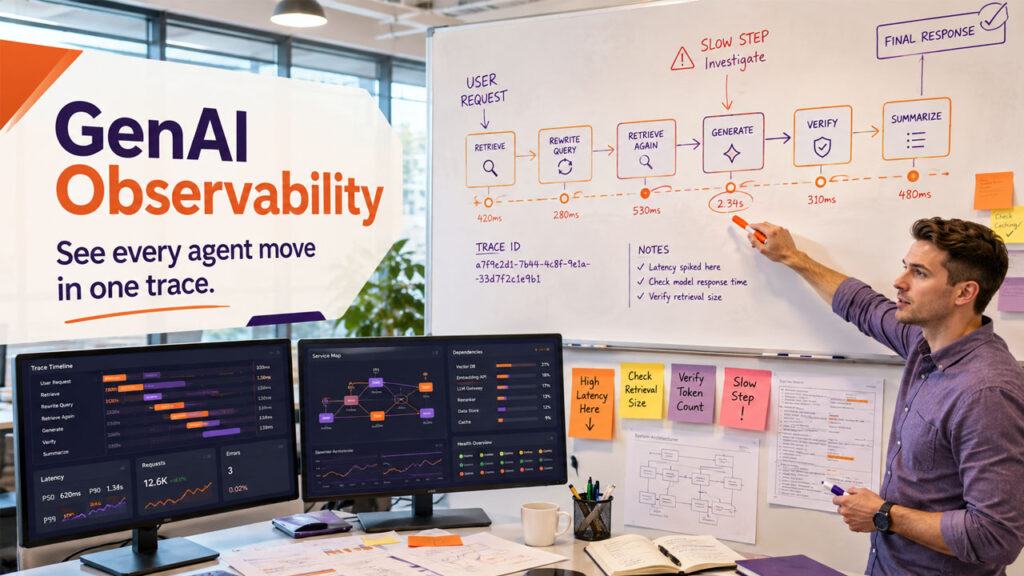
Modern GenAI systems often involve multiple LLM calls per user request: retrieve, rewrite the query, retrieve again, generate, verify, and summarize. Production observability traces all of these into a single trace, so debugging a slow or wrong response takes minutes instead of hours.
Distributed tracing tools like OpenTelemetry, LangSmith, or LangFuse make this process possible. The key configuration is to propagate trace context across LLM calls so that the full chain is visible. Without trace propagation, an engineering team debugging a production issue stares at logs across five services and tries to reconstruct what happened to one user request among millions.
7. Token Accounting Tied to Business KPIs
Production GenAI economics fail when teams measure cost per request but not cost per business outcome. A request that costs 12 cents and produces a 50,000-dollar sale is cheap. A request that costs 0.4 cents and produces nothing is wasted spending.
The discipline is to tag every LLM call with a business correlation identifier, such as session, customer, or feature, then roll up token spend by business outcome. Once the cost per qualified outcome is visible, the cost optimization conversation becomes data-driven rather than panic-driven. Most GenAI cost reduction projects discover that 70 to 80 percent of token spend produces 20 to 30 percent of business outcomes, exactly the Pareto distribution one would expect.
8. Human Review Loops on Action-Taking Capabilities
When GenAI takes real-world actions, like sending emails, processing refunds, or filing tickets, production systems include explicit human review tiers based on action risk. POCs let the agent do whatever it decided was best, then discover the first edge case at the worst possible time.
The four review tiers, from highest to lowest oversight, are audit-only, where the agent only proposes, approve-on-action, where a human approves every action, act-with-exception-review, where a human reviews flagged cases, and act-with-audit, where a human reviews logs after the fact. Agents graduate between tiers based on measured accuracy and the cost of being wrong. A refund agent should start with audit-only and graduate cautiously. A draft email agent can start higher.
9. Build Versus Buy Discipline Per Capability

Production teams decide to build versus buy per capability rather than per project. Some capabilities, like model serving infrastructure, are commodities and should be bought from cloud providers. Other capabilities, like the proprietary RAG corpus and domain-specific prompts, are the moat and must be built.
The teams that ship treat this decision matrix explicitly: commercial models for general intelligence, open-source models for sensitive data, vector databases as a commodity, and prompts and evaluation suites as custom. The teams that stall either build everything from scratch and run out of runway, or buy everything turnkey and lack differentiation.
Read also: What Is Statistics AI? Features, Benefits, Tools & Real-World Uses
What This Means for Teams Planning a 2026 Production GenAI Launch
Nine patterns may sound like a lot of architecture, but each is a one-to-four-week investment that saves a multimonth crisis later. Teams that implement seven or more patterns ship GenAI features that hold up to production load, cost scrutiny, and audits. Teams that implement three or fewer patterns ship features that demo well and break at scale.
The bottleneck is not technology. The patterns above use widely available open source frameworks and commercial models. The bottleneck is discipline. This is why organizations often partner with generative AI development services teams that have already implemented these production patterns across multiple enterprise deployments. Many teams know the patterns intellectually but skip them under deadline pressure, then pay the cost 3 months later.
For organizations evaluating production-ready generative AI development services, Devox Software publishes a reference architecture for production GenAI at Generative AI Development Services and the broader AI engineering hub at AI Development Services.
Frequently Asked Questions
Q1. Why do so many enterprise GenAI POCs fail?
The 85 percent failure rate is not about technology. POCs fail because they skip architectural patterns, evaluation suites, and cost discipline that production demands. Demo-grade systems impress at the POC stage and break at production load, audit, and cost scrutiny.
Q2. How long does it take to ship a production GenAI feature?
Typical production GenAI MVPs ship in 8 to 14 weeks from kickoff. The compression comes from using a defined reference architecture rather than rediscovering it. Teams without an architecture take 6 to 12 months for the same scope.
Q3. What is the right model for production GenAI?
No single model wins for all cases. Production systems route across multiple models based on request complexity, data sensitivity, and latency budget. Common 2026 configurations route 70 to 90 percent of requests to smaller, faster models and reserve frontier models for complex reasoning.
Q4. How important is evaluation infrastructure?
Evaluation is the single most valuable investment for GenAI production reliability. Without an evaluation suite, every code change is a risk. With one, regressions are caught at the pull request stage. The investment is typically one to three engineer-weeks and pays off within the first month.
Q5. What is the role of human review in production GenAI?
Human review tiers calibrate oversight to action risk. High-risk actions, such as financial transactions or customer communications, require approve-on-action review. Low-risk actions, like internal search and summarization, can run with audit-only review. Right-tiering oversight is more important than maximizing or minimizing it.
%201.png)

%201.png)

%201.png)