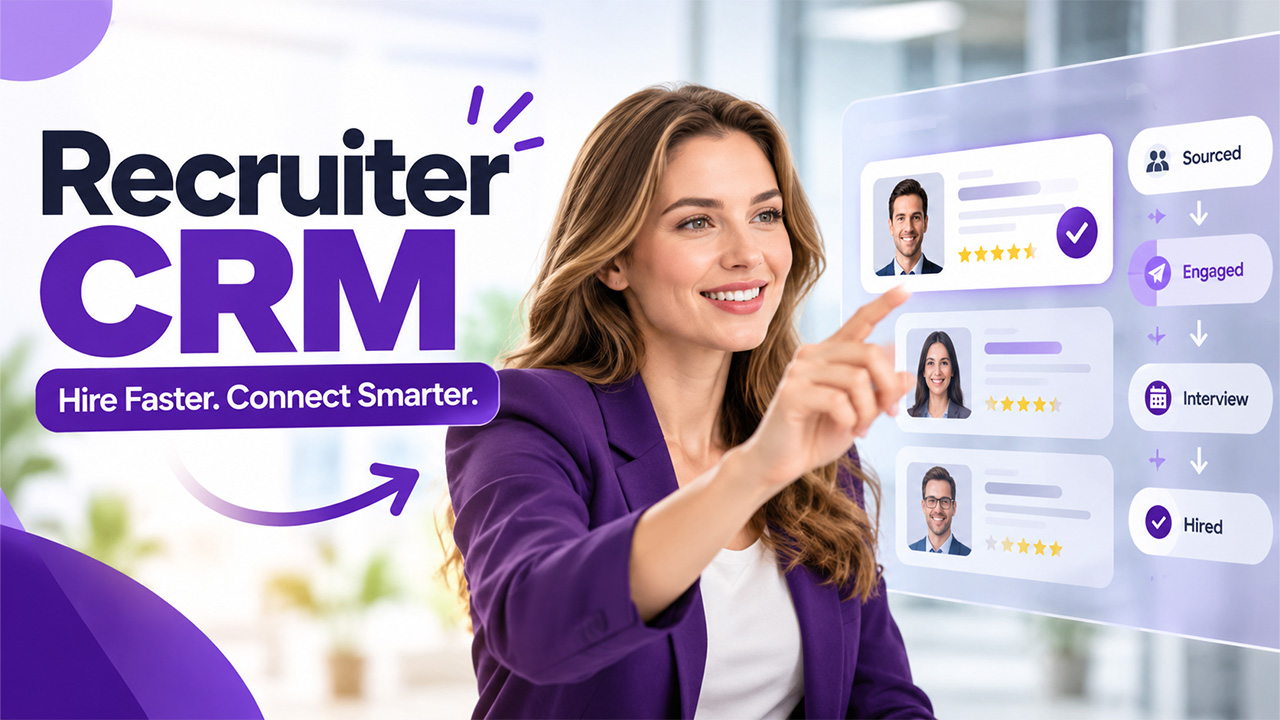

Recruiting now goes beyond just waiting for applications and collecting resumes. Recruiters want to strengthen relationships with candidates that can help you fill the vacancies sooner. A Recruiter CRM provides support to this by making sure that communication, communication data, and follow-ups stay on a single system. For organizations with internal hiring processes, a CRM for HR centralizes the same structure to recruitment workflows and talent pools. In this blog, let us cover what such systems do, which characteristics are important, and how you can select the right tool.
What Is a Recruiter CRM?
A Recruiter CRM refers to software specially built for managing relationships. It is known as a central repository where recruiters store resumes, notes, and interaction records. They then can make prospects feel engaged through personalized interaction.
It is different from an ATS, which streamlines active applicants in the present recruitment pipeline. A CRM centralizes records of candidates that the team has interviewed, met, or passed on. It ensures contact with them over the course of months or years.
The talent pool in such a platform can involve:
- Previous applicants.
- Silver medalists, which means that the candidates that the team liked but could not recruit at that time.
- Employee referrals.
- Passive candidates that are proactively sourced.
- In a few cases, contractors, current employees, and even alumni.
A CRM for HR uses this approach to internal hiring teams, which can consider candidates to be much like customers. Such platforms become available in two types: an individual tool that tethers to a current ATS, or a CRM embedded into the ATS itself. Either way, the focus is to make sure that the prospects remain warm so that a qualified shortlist is ready when a position is vacant.
Main Features to Consider in Recruitment CRM Software
Most of the tools integrate the below-mentioned capabilities:
- Talent pools: Segments of qualified prospects streamlined by skill set, recruitment requirement, or shared features.
- Search and Filtering: Searching for candidates with experience, skills, and location.
- Email and SMS campaigns: Customized drip sequences and messages that make sure that prospects remain engaged.
- Parsing of Resume: Fetching details from resumes to automatically fill out the candidate's records.
- Analytics: Keeping track of metrics like source effectiveness, time-to-fill, and offer acceptance rate.
- Integrations: Connections with email, ATS, calendar, and job boards.
Workflow automation minimizes manual tracking by managing reminders, follow-up emails, and interview scheduling. Solutions with rule-based CRM workflow automation can cause such actions to move through distinct stages without repeated manual input.
Many teams also consider LinkedIn automation tools to make sourcing faster. A few CRMs connect with GitHub and LinkedIn to extract passive candidate profiles before there is a vacancy. Zoho Recruit provides an Apply with LinkedIn feature for sourcing of socials. Platform rules are important here as well. Spott drafts customized LinkedIn messages with the help of CRM data. Recruitments can then manually send these messages on LinkedIn, connecting and engaging the candidates.
Candidate screening tools entail another important layer. Zoho Recruit involves assessments with predetermined questions, so every candidate is consistently reduced, and bias is minimized. It also combines with Checkr for checking background. Workflow automation can manage aspects of screening resumes as well.
Why Utilize a CRM for HR Teams?
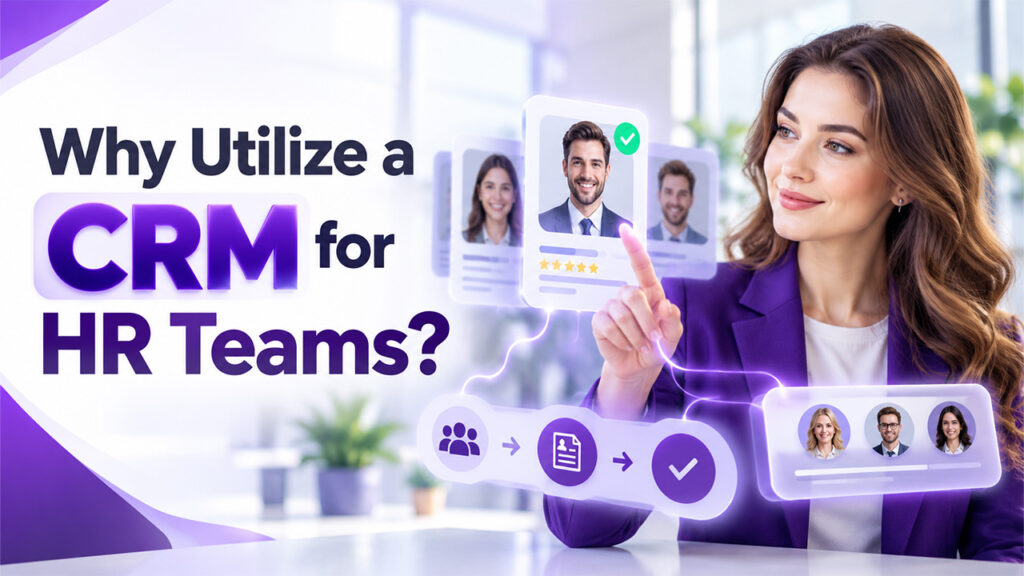
An HR CRM can replace scattered inboxes, and spreadsheets with a single record for each candidate. The main benefits are:
- Faster hiring: Engaged and pre-qualified talent pools are ready whenever recruitment happens.
- Less Reactive Recruiting: Teams source from available relationships instead of beginning from scratch for each vacancy.
- Lower Recruitment Costs: SmartRecruiters makes note of the fact a recruitment CRM can minimize dependance on outsourced agencies and other activities at the top-of-funnel.
- More Candidate Experience: Automated follow-ups means that there are very applications who do not get any response.
- Robust Collaboration: Recruitment managers and recruiters share notes, profiles, and feedback in a single place.
HR departments also handle internal records along with recruitment. OutRightCRM provides a specially built CRM solution for HR teams centered on automation of employee records and onboarding. This indicates how a single platform can cater to wider HR work and recruitment.
How to Select the Best Recruiter CRM?
Recruitment CRMs can be assessed on a few crucial factors, which is also effective as a buying checklist:
- Quality of Search: How fast can the team find candidates by experience, skills, or location?
- Accuracy of Data: Does the tool centralize candidate records through enrichment or automation?
- Communication Tools: Can outreach be kept consistent and customized with the brand of the employer?
- Integrations: Does it integrate with current email, ATS, calendar, and job boards?
Vtiger includes scalability and compliance to the list. Check for in-built controls for data deletion, consent, and audit trails like DPDP and GDPR, and for a platform that manages big candidate databases without slowing down. A robust mobile experience also aids recruiters who work on the move.
Technology alone is not sufficient to make CRM succeed. SmartRecruiters indicate that teams must be willing to engage talent pool members and past applicants, not only to recruit new people. Messaging also requires segmentation, since one newsletter is sent to everyone is seldom effective. Personalize communication to the relevant vacancy and candidate’s experience and skillsets.
OutRightCRM is an AI-powered and horizontal CRM. Its fields, modules, roles, and dashboards can all be personalized, which allows teams to map recruitment strategies to their own process. To understand how OutRightCRM help recruitment agencies, you can refer to our detailed guide on CRM for recruitment agencies that encompasses placements and candidate pipelines.
Conclusion
A Recruiter CRM transforms recruitment from a reactive task into a continuous process of building relationships. It automates repetitive follow-ups, candidate data, and ensures that talent pools remain engaged. A CRM for HR widens this to internal teams that require speed, structure, and visibility. An HR CRM operates best when its characteristics align with the recruitment volume of the team; its integrations align with the current tools, and the communication stays personal.
To check how a tailored platform can provide support to HR and recruitment workflows, explore OutRightCRM.