
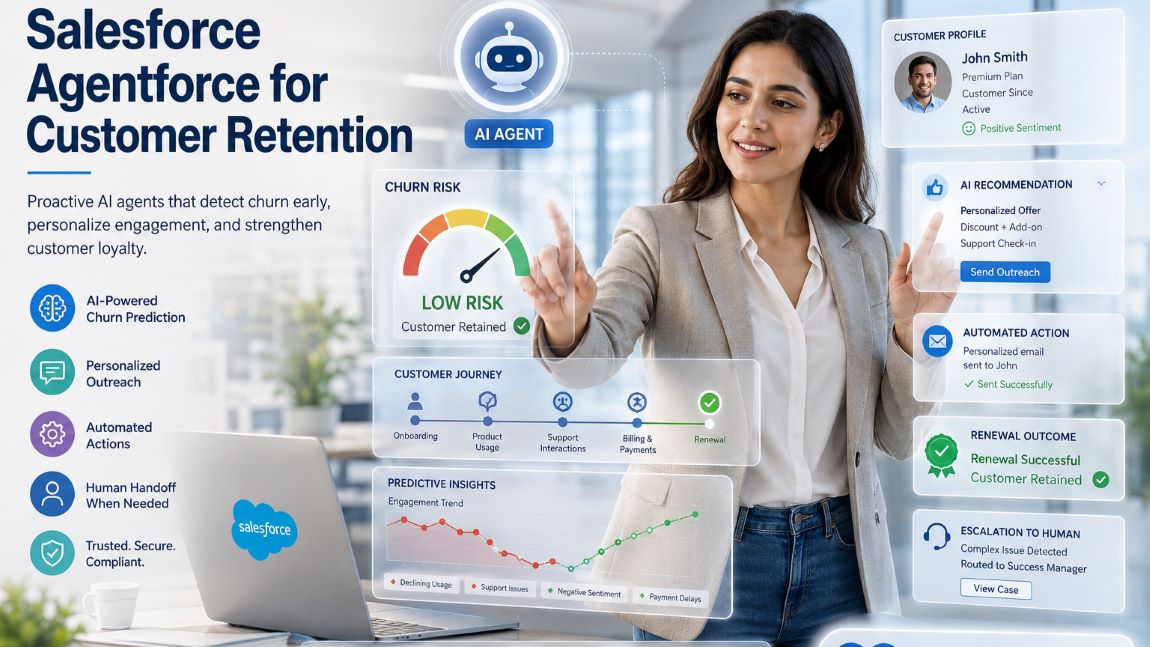

Despite all our innovations, customers today give less feedback to businesses instead of more.
Qualtrics’ 2026 Consumer Experience Trends Report found that only 29% communicate directly with companies after bad experiences (down 7.5% from 2021), with 30% of customers saying nothing at all (up 9% from 2021).
Call it survey fatigue.
It’s also coming at a rough time for companies. PwC’s Customer Experience Survey found that 70% of executives believe their customers’ expectations are changing faster than their companies can adapt.
And by the time it’s churn cancellations or failed renewals the problem’s often several months old.
To address this need, agentic AI solutions are increasingly being used to offer proactive interventions—like extended outreach that’s personalized—while also parsing warning signs across their data at scale, targeting sources of dissatisfaction, suggesting fixes, and even implementing next steps.
But as the Qualtrics survey also identified, AI’s not right for every situation. Nearly one in five consumers who’ve used AI for customer service reported getting no benefits from it; a failure rate nearly four times higher than expected from other use cases.
This guide looks at how some companies are managing to get agentic AI churn reduction right.
Customer churn typically starts before departure
Churn typically surfaces at the end of the relationship and in metrics like cancellations, lost accounts, and dropping customer satisfaction.
But the evidence is present well beforehand. PwC found that 52% of churning customers had stopped buying after a poor product or service experience, with another 29% pointing specifically to poor customer service.
And many companies still interact with customers through independent mechanisms, like billing, marketing, and customer support.
This can play out with a customer being offered an upgrade while they’re still dealing with an unresolved service complaint.
Using Salesforce Agentforce for customer retention
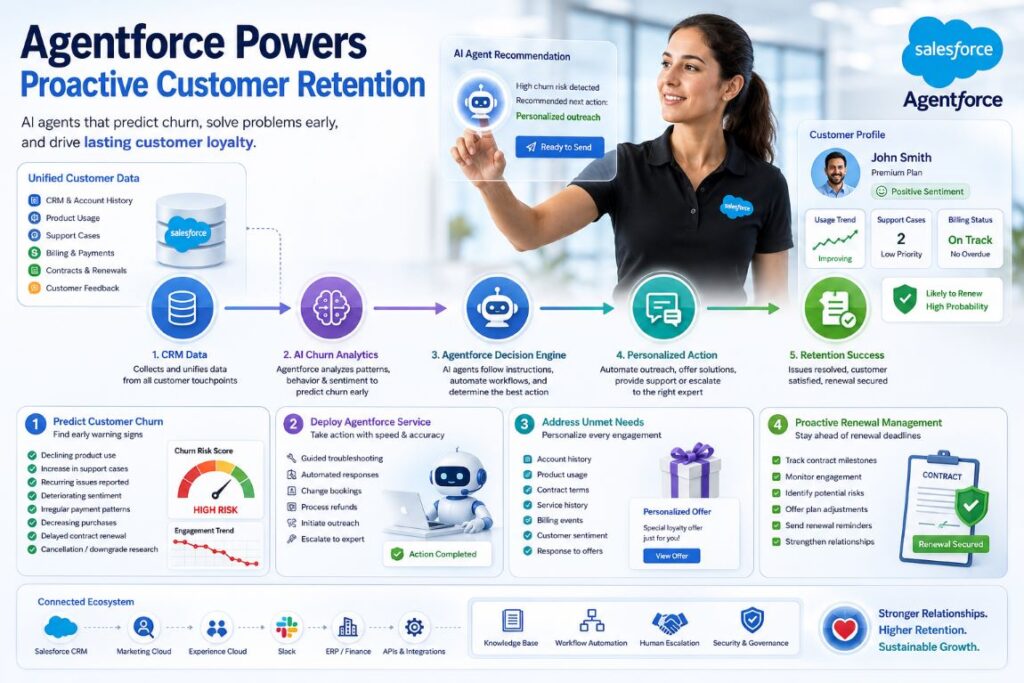
Salesforce’s Agentforce platform was built to enable its customers to create and deploy agents that work natively with their CRM and even outside sources.
Agentforce agents can draw from enterprise data, follow instructions, kick off workflows, use approved APIs, update records (and take other approved actions), and escalate or route work to the right teams where needed.
And Salesforce continues to expand this functionality, from growing their partnership with Anthropic to making acquisitions like Fin for $3.6 billion (formerly Intercom), specifically targeting AI agent functionality in customer service.
Here are several ways agents like these are being used to address churn proactively:
1. Predicting customer churn through analytics
One power of CRM systems like Salesforce is that they contain extensive amounts of data around customer behavior.
Businesses are tapping into this, by using agentic AI to look across data markers to find signs of potential churn that humans may be missing.
This includes tells like:
- Declining product use
- Increase of support cases
- Recurring issues reported
- Deteriorating sentiment
- Irregular payment patterns
- Decreasing purchases
- Delayed contract renewal
- Cancellation or downgrade research
2. Deploying Agentforce customer service to fix these problems
Salesforce’s Agentforce can act on these insights, delivering approved automation or guided troubleshooting to directly help customers.
And depending on system maturity, AI agent use can then evolve into more advanced actions, like directly changing bookings, starting refunds, initiating outreach, or escalating ASAP to the right person with full context.
3. Addressing needs customers haven’t even expressed
From the start, the promise of AI in customer service has been tantalizing because it adapts.
Rather than offering the same discount to a large subset of customers at the same time, for example, agents can offer customers deals that are specifically relevant to them.
Research from Northwestern and MIT’s Sloan School has shown that fine-tuned AI systems can do as good a job as expert analysts at both identifying and correctly categorizing customer needs.
Agents can tap into this analysis to proactively address unmet needs before they translate into dissatisfaction.
This means drawing from sources like account history, product usage, contract terms, a customer’s service history, outstanding complaints, billing events, sentiment, or response to previous offers.
4. Proactive renewal management
For subscription-based models and B2B, agents can also be tasked to move proactively, well before contract deadlines get close.
They can bring product, contract, service, engagement, and CRM information all together to give advance notice to businesses of potential problems or offer adjustments as needed to help save or improve relationships before they reach a termination stage.
For businesses using Salesforce Marketing Cloud alongside their CRM, working with Salesforce Marketing Cloud consulting companies can also help connect customer data, marketing automation, and personalized journeys to support more effective retention strategies.
AI customer service agents in action
Global business review platform Trustpilot uses an Agentforce-powered agent named Sam to authenticate users, handle repetitive inquiries, and route more complex cases to their customer service team.
Before this, they had 20 reps to handle a 15,000-case backlog. And without an effective way to sort and prioritize important cases from junk, their customers often faced a serious delay.
With their AI agent Sam, they’ve reported huge benefits, including:
- A 99% reduction in their support backlog in the first six months
- 45% decrease in the average handling time for escalations
- Self-service leading to 28% overall deflection rate with 40% through their B2B portal
Trustpilot also went from purchase to an active agent in just eight weeks.
And as in the steps profiled above, their reps are benefitting enormously from more effective routing, conversation summaries, and greatly reduced administrative work.
Financial services firm Moody’s is also famous for ratings, and it, too, has put a focus on implementing AI agents in a variety of ways.
In its go-to-market process, sales recon agents gather views from across their proprietary systems and the CRM to give sellers shared insights that align with what customers are seeing.
Service agents, meanwhile, enhance their ongoing interactions with relevant information and cross-sells, for example, in real time.
Their agents and service representatives draw on information from across systems to more rapidly identify relevant contracts, support history, usage data, and to target potential next steps.
What are the best AI solutions for reducing customer churn?
But despite winning cases like these, there are plenty of firms that are still struggling to use these tools effectively within their own organizations.
As mentioned above, Qualtrics data from 2026 found as many as one in five customers finding that their own AI in customer service experiences provided no benefit.
Security and privacy concerns abound, and all too often customers find AI agents simply mirroring the mistakes of old automated systems.
Rather than serving as a deflection barrier standing before human teams, customers want AI that provides genuinely useful self-service. That helps accelerate their needs and remembers what’s said, identifies itself and cannot by design overstep its bounds.
But in the inverse, to be useful, AI agents can't just be a closed system spouting the knowledge base customers already have access to online.
Companies that forget to marry the best of AI and their human teams may see a surge in efficiency that fails to reduce their churn at all.
Identifying the best use cases for customer retention
Agents are no longer hard to activate.
What’s hard today is everything else: the right use cases, the governance, the system connections, clean data, guardrails, and good escalation routes.
A recurring thread in studies of successful AI in business is that more of the challenges today come from rewiring the business and in the technical implementation itself.
A well-configured CRM for Sales Team can help centralize customer data, streamline workflows, and give sales representatives the insights they need to act on potential retention opportunities.
One example highlighted by the MIT Sloan School (one of 10 institutions involved in the study) came from the healthcare industry and found that the key to success was in “sociotechnical” areas. Or infrastructure, implementation, workflows, and training; in an 80%/20% split compared to the technology itself.
The researchers concluded that, “For every hour spent perfecting a model, expect roughly four hours to make it work in the real world.”
For success, agents need access to data like customer identity, CRM history, transactions, product usage, contracts, support cases, billing information, knowledge bases, customer communications, and external systems.
And of course, all of this needs to be accurate.
Choosing what an agent should do is also critical. For firms just starting out with AI, issuing credits and changing subscriptions may be a tall order as initial use cases.
Far easier ROI comes from outreach-based uses, as in scheduling, confirmations, and status updates.
Having clear thresholds on where AI needs to hand over to humans is essential, but these also must be cleanly integrated into actual business workflows.
AI systems that detect churn signals but put customers into the same long queues is of little use in curbing the problem.
Partnerships for implementing Salesforce AI customer service
Salesforce consulting and implementation is a big business, because while the CRM is an industry-leading tool, it’s also highly complex and must be correctly configured and customized to achieve the best results for each business.
So it’s no surprise that increasingly, many of these firms also offer services for measuring AI readiness and helping to implement AI agents with effective governance.
Peterson Technology Partners (PTP) is an example of these companies. With a technical consulting, recruiting, and AI background, they provide companies with the expertise needed to meet these challenges.
PTP recently helped one of the largest US school-bus transportation providers implement AI agents to more effectively manage driver onboarding, district contracts, vehicle maintenance, compliance, and customer communications.
This partnership led to cleaner data (40% reduction in duplicates in 60 days), governed metadata, enforced compliance (completeness to 94% from 61%), and improved customer service that effectively escalates critical issues to keep ahead of customer dissatisfaction.
Partners like PTP are also popular to help businesses shift underperforming agent experiments into more comprehensive, well-governed systems.
As ever in the fast-moving frontier of AI, build vs buy vs partner remains a critical decision.
Conclusion
By now it’s clear that AI is not a magic bullet for customer service.
Look no further than firms like the Swedish fintech Klarna, which showed incredible early gains from AI in customer service and slashed staff, only to have to later re-assign from other departments and ultimately rehire human agents to ensure they were keeping their customers happy.
But at a time when customers are less likely to share their frustrations before taking their business elsewhere, AI agents can provide critical assistance.
Trust and oversight remain issues that need handling, but when well-governed and drawing on quality data, these agentic solutions are offering a tantalizing glimpse into the future of proactive, personalized customer retention.
Frequently Asked Questions (FAQs)
What is Salesforce Agentforce and how does it work?
Salesforce Agentforce is the CRM-provider’s AI agent platform. Grounded in CRM and enterprise data, it enables agentic AI to help understand requests, make decisions, trigger workflows, take approved actions, and escalate to the right team members.
These AI agents are designed to go past chatbot interfaces and combine approved actions and tools access to get real work done.
What are the benefits of using AI agents for customer service?
AI has long been seen as a powerful tool for customer service, but by some measures, has been slow to develop past inbound deflection.
Salesforce Agentforce is increasingly geared for this, to automate routine requests, enable repeatable customer self-service, personalize contact, and reduce repetitive work for human team members. The company’s own 2026 research has found customer satisfaction to be the most-improved KPI reported by service organizations using their AI agents.
How can agents like Salesforce Agentforce improve customer retention?
In the area of retention, Salesforce Agentforce helps extend reach and visibility. When properly implemented and governed, it can help businesses identify customer problems faster, respond proactively, personalize interventions, and escalate high-risk situations to the right people.
By both identifying and addressing issues proactively, it can be an effective tool for both reducing churn and improving customer loyalty.
%201.png)

%201.png)

%201.png)