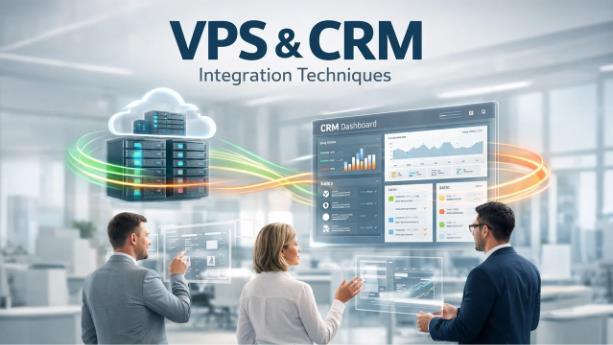

Customers and day-to-day business processes have prompted modern businesses to depend on fast, secure, and scalable systems to maintain customer relations and day-to-day business operations. VPS CRM integration is one of the most effective methods of attaining this since it is the combination of the flexibility provided by virtual private servers and the functionality of customer relationship management platforms.
When used properly, it reduces delays and technical hitches that may affect productivity. Long-term scalability and stability are also facilitated by a well-coordinated integration strategy that enables a business to expand without any restrictions on the system.
The choice of the Scalable VPS Architecture of CRM Integration
The key to successful VPS CRM integration is to select the appropriate VPS setup. An effective server must provide high availability, scalable resources, and performance capacity to support growing workloads. Since information about customers is increasing, the system should be in a position to expand without slowness or interference to the user.
A scalable VPS environment enables businesses to scale computing power, storage, and bandwidth as required. This will ensure that this vps provider system is not overwhelmed at all, even when it is at its busiest. This is also possible through proper configuration that minimizes latency and enables teams to access and control the customer data in an efficient manner.
Secure Data Transfer between Systems
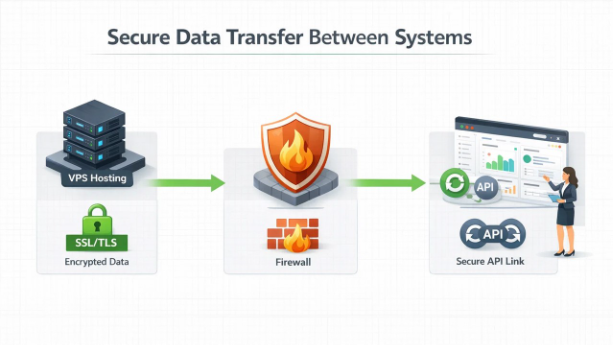
The aspect of security is important when uniting CRM systems with VPS hosting. As far as sensitive customer information is being exchanged all the time, companies should adopt high levels of protection.
Some of the key security practices are:
- Securing the data in transit with the encrypted connections (SSL/TLS).
- Implementing stringent measures to avoid unauthorized access.
- Consistently checking activity over the network to spot suspicious activity.
- Through high security standards, organizations are able to keep the customer data and develop customer trust without data leakage.
Maximizing Server Resources to enhance CRM
To ensure the stability of the systems, effective management of resources is necessary. The right execution of the CPU, memory, and storage is to make sure that the CRM platform works without delays.
Sharing of workloads among the background processes and the active user operations helps to avoid overloading of servers. Frequent performance tests allow to detect bottlenecks and the enhancement of response times. Businesses are able to achieve quicker responses to data and smooth user interfaces to all functions of CRM with proper optimization.
Integrating Seamlessly with APIs
Application Programming Interfaces (APIs) make it easier to connect CRM systems with VPS environments. With APIs, communication among different software elements is smooth, and the exchange of data is done appropriately.
In order to have an effective integration:
- Connect with proven, well-documented APIs
- Check data types to prevent transfer mistakes
- Test often to ensure consistency in communication
This strategy assists in developing an integrated system in which every part is effective.
Automated Data syncing between platforms
Automation will reduce the number of human laborers and increase consistency across systems. Automated synchronization enables the business to have updated customer data in real-time without wasting time.
Robots remove human factors and enhance efficiency. Teams are able to get the up-to-date information immediately, and this improves the coordination and decision-making within the departments. It can be particularly applicable to expanding businesses that deal with client data in large volumes.
Performance and Health of the Monitor System
Monitoring tools assist in detecting performance problems at an early stage, thus ensuring prompt corrective measures. A healthy system will see to it that the VPS and CRM platform operate efficiently without glitches that will result in an enhanced user experience and reliability of the operation.
Backup and Disaster Recovery Plans
One of the most important aspects of VPS CRM integration is data protection. Companies are to be prepared to meet such unpredictable situations as a system crash or a cyber attack.
Best practices include:
- Carrying out frequent data backups
- Maintaining backup data in various safe places
- Performing testing of recovery processes to ensure reliability
An effective backup and recovery plan reduces business downtime and ensures business continuity even in the case of an emergency.
Improving the Process of Integration with Frequent Updates
It is important to keep the VPS environment and CRM software in line with each other and ensure compatibility and security. With the system performance improvements, bugs and new features are added on a regular basis to ensure that the system is more functional. The current systems may bring about integration problems and ineffectiveness.
VPS hosting is an effective tool that can be used together with this VPS provider to enhance efficiency and scalability in businesses. Secure data handling, as well as optimized performance and automation, are only a few of the benefits of this approach to assist modern operations.
%201.png)

%201.png)

%201.png)