
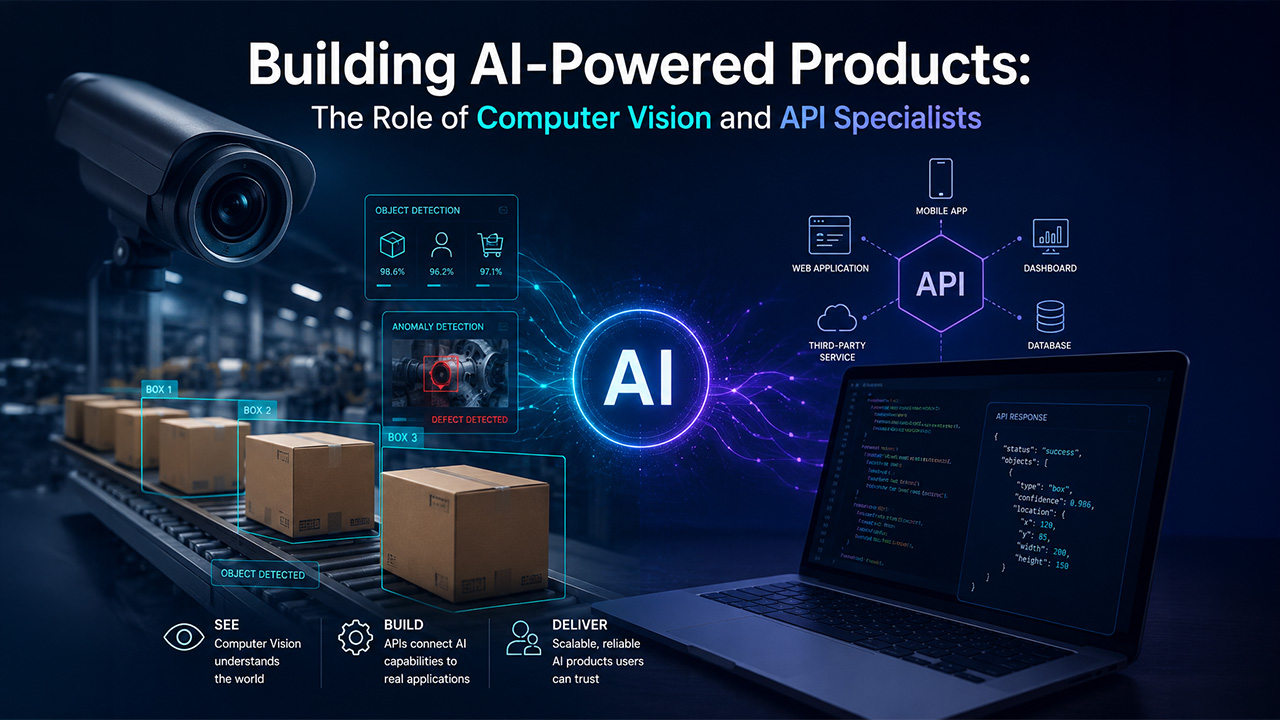

In the current digital ecosystem, artificial intelligence has grown past a demonstration stage for attracting investments. Presently, organizations are looking for artificial intelligent models that can do something impressive, not just in a controlled environment, but in full deployment as well. They need a model which offers enhanced reliability at scale, and in a form that can be accessed by the users.
Developing an AI-powered product which meets the standard requires more than just basic machine learning expertise, but requires specialists, who can make AI systems see and interpret the real world. Computer vision and API development are two of the most consequential disciplines in this effort. Neither is sufficient without the other, and the products that succeed in production are almost always those in which both are present from the start.
Organizations investing in AI product development services are increasingly focused on building production-ready solutions rather than experimental AI models. To successfully deploy AI-powered applications at scale, businesses need expertise in both computer vision development and API integration.
What AI-Powered Products Actually Require to Work in Production
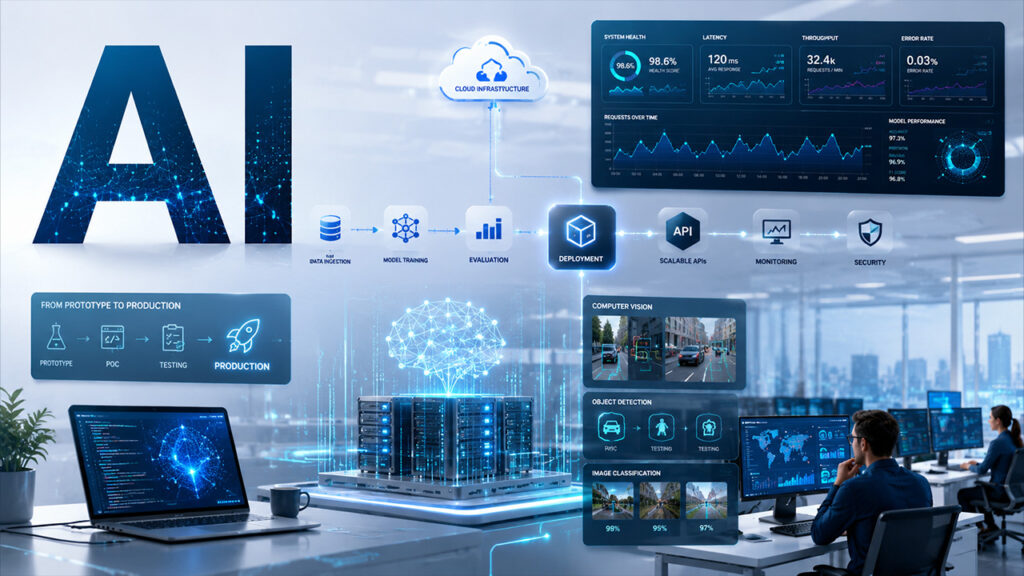
Leading providers of AI product development services understand that successful AI deployment requires more than model training. It demands robust infrastructure, scalable APIs, continuous monitoring, and computer vision systems capable of operating reliably in real-world environments.
Generally, most of the AI projects begin with a basic proof of content, which works well to generate excitement. In a controlled environment, the AI model performs well, generates excitement, and the decision to develop the project further is made. The step after this is where most AI initiative fails.
In AI-project development, production environments are different from the research environment. In production environment, data arrives in inconsistent formats with unpredictable volume. Users also interact with the system in a way that was not anticipated during development.
Performance requirements that seemed manageable in a demo become constraints that require significant engineering effort to meet reliably. The gap between a working prototype and a working product is where most AI projects stall, and it is almost always a gap in engineering capability rather than a gap in algorithmic sophistication.
Two specialisms consistently determine whether that gap gets closed. The first is the ability to build systems that accurately and efficiently perceive and interpret visual information. The second is the ability to expose AI capabilities through interfaces that other systems and users can access reliably. Without both, AI products either cannot do what they are supposed to do, or they can do it, but nobody can access it.
The Role of Computer Vision Specialists in AI Product Development
In the development of an AI product, computer vision plays a critical role. Computer vision can be explained as a discipline, which allows the machines to extract meaningful information from images or video. This means, developing a system which can identify objects in an image, for instance, a box in a warehouse photo or a packet of cereal in photo of kitchen. The system is also capable of detecting anomalies, recognizing faces, or analyzing medical scans.
Within modern AI product development services, computer vision specialists are responsible for enabling machines to interpret and analyze visual data. Their expertise is critical for applications such as retail analytics, medical imaging, manufacturing inspection, and autonomous systems.
In developing and integrating computer vision into the AI platform, computer vision specialists play a crucial role. Computer vision specialists design, train, and maintain the models that make this possible. Depending on the task, they select from a range of model architectures, each suited to different requirements:
- YOLO-based object detection for real-time processing, where speed matters more than exhaustive analysis, such as monitoring a production line
- Convolutional neural networks (CNNs) for image classification tasks, where the system needs to categorize what it sees with high accuracy
- Vision transformers for more complex tasks that require understanding relationships across an entire image, such as analyzing medical scans or satellite imagery
They also manage the data pipeline that feeds these models, ensuring that training data is representative, correctly labeled, and sufficiently large in volume to produce reliable results under production conditions. Computer vision specialists deliver the most value by translating a business requirement into a system that performs reliably outside the lab. Detecting a product defect on a factory floor sounds straightforward until the lighting changes, the camera angle shifts, or a new product variant is introduced that the model has never seen. Managing these real-world variables, through model retraining, data augmentation, and continuous evaluation, is what separates a production-grade computer vision system from a prototype that works only under controlled conditions.
When organizations engage computer vision specialists with production experience, they gain engineers who have already encountered and resolved the failure modes that cause AI vision systems to underperform in the field. That experience compresses the time between initial deployment and the point at which a system actually meets its performance targets.
The Role of API Developers in AI Product Development
An API (Application Programming Interface) is the layer that allows different software systems to communicate with each other. In an AI product context, it is the component that sits between the AI model and the rest of the world. When a mobile app sends a photograph to a computer vision system and receives a list of detected objects in response, the exchange occurs through an API. When a business intelligence dashboard pulls predictions from a machine learning model, it does so through an API. The AI capability may be sophisticated, but without a well-designed API layer, it remains inaccessible to the applications and users it is supposed to serve.
API developers in an AI context are responsible for designing and building these interfaces. According to Postman's 2025 State of the API Report, 89% of developers use generative AI in their daily work, yet only 24.3% actively design APIs with AI agents in mind. That gap is precisely where specialist API developers with experience in AI integration deliver value that generalists cannot. Their work covers several interconnected responsibilities:
Endpoint design: Defining how requests are structured, what data they carry, and what responses look like, so that consuming applications can integrate reliably without needing to understand the AI model underneath
- Authentication and security: Ensuring that only authorized systems and users can access the AI capability, and that sensitive data passing through the API is protected in transit and at rest
- Performance and reliability: Designing APIs that respond within the latency thresholds that user-facing applications require, and that handle high volumes of concurrent requests without degrading
- Versioning and backward compatibility: Managing changes to the API over time so that updates to the underlying AI model do not break applications that depend on the existing interface
For organizations looking to hire API developers with AI integration experience, the most important signal is familiarity with the specific constraints that AI systems introduce. AI models are slower than traditional database queries, their outputs carry uncertainty, and their behavior can change when the underlying model is retrained. API developers who understand these characteristics design interfaces that handle them gracefully, rather than exposing them as problems to the consuming application.
How Computer Vision and API Development Work Together
In most AI-powered products, computer vision and API development are not sequential disciplines; one does not finish before the other begins. They are parallel workstreams that need to coordinate continuously because the design decisions each team makes directly affect what the other team can deliver.
The most successful custom AI product development projects treat computer vision engineering and API development as interconnected disciplines. This collaboration enables businesses to build scalable, production-ready AI applications that deliver consistent performance.
Where the Two Roles Intersect in Practice
The clearest illustration is a retail product recognition system. A retailer wants an application that allows store staff to photograph a shelf and instantly see which products are out of stock or misplaced. The computer vision specialist builds and trains the model that analyses the photograph and identifies each product. The API developer builds the interface that receives the photograph from the mobile app, passes it to the model, and returns the results in a format the app can display.
For this to work reliably, both teams need to agree on specifics before either writes a line of production code. What image format and resolution does the model expect? What does the API response look like when the model is uncertain about a detection? How long can the mobile app wait for a response before the experience feels broken? These are not purely technical questions. They are design decisions that require both the computer vision specialist and the API developer to be in the same conversation from the start. A second example is a medical imaging platform where radiologists upload scan images and receive an AI-assisted analysis highlighting areas of concern. The computer vision model processes the scan.
The layer of API manages all the uploads and routes the image to the correct model version. It also returns the analysis with confidence scores and logs in the result for audit. If the API is not designed properly to handle large file uploads, the accuracy of the computer vision model becomes irrelevant, as the system times out even before the analysis is completed.
Read Also: Best 11 API Development Companies
Common Integration Challenges and How Strong Teams Resolve Them
Several recurring challenges appear when computer vision and API development are not well coordinated:
- Latency mismatches: Computer vision models, particularly those running on large images or video frames, take longer to process than a typical database query. API developers who are not aware of this design APIs with response time assumptions that the model cannot meet. Strong teams establish latency budgets early and design the API to handle asynchronous processing, where the app submits a request and polls for results, rather than waiting for a synchronous response
- Output format disagreements: The model based on computer vision return raw outputs, like a bounding box coordinates, confidence scores, and class labels, which are needed to be translated into something that is used by the consuming application. Without a shared schema agreed upfront, API developers interpret model outputs differently from how the computer vision specialist intended, producing incorrect results in the application layer
- Model versioning: When a computer vision model is retrained or updated, its outputs may change in ways that break existing API consumers. Strong teams implement model versioning at the API level, so that consuming applications can continue using a known model version while the new one is validated
What Happens When Computer Vision and API Expertise Are Missing From the Team
The consequences of understaffing these two disciplines follow predictable patterns. They rarely announce themselves as capability gaps at the start of a project. They surface as delivery problems months in, when the cost of addressing them is significantly higher than it would have been had the right expertise been in place from the beginning.
The most common outcome, due to absence or insufficient computer vision expertise, is that the model performs well in testing, while doesn’t work in production. For instance, a fraud detection system is trained on clean and well-lit image images, generally fails in stores where reciepts are crumpled or faded. Similarly, a manufacturing defect recognition, which works well in lab, underperforms on the factory floor, mainly because of the training data did not reflect real-world lightning condition or surface variations.
These are not algorithmic failures. They are failures of applied expertise: knowing how to build training datasets, evaluate model robustness, and manage the gap between controlled conditions and production reality. When API expertise is absent, the failure mode is different but equally costly. The computer vision model may work correctly, but the interface connecting it to the product does not. Response times are inconsistent because the API was not designed for the latency characteristics of model inference. The mobile application crashes when the model returns an unexpected output format. A model update breaks downstream applications because versioning was never implemented. The AI capability is real, but the product cannot deliver it reliably to users.
In developing an AI project, the compounding effect is significant. The project that features poorly integrated computer vision models generally produces unreliable outputs. Similarly, a poorly designed API also exposes unreliable direct outputs to the users, without buffering, validating, and graceful degradation, which are required by the production systems. Together, computer vision and API produce an AI product, which can quickly erodes user trust, regardless of how sophisticated the underlying technology is.
Conclusion
It is not sure that if an AI-powered project works during the production will work the same after deployment. AI projects are designed on various engineering disciplines, which makes that algorithm accessible, reliable, and useful in real-time conditions. In developing an advanced and accessible AI project, computer vision specialist and API developers plays a critical role.
The products that reach production successfully are almost always those where both were involved early, working in coordination rather than in sequence. The failure patterns described in this article are not hypothetical. They appear consistently in AI projects that underinvest in either discipline, and they are expensive to resolve after the fact.
Organizations that invest in professional AI product development services and prioritize collaboration between computer vision specialists and API developers are significantly more likely to build scalable, reliable, and commercially successful AI products.
%201.png)

%201.png)

%201.png)